Home Theater Speakers
Yamaha S77 HCS Review: Studio 7 Series Home Theater in a Box
A five-channel Yamaha speaker package with a more balanced sound than earlier lines, real dynamic scale, and one important omission: no subwoofer in the box.
Introduction
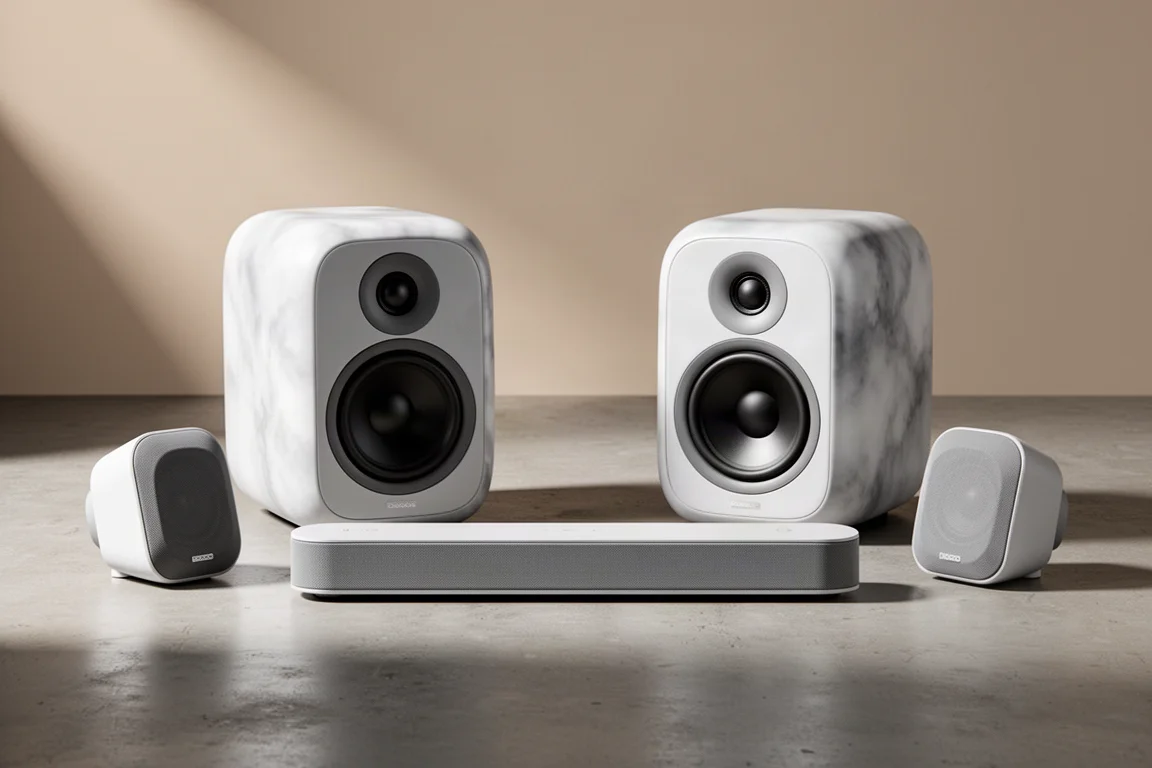
Yamaha has built a reputation on all-in-one speaker packages that remove much of the guesswork from a first home theater build, and the Studio 7 Series is the company’s latest take on that idea. The S77 HCS package pairs the line’s largest and smallest bookshelf speakers, the 17B and the 15B, with the 43C, a slimmer center channel designed to sit under a television without dominating the room.
The five-channel set sells for around $1,100, and one item is conspicuously absent from the box: a subwoofer. That matters, because the largest bookshelf in the package reaches down to 64 Hz on its own, and in-room extension may dip closer to 40 Hz in a typical room. That is enough to make music and most movie effects genuinely exciting. For full-range cinematic playback, you will want to budget for a sub.
Who the Yamaha S77 HCS Is For
The S77 HCS is aimed at listeners stepping up from a soundbar or from television speakers who want a traditional setup: two front speakers for stereo imaging, a physical center channel for dialogue, and surrounds that create a proper bubble of sound.
Because the speakers are rated at a nominal 4 ohms with sensitivity between 87 and 91 dB, they are easy enough to drive as long as the amplifier or home theater receiver is comfortable with a 4-ohm load. Most mid-level receivers will handle them without difficulty.
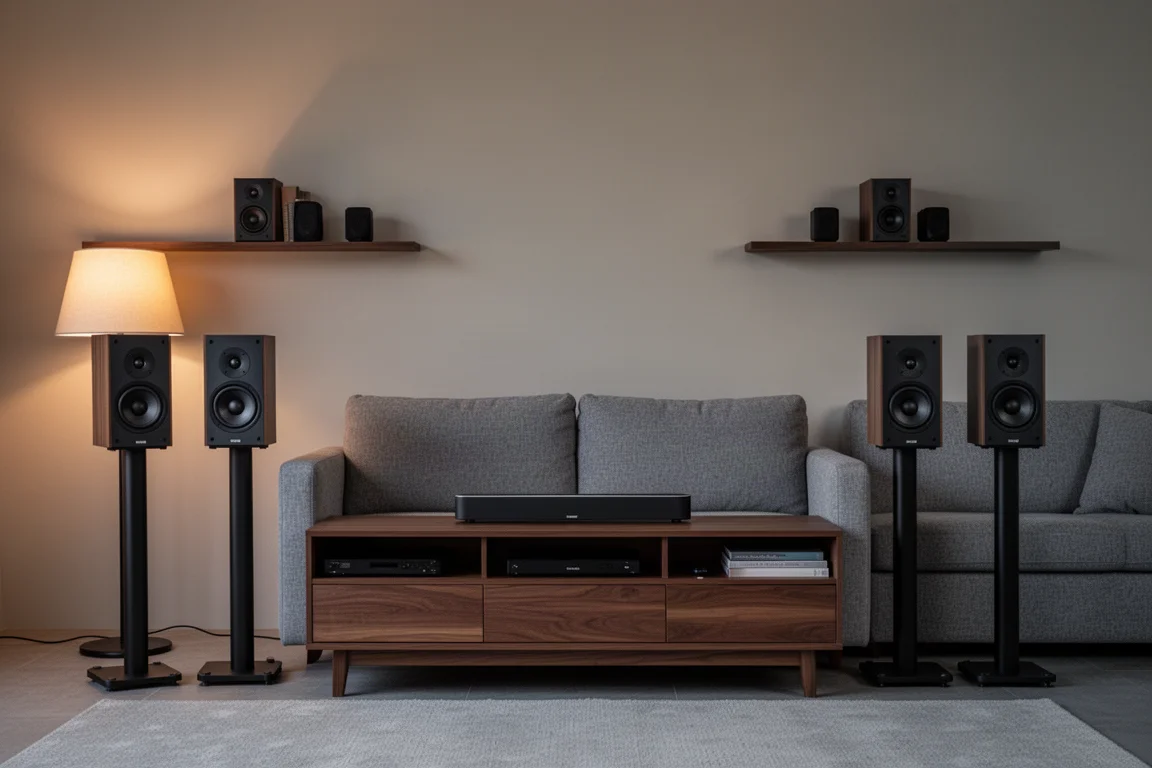
It also makes sense for anyone who already owns a subwoofer or plans to add one. The 15B works particularly well as a surround speaker, and the whole set crosses over cleanly once a sub takes over the lowest octave.
Design and Build Quality
Yamaha is known for fusing style with substance at a reasonable price, and the 7 Series moves in a new visual direction compared with the older Studio 8 and Concert 9 lines. These are not ordinary black boxes: the cabinets come in a dark blue with gray accents or a cloudy white with gray accents, so the system can be matched to a room instead of hidden inside it.
Build quality has improved noticeably. Every speaker in the series carries a 7-degree upward tilt to help with time alignment, and that same geometry allows the crossover components to be mounted in the base of the cabinet rather than at the back, where they sit in most speakers at this price. The cabinets also have rounded edges to reduce diffraction, which should translate into better imaging and separation.
The 43C applies the same approach in a slimmer cabinet, which is what makes it practical beneath a television.
Sound Quality and Dynamics
The Studio 7 Series still sounds like a Yamaha where it counts: lively, dynamically interesting, and genuinely entertaining with big action material. What has changed is the tuning. Earlier Yamaha speakers earned a reputation for a brighter, livelier, more V-shaped response, and the 7 Series takes a more refined and mature approach. The 17B and the 15B both deliver a more linear overall response and tone. They are not strictly neutral, since some resonance and energy remains in the low-mid bass and bass around 100 Hz, but the bass stays punchy and present without artificially clouding the midrange.
Midrange intelligibility is a real strength, and once the bookshelves are crossed over to a subwoofer they sound far larger than their dimensions suggest, close to tower-like in scale.
Dynamics and soundstage are where the system justifies its price. In a large room the speakers filled the space without strain, and a five-speaker setup with a sub handled a long, demanding Atmos concert film convincingly. Height information was audible in Atmos content even though no overhead channels were connected and none of the speakers use upward-firing drivers, which is likely a benefit of that 7-degree upward rake. The soundstage is at its strongest between the speakers rather than far beyond them.
Choosing Between the 17B and 15B Bookshelves
Both bookshelves produce essentially the same in-room response, so the practical difference comes down to bass. The larger 17B plays a little deeper than the smaller 15B, and both share a similar low-frequency lift to roughly the same degree. In everyday listening the two are not dramatically different, which means the decision is mostly about space and budget.
The 15B can comfortably anchor a stereo system or a full home theater, especially when a subwoofer is part of the plan. In this five-channel package the 15Bs serve as the surround speakers, where they perform very well. If you want the deepest response the bookshelves can deliver on their own, the 17B is the one to choose.
The 43C Center Channel and the Highs
The 43C shares the low-frequency character of the bookshelves, and that extra energy costs it some clarity. There is a sensation of chestiness in the center channel that the bookshelves do not exhibit. The remedy is simple: cross the center over higher than the bookshelves, above 100 Hz, which removes the boosted region from its workload and cleans up dialogue noticeably.
The high frequencies are extended, though not as airy as what more expensive speakers provide. At very high volumes, around 85 dB and above, the treble can show a touch of graininess rather than airiness. The tweeter rolls off somewhat, but nowhere near as softly as some competing designs, and it is not as forward as the entry-level models from more expensive brands. Importantly, the highs never came across as fatiguing or harsh, and their extension adds useful detail.
How the Studio 7 Series Compares
Against other five-channel packages, the Yamaha sits in the same price region as alternatives such as the Def Tech Pro Cinema 60 and the SVS Prime Satellite system, both of which include a subwoofer. Those systems can sound leaner and more treble-forward, and they occupy less visual space. The Yamaha counters with larger cabinets and bigger mid-bass drivers, so it does not need a subwoofer to flesh out its midrange and bass the way the smaller systems do, and its balance across the range is more even. If you want speakers you will be happy to show off, this is the set.
Against Yamaha’s older Studio 8 line, the 7 Series is a step up for small to medium rooms, with a less bright and less boomy character. The Studio 8 line could be upgraded with upward-firing Atmos modules, and there is no indication yet that a comparable add-on is planned for the 7 Series.
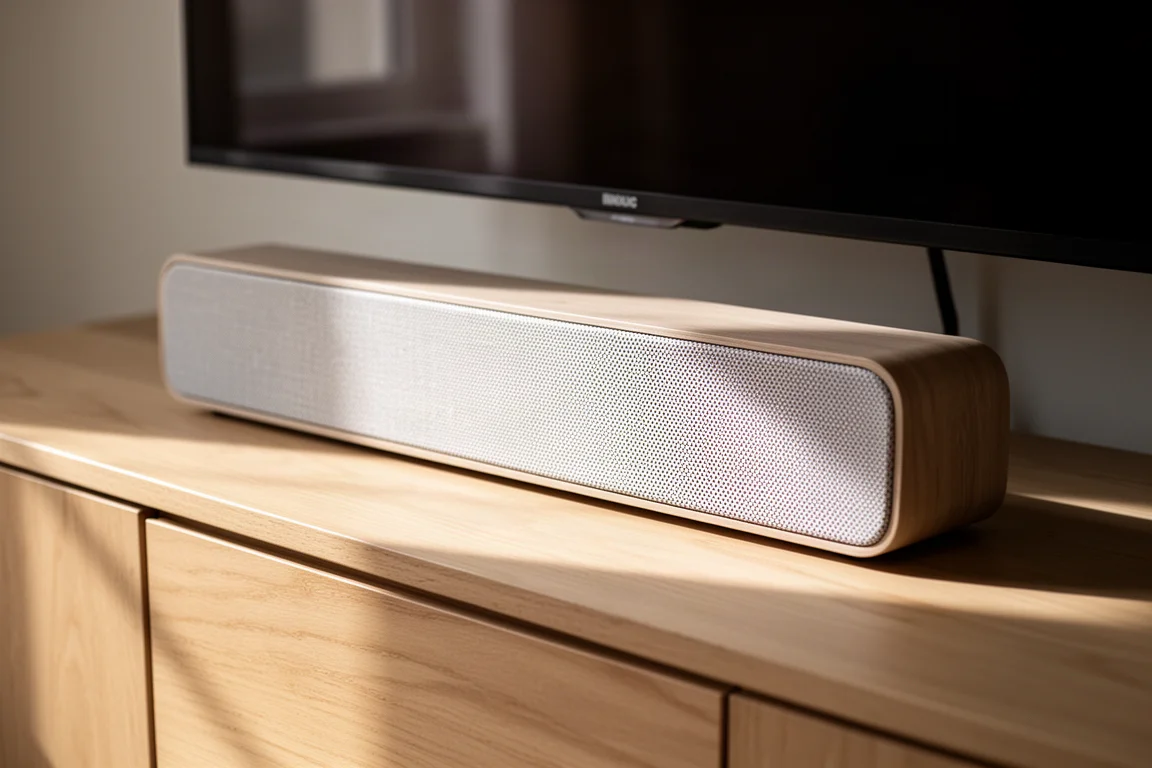
Against soundbars, the picture splits. For stereo playback the Yamaha wins on hi-fi stereo imaging, which most soundbars cannot match. For movies the decision is closer: a premium soundbar takes up less space, packs in more drivers, and delivers a more immersive Atmos experience with no extra outlay for a receiver or subwoofer. Neutral-voiced soundbars also tend to be the better choice for music listening. If you are used to two speakers, a phantom center, and a proper soundstage, the Yamaha package will be the more satisfying option.
Things to Consider Before Buying
A few practical points are worth weighing before committing to the S77 HCS.
- No subwoofer is included. This is the package’s biggest omission, and it is worth planning the extra budget from the start.
- Nominal impedance is 4 ohms across the line, so check that your receiver or amplifier is rated to handle that load.
- The center channel benefits from a higher crossover setting, above 100 Hz, to avoid the chesty character described above.
- There is no dedicated Atmos add-on. For true overhead channels you would need in-ceiling speakers or a pair of bookshelves mounted overhead.
- Availability has been limited, with the Studio 7 Series not widely sold in North America and stock appearing mostly through online listings, so it is worth confirming availability before building a system around it.
Buying Advice
If you want a traditional speaker system that will grow with you, and you are ready to add a subwoofer, the S77 HCS is a strong value at around $1,100. Budget for a subwoofer as well, since a competent budget model can be found for under $400, and pair the set with a receiver that handles a 4-ohm load. A complete setup with receiver and sub landed under $2,000, which is comparable to what a good soundbar costs on its own.
The package makes the most sense for listeners who value stereo imaging and a physical center channel over the convenience of a single bar. If space is tight or you want the simplest possible installation, a soundbar remains the easier path. If you want speakers that will still impress you in a few years, the Yamaha is the more rewarding purchase.
Conclusion
The Studio 7 Series is a genuine step up over Yamaha’s previous speaker lines, with a more mature and more balanced sound that should appeal to a wider audience than the brighter, more V-shaped designs of the past. The S77 HCS delivers real scale and dynamics for the money and remains an affordable way into a proper home theater. Plan for the subwoofer, pair it with a capable receiver, and it is an easy system to recommend.
Product link
View more details for Yamaha S77 HCS
This product is mentioned in the review. Check the specifications, options, and compatibility before buying.
View more details for Yamaha S77 HCSFurther reading
Related Reviews
Home Theater Speakers
Arendal 1723 THX S Monitor vs 1723 THX Monitor: Which Two-Way Monitor Fits Your Room?
A practical comparison of the Arendal 1723 THX S Monitor and the larger 1723 THX Monitor, covering driver size, sensitivity, bass extension, and room fit.
Home Theater Speakers
Emotiva A1 Review: A Small Speaker With Serious Surround Flexibility
A sealed two-way speaker built for Dolby Atmos, surround, and compact desktop duty at $179. Here is what it does well and what to check before buying.
Home Theater Speakers
Emotiva C2+ Review: High Output Center Channel With a Narrow Sweet Spot
The Emotiva C2+ delivers serious output, deep bass for its size and high sensitivity, but its widely spaced midrange drivers create a horizontal sweet spot that rewards centered seating.