Home Theater Speakers
Emotiva C2+ Review: High Output Center Channel With a Narrow Sweet Spot
The Emotiva C2+ delivers serious output, deep bass for its size and high sensitivity, but its widely spaced midrange drivers create a horizontal sweet spot that rewards centered seating.
Introduction
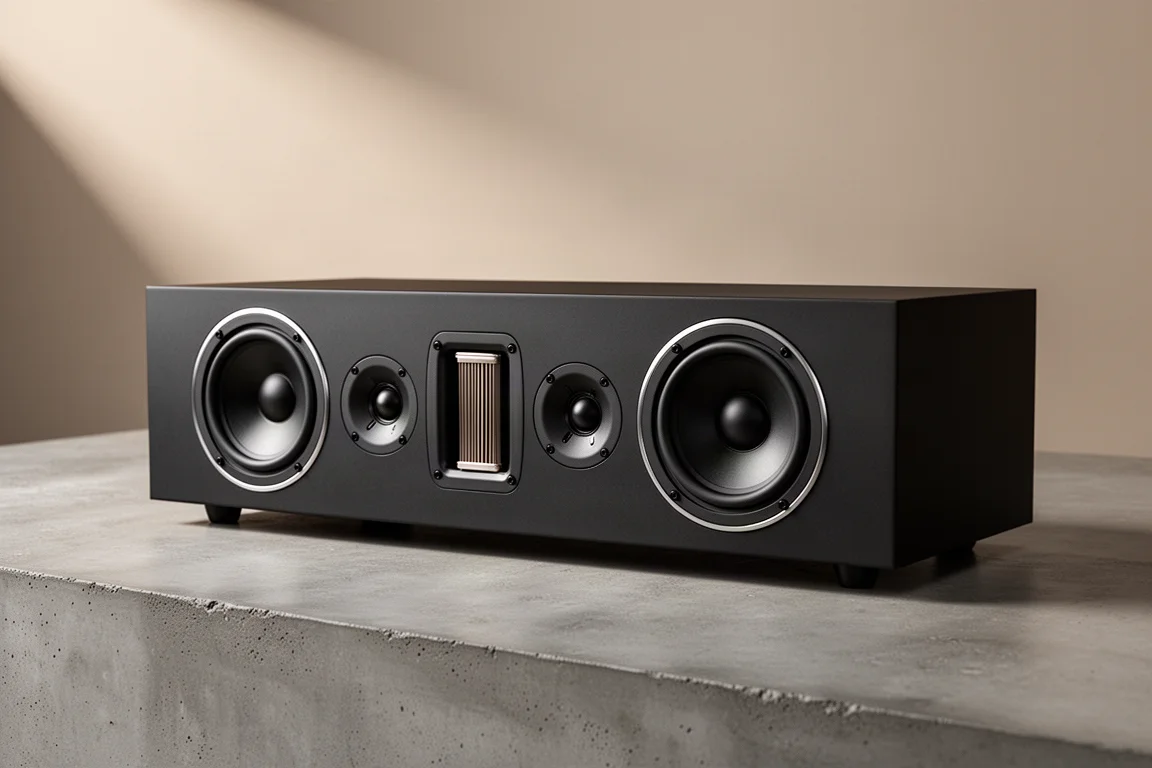
The Emotiva C2+ is a large three-way center channel built around an AMT folded ribbon tweeter, two midrange drivers and two 6.5-inch woofers. The cabinet is ported at the rear, with multi-way binding posts that allow bi-amping.
Its priorities are easy to read from the design. The C2+ is a high-output speaker with a $399 price tag, and it delivers bass and dynamic range that most center channels at this level do not. The trade-off shows up in linearity. Two midrange drivers placed roughly four and a half inches apart behave as one source at low frequencies, then gradually behave as two competing sources as frequency rises. That transition, together with a suspected cabinet resonance, shapes the on-axis response and narrows the usable listening window.
This review covers what the speaker does well, where it struggles, and who should consider it.
Who This Speaker Is For
The C2+ is a home theater center channel, and it makes the most sense in a room where most listeners sit close to the center line. Dialogue clarity at the primary seat is its strength, and it has the output to fill a medium to large room without straining.
It also suits buyers who want that output without adding a separate power amplifier. Average sensitivity measures 89.4 dB from 300 Hz to 3 kHz, close to 90 dB, so a typical AV receiver can drive it to high levels. Bass extension reaches an F3 of 63 Hz and an F10 of 42 Hz, which gives the speaker enough low-end weight to carry a soundtrack on its own, though a subwoofer remains the usual choice in a home theater system.
Main Strengths
Output is the headline. The C2+ plays loud, and it stays composed while doing it. At a 96 dB test level, distortion stays below 1 percent THD down to about 90 Hz, and below 3 percent THD down to roughly 40 Hz. Compression on the low end is well controlled, so the speaker does not collapse when the mix gets busy.
The cabinet also offers useful setup flexibility. Two rear ports and multi-way binding posts allow bi-amping, and the speaker’s impedance stays above 4 ohms across most of its range.
Bass Depth and Output
Bass is genuinely good for a center channel of this size. The F3 of 63 Hz and F10 of 42 Hz mean real low-frequency content comes through with reasonable output, and the distortion figures suggest it stays clean. Listeners who value weight and impact from the center channel will find a lot to like here.
Midrange and Treble Character
The midrange itself is solid. Where the speaker draws attention is above it: the folded ribbon tweeter has a naturally elevated top end, and the predicted in-room response trends upward toward the treble, reaching roughly 7 dB above the midrange if that slope continues. The same prediction also shows the dip-and-peak behavior around 1.5 kHz rather than smoothing it away.
That treble lift is the kind of thing most AV receivers can address. Room correction or manual equalization can pull the top end down and adjust overall tonality to taste, and the adjustment holds up in practice. The dip-and-peak feature around 1.5 kHz is harder, because it happens over a narrow band and needs precise filters to address.
Things to Consider Before Buying
The on-axis response is where the design compromises become visible. Around 1.5 kHz there is a dip that falls about 6 dB below the mean, immediately followed by a peak about 3 dB above the mean. Part of this comes from comb filtering between the two midrange drivers, whose center-to-center spacing puts the transition at roughly that frequency. A sharp dip-to-peak shape like this also points to an internal cabinet resonance, and impedance data shows a separate resonance near 300 Hz.
Directivity is the second consideration. The midranges begin to beam and narrow the radiation pattern, then the tweeter widens it again, and the treble radiates strongly toward the side walls. The result is a mismatched pattern from the midrange into the treble and a noticeably uneven off-axis response.
Sweet Spot and Seating Position
The horizontal window is about 20 degrees wide through most of the response. In practical terms, at an eight-foot listening distance, a listener cannot sit more than roughly three feet off the speaker’s center line before the response changes. At twelve feet, the limit is closer to four feet. For a primary seat this is workable. For a wide sofa with several viewers, it is a real constraint.
Vertically, the speaker is more forgiving, but only in one direction. Listeners should not sit below the tweeter line, which is the measurement reference point. Sitting 10 to 15 degrees above that line keeps the response intact, so a slightly raised second row can work. Mounting the speaker above a screen is not advisable.
Amplifier and Placement Considerations
Impedance dips to about 3 ohms near 150 Hz, though it remains above 4 ohms for most of the range. Buyers with a modest receiver should confirm compatibility with the manufacturer before committing.
The tweeter also compresses under sustained high output. At 7 kHz and 102 dB it loses about 1.5 dB, and at 10 kHz with 20 dB of dynamic range the loss is similar. There is also roughly 1 dB of dynamic range lost in the dip region. None of this is dramatic, but it is worth knowing if the speaker will be pushed hard for long stretches. Equalization helps with tonality, though the narrow dip-and-peak feature needs precise filters and may not be fully resolved by a basic room correction routine.
Buying Advice
At $399, the C2+ is priced to deliver output rather than perfect linearity, and it does that job well. Buyers who sit near the center of the room, want strong bass from the center channel and have a receiver with room correction will get a lot of value here.
Buyers with wide seating arrangements should weigh alternatives carefully. Coaxial or concentric center channel designs keep their drivers on a single axis and avoid the spacing problem that limits this speaker’s horizontal window. Emotiva also offers a smaller center channel in the same family, which is worth a look for rooms where maximum output matters less than cabinet size.
Conclusion
The Emotiva C2+ is a high-output center channel with real bass, high sensitivity and clean behavior at high levels. Its weakness is consistency across a wide listening area, caused by two midranges spaced far enough apart to interfere in the upper midrange, along with a narrow dip-and-peak feature in the on-axis response and an elevated top end that most receivers can tame.
If your seating keeps listeners near the center line, the C2+ delivers a great deal for the money. If your room demands even coverage across several seats, a concentric design or a smaller model in the same line is the more sensible path.
Product link
View more details for Emotiva C2+
This product is mentioned in the review. Check the specifications, options, and compatibility before buying.
View more details for Emotiva C2+Further reading
Related Reviews
Home Theater Speakers
Arendal 1723 THX S Monitor vs 1723 THX Monitor: Which Two-Way Monitor Fits Your Room?
A practical comparison of the Arendal 1723 THX S Monitor and the larger 1723 THX Monitor, covering driver size, sensitivity, bass extension, and room fit.
Home Theater Speakers
Emotiva A1 Review: A Small Speaker With Serious Surround Flexibility
A sealed two-way speaker built for Dolby Atmos, surround, and compact desktop duty at $179. Here is what it does well and what to check before buying.
Home Theater Speakers
Focal Kanta No.3, Kanta Center and Sub 1000F: A Three-Piece Home Theater System
A close look at the Focal Kanta No.3 tower, Kanta Center and Sub 1000F subwoofer, with listening notes, clear strengths, and the trade-offs to weigh before buying.