AV Receivers
Yamaha RX-A6A Review: A 9.2 Channel AV Receiver With Real Strengths and Real Quirks
A measured look at the Yamaha RX-A6A, covering its excellent analog preamp section, its genuine two channel power, and the channel and digital full scale behaviour worth knowing before you buy.
Introduction
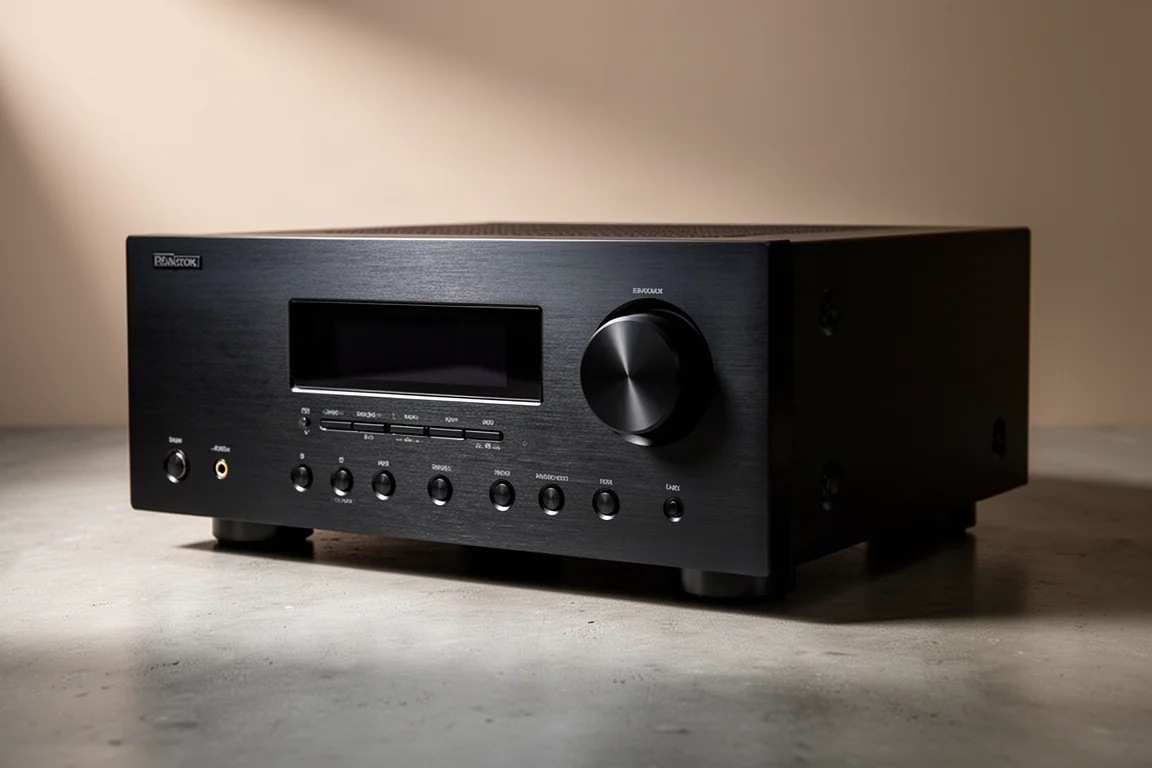
The Yamaha RX-A6A is a 9.2 channel AV receiver with Dolby Atmos processing and 8K HDMI connectivity, and it sits near the top of the brand’s home theater lineup. Its feature set includes balanced XLR preamp outputs, a seven band manual parametric equalizer for every channel, and adjustable DAC filter and HDMI jitter settings, all of which are unusual at this level.
Bench measurements reveal a receiver with genuinely strong foundations. The analog preamp section measures at a level normally reserved for dedicated two channel components, the amplifier exceeds its rated output with two channels driven, and the bass management follows textbook crossover slopes. There are also a few quirks: certain channels behave differently from the rest under specific digital conditions, and the protection circuits cap how much power the receiver will deliver when many channels are driven at once.
The goal here is to separate the findings that are likely to be audible in a real room from the ones that are mostly academic, so a purchase decision can rest on what actually matters.
All measurements discussed below were taken with the impedance switch on its high setting (8 ohms or more) and eco mode off, unless stated otherwise, because both of those settings change the results substantially.
Who this product is for
This receiver makes the most sense for two kinds of buyers.
The first is someone building a 9.2 channel Atmos system who wants a capable processor at the centre of it. The preamp outputs stay clean up to 4 volts RMS unclipped on every channel, which is double the 2 volts RMS typically needed to drive an external amplifier to full output given the 26 to 29 dB gain structure common in power amplifiers. The XLR outputs double that again, delivering 8 volts RMS. For anyone planning to add external amplification later, or to drive demanding speakers with dedicated amplifiers, that headroom matters.
The second is someone who enjoys tuning a system. Seven bands of manual parametric EQ per channel, filter adjustments that reach down to roughly 16 Hz, and selectable DAC filters give a level of control that most receivers in this class do not offer.
It is a less obvious fit for anyone hoping to power nine channels at high output from the internal amplifiers alone. Multi-channel power is limited, and that trade-off is covered in detail below.
Main strengths
The analog preamp section is the standout. With an analog input routed through Pure Direct, total harmonic distortion plus noise measured 0.001%, which converts to roughly 100 dB SINAD. Frequency response stayed flat out to the limit of the measurement sweep, and the noise floor was exceptionally low. These are figures that would be respectable in a high end dedicated two channel preamp, and they suggest the receiver is well suited to serving as the front end of a serious system.
Signal to noise ratio reinforces that impression. Driving the analog input to produce 2 volts RMS of output yielded 106 dB in Pure Direct mode. With the DSP engaged and a digital input, the same 2 volt output measured 106 dB, while Pure Direct reached 111 to 112 dB, a difference of roughly 6 dB.
Bass management is another area where the receiver overdelivers. Despite carrying no THX certification, the crossovers follow textbook THX behaviour. A crossover set to 80 Hz produced a low pass filter with a 24 dB per octave slope and a minus 6 dB point at 80 Hz, paired with a second order high pass at 12 dB per octave. With the DSP engaged, response stayed flat to 50 kHz, a benefit of the 96 kHz sampling rate.
Build quality supports the measurements. The chassis is heavy at roughly 40 pounds and houses a substantial power supply.
Taken together, these results describe a receiver whose processing and preamp stages are its strongest assets rather than its internal amplification.
Analog and digital performance in detail
With an analog source, Pure Direct and Straight mode do not measure the same. Pure Direct keeps the signal path analog and produces ruler flat response with 0.001% distortion. Straight mode engages the DSP and the analog to digital converters, and the 96 kHz sampling rate limits usable bandwidth to about 48 kHz, where response begins to roll off. Distortion in Straight mode rose to roughly 0.005% at higher frequencies. That shift is measurable, though unlikely to be audible.
Noise is the more noticeable difference. On an analog input, signal to noise ratio fell from 106 dB in Pure Direct to about 82 dB in Straight mode, a consequence of the analog to digital conversion stage. Pure Direct is the better choice for critical listening, with the caveat that it bypasses bass management entirely.
Through HDMI, the preamp outputs measured about 0.002% distortion in Pure Direct and clean output up to roughly 4 volts RMS, with 3.9 volts at 0.1% and 4.2 volts at 1%. Straight mode measured around 0.005%.
One finding deserves attention. The centre channel, surround left, and surround right measured about 0.05% distortion, roughly 66 dB SINAD, which is around 20 dB worse than the other channels. Those other channels exceeded 90 dB SINAD. The behaviour appears as the digital input level approaches full scale, emerging around minus 9 dBFS and persisting to 0 dBFS. Yamaha has acknowledged the issue, and a firmware remedy may follow. At 0.05% distortion this is not something most listeners will hear during films or music, but it is an inconsistency that should not be present in a receiver at this level.
Spectrum analysis of the main left and right channels was excellent. With a 1 kHz tone at minus 10 dBFS and 2 volts RMS output, the third harmonic sat about 102 dB below the fundamental. At full scale it worsened by roughly 6 dB but remained about 95 dB down. The centre and surround channels showed a third harmonic around 70 dB below the fundamental. The main channels also showed no 60 Hz hum residual and no DC offset.
Channel separation is solid. In the worst case, with every other channel driven as a disturber, crosstalk measured about minus 60 dB at 10 kHz at the amplifier outputs, and roughly 20 dB better at the preamp outputs.
Amplifier power and the protection circuits
Two channel performance is strong. The receiver is rated at 150 watts, and it delivered 150 watts continuous with two channels driven below 0.1% distortion. On 1 kHz sweeps with two channels driven, output reached 186 watts per channel into 8 ohms at 1% distortion and 282 watts per channel into 4 ohms at 1%. A single channel produced 200 watts at 1% and 175 watts at 0.1%, while two channels managed 168 watts at 0.1%. Those figures sit above the rated specification.
The picture changes as more channels are driven. Four channels produced 136 watts at 0.1% and 152 watts at 1%. Five channels produced 71 watts at 0.1% and 81 watts at 1%. With seven channels driven, output settled at 52 watts. The limiting is deliberate: the receiver has three levels of protection, one of which cannot be defeated, and it engages even with the high impedance setting selected and eco mode off. Sustained test tones are what trigger it, and typical music or film content is unlikely to do the same, but the internal amplifiers will not deliver their full potential across many channels at once.
Two settings change the outcome dramatically. Eco mode reduces output to roughly 60 to 67 watts depending on the distortion threshold, which makes it worth avoiding unless the receiver is being used purely as a preamp. The low impedance setting is worse. With two channels driven into 8 ohms it costs only about 5% of output, but with four channels driven it drops power to 43 watts at 0.1% and 54 watts at 1%, down from around 130 watts. That setting exists for regulatory testing rather than for real systems, and it should be left on the default 8 ohm minimum position regardless of the nominal impedance of the speakers in use.
Two more observations from the amplifier stage. Frequency response was flat to 50 kHz, and power did not double when moving from 8 ohms to 4 ohms. Distortion at 1 watt measured around 0.05% or lower, with the second harmonic about 71 dB below the fundamental, which is acceptable but not as refined as the best amplifier sections in this category.
The practical takeaway is that the internal amplifiers are capable with two channels and progressively constrained as channel count rises.
Setup and tuning tools worth using
The manual parametric EQ is the most useful setup feature. Each channel offers seven bands, and the bandwidth is set using the centre frequency divided by the difference between the upper and lower corner frequencies, which determines Q. A test filter at 32 Hz with a Q of 1.6 and an 8 dB cut landed almost exactly on target. Frequency selection is finer than on earlier generations of this receiver, and adjustments reach down to about 16 Hz, which allows meaningful correction of low frequency room problems.
DAC filter settings offer three options: sharp rolloff, slow rolloff, and short latency. With a 44.1 kHz input and high resolution analysis, differences are measurable. Slow rolloff begins rolling off first, around 18 kHz, followed by short latency, with sharp rolloff preserving the most bandwidth. Sharp rolloff is the sensible default. At higher sampling rates the differences move outside the audible band and the setting becomes largely irrelevant.
HDMI jitter settings at levels one, two, and three produced almost no measurable difference in this setup, which is worth knowing before spending time comparing them.
Things to consider before buying
Several points are worth weighing before committing.
Multi-channel power is capped by the protection circuits, so a system that needs high output from nine channels simultaneously will benefit from external amplification. The preamp outputs are strong enough to make that a practical route.
The elevated distortion on the centre and surround channels near digital full scale is a real measurement anomaly. It is unlikely to be audible, and the manufacturer is aware of it, but buyers who want flawless channel to channel consistency should know it exists.
Extra Bass deserves caution. When the main speakers are set to large, the feature works as expected: the mains run full range and their signal is copied to the subwoofer, with the crossover based on the main channel setting. When the mains are set to small and Extra Bass is enabled, the receiver applies frequency shaping with a lift in the 80 to 100 Hz region and alters the subwoofer output in ways that are barely documented. Yamaha describes the behaviour as intentional, based on the idea that harmonics help the brain perceive a missing fundamental, but the audible benefit has not been independently verified and small speakers could be pushed harder than intended.
Pure Direct bypasses bass management, so anyone relying on a subwoofer for two channel listening will need Straight mode instead, accepting the small increase in noise and distortion.
Finally, the receiver is heavy at around 40 pounds, which is worth planning for during installation, and it carries no THX certification despite its textbook crossover behaviour.
Buying advice
For most buyers, the decision comes down to intended use. If the receiver will anchor a 9.2 channel Atmos system and either drive two channel content directly or feed external amplifiers, the measured performance supports the purchase. The preamp section is excellent, the XLR outputs provide generous voltage headroom, the bass management is textbook, and the manual parametric EQ gives more control than most alternatives.
Three setup choices protect that performance. Leave the impedance switch on its default 8 ohm minimum setting. Turn eco mode off unless the receiver is used purely as a preamp. Use Pure Direct for two channel listening when bass management is not required, and Straight mode when it is.
Buyers who need maximum output from nine internal channels at once should plan for external amplification, since the protection circuits limit sustained multi-channel output. Buyers who want a set and forget DAC filter should select sharp rolloff.
The digital full scale behaviour on the centre and surround channels is a known issue that may be addressed in firmware, and it does not change the overall picture for typical home theater use.
Conclusion
The Yamaha RX-A6A is a receiver with genuine strengths and a few honest caveats. Its analog preamp section measures like a high end two channel component, its two channel power exceeds the rating, and its bass management and EQ tools are better than the class norm. Its multi-channel power is limited by protection circuitry, and a small group of channels shows elevated distortion near digital full scale.
For buyers who value processing quality, tuning flexibility, and a strong foundation for external amplification, the strengths are likely to outweigh the quirks. For buyers who want nine channels of internal power at high output, the limitations are worth understanding before purchase.
Product link
View more details for Yamaha RX-A6A
This product is mentioned in the review. Check the specifications, options, and compatibility before buying.
View more details for Yamaha RX-A6AFurther reading
Related Reviews
AV Receivers
Anthem MRX 740 8K Review: Composed Home Theater Sound With a Few Rough Edges
A close look at Anthem's mid-tier MRX 740 8K receiver, covering its sound, ARC Genesis room correction, HDMI 2.1 features and the daily quirks worth knowing before you buy.
AV Receivers
Anthem MRX 740 vs MRX 1140: Which AV Receiver Fits Your System?
A measured look at the Anthem MRX 740 and MRX 1140, covering preamp output performance, amplifier behaviour, bass management, and expansion headroom.
AV Receivers
Best AV Receivers for Home Theater: Denon, Onkyo, Marantz and Yamaha Compared
Four home theater receivers compared on features, sound character, setup and value, with clear guidance on which one fits which kind of buyer.