AV Receivers
Anthem MRX 740 vs MRX 1140: Which AV Receiver Fits Your System?
A measured look at the Anthem MRX 740 and MRX 1140, covering preamp output performance, amplifier behaviour, bass management, and expansion headroom.
Introduction
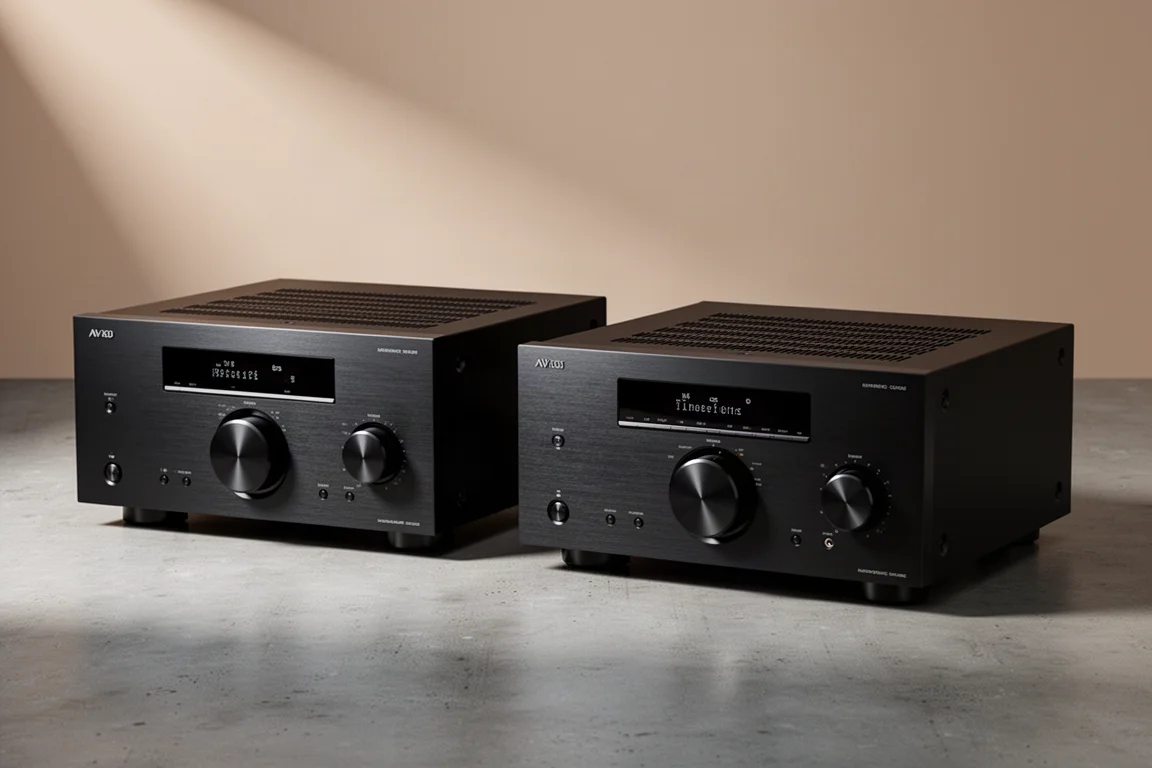
The Anthem MRX 740 and MRX 1140 are the two most closely related AV receivers in the brand’s current lineup. They share the same preamp architecture and the same five-channel class A/B amplifier block, and they differ mainly in processing capacity, the number of class D channels, and the power supply behind them. That makes the choice between them less about outright quality and more about how many speakers you intend to drive and how much expansion headroom you want.
What Both Receivers Share
The strongest part of both designs is the preamp section. The preamp outputs deliver 5 Vrms unclipped, and 5.48 Vrms at 0.1% THD+N, which is more than double the roughly 2 Vrms that most power amplifiers need for full output. Best-case SINAD lands around 106 dB at approximately 3 Vrms, which corresponds to about 0.0006% THD.
Frequency response is flat down to about 10 Hz, with the -3 dB point above 70 kHz, well beyond the audible band. Signal-to-noise ratio measured 110 dB A-weighted at 2 Vrms with a full-scale digital input. Worst-case crosstalk isolation, measured with every channel driven and one channel left undriven, stayed above 70 dB at 20 kHz.
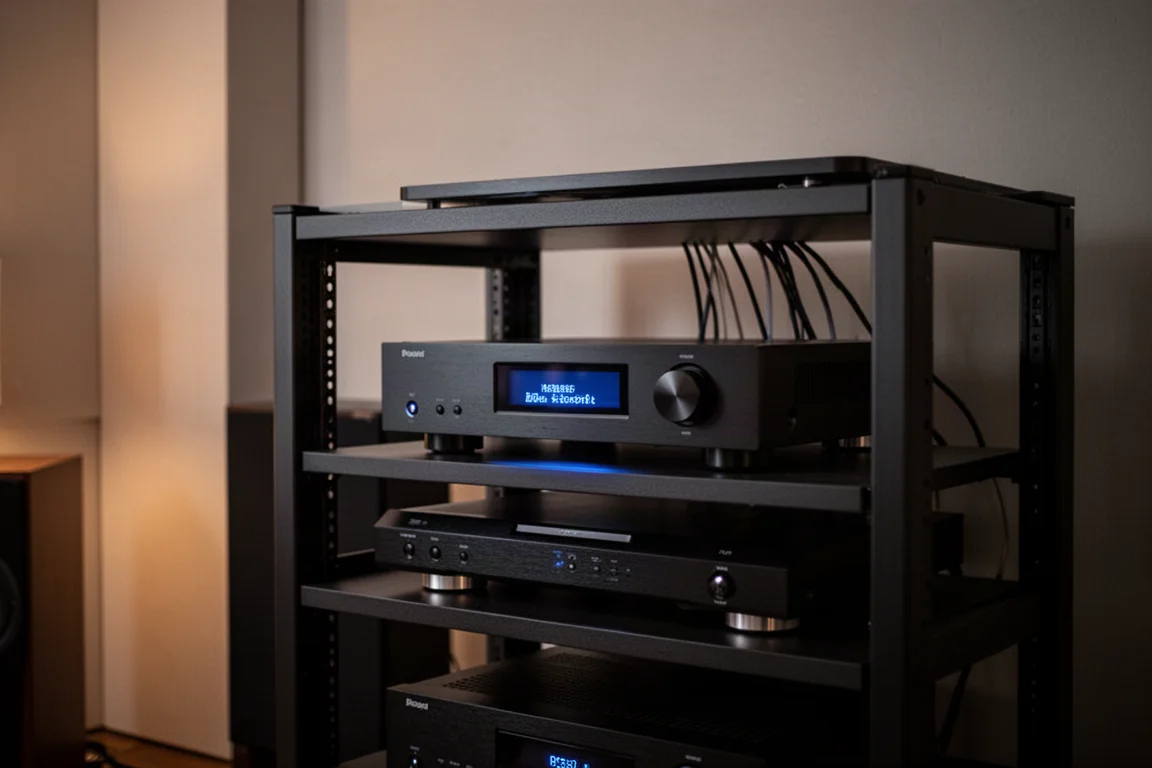
Neither receiver includes an analog bypass or a phono stage, so vinyl listeners would need to step up to the AVM 70 processor for those features. Analog inputs still behave well: bandwidth reaches roughly 48 to 50 kHz, which points to 96 kHz analog-to-digital converters, with distortion under 0.05% THD+N at 20 kHz and a signal-to-noise ratio of 94 dB A-weighted at 1 V input and 2 Vrms output.
Both units also stay cool in a rack, which is a practical advantage for anyone stacking equipment inside a closed cabinet. The class D channels play a large part in keeping chassis heat down.
Anthem MRX 740: Seven Channels of Amplification
At $2,899, the MRX 740 provides seven channels of amplification: five class A/B channels rated at 140 W per channel and two class D channels rated at 60 W per channel. Processing covers 13 channels, and an E-core transformer sits behind the class A/B section.
With two channels driven into 8 ohms, the MRX 740 measured 130 W per channel at 0.1% THD, and 145 W per channel with a single channel driven. With all five class A/B channels driven, output settled at 85 W per channel at 0.1% THD and 89 W per channel at 1%. Into 4 ohms the receiver current limited at roughly 163 W, a protective behaviour that does not affect 8 ohm performance. At 1 W output, the spectrum showed power supply residuals between about -70 dB and -80 dB at 60 Hz, low enough to be inaudible.
Anthem MRX 1140: More Processing, More Channels
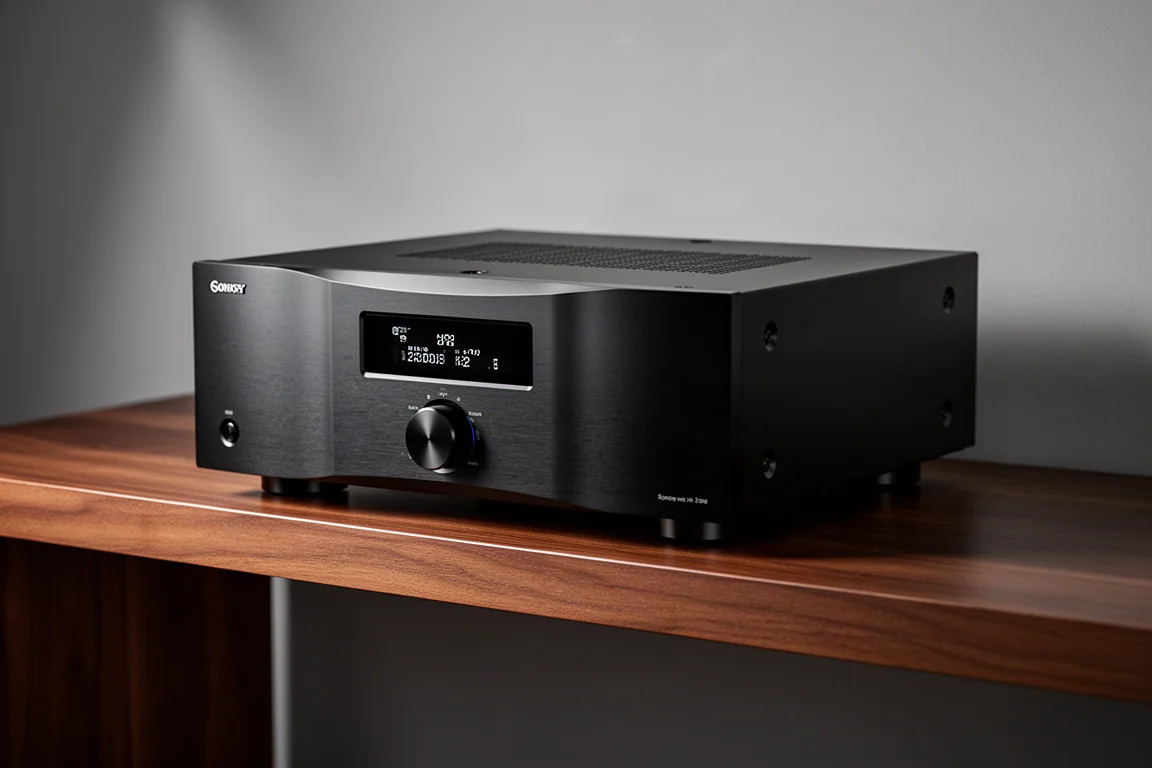
The MRX 1140 steps up in capacity rather than architecture. It offers 15 channels of processing, excluding subwoofers, and 11 channels of amplification: the same five class A/B channels at 140 W each, plus six class D channels at 60 W each. Two independent subwoofer outputs allow separate delay and level settings for each subwoofer, and the extra processing supports front wide speakers. A toroid transformer replaces the E-core design.
That larger supply shows up in the numbers. With two channels driven into 8 ohms, the MRX 1140 measured 153 W per channel at 0.1% THD, a clear advantage over the MRX 740. Into 4 ohms it produced 203 W momentarily before current limiting down to about 163 W within roughly 200 milliseconds, and it measured 173 W at 0.1% THD and 176 W at 1%. Its 1 W spectrum was also cleaner than the MRX 740’s.
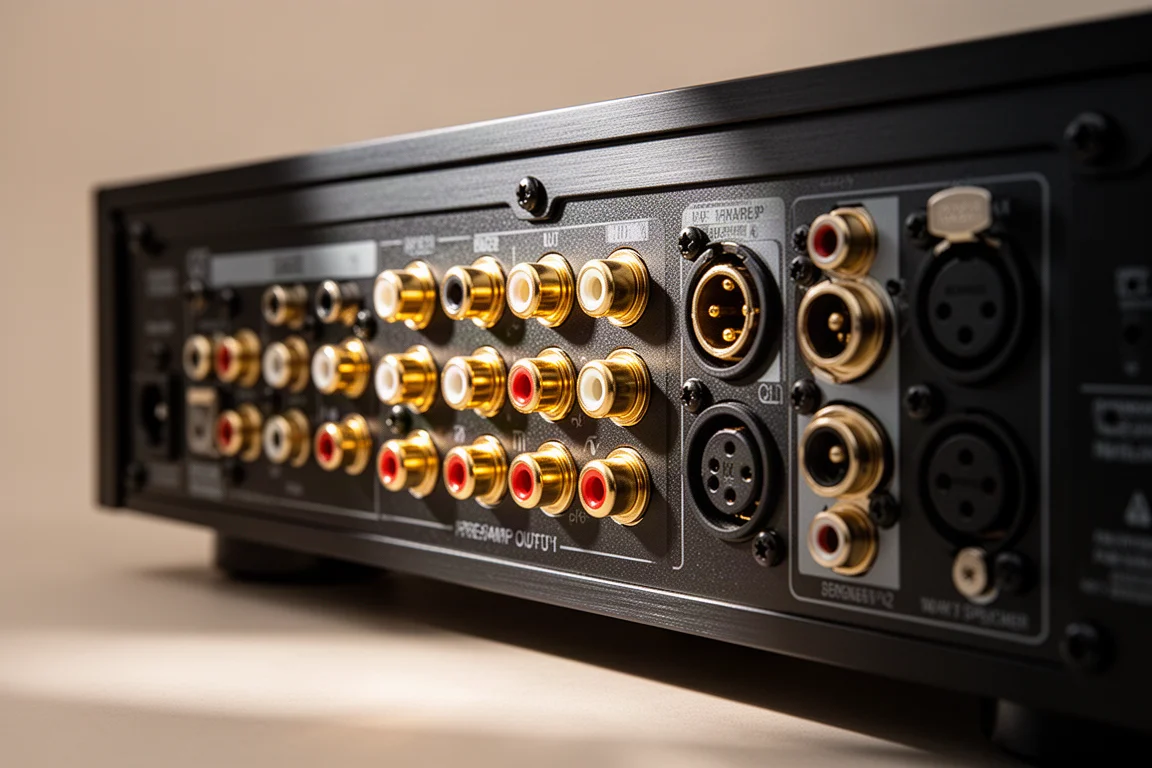
Both receivers make sense as the front half of a separates system later on, and the MRX 1140 simply gives you more room to grow before external amplification becomes necessary.
Class D Channels and Dynamic Headroom
The class D amplifier section is best treated as support rather than primary power. Its -3 dB points sit at 20 Hz and 17 kHz, so it is bandwidth limited compared with the class A/B channels, though that is acceptable for height and surround duties. Four channels driven produced 60 W per channel at 1% THD and 53 W per channel at 0.1%, two channels driven reached about 70 W per channel, and burst output measured 103 W per channel. At 1 W the class D spectrum was very clean, with residuals 101 dB below the fundamental.
Dynamic burst testing with a CEA-2006 pulse returned 315 W with both channels driven into 4 ohms, so there is substantial headroom on transients. Amplifier crosstalk measured about -50 dB at 20 kHz in a worst-case test.
Because the class D channels are rated at 60 W against 140 W for the class A/B channels, reassigning them to biamp the front speakers gives up roughly 3.7 dB of output. The class A/B channels are the better choice for the front stage.
Bass Management and Firmware Updates
Bass management follows a specific logic. To run the main speakers full range while still feeding the subwoofer, you engage a feature called super sub fronts. With no crossover applied to the mains, the subwoofer crosses over at 40 Hz. If you want a more typical 80 Hz crossover while keeping the mains large, you select the crossover and then enable super sub fronts; otherwise the mains receive a high pass filter at the selected frequency.
The high pass slope is 12 dB per octave. The low pass slope originally matched at 12 dB per octave, which is shallower than the 24 dB per octave typically preferred for subwoofer integration, and a firmware update raised the low pass to 24 dB per octave. Owners running an older version should check the web interface and update.
Amplifier Matrix and Expandability
The amplifier matrix lets you reassign channels. Front channels can be configured as front, zone 2, front wide, or height 3, which gives you flexibility in how the internal amplifiers are used. A sensible configuration is to let the internal amplifiers handle the height and surround channels, then add a dedicated multi-channel amplifier for the front stage.
Anthem has also indicated that HDMI 2.1 upgrades are planned for the future, so the platform has a defined upgrade path.
Which Receiver Fits Your System?
If you need seven amplified channels and 13 channels of processing, the MRX 740 at $2,899 covers a conventional setup well, and its preamp outputs leave a clear upgrade path. If you want front wides, two independently adjustable subwoofer outputs, or you plan to expand toward a larger immersive layout, the MRX 1140’s 15 channels of processing and stronger power supply justify the step up.
Both models are at their best when the internal amplifiers handle the less demanding channels and a separate amplifier drives the front speakers. That is where the preamp section’s 5 Vrms output and low noise floor pay off, and it is the approach that keeps the receiver running comfortably rather than pushing it toward its limits.
Conclusion
The MRX 740 and MRX 1140 share a genuinely strong preamp stage, measured at 5 Vrms unclipped with 110 dB signal-to-noise and isolation above 70 dB, and both stay cool in a rack thanks to the class D channels. The MRX 1140 adds processing capacity, two independently adjustable subwoofer outputs, a toroid transformer, and more measured output at 8 ohms. The MRX 740 keeps the same core quality in a smaller, less expensive package. Match the channel count and processing you actually need, plan for an external amplifier on the front stage, and either receiver will serve as a solid foundation.
Further reading
Related Reviews
AV Receivers
Anthem MRX 740 8K Review: Composed Home Theater Sound With a Few Rough Edges
A close look at Anthem's mid-tier MRX 740 8K receiver, covering its sound, ARC Genesis room correction, HDMI 2.1 features and the daily quirks worth knowing before you buy.
AV Receivers
Best AV Receivers for Home Theater: Denon, Onkyo, Marantz and Yamaha Compared
Four home theater receivers compared on features, sound character, setup and value, with clear guidance on which one fits which kind of buyer.
AV Receivers
Denon A1H Review: A 15.4-Channel Flagship Receiver With One Big Caveat
The Denon A1H delivers fifteen channels, four independent subwoofer outputs and superb surround sound once Dirac Live is added, but the licence cost is part of the real price.