AV Receivers
Yamaha RX-A6A Pure Direct Review: Does the Button Actually Change Anything?
Bench measurements of the Yamaha RX-A6A show what Pure Direct really does with analog and HDMI sources, where the gains are measurable, and when Straight mode is the better choice.
Introduction
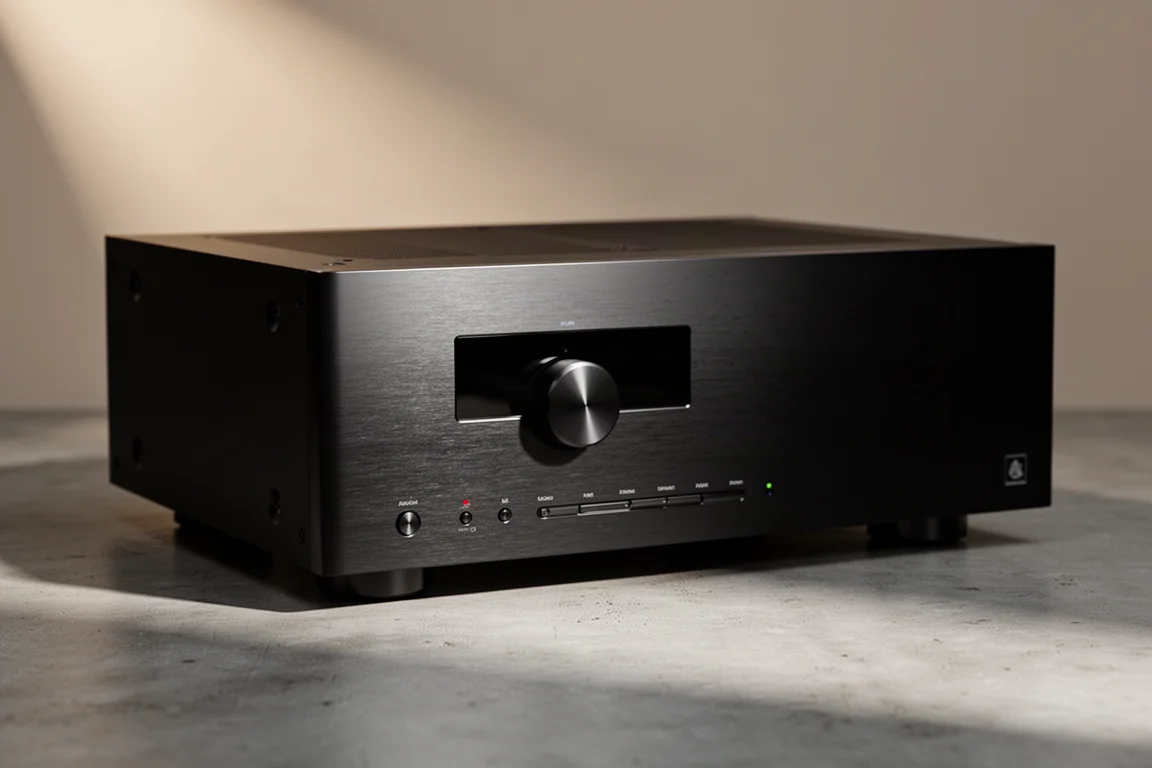
Pure Direct has been a fixture on Yamaha receivers for years, and a lot of owners press the button without knowing exactly what changes inside the chassis. Is it a genuine signal path change, or just a reassuring light on the display? Bench measurements of the Yamaha RX-A6A AV receiver, run side by side in Pure Direct and Straight mode across analog and HDMI inputs, give a clear answer: the button does something real, and how much it matters depends almost entirely on which input you use.
With analog sources the difference is large enough to measure and, in a very quiet room, large enough to hear. With HDMI sources the gap narrows to a few decibels that most listeners will never notice. Both results are worth understanding before you decide how to set up the receiver.
Who the RX-A6A Is For
The RX-A6A is a home theater receiver with an unusually serious two-channel core. It offers balanced XLR inputs, conventional unbalanced analog inputs, and a phono stage, plus preamp outputs that deliver a clean 4 V RMS on the unbalanced side and 8 V RMS on the XLR front channels. That is generous output headroom for a receiver, and it gives the unit a dual identity.
It suits two kinds of buyers. The first is the analog-first listener who runs a turntable, a disc player, or an outboard converter and wants a transparent preamp rather than a processor. The second is the HDMI-centric home theater owner who wants a clean digital path and may also care about the last few decibels of noise performance. Yamaha’s own design priorities reflect that split: the digital-to-analog converters are genuinely high quality, while the analog-to-digital converters are treated as a lower priority, since the large majority of owners feed this receiver over HDMI.
Main Strengths
The analog preamp section is the standout. Measured through the unbalanced analog inputs in Pure Direct, the frequency response is ruler flat all the way to the 80 kHz limit of the test equipment, remains flat down to 10 Hz, and rolls off by only about 1 dB below 5 Hz. Total harmonic distortion plus noise sits at roughly 0.001 percent, which works out to about 100 dB SINAD. That is a very quiet, very linear analog stage.

Output capability is equally strong. A voltage sweep confirms a clean 4 V RMS from the unbalanced preamp outputs and 8 V RMS from the balanced XLR outputs, which is enough drive for a wide range of power amplifiers and active speakers.
On the digital side, HDMI playback with a full-scale signal and 2 V out reaches 111 dB signal-to-noise ratio in Pure Direct, a genuinely state-of-the-art figure for an AV receiver. Distortion and frequency response through HDMI are excellent in either mode, with differences that are far smaller than what appears on the analog inputs.
What Pure Direct Changes With Analog Sources
This is where the button earns its place. In Straight mode, the receiver routes the analog signal through its digital signal processing, and the consequences are visible on the bench. The response rolls off below 10 Hz, rolls off above roughly 40 kHz, and hits a brick wall near 48 kHz because the sampling rate is 96 kHz. The overall level drops slightly as well. Distortion rises too, most noticeably above 500 Hz, moving from about 0.001 percent in Pure Direct to roughly 0.005 percent in Straight mode.
The bigger story is noise. Measured with around 400 mV in and 2 V out, Straight mode produced 82 dB signal-to-noise ratio, a respectable but unremarkable result. Switching to Pure Direct improved the noise floor by roughly 15 to 20 dB, and the SINAD advantage measured about 15 dB. In practice that shows up as audible hiss near the tweeter with a sensitive speaker in a quiet room when an analog source runs in Straight mode. Whether you hear it depends on speaker sensitivity, how close you sit to the drivers, and how quiet your room is, but the mechanism is real rather than imagined.
There is one trade-off to know about. Pure Direct bypasses the digital-to-analog conversion stage entirely, which means it also bypasses bass management. If you want to high-pass your main speakers at, say, 80 Hz with a 12 dB per octave rolloff and hand the low bass to a subwoofer, you have to use Straight mode. The measurement confirms that 80 Hz filter behaves exactly as specified, with distortion above the crossover remaining low. Below the crossover the plotted distortion is simply filtered noise and should be ignored.
How Pure Direct Behaves With HDMI Inputs
With an HDMI source, the frequency response in Straight and Pure Direct modes is essentially identical, and distortion differences are much smaller than on the analog side. There is some slight ringing in the post-filter output above 50 kHz, which sits far above anything in the audible band and poses no risk to tweeters. The SINAD gap between the two modes falls to about 5 dB, which is minuscule and very unlikely to be audible.
Noise performance is still worth noting. With a 0 dBFS digital signal in and 2 V out, Straight mode measured 105 dB signal-to-noise ratio, which is good but a few decibels short of the best receivers on the bench. Pure Direct raised that to 111 dB, a genuine improvement for owners running high-sensitivity speakers at close range or who simply want the quietest possible output.
Two further menu items are worth a mention. The receiver offers several HDMI mode settings related to jitter control, and HDMI mode 3 measured best, with slightly less ringing, a little more bandwidth, and marginally lower distortion, though the differences are not something you are likely to hear. The DAC digital filter options, which include slow rolloff, sharp rolloff, and short latency, produced no measurable difference at all in these tests, which suggests the setting may not be altering the output in a meaningful way. Treat those options as experimental rather than essential.
Things to Consider Before Buying
Pure Direct disables bass management, so anyone running a subwoofer with small main speakers will spend most of their time in Straight mode and should weigh that against the analog noise benefit.
The analog-to-digital stage is the weaker half of this receiver. If your priority is analog purity, Pure Direct is the mode that delivers it, and it is a meaningful upgrade over Straight in that specific use case. If you feed the RX-A6A exclusively over HDMI, the two modes are close enough that the choice comes down to personal preference rather than audible performance.
Firmware matters on a modern receiver, particularly with HDMI behavior, so it is worth keeping the unit on the latest version. It is also worth being clear about what these results represent: they are bench measurements of the preamp and output stages rather than a full listening evaluation with speakers in a room, so treat them as a strong indicator of transparency rather than the complete picture.
Buying Advice
If you run analog sources, use Pure Direct and leave it there. The lower noise floor and cleaner distortion profile are measurable, repeatable, and in quiet conditions audible, and you give up nothing except bass management. If you need that bass management, Straight mode remains a perfectly capable path with respectable measurements.
If you run HDMI sources only, Straight mode is fine. Pure Direct does deliver a better noise figure, and owners with very sensitive speakers or a very quiet room may appreciate it, but the difference is small and most listeners will not notice. Either way, the RX-A6A presents a strong case as a receiver whose two-channel foundation is genuinely well engineered, not just well marketed.
Conclusion
The Pure Direct button on the Yamaha RX-A6A is not a light show. With analog inputs it bypasses the DSP and the conversion stage, cutting the noise floor by roughly 15 to 20 dB and lowering distortion, at the cost of bass management. With HDMI inputs it narrows to a modest noise advantage of around 5 to 7 dB with no meaningful change in frequency response. Buyers who care about analog fidelity get a clear, defensible reason to press it. Everyone else can leave the receiver in Straight mode and enjoy excellent digital performance without worrying that they are missing something.
Product link
View more details for Yamaha RX-A6A
This product is mentioned in the review. Check the specifications, options, and compatibility before buying.
View more details for Yamaha RX-A6AFurther reading
Related Reviews
AV Receivers
Anthem MRX 740 8K Review: Composed Home Theater Sound With a Few Rough Edges
A close look at Anthem's mid-tier MRX 740 8K receiver, covering its sound, ARC Genesis room correction, HDMI 2.1 features and the daily quirks worth knowing before you buy.
AV Receivers
Anthem MRX 740 vs MRX 1140: Which AV Receiver Fits Your System?
A measured look at the Anthem MRX 740 and MRX 1140, covering preamp output performance, amplifier behaviour, bass management, and expansion headroom.
AV Receivers
Best AV Receivers for Home Theater: Denon, Onkyo, Marantz and Yamaha Compared
Four home theater receivers compared on features, sound character, setup and value, with clear guidance on which one fits which kind of buyer.