Vintage Audio
Yamaha CR-800 Review: A 1974 Stereo Receiver Worth Hunting Down
A close look at the Yamaha CR-800, a 1974 receiver rated at 45 watts per channel with a full wood case, variable loudness, and a few quirks worth checking before you buy.
Introduction
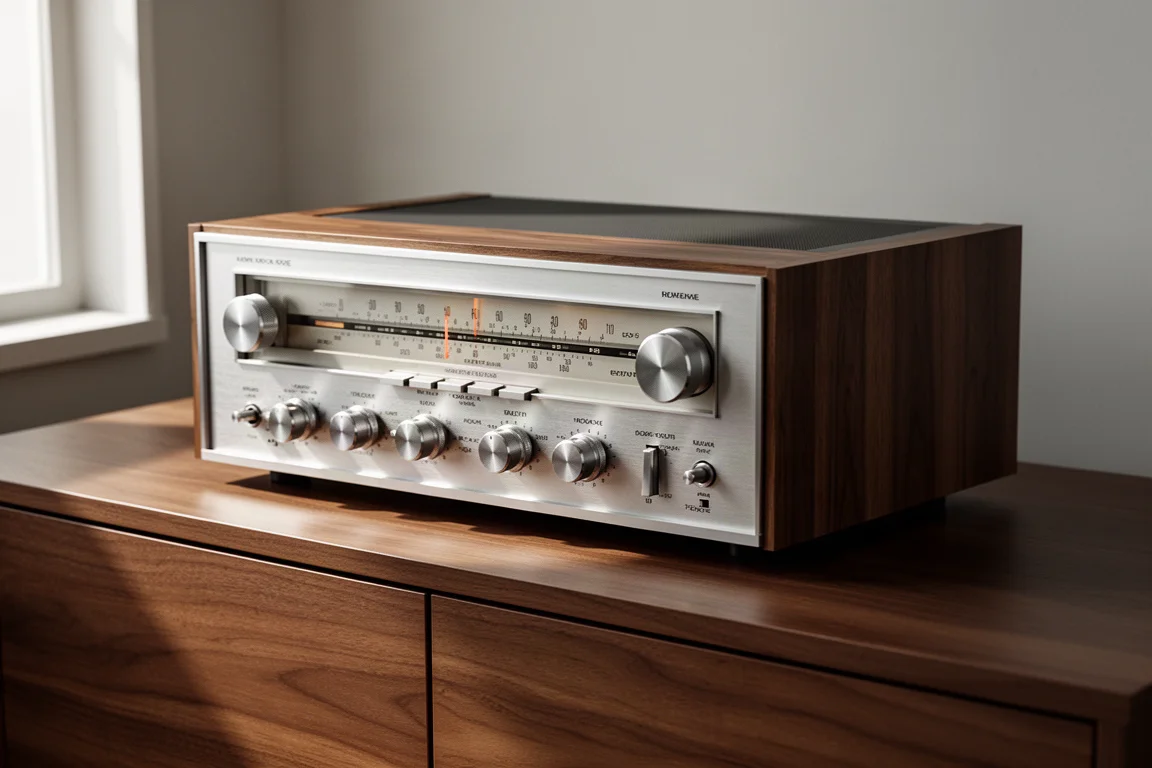
The Yamaha CR-800 dates from 1974, which places it squarely in the era of heavy faceplates, detented controls, and wood-veneer cabinets. It is a stereo receiver rated at 45 watts per channel into 8 ohms, specified as safe for speaker loads between 4 and 16 ohms, with a claimed total harmonic distortion figure of 0.1 percent.
What makes this model interesting today is not raw output. It is the way Yamaha put the thing together: an all-metal front panel, knurled metal knobs, a full wood cabinet that wraps the entire chassis, and a variable loudness circuit that gives you more control over low-level listening than most receivers of the period. It is also a receiver with documented quirks, and knowing them before you buy is the difference between a satisfying purchase and a project.
Who This Receiver Is For
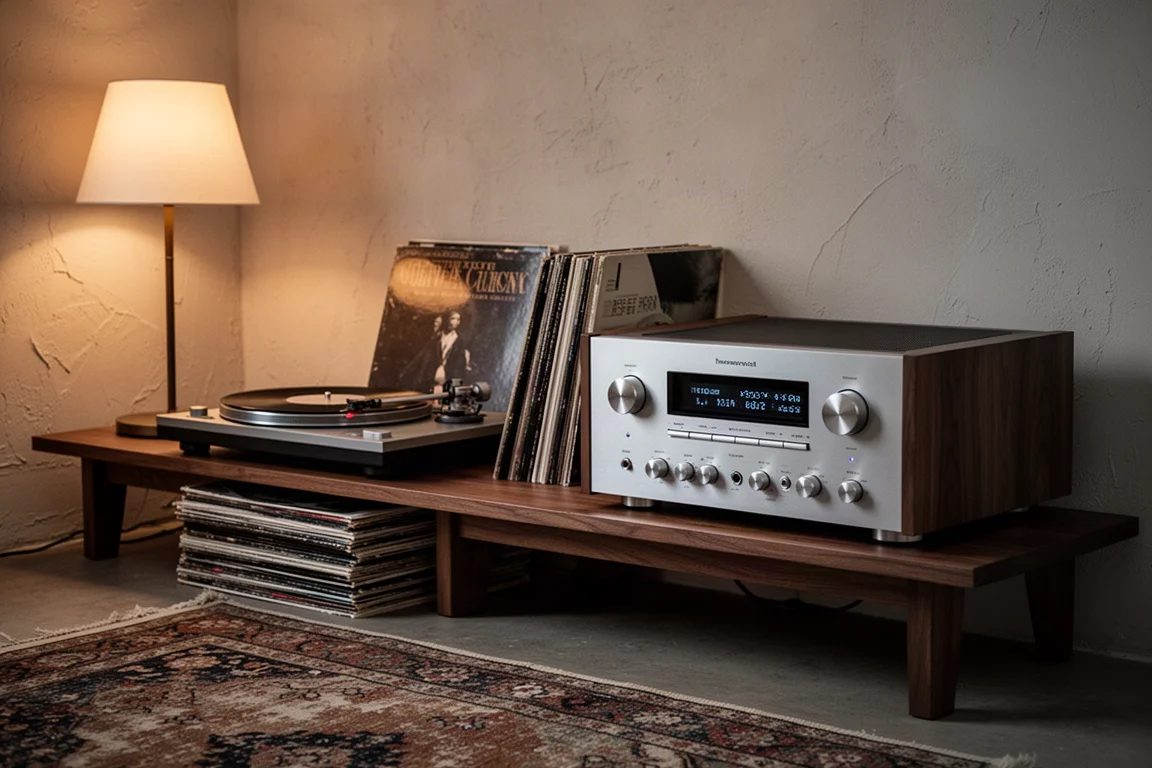
The CR-800 suits anyone building a vinyl-first two-channel system. It carries two phono inputs, a tape loop for dubbing between two decks, and enough usable power for most bookshelf and modest floorstanding speakers. The tuner is built in, so FM and AM listening needs no extra box. If you already own a turntable, a pair of efficient speakers, and a shelf to put them on, this receiver slots into that setup without adapters or workarounds.
It is a poor fit for anyone who wants remote control, digital inputs, room correction, or balanced connections. The CR-800 is single-ended throughout, and its power cord is as thin as anything else from the 1970s. It also rewards a buyer who is comfortable with used equipment and, ideally, with a technician nearby. This is a 50-year-old piece of electronics, and it should be treated as one.
Main Strengths
The case for the CR-800 rests on three things: how it is built, how it sounds, and how much control the front panel gives you over that sound. Each deserves its own look.
Build Quality and the Wood Case
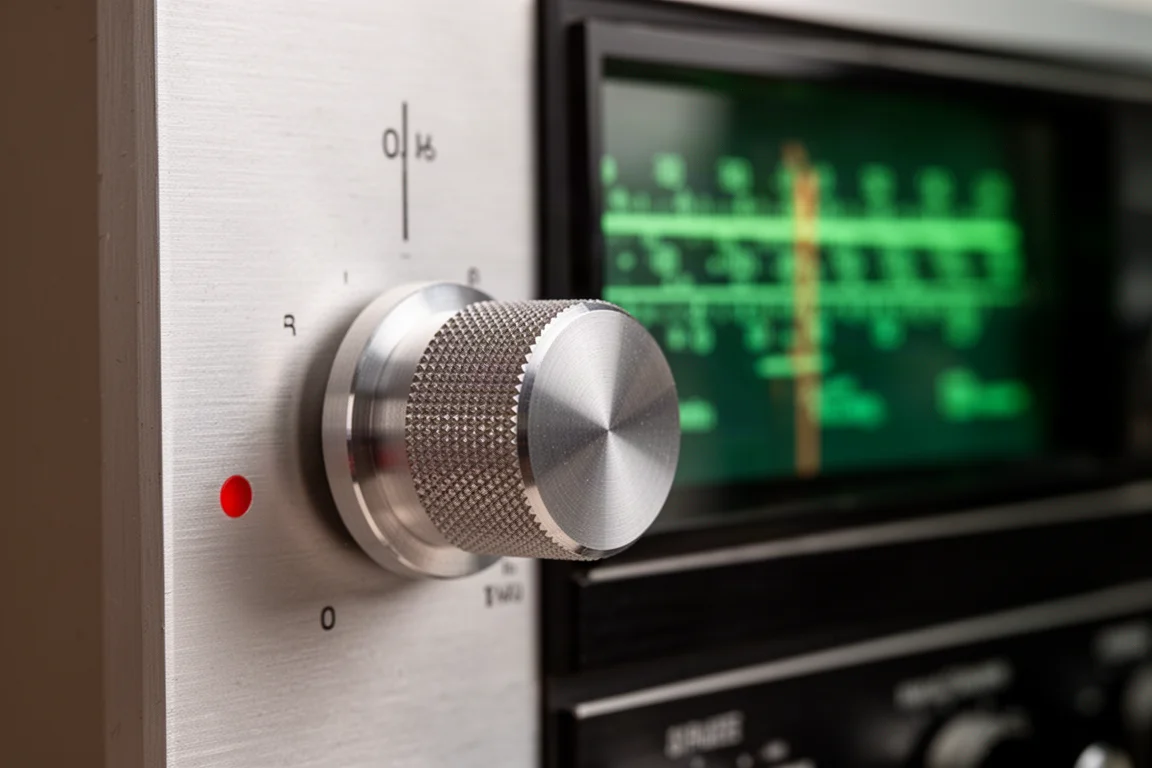
Almost everything you touch on the CR-800 is metal. The knobs are knurled aluminum, the tone controls click into detented positions rather than spinning freely, and each one carries a small red dot so you can see exactly where it is set. Even the ventilation panel on top is brushed aluminum rather than a plain black cover.
The cabinet is the standout detail. The receiver is encased in wood, likely walnut or at least walnut veneer, and the wood surrounds the whole chassis rather than acting as a thin side shroud. Servicing reflects that design: remove four screws on the bottom and the entire chassis slides out through the front. On most receivers of the era you unscrew a cover at the sides, slide it back, and lift it off. This one is a different approach, and it feels considerably more substantial as a result.
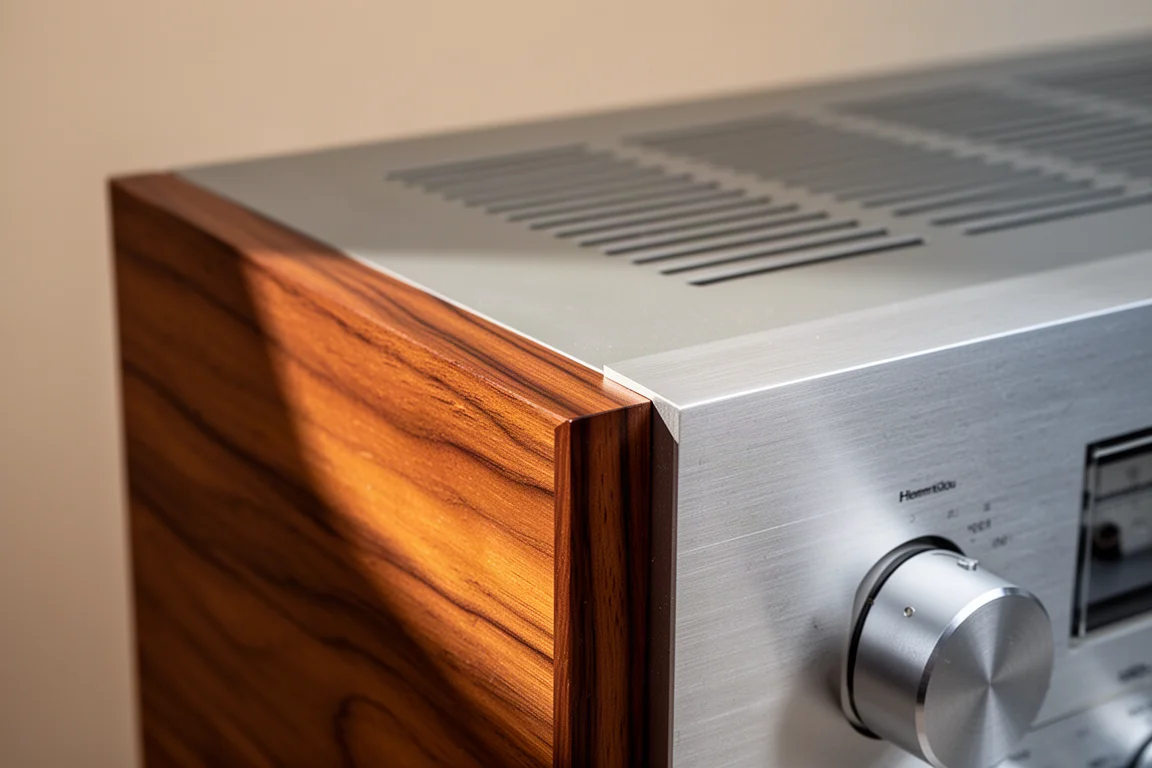
That construction has practical consequences. A full wood cabinet means the receiver wants a stable, dry surface with some airflow, and it means cosmetic condition matters more than usual, because veneer damage is difficult to disguise. It also means the unit is heavy for its power rating. Buyers who care about how a component looks in a room will find this one easy to live with.
Sound Character
The published power figures are more generous than the headline number suggests. Yamaha rated the CR-800 at 45 watts per channel with both channels driven from 20 Hz to 20,000 Hz, and 55 watts into a single channel driven across the same range. Into 4 ohms it is rated at 50 watts, and with a 1 kHz test tone it reaches 60 watts with both channels driven and 70 watts with one channel driven. Those continuous ratings are the meaningful ones, and Yamaha was known for keeping its numbers conservative.
In practice, that means the volume dial rarely needs to travel far. Normal listening below 80 to 85 dB tends to sit around 1 or 2 on the dial, with 3 or 4 arriving only for louder sessions. The receiver sounds larger than 45 watts would suggest.
The variable loudness control is the most interesting part of the sound. It is not a simple on or off button. The knob adjusts a boost of up to plus 10 dB at 100 Hz and up to plus 5 dB at 1 kHz, which puts useful emphasis on the range where voices sit. Around the middle of its travel the effect is subtle and welcome for quiet evening listening. Pushed to maximum, the sound becomes noticeably bassy and slightly muffled, with less top-end clarity, so it is a control to use deliberately rather than leave wide open.
Set against a Pioneer SX-3700, the CR-800 came across as the more three-dimensional of the two. Imaging felt larger and more definitive, and the presentation felt more organic and immersive. The Pioneer was the quieter of the pair in operation and serves as a perfectly good daily driver, but the Yamaha had the more expressive character.
Controls, Loudness, and Filters
Working across the front panel from left to right: the power switch, then the speaker selector for A, B, or A plus B. Next is a microphone input with its own level control, a feature that allowed karaoke or PA use, followed by a headphone output.
The tone section comes next. Bass and treble are detented with red position markers, then the variable loudness knob, then the volume control with a concentric balance knob nested inside it. The concentric arrangement is elegant and smooth, though on some examples a sticky balance control can drift slightly as the volume is turned, so it is worth working both controls through their range before buying.
The lower row of switches covers a minus 20 dB mute, which lowers output rather than cutting it entirely, and a set of filters. The low filter acts as a high-pass, rolling off everything below roughly 70 Hz at 12 dB per octave. A second filter handles 20 Hz, effectively a subsonic filter for warped records and turntable rumble. The high filter, labeled high blend, is specified at minus 3 dB at 8 kHz with a 12 dB per octave slope.
Those filters are more useful than they first appear, because the CR-800 has preamp outputs and a low filter that together allow basic bass management. Cutting everything below 70 Hz from the main speakers, while running a subwoofer from the speaker-level inputs, is a workable arrangement. One caveat: the rear panel has a coupler switch, and engaging it into preamp mode disconnects the internal preamp from the power amplifier section. That is what lets the CR-800 serve as a standalone power amplifier, but it also means the receiver’s own preamp is out of the chain.
Tuner, Inputs, and Outputs
Input selection covers auxiliary, two phono inputs, and a tape section with dubbing between two decks, plus FM muting, FM, and AM. Both phono inputs work as expected, which matters for anyone running two turntables or a turntable and a second phono source.
The rear panel carries the antenna connections, a phono ground, the phono and auxiliary inputs, two tape in and out pairs, preamp outputs, main inputs, the coupler switch, and two sets of speaker outputs. Four AC outlets are provided, a mix of switched and unswitched, along with the main fuse. This is a period-correct layout, and it is unusually complete for the class.
Lighting is restrained compared with many receivers of the same era. Rather than a fully illuminated dial, the CR-800 uses only a few lamps, one of which sits behind the tuner dial, which itself moves back and forth. The result is a soft glow rather than a wall of light. Those lamps are incandescent, and replacement LED kits exist for anyone inclined to fit them.
Things to Consider Before Buying
The most important thing to know is that the CR-800 can produce a low-level hum or hiss between tracks. It is audible as a faint, wind-like background noise, it is not tied to the volume control, and it tends to grow louder the longer the unit runs. Running the preamp outputs into a separate power amplifier did not remove it, which points to the amplification stage rather than the preamp. For most listeners it is a minor annoyance rather than a deal breaker, but it is the kind of thing worth budgeting a service visit for.
The second consideration is documentation. Original warranty cards, specification sheets, and full owner’s manuals sometimes survive with these receivers, complete with the selling dealer’s stamp, and they are a genuine bonus. They are also rare. Most vintage receivers arrive with nothing at all, and a buyer should not assume paperwork will be included.
Third, it is worth understanding where the CR-800 sits in Yamaha’s range. The CR-600 shared the same styling in 1974 but was rated at 35 watts per channel. The CR-400 arrived in 1977 at 16 watts per channel. The CR-900 came later, in 1981, rated at 70 watts per channel. If the CR-800 is more power than you need, the CR-600 offers the same look and feel with less output, and even 16 to 20 watt receivers of this generation reach surprising volume with efficient speakers.
Finally, plan for the wood. A cabinet this exposed shows every scratch, and veneer repairs are not something most owners can do at home.
Buying Advice
Before committing to any vintage receiver, including this one, test it with a pair of speakers you are not attached to. If something goes wrong during the first hours of operation, the loss is limited, and you can move to better speakers once the unit has proven stable.
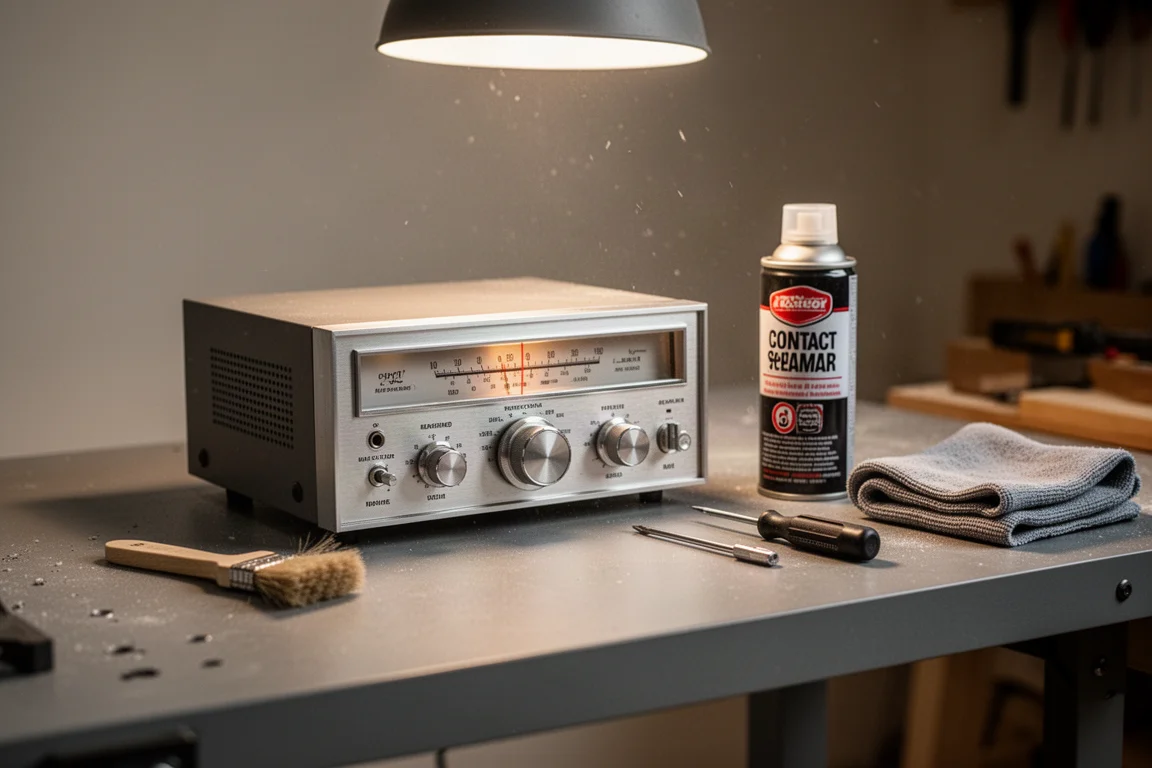
When you inspect a CR-800, turn the volume all the way down and listen for hum or hiss between tracks. Then leave it running for a while and listen again, since the noise can increase as it warms up. Work the balance control through its full travel while adjusting volume to check for stickiness. Confirm that both phono inputs pass signal, that the tuner locks onto stations, and that the filters and loudness knob audibly change the sound. Check the wood for lifting veneer and the faceplate for scratches, and ask whether any documentation comes with it.
On price, these trade on the secondhand market, and condition drives the number more than anything else. A clean example with original paperwork and a quiet amplifier section is worth paying more for than a cosmetically rough unit with an unexplained hum, because the cost of a proper service can easily exceed the difference. Buy in good shape rather than buying cheap and hoping.
Conclusion
The Yamaha CR-800 earns its reputation on construction and character rather than on watts. The all-metal front panel, detented controls, full wood cabinet, and variable loudness circuit add up to a receiver that is genuinely pleasant to use, and its continuous power ratings are honest enough that 45 watts goes further than the number implies. The hum and hiss reported on some units are a real consideration, and the modest lamp count will disappoint anyone who wants a glowing dial.
If you want a two-channel receiver with a built-in tuner, two phono inputs, and a sound that leans toward large, immersive imaging, the CR-800 is a strong candidate, provided you buy a good example and accept that a 1974 component may eventually need attention. Handled that way, it is an easy recommendation.
Product link
View more details for Yamaha CR-800
This product is mentioned in the review. Check the specifications, options, and compatibility before buying.
View more details for Yamaha CR-800Further reading
Related Reviews
Vintage Audio
Affordable Vintage Receivers: 8 Overlooked Models Worth a Second Look
A practical guide to eight vintage stereo receivers that stay under the collector radar, with real strengths, honest trade-offs, and what to check before you buy.
Vintage Audio
Conrad Johnson PV8 Review: A 1988 Tube Preamplifier With Real Character
A vintage tube preamplifier with a built-in phono stage, six tubes, and a warm, sweet presentation that makes long listening sessions effortless.
Vintage Audio
Dynaco PAS-3 and Krell PAM-1: Two Vintage Preamplifiers Worth Knowing
A restored 1964 all-tube preamplifier and a dual mono solid-state classic from the mid 1980s, compared on sound, usability and restoration quality.