Music Streamers
WiiM Ultra Review: A Feature-Packed Music Streamer Under $500
The WiiM Ultra pairs a 32-bit ESS DAC, HDMI ARC, a built-in phono stage, and room correction in a compact aluminum chassis. Here is what it does well and where it holds back.
Introduction
The WiiM Ultra is the brand’s flagship music streamer, and it arrives with a longer feature list than anything else in the WiiM range. Alongside an updated digital-to-analog converter, it adds a full-color touchscreen, an HDMI ARC input, a built-in phono stage, and a subwoofer output with its own tuning controls. For listeners who want one box to handle streaming, TV audio, vinyl, and headphones, that combination is unusual at this price level.
This article covers what the Ultra does well, where it falls short of more expensive streamers, and who should consider it.
Who the WiiM Ultra Is For
The Ultra is aimed at listeners building a compact, all-in-one system rather than a rack of separate components. It suits people who stream from services such as Spotify, Tidal, Amazon Music, or Qobuz, and who also want to connect a TV over HDMI ARC, play records through an internal phono section, and plug in headphones at night.
It is also a natural fit for anyone already using WiiM products. The same WiiM Home app controls the whole family, so an Ultra can join an existing setup as part of a whole-home audio system.
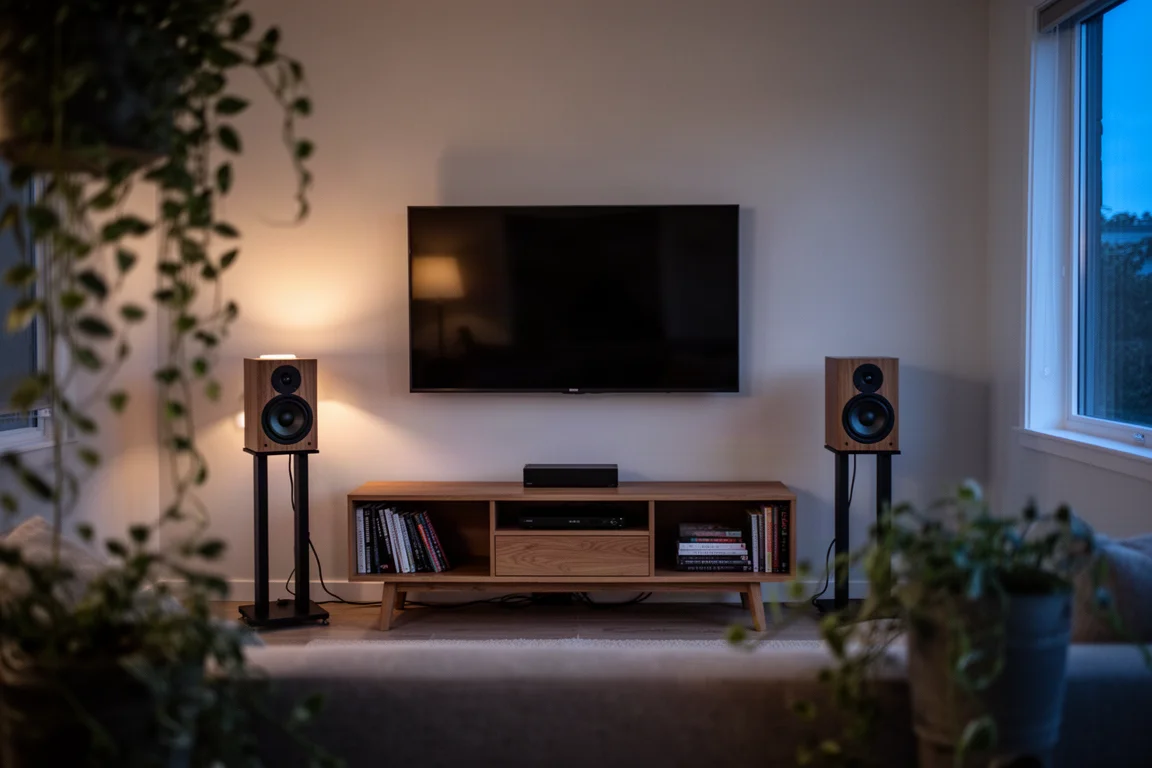
It makes the most sense as the hub of a main system paired with a capable power amplifier or higher-end powered speakers. Used with the WiiM Amp or a pair of compact powered speakers, it works, but in that configuration it is better suited to a second setup in a bedroom or office than to a serious main system.
Design and Build Quality
The Ultra introduces a chassis that WiiM has not used before, taking the aluminum construction of the WiiM Amp further. At roughly 8 inches wide, 8 inches deep, and 3 inches tall, it is slightly larger than the WiiM Amp but still compact for a home audio component.
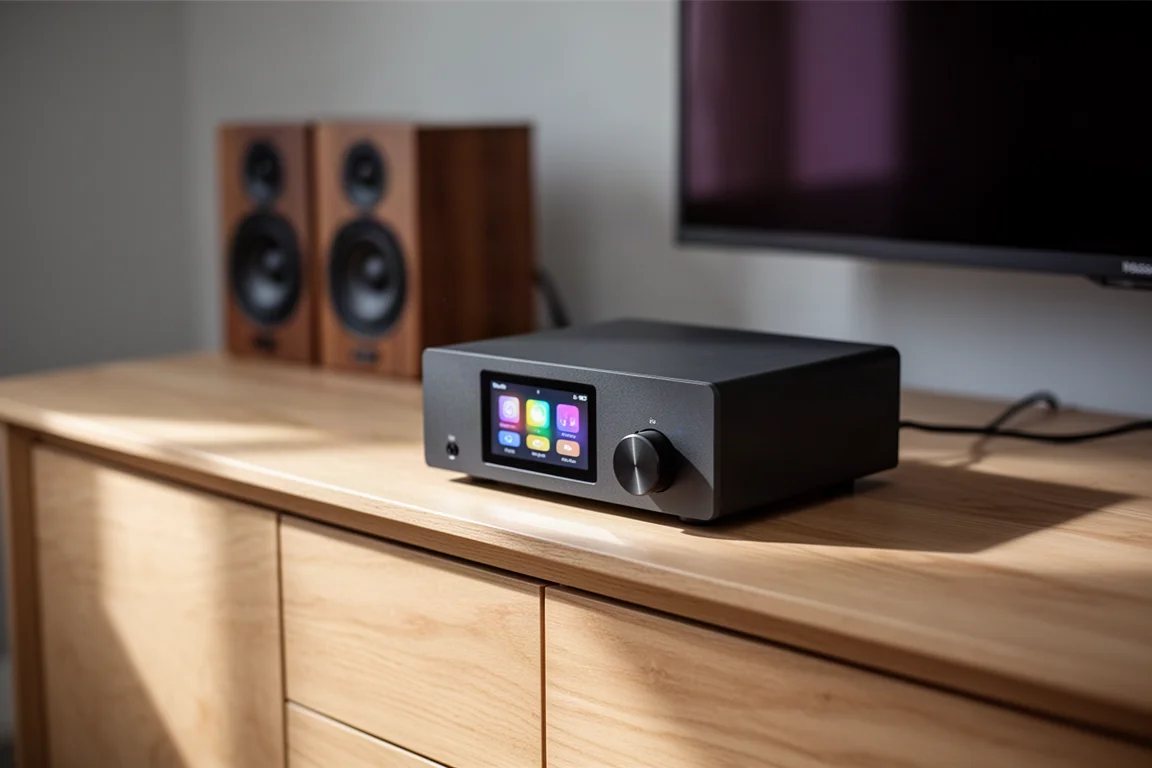
The casework uses the same dark gray finish as the WiiM Amp, while the front panel is black. That combination gives the Ultra a more upscale look than earlier WiiM models, and the front panel is where the new features live: a large volume knob, a 3.5 mm headphone jack, and a glass-covered 3.5 inch touchscreen.
Touchscreen, Remote, and Controls
The 3.5 inch touchscreen is a first for WiiM. It is a full-color display that can show app widgets, large album artwork, playback controls, the play queue, presets, EQ settings, audio input and output selection, and device settings. It also guides users through the out-of-box experience and firmware updates, and gives visual feedback when the play mode changes. During standby it can display the time and date, and the wallpaper is customizable.
For listeners who like to interact with their music physically rather than through a phone, the screen is a genuine alternative. A small remote is included as well, so there are three ways to control the Ultra: the touchscreen, the remote, or the WiiM Home app.
The screen gets the job done, but it does not match the quality of the larger, more responsive color displays on more expensive streamers. Listeners who consider a big, responsive touchscreen essential will need to look at units costing considerably more.
Connectivity and Inputs
The back panel covers a wide range of sources. There is a power connector for the included cable, a 12 V trigger output for switching other components on and off, coaxial and optical outputs, and USB, which doubles as a connection for USB music storage devices. Digital inputs include optical and HDMI ARC, the latter allowing a single-cable connection to a TV for higher-quality audio than the television’s own output.
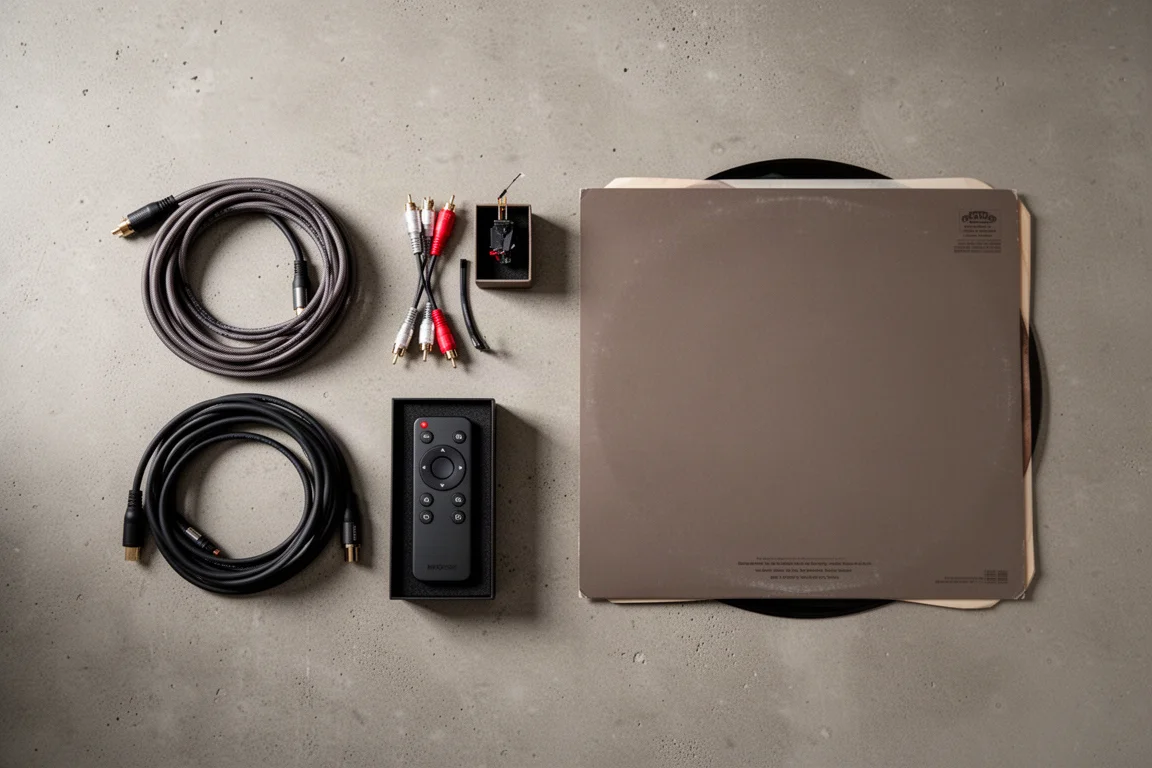
An analog RCA input accepts any analog source, and there is a phono input with a ground connection for a turntable.
The subwoofer output is a notable inclusion because it is not the full-range output many products in this price class provide. Crossover frequency, level, phase, and delay can all be adjusted from the front panel or the WiiM Home app, and the room correction feature can be used to integrate the subwoofer with the room more effectively. For anyone who has calibrated a subwoofer before, that level of control is a meaningful addition.
Phono Stage, Headphone Output, and Subwoofer Integration
The internal phono section goes further than most built-in stages at this price. It has an analog moving magnet or moving coil gain circuit before the signal reaches the same Texas Instruments PCM1863 analog-to-digital chip used for the Ultra’s other analog connections, which is the best ADC chip WiiM has used in its products. RIAA equalization is then applied in the digital domain before the signal passes to the internal DAC.
Moving coil support is uncommon here, but it comes with a limitation. The moving coil setting allows up to 56 dB of gain and the loading cannot be changed, so only entry-level moving coil cartridges will work well. Most listeners will be better served by a moving magnet cartridge.
In practice the phono stage is a viable option for vinyl listeners who want a simple, single-box solution. Sound is well balanced and accurate to the source, and it holds its own against the built-in phono sections of other value-priced gear. It will not replace a dedicated phono stage, and some vinyl purists may object to RIAA equalization being handled digitally, though that did not create audible issues during listening.
The front-panel headphone jack, powered by a Texas Instruments TPA6120A2 headphone amplifier chip, adds convenience for late-night listening. It sounds good and will drive most efficient headphones, but it is not a replacement for a dedicated headphone amplifier or a dedicated DAC and amp combination.
Streaming Services, the App, and Room Correction
The built-in streamer handles Spotify Connect, Tidal Connect, Google Cast Audio, Alexa built in, DLNA, and SqueezeLight, with Roon currently being certified. The WiiM Home app adds native access to Spotify, iHeartRadio, Tidal, Amazon Music, Qobuz, Napster, and Deezer.
Playback is gapless at up to 24-bit/192 kHz, with no upsampling or downsampling of the native resolution, which matters to listeners who want the source delivered as it was mastered. DSD is not supported at present, though a feature to convert DSD to PCM for playback is in development.
Network connection is straightforward over Ethernet, and the Ultra also includes Wi-Fi 6E for placements further from the router, along with Bluetooth 5.3 and Bluetooth Low Energy. The internal Bluetooth transmitter and receiver allow both sending and receiving, with support for SBC, AAC, and LC3 codecs. LDAC and aptX are not supported.
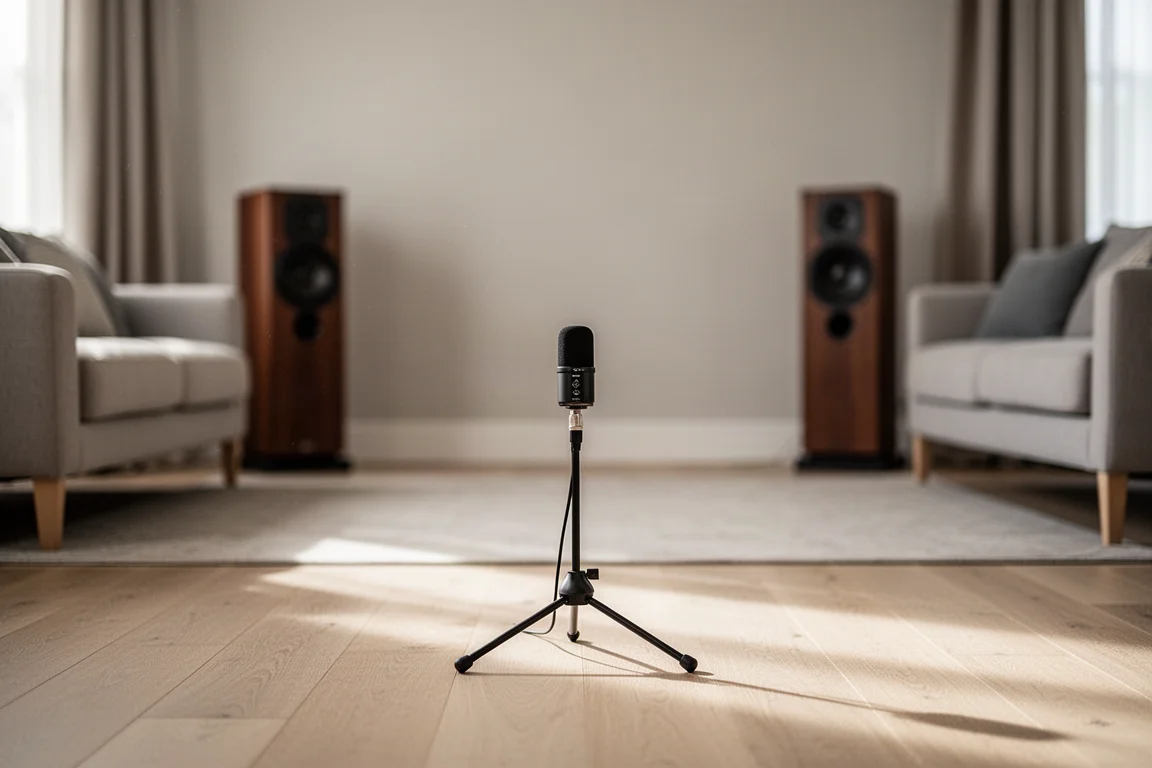
Room correction is new to WiiM on this model. It uses the microphone in an iPhone, with Android not currently supported, and applies corrections to both the stereo speakers and the subwoofer. It is not a comprehensive system on the level of Dirac Live and it is limited by the iPhone microphone, so it is not a substitute for well-placed speakers or room treatment. Even so, it can help with an unbalanced frequency response caused by room interactions and bass problems, and it handled minor corrections admirably. A 10-band graphic and parametric EQ is included as well, and both room correction and EQ can be switched off entirely if you prefer the untouched signal.
Sound Performance
Used as a streamer and preamplifier feeding a Parasound New Classic 275 v2 power amplifier and a range of speakers, the Ultra presented music cleanly and clearly with good detail. Bass was punchy without drawing attention to itself, the midrange was well balanced, and the treble carried the drive and detail without becoming aggressive or peaky. The internal DAC is a clear step up from WiiM’s earlier streaming products.
In a higher-end system, with an external DAC feeding a McIntosh MA352 hybrid integrated amplifier and McIntosh XR100 tower speakers, the Ultra showed that it can scale. Detail retrieval was excellent for a component in its price class and only bettered by more expensive streamers.
The area where the Ultra trails pricier streamers is soundstage width, instrument separation, and placement. The stage is not as wide or naturally scaled as the better streamers, and imaging, while good, is not as locked in. Those limits are where the Ultra shows its price class.
Things to Consider Before Buying
The Ultra is a strong all-in-one, but a few trade-offs are worth weighing before you buy.
None of these are dealbreakers for the right listener, but together they shape what the Ultra is best at.
- Moving coil support is limited to 56 dB of gain with fixed loading, so most users should plan on a moving magnet cartridge.
- DSD files are not supported today, though conversion to PCM is in development.
- Bluetooth omits LDAC and aptX, supporting SBC, AAC, and LC3 instead.
- Room correction requires an iPhone and does not currently support Android.
- The touchscreen is functional rather than premium, and better displays are available on considerably more expensive streamers.
- Soundstage width and image separation fall short of more expensive streamers.
Buying Advice
For a streamer in the under $500 price class, the Ultra is hard to match on features. It combines a preamplifier section, a phono stage with moving coil support, a 32-bit ESS Saber ES9038Q2M DAC, HDMI ARC, a subwoofer output with full tuning controls, room correction, and a parametric EQ in a single compact chassis. Assembling the same capability from separates would cost considerably more and take up far more space.
The system around it matters. Pair the Ultra with a better power amplifier or a pair of higher-end powered speakers and it rewards the investment. If your budget stretches to a more ambitious streamer, the gains are mostly in soundstage scale and imaging rather than in features.
Conclusion
The WiiM Ultra is a compelling option for music lovers who want a wide feature set at a lower price. It is easy to set up, pleasant to live with, and capable of anchoring a genuinely rewarding system. Buy it for the flexibility and the value, and accept that the last word in soundstage and imaging still belongs to streamers that cost significantly more.
Product link
View more details for WiiM Ultra
This product is mentioned in the review. Check the specifications, options, and compatibility before buying.
View more details for WiiM UltraFurther reading
Related Reviews
Music Streamers
Arylic S10 Plus vs WiiM Mini: Two Affordable Music Streamers Compared
A practical comparison of the Arylic S10 Plus and the WiiM Mini, covering connections, apps, tone controls, and how each internal DAC actually sounds.
Music Streamers
Auralic Aries G1.1 Review: A Streaming Transport That Lifts a Resolving System
A close look at the Auralic Aries G1.1 streaming transport, covering its twin-transformer power supply, Tesla G2 processing, Lightning DS app and the systems where it genuinely pays off.
Music Streamers
Bluesound Nano Review: A Compact Streamer That Keeps Things Simple
The Bluesound Nano is a stripped-down network streamer at $299, with a solid chassis, quick setup, and a clean, punchy sound. Here is what to know before buying.