Hi-Fi Audio
Volumio Revo Review: A Streaming Transport Built Around Sound Quality
The Volumio Revo is a screen-free streaming transport that hands conversion duties to your own DAC. Here is what it does well, and what to weigh before buying.

Introduction
A streaming transport exists for one reason: to hand your digital-to-analogue converter the cleanest possible signal and let it handle the conversion. If you already own a DAC you like, paying a second time for conversion inside a streamer is money spent on a part of the chain you will never use.
The Volumio Revo takes that idea seriously. It is a compact, screen-free transport from a company that spent years building an audio-focused operating system for small single-board computers before moving into its own hardware. It is hand assembled in Florence, Italy, priced at £849, and it arrives with no display, no remote control and no surplus circuitry. Volumio also offers a matching upgrade power supply, the Line 5, which is worth a closer look.
Who the Volumio Revo Is For
The Revo is aimed at listeners who already have a DAC they trust and want to feed it better. Everything in the design points at that single job, from the isolated digital outputs to the internal power filtering, and the price sits below the four-figure line that usually separates entry-level streamers from serious transports.
It also suits anyone with a large local library. A USB 3.0 port gives fast access to music stored on external drives, additional USB 2.0 ports let you attach more storage, a microSD slot accepts a card loaded with albums, and network playback runs over Wi-Fi or Ethernet.

A further attraction is control. With a TV or monitor connected over HDMI, the interface appears on screen, and a touchscreen lets you interact with the player directly instead of reaching for a phone or tablet. Small monitors are inexpensive, so this is a genuinely practical alternative to app-only operation.
The Revo is a less obvious fit for listeners who want the broadest possible feature set. A digital hub such as the Bluesound Node Icon includes HDMI ARC and a wider spread of connections at a similar price, and that matters if you want one box to serve both television and music.
Design, Build, and Connectivity
The Revo is a simple object: a slim aluminium case measuring 270 x 150 x 50 mm and weighing 2.25 kg, with a single button on the front face to take it in and out of standby. There is no screen and no remote control in the box.
Connectivity is generous for a transport at this price. AES/EBU and coaxial digital outputs are galvanically isolated, and the dedicated USB output for an external DAC is heavily filtered. Internally, the main board carries an extensive filtering chain of inductors and electrolytic capacitors, with power separated out for each section, including one supply dedicated to the internal clock and its stabiliser. The digital outputs are spaced apart to minimise interference between them.
The streaming engine is a compact single-board computer built around an Amlogic processor with a quad-core Cortex-A55 CPU, 2 GB of RAM and 16 GB of flash storage. The supplied power adapter is rated at 5 V and 3 A.
Main Strengths: Sound Quality and Digital Outputs
Sound quality is where the Revo separates itself. It passes a remarkably clean signal to an external DAC, free from any particular coloration, and it does so with a level of detail that is unusual at this price.
The soundstage is expansive and precise. Bass definition, mid-range transient attack, top-end extension, airiness and refinement are all strong, instruments are well separated, and nothing draws attention to one part of the frequency spectrum. Dynamic shifts are handled with assurance.
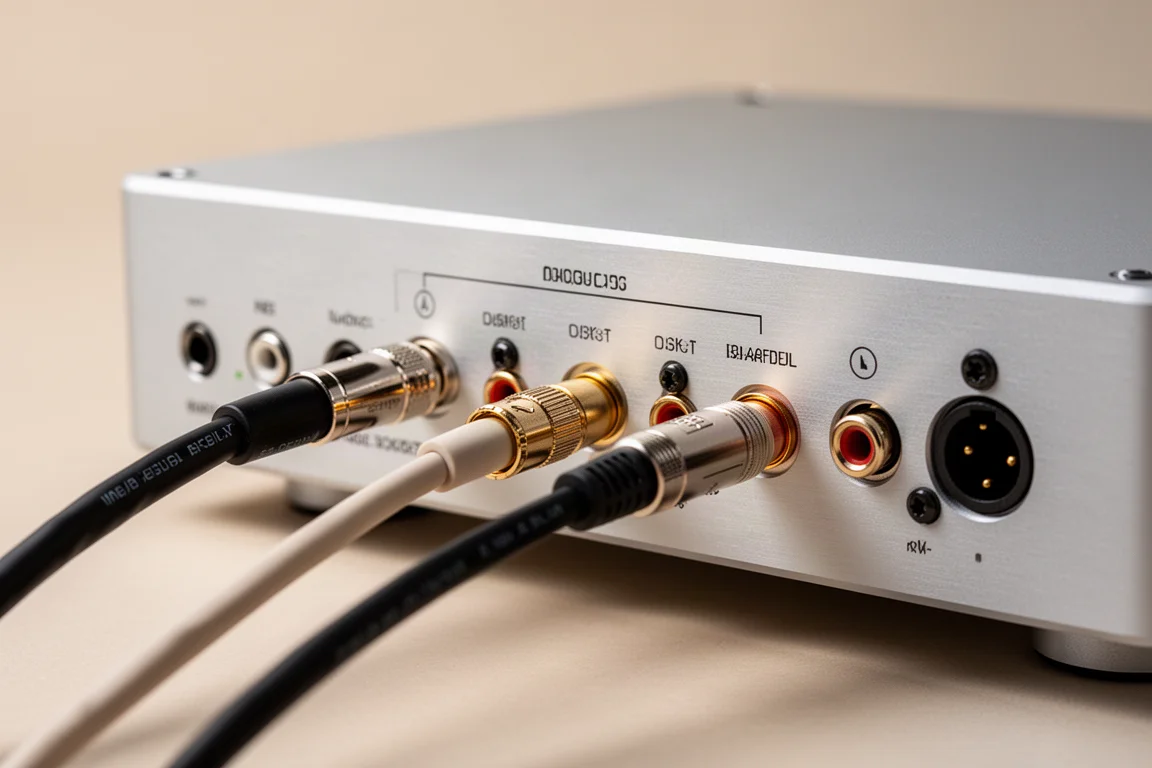
The digital outputs do not all sound identical, because the signal path is not the same in each case. Coaxial is not quite as clean as USB, while AES/EBU improves resolution and opens the soundstage further still. Even the least of the three is described as very good, so this is a matter of degree rather than a weak link.
Software behaviour is part of the story too. Volumio OS has something of a reputation for dropouts on third-party hardware, but on the company’s own components it proved responsive and reliable, and a 2 TB external drive was recognised without trouble.
The Line 5 Power Supply Upgrade
The Line 5 sells for £349 and is discounted when bought together with the streamer. Inside, a 120 VA transformer feeds four 10,000 microfarad audio-grade capacitors in the first stage and four 3,600 microfarad capacitors in the second, for 54,400 microfarads in total, a figure that puts plenty of rivals to shame. The casework is sturdy and functional, though it does not visually match the Revo, so it is best tucked out of sight.
The effect is not subtle. With the Line 5 supplying power, everything becomes cleaner and more focused. Bass definition and mid-range transient attack improve most obviously, and the soundstage opens up further, with performers more firmly located. It is the difference between a transport that trades blows with a respected older reference and one that moves clearly ahead of it.
How the Volumio Revo Compares With Other Streamers
At around £300, the Bluesound Node Nano is a strong reference point below £1,000, and its ESS Saber 9039 Q2M DAC makes it an excellent one-box solution. Used as a transport through its optical or coaxial outputs it also performs well, although its USB output is not optimised for that job. Even so, the Revo is a step up rather than a sidegrade: a far more expansive and precise soundstage and noticeably more micro detail, with the two only really level on even-handed tonality.

The Bluesound Node Icon, at a similar price to the Revo, is excellent value as a digital hub. Its HDMI ARC input and broader connection set make it the more flexible purchase, and its fuller mid-range adds a warmth some listeners will prefer. On fidelity, though, the Revo is comfortably ahead across the board.
The Auralic Aries G1 is a fairer test of what the Revo can do. With the standard power supply, the two transports are surprisingly close, producing a similar sound field and pulling a similar amount of information from recordings, with the older Auralic offering a slightly fuller, richer tone. Add the Line 5 and the picture changes, with the Revo moving beyond the Aries G1. Auralic’s newer S1 series is a two-box combination costing around £3,000, more than twice the price of the Revo and Line 5 together, but no direct comparison was possible.
Things to Consider Before Buying
- There is no screen and no remote control. Control comes from the app or from a display connected over HDMI.
- Volumio OS is capable and stable but not as intuitive as some rival platforms, and it takes time to learn where functions live. Starting a track from a playlist requires a double tap rather than a single one, and there is no quick way to jump alphabetically through a long list. Both are minor issues that a firmware update could address.
- Streaming support covers Spotify through a plug-in, Apple Music over AirPlay, Tidal Connect, Spotify Connect and Roon, with Qobuz Connect expected to follow. Amazon Music is not available.
- There is no HDMI ARC, so the Revo is not the obvious choice if you want a single hub for television and music.
- The Line 5 does not match the Revo visually and is best hidden away.
- A Revo Plus model adds an upgraded clock and an I2S connection for listeners who want to go further.
Buying Advice
If your amplifier and speakers together retail for under £1,000, you can skip the linear power supply and keep the total sensible. In that kind of system the Revo still delivers a clear improvement in sound quality over a streamer such as the Node Nano.
In a mid-tier system, the Revo performs admirably on its standard supply, and the Line 5 brings noticeable gains. Once you have heard the combination, going back to the stock supply is difficult. At £349, and discounted when bundled with the transport, the Line 5 is a strong value upgrade that also future-proofs the Revo against later changes elsewhere in the system.

If you want to go further, the Revo Plus adds an upgraded clock and an I2S connection.
Conclusion
The Revo is a reminder that stripping a product back to the essentials can be an advantage. With no screen to power, no remote to feed and no surplus buttons, the budget has gone into the parts that shape the digital signal. The result is a streaming transport that competes with models costing considerably more, and with the Line 5 in place it goes further still.
Listeners who want the widest feature set, the friendliest interface or built-in conversion should look elsewhere. For anyone whose priority is the quality of the signal arriving at their DAC, the Volumio Revo is one of the most convincing transports at this price.
Product link
View more details for Volumio Revo
This product is mentioned in the review. Check the specifications, options, and compatibility before buying.
View more details for Volumio RevoFurther reading
Related Reviews
Hi-Fi Audio
Accuphase C-57 vs Allnic H-7000V: Two High-End Phono Stages Compared
A fully balanced solid-state phono stage with a pitch-black noise floor meets a tube design built for well-loved records. Here is how to choose between them.

Hi-Fi Audio
Active vs Passive Hi-Fi: Five Components for a Modern System
Five components that define modern active and passive hi-fi systems, with the strengths, trade-offs and setup details worth weighing before you buy.
Hi-Fi Audio
Advance Paris A10 Apex Review: A Hybrid Integrated Amplifier That Covers a Lot of Ground
A French hybrid integrated amplifier with a class A tube preamp stage, analogue power meters, and an internal DAC and phono stage good enough to make extra boxes unnecessary.