Powered Speakers
Vanatoo Transparent One Encore Review: Compact Powered Speakers With Serious Engineering
A compact, bi-amped powered speaker pair with real cherry veneer, DSP-assisted bass down to 48 Hz, and a digital-first feature set at $600.
Introduction
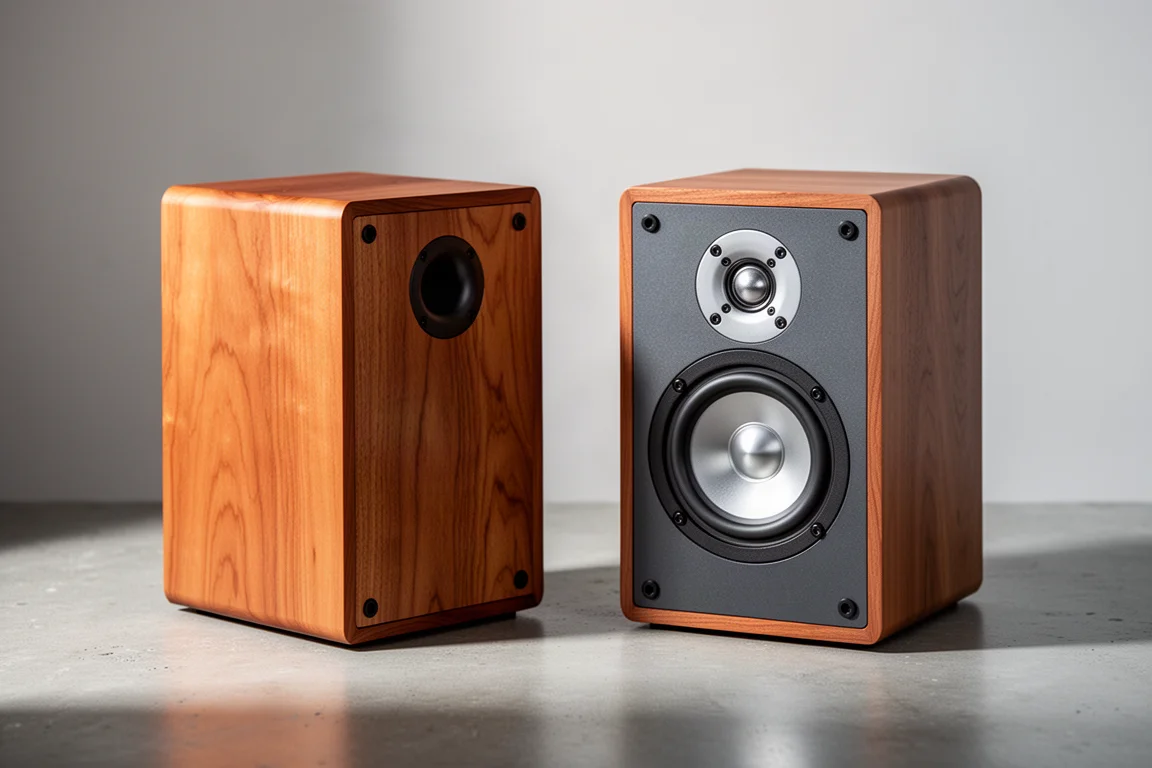
The Vanatoo Transparent One Encore is a compact powered speaker pair that sells for $600, and it comes from a small company whose engineers have spent their careers designing speakers. That background shows in the parts of the product most buyers never see: four dedicated amplifiers, a DSP stage tuned specifically for the cabinet, and a cabinet finished in real cherry veneer at a price where most competitors settle for vinyl wrap or paint.
The Encore is a digital-first design. It is aimed at computers, televisions, and games, and it carries a full complement of digital inputs plus a subwoofer output for 2.1 systems. If your listening happens at a desk or in front of a screen, this is one of the more compelling options at its price.
Who the Vanatoo Transparent One Encore Is For
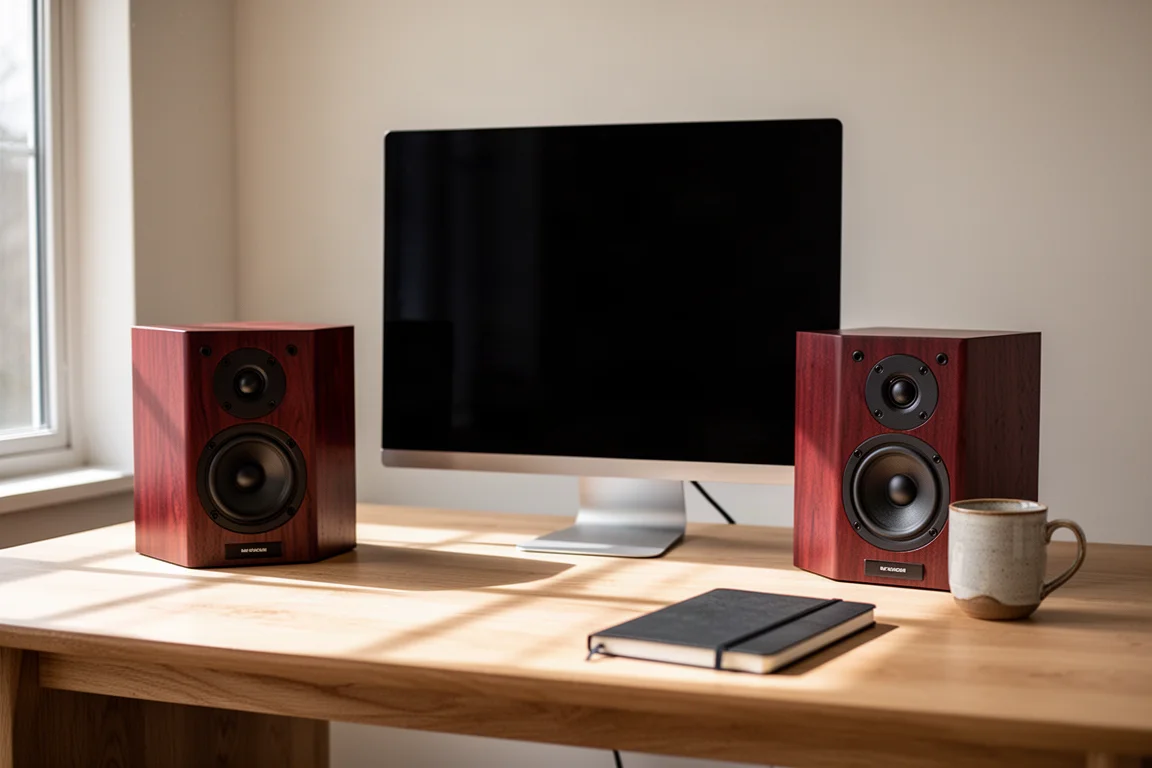
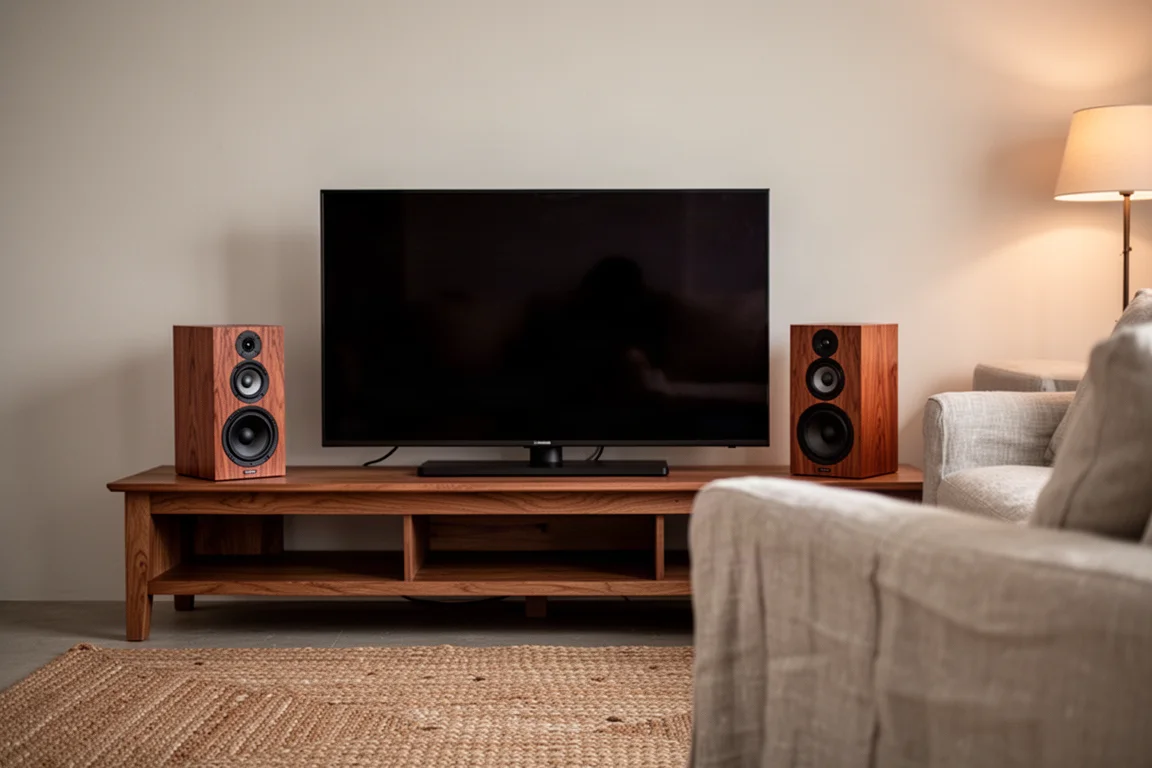
Two use cases stand out. The first is a soundbar replacement: a pair of these beside or under a television gives a proper stereo image instead of a single bar, and the subwoofer output makes it easy to add low end later. The second is a digital two-channel or 2.1 system on a desk or in a small room.
The physical size supports both. Each cabinet measures 10 inches high, 6.5 inches wide, and 7.5 inches deep, so they fit on a shelf, a desk, or a media console without dominating the space. Because the design uses a passive radiator rather than a port, the cabinets can sit close to a wall without the boominess that ported speakers often develop in tight placements.
Vinyl is possible, but with a caveat worth knowing up front. Analog input is a single 3.5 mm jack, so a turntable needs either a built-in phono stage or a separate phono preamp, plus an RCA-to-3.5 mm cable. Listeners who insist on 24-bit/192 kHz playback should also check the DAC section below, because this speaker tops out lower than that.
Design, Build, and Placement
The cabinet finish is the first surprise. The cherry surface is real wood veneer, not paint or a printed wrap, which is unusual for a powered speaker at this price. The enclosure walls are roughly three-quarters of an inch thick, and the result is a cabinet that stays quiet and resonance-free when the drivers are working hard.
The driver complement is a 5.25-inch aluminum woofer, a 1-inch aluminum dome tweeter, and a passive radiator mounted on the back. That passive radiator is the reason the low end can reach as deep as it does without a port, and it also makes the speaker less fussy about where it sits in a room.
Connectivity and Everyday Control
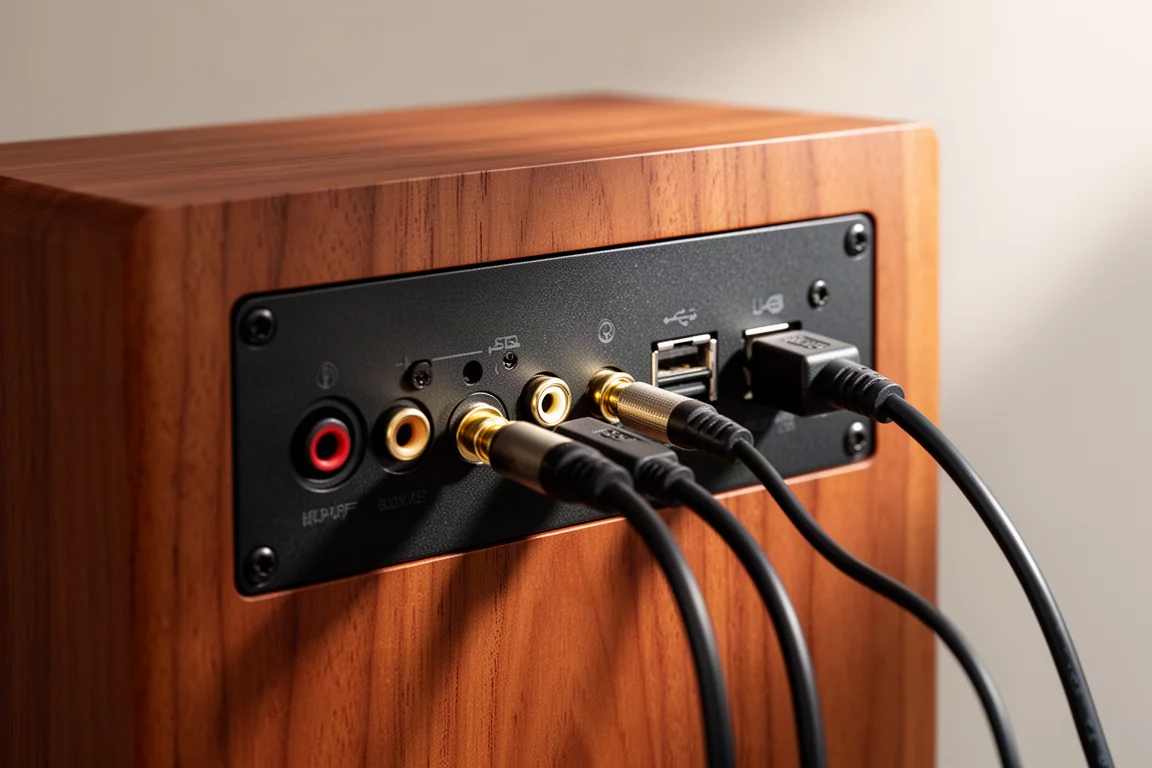
The rear panel is unusually complete for the category. There is a volume control plus separate treble and bass knobs, and each knob has a defined start, middle, and end rather than spinning endlessly, which makes repeatable adjustments easy.
Inputs and outputs cover most modern sources: a subwoofer output, a 3.5 mm analog input, a Bluetooth pairing button, a full-size USB input, an optical input, and a coaxial input. A small USB connection handles firmware updates. A switch lets you designate either cabinet as the left or right speaker, which helps when outlet placement decides the layout for you.
Two practical details are worth noting. The two cabinets connect through a four-pin proprietary cable, so a damaged cable means going back to the manufacturer for a replacement. The power cord is also fixed rather than detachable, which limits how easily you can swap in a longer cable; an extension cord works, but a removable cord would suit a product this polished.
The supplied remote is a genuine highlight. It covers Bluetooth, every input, tone controls with a reset to the middle, volume, and mute, and it uses an enable step so an accidental bump does not change a setting. The surface has a slight texture that keeps it from slipping out of your hand, and the button layout suggests it was designed specifically for this product rather than pulled from a catalog.
Bluetooth is included for quick wireless playback from a phone or tablet, and the tone controls remain available on whatever source you choose.
Sound Quality in Practice
Imaging and soundstage are the strongest technical arguments for the Encore. Small speakers tend to image precisely, and this pair does exactly that: instruments lock into place with pinpoint accuracy and lateral movement across the stage stays seamless. The presentation is more laser-focused than immersive, and the image sits largely on a single plane rather than rising tall the way a floorstander can, but within that plane it is remarkably accurate.
Bass is where the DSP work pays off. The Encore reaches down to 48 Hz at minus 3 dB, which is far deeper than the cabinet size suggests, and it delivers both weight and extension rather than one at the expense of the other. The trade-off is character: the low end is analytical rather than rich, so some of the texture and tone of an acoustic bass gets smoothed over even though the notes themselves are all there. For most listeners that is an easy trade for the depth on offer.
Midrange is clear and detailed without tipping into analytical. Female vocals come across as natural and unforced; male vocals are slightly less rich than the most natural-sounding speakers in this class, but the presence and intensity of a voice are never in question.
Treble is excellent, with the crisp character that aluminum dome tweeters are known for. At higher volumes that character can become a touch intense, and the tone controls are the fix: pulling the treble down a step keeps things comfortable. Even at louder levels the sound never became fatiguing.
Amplification and DSP Modes
Inside the system there are four Class D amplifiers: 100 watts for the woofers and 20 watts for the tweeters. That means the speakers are bi-amped out of the box, with separate amplification for each driver rather than a single amp split passively.
The DSP is doing more than adding a bass bump. Vanatoo calls the low-frequency processing Clear Bass, and it is the reason a cabinet this small can produce the depth described above. Two DSP modes change how the system behaves when a subwoofer is connected: a shelf mode that sets the low-pass crossover at 125 Hz for a fuller, more energetic sound, and a flat mode that moves the crossover down to 80 Hz for studio-style monitoring. Shelf mode suits casual listening and movies; flat mode suits critical work.

One specification will matter to some buyers: the internal DAC is limited to 24-bit/96 kHz, so 24-bit/192 kHz files will play, but not at their full resolution. An external DAC connected through the 3.5 mm input bypasses that limit entirely, which is a clean workaround for anyone with a large high-resolution library.
Things to Consider Before Buying
Four points are worth weighing before you commit.
First, the DAC ceiling. If bit-perfect playback of 24-bit/192 kHz material is a requirement, plan on an external DAC or look elsewhere.
Second, analog flexibility is limited. There is one 3.5 mm analog input, no RCA jacks, and no phono stage. A turntable and a CD player cannot both be connected through analog at the same time; a CD player with a digital output can still join the system through an optical or coaxial input, and an external phono preamp solves the turntable side.
Third, the fixed power cord and the proprietary four-pin cable between cabinets reduce your options for longer runs or easy replacement.
Fourth, the aluminum dome tweeter has a character of its own at higher volumes. The tone controls mitigate it, but the signature does not disappear completely.
Buying Advice
At $600 the Transparent One Encore competes with a crowded field of powered speakers, including options that cost less. The case for this one rests on engineering rather than price: bi-amped Class D amplification, DSP tuned to the cabinet, a resonance-controlled enclosure with real wood veneer, a full digital input set with a subwoofer output, and a remote that was clearly designed for the product.
Support matters here too. Vanatoo is a small company, and buyers deal with the people who designed the speaker rather than a large support queue, which is a meaningful advantage in a category where firmware, DSP modes, and setup questions come up.
If you want a television sound upgrade or a compact digital system that can grow into 2.1, the Encore fits the brief closely. If your priority is analog sources or the highest available sample rates, budget for the extra pieces described above or consider a different design.
Conclusion
The Vanatoo Transparent One Encore is a compact powered speaker pair that punches well beyond its cabinet size. Its strengths are deep DSP-assisted bass, precise imaging, a genuinely complete digital feature set, and a build that includes real cherry veneer and thick cabinet walls. Its compromises are a 24-bit/96 kHz DAC ceiling, a single 3.5 mm analog input, a fixed power cord, and treble that can run hot at volume.
For a soundbar replacement or a digital two-channel and 2.1 setup, those trade-offs are easy to live with. Buyers who need analog flexibility or full high-resolution playback should plan their accessories first, then decide.
Product link
View more details for Vanatoo Transparent One Encore
This product is mentioned in the review. Check the specifications, options, and compatibility before buying.
View more details for Vanatoo Transparent One EncoreFurther reading
Related Reviews
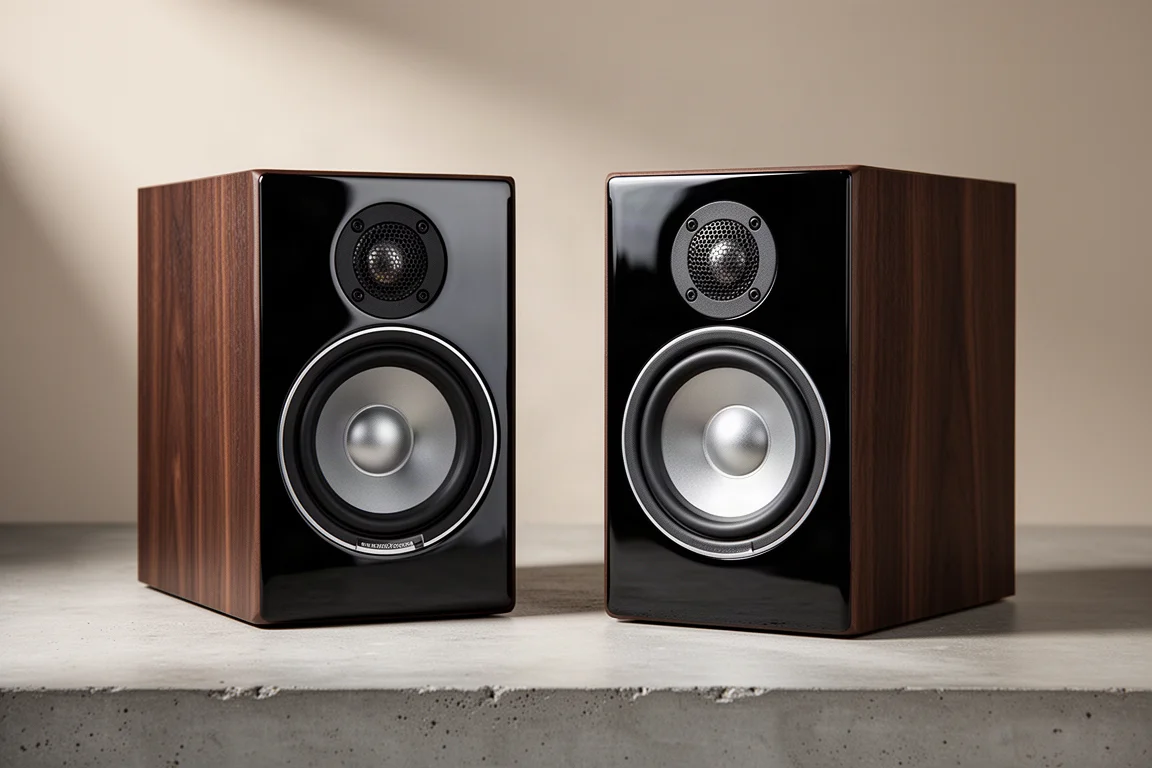
Powered Speakers
AbramTek X50 Review: Powered Speakers With Real Bass and a Full Feature Set
The AbramTek X50 pairs a phono preamp, HDMI ARC, optical, and Bluetooth with genuinely capable sound. Here is what it does well and what to check before buying.
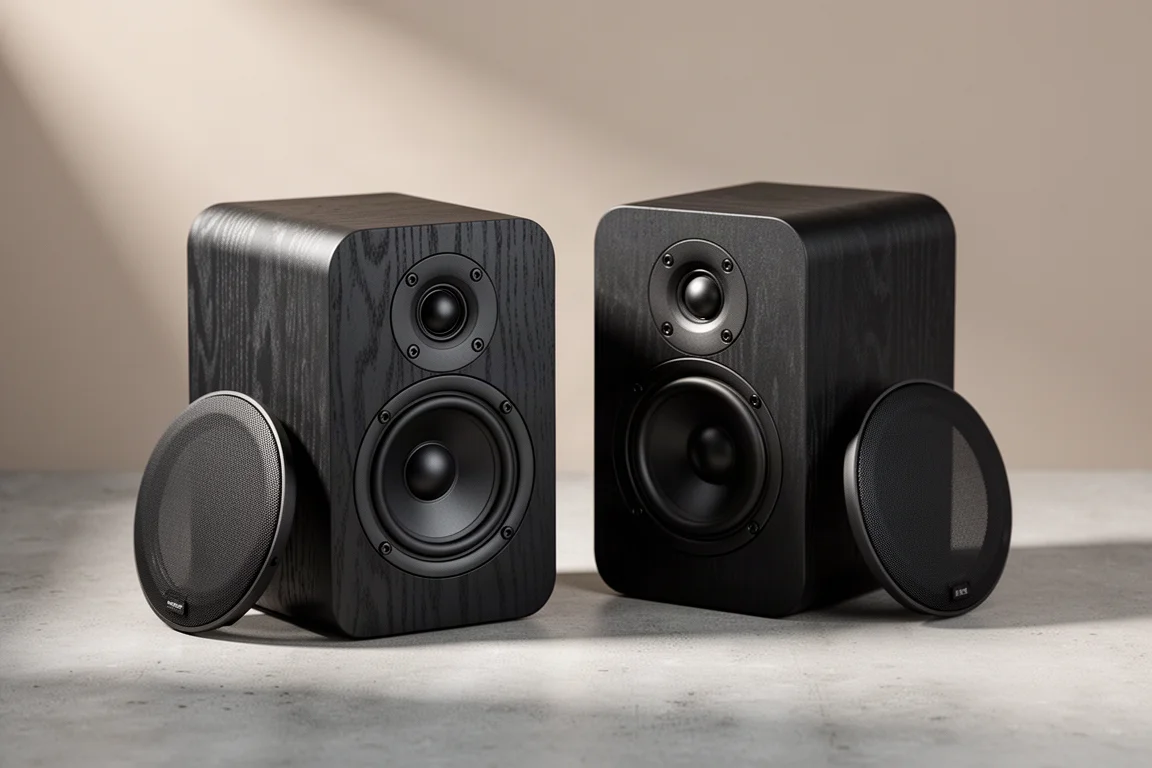
Powered Speakers
Amazon Basics Powered Speaker Review: Useful Features, Compromised Sound
A practical look at the Amazon Basics Powered Speaker: a handy remote and an optical input, held back by shouty upper mids, minimal bass, and erratic pricing.
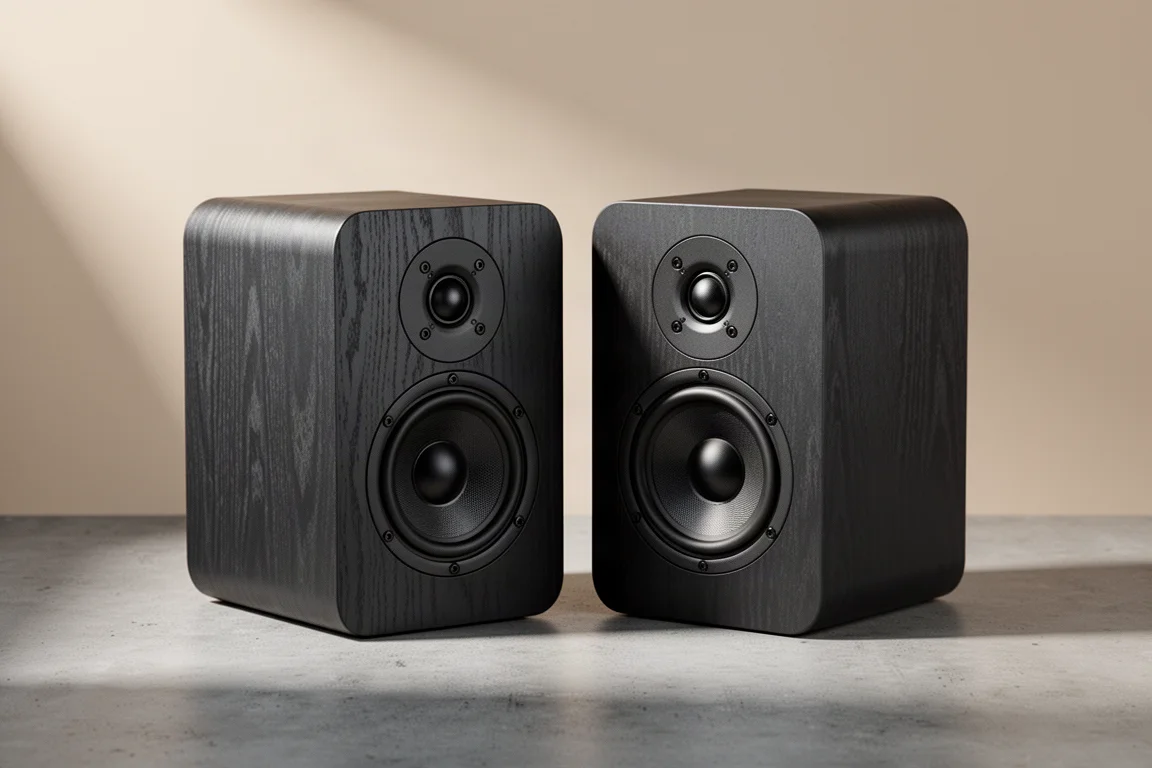
Powered Speakers
Aperion Audio Alaire Review: Compact Powered Speakers With Serious Bass
A compact two-way powered speaker with genuine low-end punch, excellent imaging, and a control scheme that depends entirely on its remote.