Sleeping Bags
U.S. Forestry Service Firefighters Sleeping Bag Review: A 1980 Surplus Bag That Still Earns Its Place
A 1980 U.S. Forestry Service firefighters sleeping bag with a 30°F comfort rating, a convertible shell and a used price around $40 to $50. Here is what to check before you buy one.
Introduction
Military surplus gear often looks like a bargain until you try to live with it. The U.S. Forestry Service firefighters sleeping bag is the other kind of surplus find: a genuinely practical piece of kit that was built for working crews and still does its job decades later.
This bag was fielded in 1980 and produced by Tenor Industries, a military contractor, to military specifications and with military materials. A military version followed in 1981, and the two share the same basic design. The bag carries a stock number, 8465011, which makes it easier to trace what you are actually buying. It was designed as an intermediate cold weather sleeping system, with a 30°F comfort rating and a 20°F push rating.
What makes it interesting today is the combination of price and capability. Used examples typically sell for around $40 to $50, and the design includes a handful of genuinely useful features that plenty of modern budget bags leave out.
Who This Sleeping Bag Is For
This is a car camping and truck camping bag first. At four pounds it is not heavy by surplus standards, but packed size is the real story. Stuffed into a large storage bag it measures roughly 19 inches by 10 inches by 10 inches, and the older polyester insulation does not compress much beyond that. Backpackers should look elsewhere. Anyone who drives to camp, keeps gear in a vehicle, or wants a spare bag for guests and emergencies will find that trade-off easy to accept.
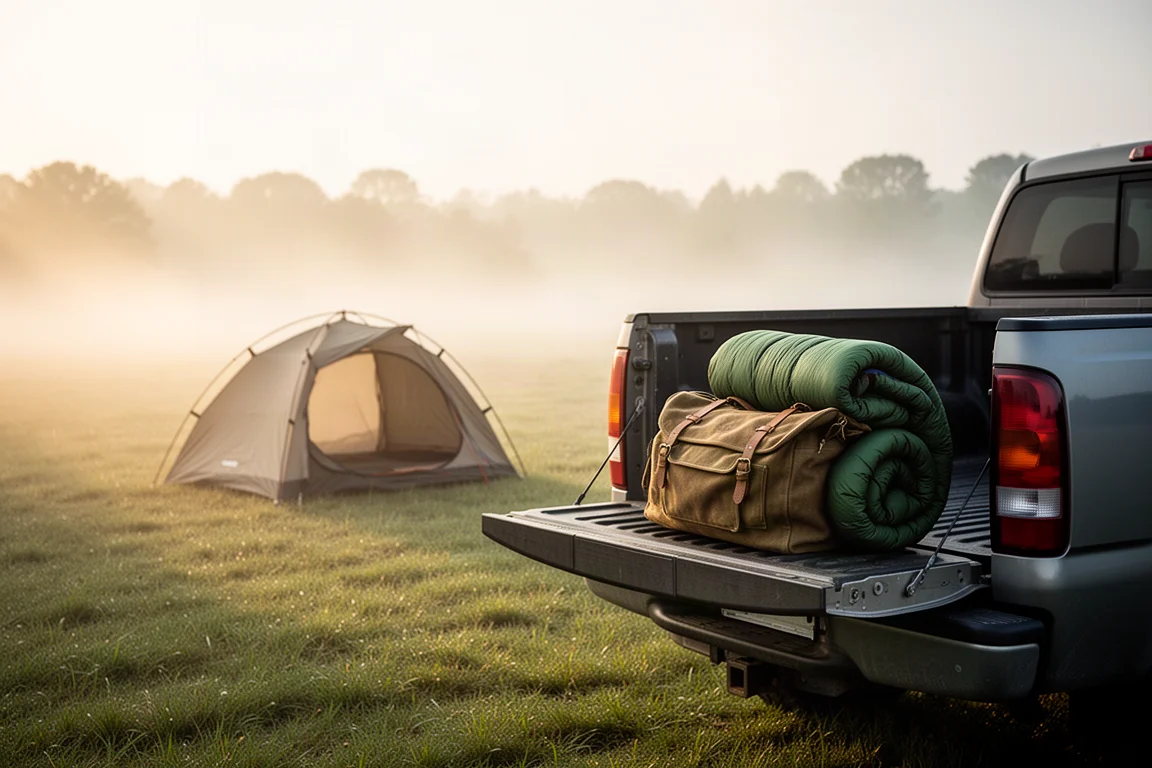
It also makes sense as an inexpensive first sleeping bag for a scout, a new camper, or anyone who needs something warm and cheap without shopping for a premium brand. The bag is 80 inches long from the foot to the tip of the hood, 26 inches wide at the shoulders, and tapers to 22 inches, which is roomy enough for most adults.
Main Strengths
The temperature rating is the headline: 30°F for comfort with a 20°F push. Treat the 30°F figure as realistic when you wear layered clothing, with comfort closer to 40°F in light clothing such as shorts and a t-shirt. That makes it a genuine three-season option for mild and cool weather rather than a deep winter bag.
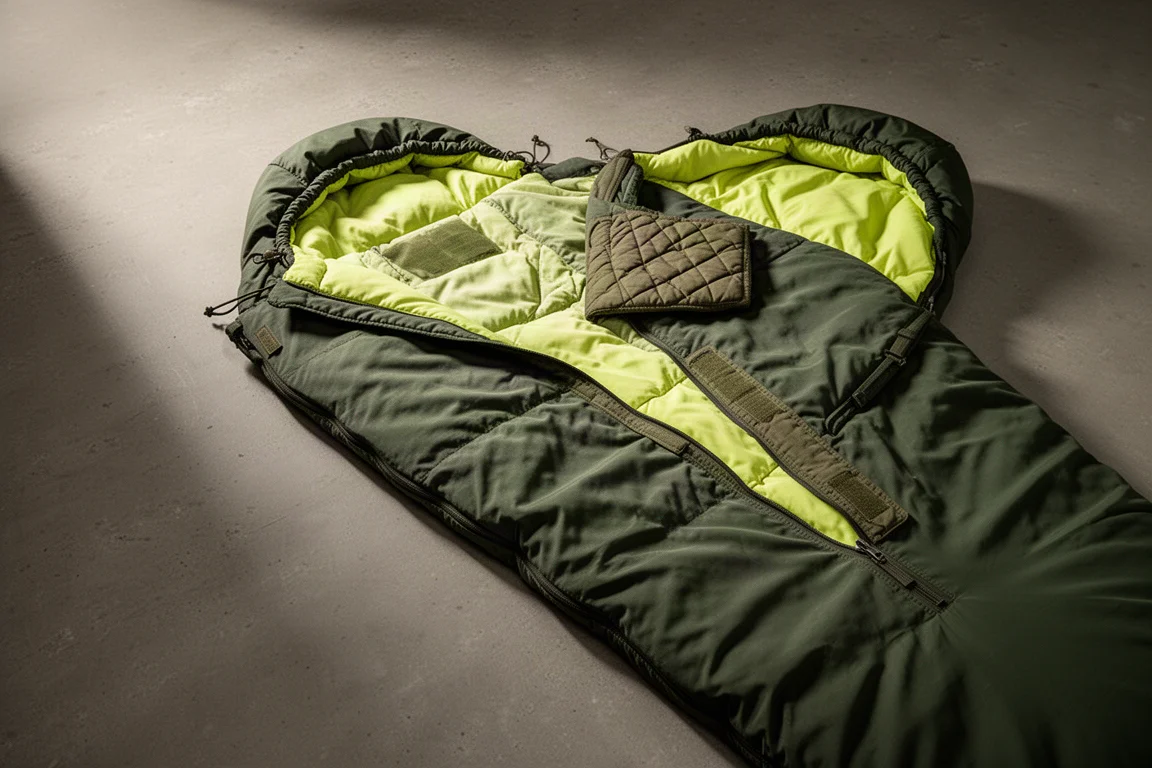
The shell is convertible, which is unusual at this price. Turn the bag inside out and you can choose which fabric faces outward. With the forest green nylon on the outside you get a low-key look around camp. With the high-visibility neon yellow-green facing out you get a bright surface that is easy to spot. Flipping the shell also moves the draft collar: it sits inside with the yellow side out, and outside with the green side out, where it lays across the zipper.
The rest of the feature list is practical rather than decorative. A full-length YKK zipper runs all the way around the bag and lets it open completely flat as a blanket for warmer nights. A second zipper at the foot lets you vent your feet if you get too warm. Two compression straps at the foot end allow you to roll the bag and tie it off. The hood has a center drawcord so you can pull it around your head and turn the bag into a mummy shape, and a velcro tab connects the body of the bag to the hood.
Build Quality and Materials
The shell is nylon inside and out, with polyester insulation, and the bag was built to military specifications rather than to a consumer price point. The label identifies it as a general purpose synthetic filled sleeping bag made in 1980, and it lists care instructions alongside the manufacturer and the stock number.
What stands out most is how well the materials have held up. A bag produced in 1980 that still shows no structural issues is a strong argument for surplus gear, provided the individual example you buy has been stored reasonably well. The zipper, the velcro tab, and the hood all contribute to a build that feels purposeful rather than cheap.
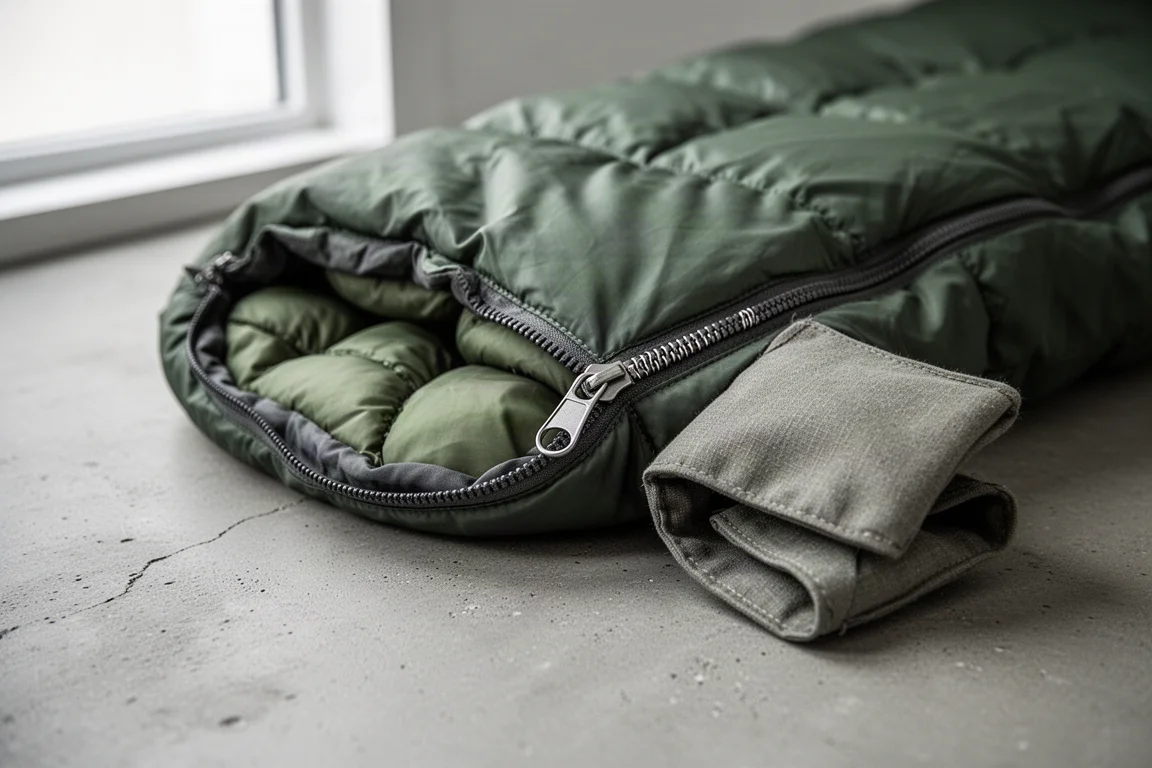
The design also reflects where it came from. It was made for forestry crews who needed one bag to cover a wide range of conditions, and the convertible shell, the blanket mode, and the venting zipper all come directly from that requirement.
Things to Consider Before Buying
Bulk is the biggest compromise. The bag does not compress, and no compression or storage bag was included with the original product, so you will need to supply a large one yourself. Even then it stays big. For a car or a truck that is fine. For anything carried on your back, it is not.
Compatibility claims deserve scepticism. This bag predates the modular sleep system used by the U.S. military today, and it is not the intermediate bag for that system. It does not use the same snaps or the same hardware, so it will not interconnect the way the actual intermediate bag does. Listings that suggest otherwise are describing the bag inaccurately.
The colors are the standard U.S. Forestry Service scheme, and they are a matter of taste. The exterior is a true forest green rather than olive drab, and the interior is a bright neon yellow-green. That lining is genuinely useful in practice, because a phone, a battery bank, or a pair of glasses stands out against it instead of disappearing into a dark bag.
Finally, remember that these are surplus items. Condition, completeness, and the presence of a storage bag vary from one listing to the next, so the individual example matters more than the model name.
Care, Storage, and Packability
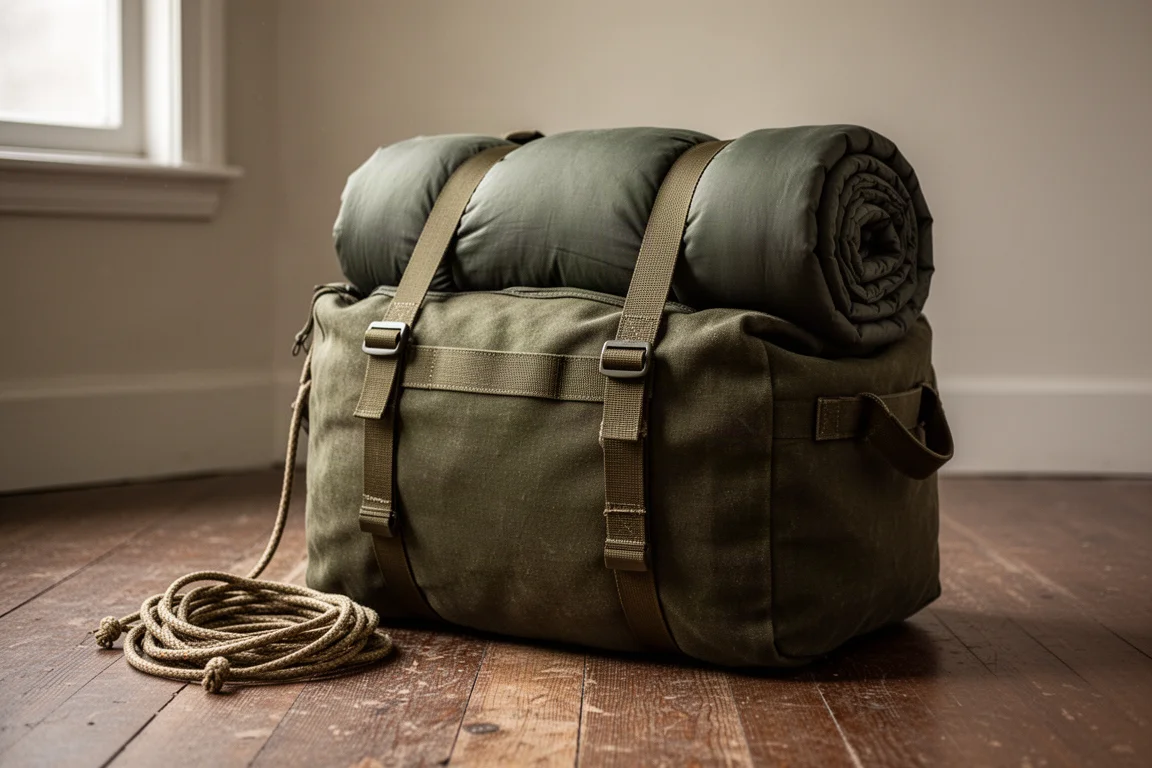
Plan on buying a large storage bag unless the listing you choose includes one. A stuffed size of roughly 19 by 10 by 10 inches means a standard compression sack will not do the job, and the bag is already at its limit in a generously sized bag.
The two compression straps at the foot end are the practical answer. Roll the bag from the hood down, cinch both straps, and it becomes a manageable bundle you can tie off and carry or store. Because the insulation is older polyester, it does not spring back the way modern synthetics do, so treat this as a bulky item that lives in a vehicle or a gear bin rather than something you stuff into a pack.
The sewn-in label carries care instructions, which is useful for a bag this old. Because the shell can be turned inside out, airing the bag between trips is straightforward.
What This Bag Costs and Where to Find It
Used examples generally run about $40 to $50, and new or unissued examples around $70. Military surplus retailers list it as well, with at least one site pricing it near $40. The military version sells in the same range, so there is little reason to pay a premium for one over the other.
The modular sleep system used by the U.S. military today is worth keeping in mind as a price reference, since its components can be bought individually at low prices. That competition is a good reason to stay disciplined: around $55 is a sensible ceiling for the forestry bag in good used condition, and $70 or more is hard to justify for a bulky synthetic bag with no storage sack. Listings asking around $130 are far outside what this bag is worth.
Availability comes and goes on auction sites and military surplus retailers, so it pays to watch listings rather than buy the first one you see.
What to Verify Before You Buy
Start with the stock number. A genuine example carries 8465011 on its label, along with the manufacturer and the 1980 production date. That label is the simplest way to confirm what you are looking at.
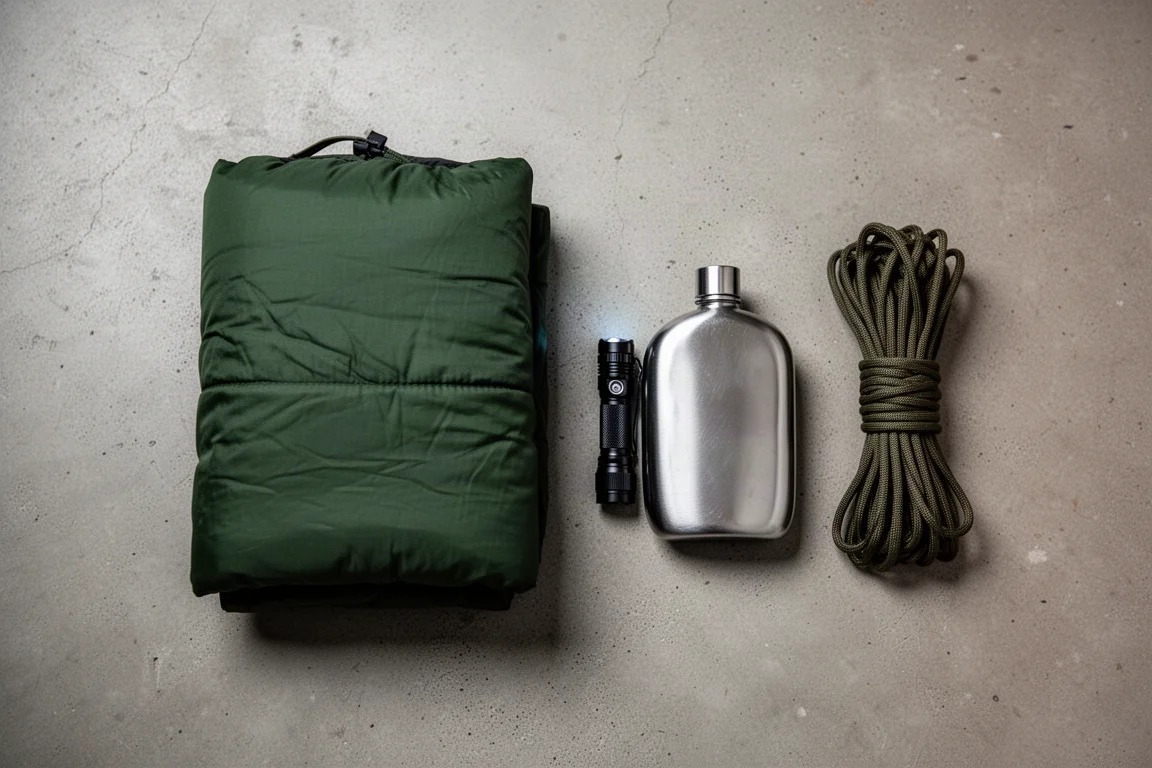
Then check the details that matter on a used bag. The zipper should run smoothly around the full length and down to the foot vent, the velcro tab should still hold the hood in place, and the hood drawcord should be intact. Ask whether a storage bag is included, since the original did not come with one.
Finally, be sceptical of any listing that claims modular sleep system compatibility. The hardware does not match, so that claim tells you more about the seller than about the bag.
Conclusion
For around $40 to $50 used, the U.S. Forestry Service firefighters sleeping bag delivers a 30°F comfort rating, a full-length zipper that opens into a blanket, a convertible shell with a high-visibility lining, and construction that has survived more than four decades of storage and use. It is bulky, it is not a backpacking bag, and it needs a storage bag you will probably have to buy separately.
For car camping, truck camping, emergency kits, and inexpensive starter gear, those compromises are easy to live with. Check the label, inspect the zipper and hood, ignore compatibility claims, and keep your budget near $55. At that price this is one of the more sensible pieces of surplus gear you can put in a vehicle.
Product link
View more details for U.S. Forestry Service Firefighters Sleeping Bag
This product is mentioned in the review. Check the specifications, options, and compatibility before buying.
View more details for U.S. Forestry Service Firefighters Sleeping BagFurther reading
Related Reviews
Sleeping Bags
Best Down Sleeping Bags Under $300: Four Backpacking Options Worth a Look
Four down sleeping bags that stay under $300, compared on fill power, baffle design, hood comfort, and packed size.
Sleeping Bags
Best Sleeping Bags and Sleep Systems: Five Premium Down Picks Compared
Five premium down sleeping bags and sleep systems compared on warmth, weight, construction, and value.
Sleeping Bags
Big Agnes Lost Ranger UL 3-in-1 Sleeping Bag System Review: One Bag, Three Setups
A practical look at the Big Agnes Lost Ranger UL 3-in-1 Sleeping Bag System, covering how the three configurations work, where it shines, and the details worth weighing before buying.