Bookshelf Speakers
Totem Acoustics KIN One Review: Big Sound From a Very Small Speaker
A compact two-way standmount with a wide soundstage and bold finishes, plus the placement and EQ it needs to sound its best.

Introduction
Small speakers usually ask you to accept a compromise. The Totem Acoustics KIN One is a compact two-way standmount that tries to make that compromise a little more appealing, and it does so with a finish palette that stands out immediately. The review unit is pink, and the KIN One is also offered in white, black, orange and teal. For anyone tired of black and white boxes, that alone is worth noting.
Under the grille it is a two-way design: a 1 inch titanium-infused soft dome tweeter crossed to a 4 inch mHex cone woofer. Power handling is rated at 20 to 100 watts, impedance is specified at 6 ohms, and each speaker weighs roughly 6 lb, or about 3 kg. Totem lists sensitivity at 89 dB.
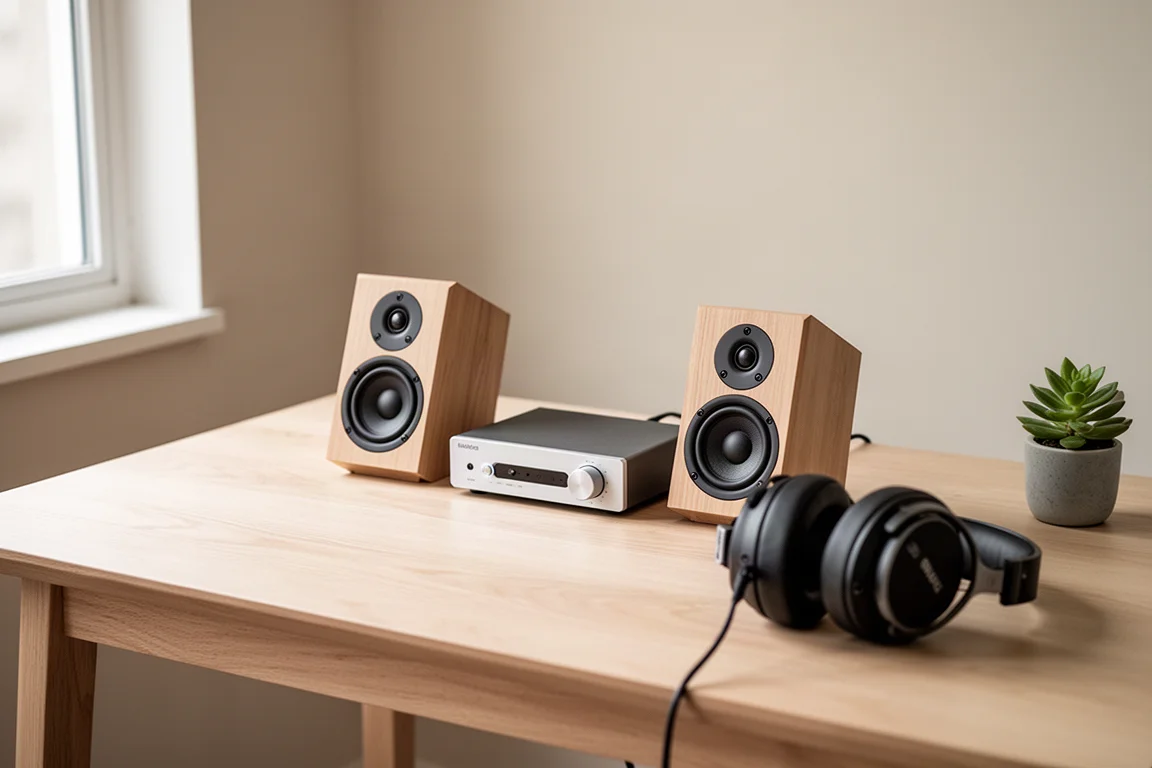
The short version is that the KIN One is a characterful speaker rather than a neutral monitor. It leans back on its own so it can sit on a desk and point up toward your ears, which is a genuinely thoughtful touch for nearfield use, and it produces a wider soundstage than its dimensions suggest.
Who the KIN One Is For
This is a speaker for listeners who value personality over flatness. Its strongest case is desktop and small-room use, where a compact cabinet and a slight upward tilt toward the listener make a real difference to how the sound arrives.
It is also a natural fit for a first proper two-channel system built around a small amplifier. The 6 ohm impedance and 20 to 100 watt power rating mean it does not demand an enormous amplifier to get going, and its wide horizontal dispersion helps it fill a modest space without precise room treatment.
Listeners who want a reference-flat response, deep bass from a standmount, or high output for a large room should look elsewhere. The KIN One is small in the literal sense, and it does not pretend otherwise.
Design and Build Quality
The KIN One is genuinely tiny. Set beside other compact standmounts it reads as a much smaller object, closer to a desktop speaker than a traditional bookshelf model. Each cabinet weighs about 6 lb, which makes placement and repositioning easy.
The angled baffle is the detail that shapes everything else. Because the cabinet leans back, a pair placed on a desk fires slightly upward rather than straight ahead, lining the tweeter up with seated ear height without a stand. The rear-ported cabinet also means the wall behind the speaker becomes part of the tuning.

The finish options are a real part of the appeal. White, black, orange, teal and pink cover a much wider range than the usual two choices, and the pink sample looks deliberate rather than novelty. It is the kind of speaker that reads as furniture in a good way, which matters if it is going to live on a desk or a shelf.
Sound Character and Measured Performance
Subjectively, the KIN One throws a big sound. Horizontal dispersion is wide, on the order of plus or minus 75 degrees through the midrange, and that is where the sense of spaciousness and envelopment comes from. The vertical window is much narrower, so listening height matters more than it usually does.
Tonally, the speaker has its own balance. There is a mild dip through the midrange and upper midrange, roughly in the 600 Hz to 1 kHz region, while the upper midrange and lower treble sit a little forward. A resonance appears near 800 Hz, most likely from the rear port, and it can make the presentation sound slightly hollow. Treble also rolls off early, around 8 kHz, which costs some air and presence at the top end.
Measured sensitivity came in around 83.4 dB, well below the 89 dB specification. Bass extension is limited by the 4 inch woofer: F3 sits near 91 Hz and F10 near 59 Hz, with in-room extension to roughly 80 Hz.
Distortion behaviour is reasonable for the driver size. The speaker stays clean up to roughly 86 dB, but at 96 dB at one metre things begin to change, with distortion that looks crossover related and rising low-frequency distortion. Multi-tone distortion is relatively high, which is expected from a 4 inch midwoofer rather than a sign of a faulty design. Dynamic range tops out around 26 dB at the highest output levels.
Living With the KIN One: Placement, Power, and EQ
Placement has a clear starting point. Totem recommends roughly 12 inches, or about one third of a metre, from the wall behind the speaker. Pull them further out and the bass rolls off quickly; push them much closer and the low end can sound bloated. A foot of clearance is a sensible place to begin.
Aiming is the other lever. Because the top octaves fall away above 8 kHz, pointing the speakers toward the listening position helps. If the resulting angles look awkward in the room, toeing them outward and using EQ to bring the mid and upper treble down to match the attenuated top end keeps the balance smoother.
A small integrated amplifier with app-based EQ transforms what this speaker can do. Four bands of parametric adjustment are enough to lift the midrange dip, flatten the upper treble, and, if desired, add a little energy above 8 kHz. It is the difference between a speaker that sounds pleasant and one that sounds dialled in.
Adding a subwoofer crossed over around 80 Hz is the other meaningful upgrade. It removes the low-frequency burden from the 4 inch woofer, which lowers midrange distortion and improves resolution and detail in the range where most music lives.
Things to Consider Before Buying
The KIN One is not a linear speaker, and no amount of positioning will change that. If you want a flat response straight out of the box, this is not the right tool.
It is also a genuinely small speaker. It does not play loudly, and it will not fill a large room with bass. Sensitivity is lower in practice than the specification suggests, so amplifier headroom is worth thinking about before you commit.
Finally, the rear port and the early treble roll-off make the KIN One more placement sensitive than a sealed or front-ported design. Buyers who cannot leave roughly a foot of space behind the speakers, or who cannot angle them toward the listening position, will get noticeably less out of them.
Buying Advice
The KIN One makes the most sense as part of a deliberate small system. Pair it with a compact amplifier that offers a few bands of EQ, place it about a foot from the wall, aim it at your ears, and consider a subwoofer crossed over near 80 Hz. Do that and the speaker delivers a wide, enveloping soundstage that is far bigger than its cabinet.
Skip it if you need high output, deep bass from the speakers alone, or a neutral tonal balance with no adjustment. The KIN One rewards the listener who is willing to tune it rather than the one who wants to plug it in and forget it.
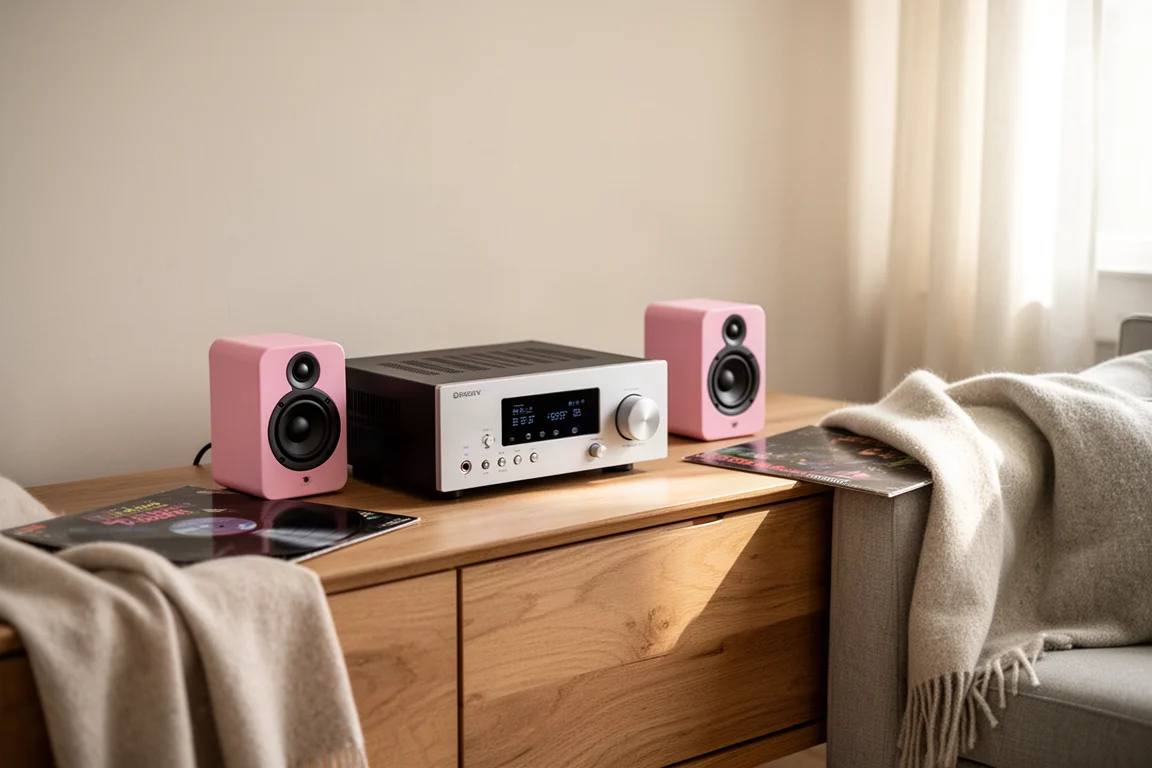
The colour range is a genuine bonus rather than a gimmick. A speaker that looks this good in a room is more likely to be used, and once it is set up properly the KIN One is easy to live with day to day.
Conclusion
The Totem Acoustics KIN One is a small speaker with a strong point of view. Its wide horizontal dispersion and its bold finishes make it stand out, while its midrange dip, early treble roll-off and limited bass extension mean it needs thoughtful placement and a little EQ to sound its best. For a desk or a compact room, and for a listener who enjoys tuning a system, it is a compelling little speaker.
Product link
View more details for KIN One
This product is mentioned in the review. Check the specifications, options, and compatibility before buying.
View more details for KIN OneFurther reading
Related Reviews
Bookshelf Speakers
Acoustic Energy A100 Mark II Review: A Compact Standmount With an Expansive Soundstage
The Acoustic Energy A100 Mark II brings clarity, natural tonality and a wide soundstage to an entry-level standmount, with a few setup details worth knowing first.
Bookshelf Speakers
Acoustic Energy AE-100 Mark II Review: Compact Bookshelf Speakers With Standout Imaging
A compact British two-way bookshelf speaker with deep, layered imaging, fast bass, and a slight treble lift to weigh against a crowded $500 field.
Bookshelf Speakers
Acoustic Energy AE100 MK2 Review: Measured Performance and Four Alternatives
A close look at the Acoustic Energy AE100 MK2 bookshelf speaker, what its measured performance reveals, and four alternatives with different trade-offs.