Bookshelf Speakers
Acoustic Energy AE-100 Mark II Review: Compact Bookshelf Speakers With Standout Imaging
A compact British two-way bookshelf speaker with deep, layered imaging, fast bass, and a slight treble lift to weigh against a crowded $500 field.
Introduction
The Acoustic Energy AE-100 Mark II is a compact two-way bookshelf speaker from a British manufacturer with a long history in affordable hi-fi. For years it sat largely out of reach for listeners in the United States. It is now sold in the Americas at around $500, while the same speaker has sold in the United Kingdom for roughly 260 pounds. That transatlantic gap is familiar to anyone who follows this corner of the market: British brands cost more in the States, just as American brands cost more in Europe.
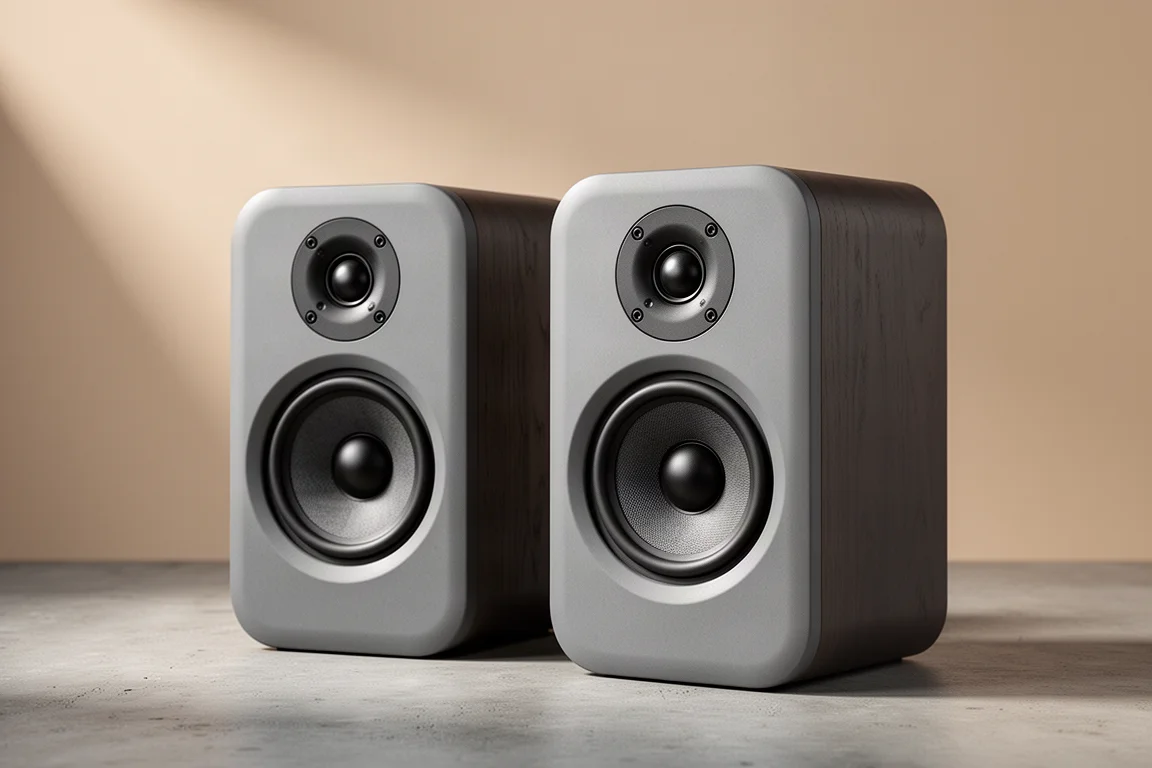
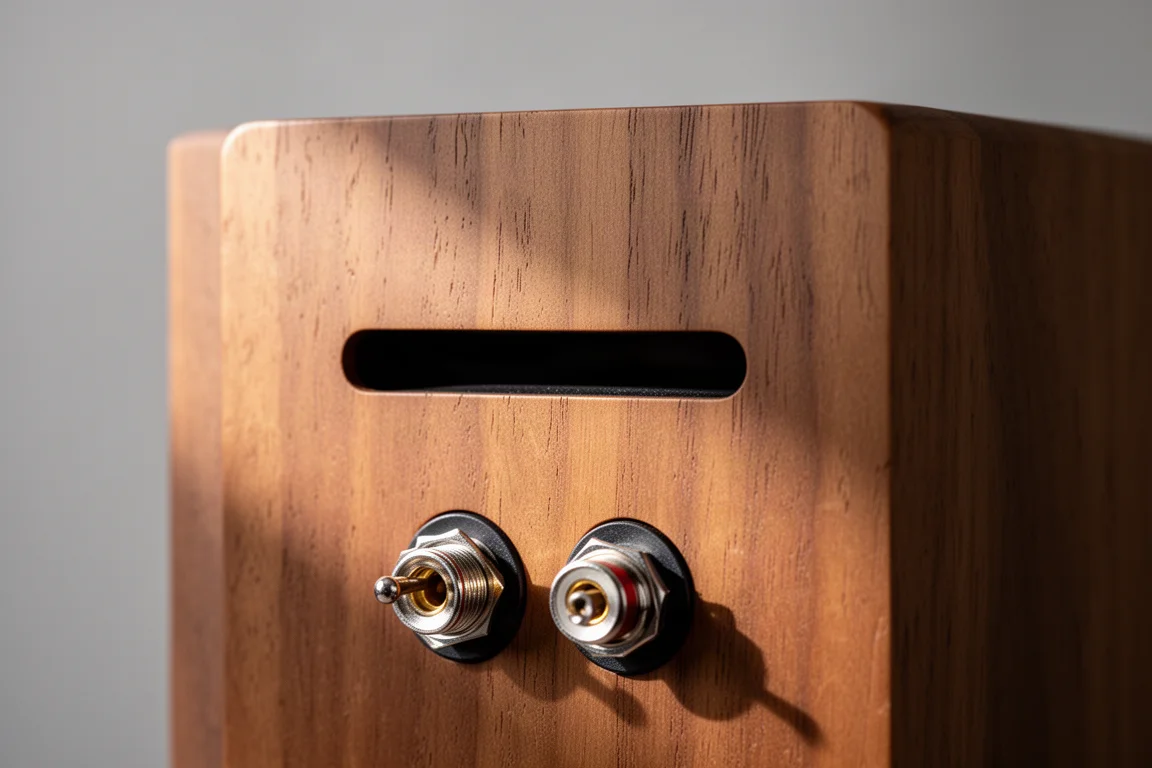
The cabinet itself is small. The AE-100 Mark II pairs a 5.25-inch woofer with a 1-inch soft dome tweeter positioned close to the woofer, a layout that nudges the design toward point-source behaviour. A slot port sits on the rear panel above a set of binding posts, and the cabinet uses softly rounded corners rather than hard edges. Acoustic Energy builds the enclosure from HDF rather than the more common MDF, a material choice associated with lower resonance and a stiffer, less lively cabinet.
This article walks through what the AE-100 Mark II does unusually well, where it asks for a little patience, and whether it earns a place at its US price against a very crowded field of $500 bookshelf speakers.
Who the Acoustic Energy AE-100 Mark II Is For
This is a speaker for listeners who care most about imaging, clarity, and a well-defined soundstage, and who are working in a small to medium room. It suits nearfield and desktop setups particularly well, and it works happily in a straightforward two-channel system fed by an integrated amplifier or a home theatre receiver running in stereo.
It is less suited to very large rooms where high output is the priority, and less suited to listeners who want a thick, warm, bass-forward presentation. The AE-100 Mark II is not a warm speaker, and it is not designed to be one.
Design and Build Quality
The specification sheet is simple and conventional in the best sense. A 5.25-inch woofer handles the lower registers, with a 1-inch soft dome tweeter mounted close by to keep the two drive units behaving more like a single source. Acoustic Energy reports low-frequency extension down to around 51 Hz, and the crossover sits at roughly 2,900 Hz. That is a fairly high crossover point for a soft dome tweeter, which means the woofer carries the vast majority of the midrange. In practice that choice pays off, because there is no audible tonal shift as the signal hands over from one driver to the other.
Around the back, a slot port handles bass tuning, and the binding posts sit below it. The rounded cabinet corners are a small detail that suggests a little care went into the enclosure, and the HDF construction gives the speaker a solid, dead feel when you knock on the side panel. For a compact cabinet, that matters: less cabinet resonance means less colouration smeared across the midrange.
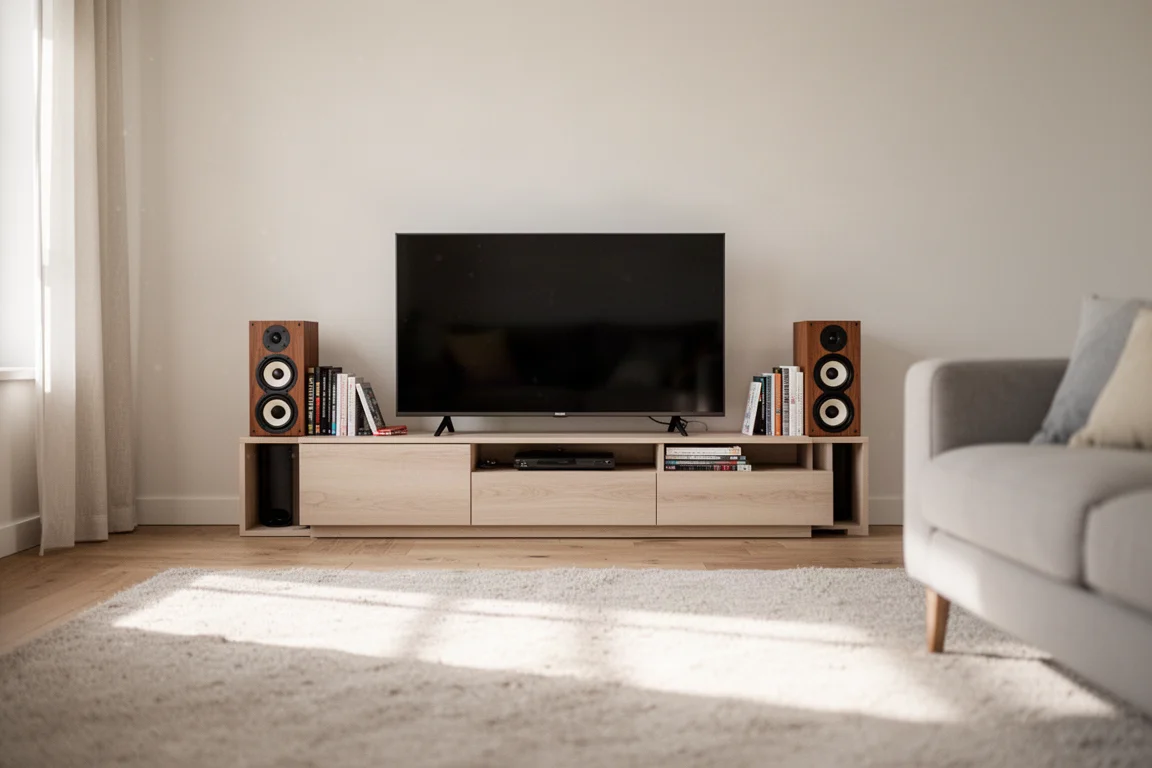
The compact footprint is one of the speaker’s quiet advantages. It is easy to place on a desk, a sturdy shelf, or a modest stand, and it will not dominate a small room. Because the port fires rearward, it does want a little space behind it, which is worth planning for before you commit to a shelf position.
Soundstage and Imaging
Imaging is the headline. The AE-100 Mark II throws a stage that extends well beyond the outer edges of the cabinets, with layers of depth that stay stable rather than collapsing into a flat plane. Individual instruments lock into place and stay there. Compared with the original ELAC Debut B6, a speaker long respected for this exact quality, the AE-100 Mark II goes further on both image precision and the sense of front-to-back depth.
The design explains part of it. Getting the tweeter close to the woofer encourages the two drivers to behave as a near point source, and that usually translates into a cleaner, more coherent stage. A good deal of it also comes down to the cabinet and the crossover work, because a speaker with a ragged midrange simply cannot image this cleanly.
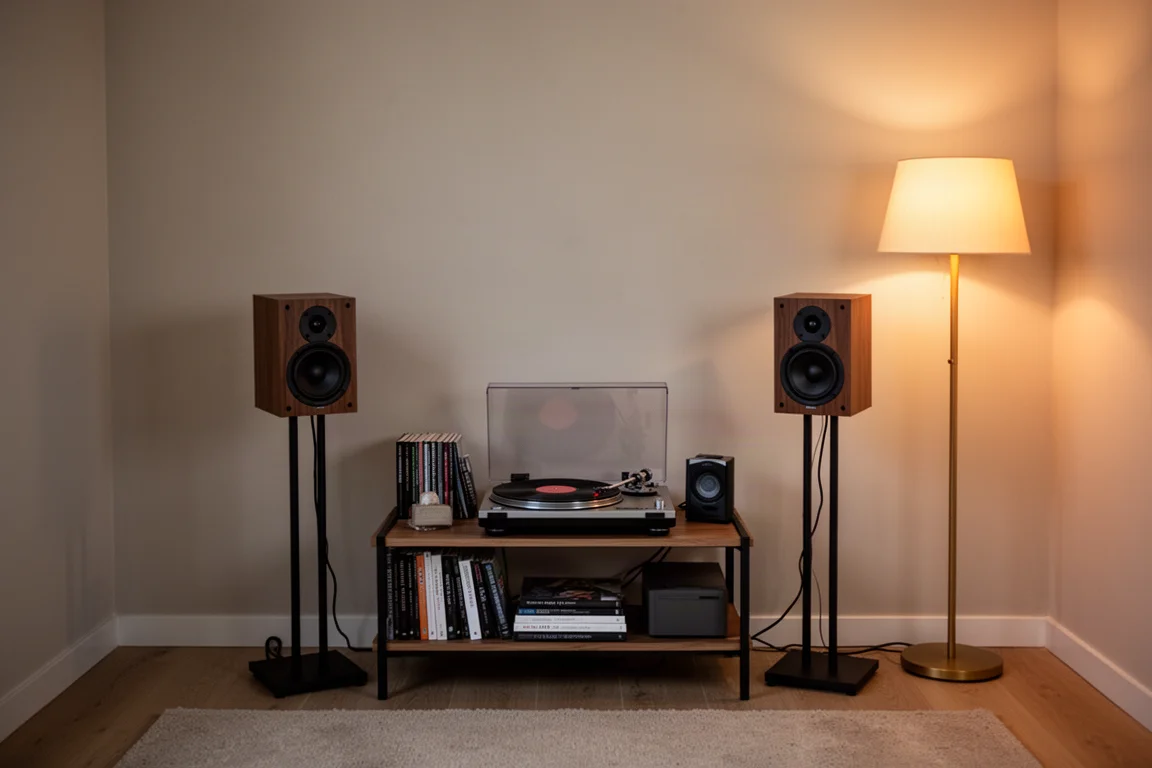
Placement matters more than usual here. In a large room, pushing the speakers close to the wall for a bit of bass reinforcement made the stage feel oddly shaped. Pulling them further out, with reasonably symmetrical side boundaries, restored the focus and let the imaging do what it does best. If you have the room to give them a little breathing space, take it.
Bass, Midrange, and Dynamics
Acoustic Energy rates the low end at around 51 Hz, and British manufacturers in this price bracket tend to be conservative with that number. On listening, the AE-100 Mark II sounds like it reaches lower than the figure suggests. The bass is full, extended, and quick, and it is not warm or overripe in character. It also does not smear the rest of the range, which is the more important point.
Dense, fast material with relentless kick drum work is a genuine test for a small cabinet, and the AE-100 Mark II keeps up far better than its size implies. Bass lines come through plucky and deep, clearly separated from everything else rather than baked into a single undifferentiated low-end blob. Instrument separation across the board is excellent, and that clarity is arguably the speaker’s core virtue.
The midrange is clean, defined, and slightly cool in balance rather than lush. Acoustic guitar strings have texture and bite; vocals sit clearly in the mix, a touch stepped back but never recessed enough to feel distant. There is no tonal discontinuity between the woofer and the tweeter, which is a common failing in two-way designs and a real achievement here. If the midrange leans anywhere, it leans a little cool, and that is a familiar trade-off for a speaker that prioritises detail.
Dynamics hold together well at realistic listening levels. Played from around 75 dB up to a little north of 80 dB, the AE-100 Mark II stays composed and does not get shouty, which is not something every compact speaker manages. Above roughly 85 dB it becomes noticeably more forward and in your face, so this is a speaker to enjoy at sensible volumes rather than to push to party levels in a big room.
Treble Character and Sibilance
The treble is where the AE-100 Mark II asks for the most understanding. There is a mild lift somewhere in the 4 to 6 kHz region. The practical result is that cymbals can sound a touch hot, and certain recordings will show a little sibilance on vocal consonants. A tambourine on a busy rock track comes through with startling separation and cleanliness, but also with a hint of extra spice.
Whether that is a problem depends entirely on where a lift sits in the frequency range. A bump down around 1,800 Hz to 2 kHz would be much harder to live with, because that region sits right in the heart of the midrange and colours everything. A gentle emphasis higher up, in the 4 to 6 kHz area, is far easier to accept, and it tends to read as detail rather than as coloration.
Even notoriously sibilant material stays reasonably controlled. The lift is audible, but it does not tip into harshness or turn a bright recording into an unpleasant one. For listeners who like a little extra bite and air at the top, this will read as a strength rather than a flaw. For listeners who prefer a silky, rolled-off treble, it is worth hearing the speaker first if you can.
Things to Consider Before Buying
The AE-100 Mark II lands in one of the most competitive price bands in hi-fi. At around $500 in the United States, it sits alongside the ELAC Debut B2 Plus at a similar price, the SVS Prime Bookshelf at roughly $600, the Polk R100, the Wharfedale Diamond 12.2, the KEF Q350 when it is discounted, and the Wharfedale Denton 80th Edition. These speakers do not all sound alike, and the differences are meaningful rather than cosmetic.
Two practical points are worth weighing. First, build quality in this group is not uniform: the Wharfedale Denton 80th Edition is notably more substantial in construction than most of its rivals here, including the Acoustic Energy. Second, the mild treble lift means system matching has some influence. A bright amplifier paired with a bright recording will compound the emphasis, while a neutral or slightly relaxed source will keep things balanced.
Placement is the other consideration. The rear slot port and the way the soundstage behaves near boundaries mean these speakers reward a little experimentation. If your room only allows them pushed tight against a wall, the stage may not develop the way it should.
Finally, availability is still developing in the United States. Retailer coverage is not yet as broad as it is for the long-established names in this category, so it is worth confirming stock and support before ordering.
Buying Advice
Buy the Acoustic Energy AE-100 Mark II if imaging and clarity are what you value most, if you listen in a small to medium room, and if you can give the speakers a little space behind and beside them. At around $500 it delivers a level of soundstage depth and image precision that is genuinely rare, and it does so with a neutral, exciting balance rather than a warm, forgiving one.
Look elsewhere if you need high output in a large room, if you prefer a warm and rounded tonal signature, or if build heft and cabinet mass are high on your list of priorities. In that last case, the Wharfedale Denton 80th Edition is the more substantial piece of furniture. If you can audition the AE-100 Mark II against one or two of its direct rivals in the same room, do it, because at this price the differences between good speakers come down to taste as much as quality.
Conclusion
The Acoustic Energy AE-100 Mark II is a genuinely impressive compact bookshelf speaker. Its soundstage and imaging are its defining strength, its bass is full, extended, and fast, and its midrange is clear enough to make instrument separation feel effortless. The slight lift in the upper treble is real, but it is the kind of emphasis that reads as detail, and it never crosses into harshness. At around $500 in the United States, it faces serious competition, but it earns its place in that conversation on the strength of what it does with a stereo image. For a small room, a desktop, or a modest two-channel system where clarity comes first, it is an easy speaker to recommend.
Product link
View more details for Acoustic Energy AE-100 Mark II
This product is mentioned in the review. Check the specifications, options, and compatibility before buying.
View more details for Acoustic Energy AE-100 Mark IIFurther reading
Related Reviews
Bookshelf Speakers
Acoustic Energy A100 Mark II Review: A Compact Standmount With an Expansive Soundstage
The Acoustic Energy A100 Mark II brings clarity, natural tonality and a wide soundstage to an entry-level standmount, with a few setup details worth knowing first.
Bookshelf Speakers
Acoustic Energy AE100 MK2 Review: Measured Performance and Four Alternatives
A close look at the Acoustic Energy AE100 MK2 bookshelf speaker, what its measured performance reveals, and four alternatives with different trade-offs.
Bookshelf Speakers
Amphion Argon1 Review: A Neutral Finnish Bookshelf Speaker Worth the Premium
A two-way Finnish bookshelf speaker with a titanium dome tweeter, tight bass, and a remarkably neutral midrange. Here is what to know before buying.