Experimental Aircraft
Timber Tiger ST: A 95% Scale Ryan ST Replica You Can Build From a Kit
The Timber Tiger ST is a 95% scale replica of the classic 1933 Ryan ST, engineered for modern engines, easier kit construction, and light sport compliance.

Introduction
Few aircraft inspire affection the way the 1933 Ryan ST does. It has been admired in magazines and museums for decades, prized for its beautiful lines and excellent handling, but real examples are vanishingly rare. There may be only one flying in the United States, with a handful more in New Zealand and Australia. The Timber Tiger ST exists to fill that gap: a 95% scale replica of the Ryan ST that you can build yourself from a kit, engineered around a modern powerplant and practical construction methods.
What the Timber Tiger ST Is
The Timber Tiger ST is a faithful 95% scale replica of the Ryan ST, and the reasoning behind that scale is deliberate. Scaling an aircraft down reduces mass disproportionately because weight tends to follow a cubic scaling function, and the designers saved roughly 250 pounds compared with the original. That weight saving moves the aircraft into a different weight class entirely.

It also opens the door to more affordable and practical engine options. Instead of hunting down a scarce original inline Menasco engine, essentially a boat anchor today, builders can install a Rotax 912 in the nose. The 95% scale also qualifies the aircraft as a light sport airplane. The prototype’s empty weight sits at 814 pounds with enough oil to be safe, remarkably close to the empty weight of the Pitts S-1 parked beside it. Notably, the fuselage width was kept at 100% of the original, because people have not gotten smaller over time.
Construction: All-Metal Wing and Monocoque Fuselage
The wing is all metal, with metal ribs and a metal spar, then covered with fabric and paint. There is no wood in the wing, and the CNC-cut parts go together in a straightforward way: ribs attach to the spar, and the assembly is covered using Stewart Systems.
The rest of the airframe uses an aluminum monocoque fuselage. Skins are connected to a series of bulkheads running down the fuselage, and the skin between them is stressed, so part of the structure’s rigidity comes from the skin itself. You can trace the vertical rivet lines down the fuselage to see exactly where each bulkhead sits, with longerons straddling the cockpit.
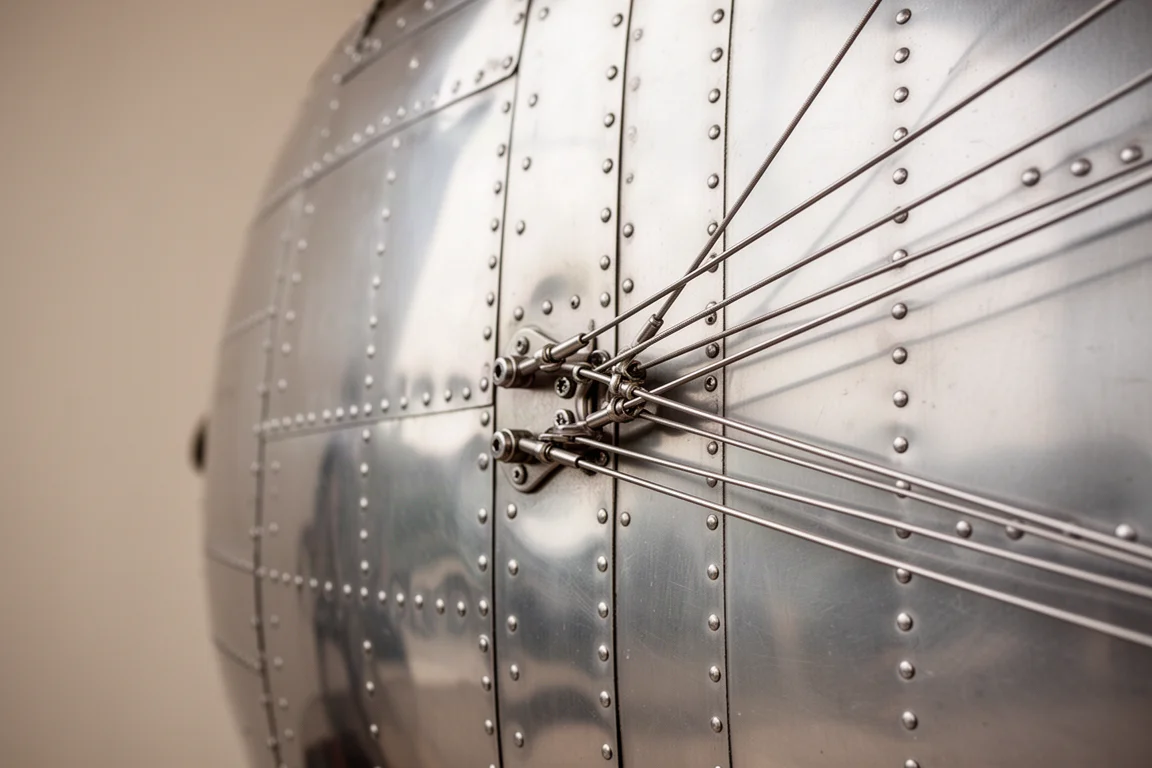
Assembly is made easier with factory-built jigs, since the fuselage cannot simply be laid out on a flat table and the jigs hold everything in alignment. Timber Tiger can supply these jigs, which is a genuine convenience for builders. Like a biplane, the aircraft relies on flying wires below the wing and landing wires above it, stretched aluminum wires under hundreds of pounds of tension that form the bridge structure holding everything together. The wires come in stepped sizes, from thick half-inch wires under the wing to the lightest landing wires on top.
Landing Gear: Trailing Link Over Leading Link
The landing gear echoes the original Ryan’s look but is not the same mechanical beast. The original used leading link gear, a design you rarely see on modern aircraft because its geometry changes as the suspension flexes, which made the original a handful on pavement.
The Timber Tiger ST instead uses trailing link gear, with suspension provided by an arm that moves against a rubber puck, similar in concept to a Mooney. The result is a mechanically simple system that tracks better on the ground and is easier to live with.

Getting in and out is manageable too: a small wing walk provides a step, then you come up onto the structure, step onto the seat, and tuck into the cockpit with your left hand on the throttle and right hand on the stick.
Flight Performance and Handling
The published numbers make the aircraft’s character clear. Climb-away speeds around 60 knots are comfortable, with Vy about 55 knots and Vx about 48 knots. In smooth air the approach is flown around 50 knots; in bumpier conditions 60 knots gives a little more authority. Stall speed reads in the low 30s indicated, roughly 40 knots true.

Handling is a highlight. Low-speed manners are excellent, and aggressive forward slips are equally at home: standing on the rudder and dragging the wheels sideways through the air produces no buffeting and no blanketing of the tail. For short-field work over trees, slipping the plane down between 50 and 60 knots and being well stopped within a thousand feet is entirely realistic. At the top end, Vne is set at 135 knots and has been tested to that figure, while cruise at 5,200 rpm on the Rotax delivers about 86 knots true at 2,500 feet on a standard day.
Buying Advice and Availability
The Timber Tiger ST suits builders who want the look and handling of a pre-war classic without the scarcity, cost, and maintenance burden of an original inline engine. Full kit pricing, order forms, galleries, and videos are available through the company’s website at timbertigeraircraft.com. Designer and owner Nick Fannin-Steele is available to answer questions, and prospective builders can even arrange a visit to the prototype itself.
The aircraft lives on a private airstrip with the identifier 9A9, with details at ninealpha.org, where you can plan a visit and potentially arrange a demo ride. The prototype is also being taken to fly-ins, including smaller events, so keep an eye out locally if you want to see it in person.
Conclusion
The Timber Tiger ST solves a real problem: it brings one of aviation’s most beloved aircraft within reach of ordinary builders. With a 250-pound weight saving, light sport qualification, a modern Rotax 912 powerplant, jigs-assisted all-metal construction, and handling that honors the original’s reputation, it is a thoughtfully engineered tribute rather than a mere copy. For builders who have always loved the Ryan ST, this kit is the most practical way yet to own that experience.
Product link
View more details for Timber Tiger ST
This product is mentioned in the review. Check the specifications, options, and compatibility before buying.
View more details for Timber Tiger STFurther reading
Related Reviews
Aviation
Aero Technics ACH 212 Solo Review: A Carbon Fiber Solo Kit Aircraft You Can Build Fast
A nearly 30-year-old Czech design still offered only as a kit: 90% carbon fiber, quick-release wings, a 350 to 400 hour build, and performance that surprises.

Aviation
Top Part 103 Ultralight Aircraft You Can Build and Fly Without a License
From the Aerolite 103 to the Kolb Firefly, these Part 103 ultralights offer flying fun with no pilot license required.
Aviation
Top Personal Rotorcraft You Can Buy Now: Gyroplanes and Kit Helicopters Worth a Look
From the AR-1 gyroplane to the turbine-powered Mosquito XET, five kit-built rotorcraft with real specs, prices, and build paths.