Thermal Optics
Thermal Master DV2 Review: A Budget-Friendly Thermal Camera for Wildlife Watching
Hands-on impressions of the Thermal Master DV2, a bird watching thermal camera with a huge touchscreen, photo and video capture, and real strengths and limits for finding wildlife at night.
Introduction
Thermal imaging has long been dominated by devices that cost several thousand dollars, which makes the Thermal Master DV2 an interesting proposition. Marketed as the first bird watching thermal camera, it sits in the hundreds-of-dollars range rather than the thousands, and promises a 512x384 super-resolution view, a 360-degree touchscreen, and AI-assisted image processing aimed specifically at finding birds. To see whether that promise holds up, this review covers extended daytime and nighttime testing in yards, trees, and open ground, plus comparisons with two other thermal devices at very different price points.
First Impressions and Design
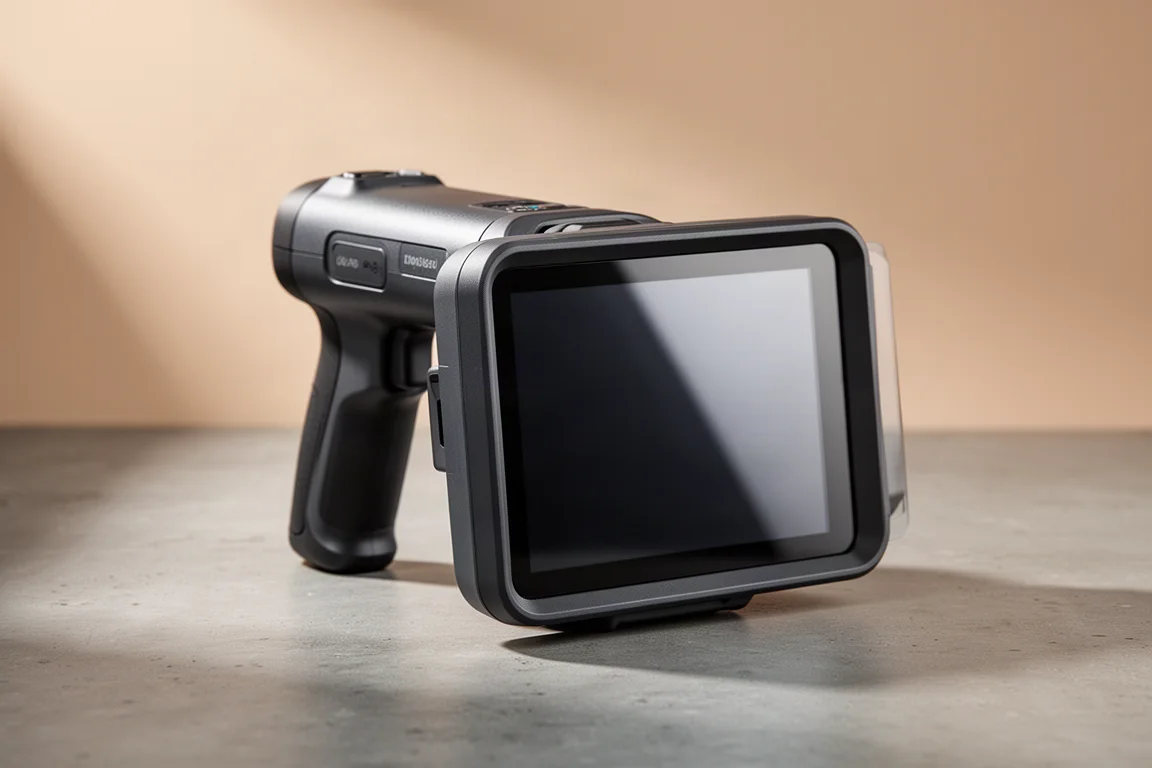
The DV2 looks less like binoculars and more like a compact handheld camcorder, with a surprisingly massive screen dominating the back of the unit. That screen is a 360-degree touchscreen with large, simple icons for switching color modes and shooting modes, which makes the whole device feel far more approachable than look-through monocular designs. Out of the box you get a padded carrying case, a removable battery that charges over USB-C, a charging cable, straps, and an Allen wrench.
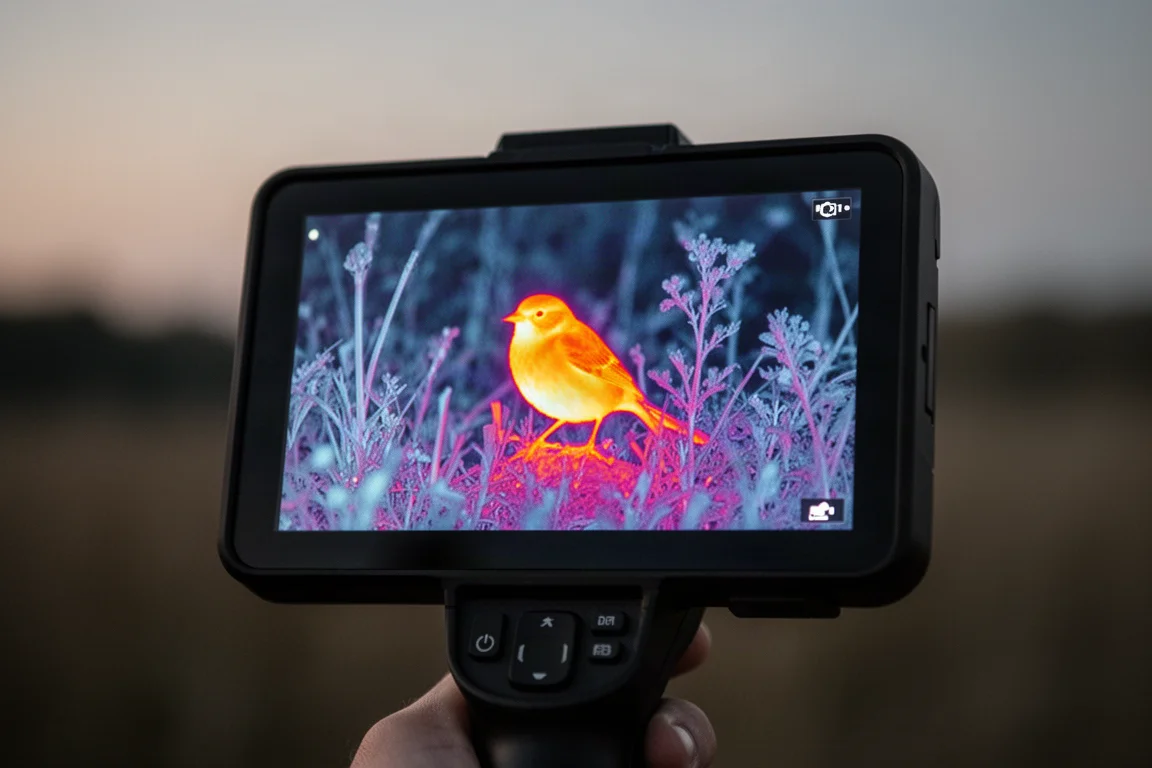
A focus wheel on the front works well for dialing in subjects, and a red button activates a built-in laser pointer. The menu system includes a bird mode alongside options for more detail, generally suited to cool dry environments, or more contrast, better for warmer conditions. There is also a button that places a crosshair over the hottest area in view, plus Bluetooth and Wi-Fi connectivity so you can mirror the thermal view on your phone. Notably, it captures both photos and video, which not every thermal in this class can say.
How It Performed in the Field
In daylight testing, results were mixed for small birds. A robin on the lawn was easy to pick out on the thermal display, but a house finch in a tree that was clearly visible to the naked eye simply did not register. Smaller birds showed up more reliably when they were moving, and a house finch at a feeder lit up well up close. The core issue is that thermal imaging reads relative temperature, so on a warm summer day when everything in the scene carries a similar heat signature, small feathered animals blend in. Feathers also appear to insulate body heat, which makes birds dimmer on the display than mammals of comparable size. Tree trunks light up brightly too, and warm leaves occasionally produced false positives.

Mammals are where the DV2 genuinely shines. Rabbits, chipmunks, ground squirrels, and even a small mouse moving through brush all produced bright, well-defined signatures with visible differentiation between hotter and cooler parts of the body. A feral cat at night was easy to identify by shape. At a gas station after dark, a group of roosting house sparrows, first located by ear and then confirmed with the device, appeared as a total slam dunk, and a single sleeping house sparrow with its head tucked in was picked out of dense foliage on a later pass. Ducklings in a waterway at night were spotted with the thermal before any light was needed.
Night Testing: Birds and Mammals
Nighttime proved more forgiving than daylight for birding, and the most memorable session involved flying squirrels. Their heat signatures were extremely clear, and because the thermal display does not disturb them the way a bright light does, they kept chasing each other around while being watched.

Not every night walk was a success, though. Extensive searching of backyard trees failed to surface any roosting birds, likely because stationary birds look like just another small warm patch in the canopy. The overall pattern is consistent: mammals are reliable, larger and closer birds are workable, and small or distant birds require patience and proximity.
How It Compares to Other Thermal Cameras
Compared with the Teslong thermal monocular, the DV2 is a clear step up. The Teslong produces blobby images with little edge definition and limited color differentiation, and it only captures photos, not video. The DV2 renders sharper edges, a broader spectrum of heat colors, and adds video recording, which is a meaningful practical advantage. The AI processing appears to contribute to the clearer image separation.
The Zeiss DTI4, a unit in the several-thousand-dollar range, is a different league. Its 640x512 sensor with roughly 327,680 pixels delivers daytime-like clarity and locks onto tiny birds at a distance where the DV2 loses them. The DV2 sensor is 256x192, around 49,000 pixels, boosted to a claimed 512x384 via super-resolution mode, and the Teslong sits at the same 256x192 base. In a side-by-side rabbit comparison, the Zeiss produced the clearest image even at roughly double the distance. The takeaway is straightforward: more pixels mean more differentiation per object, and that is where premium thermal units earn their price.
Things to Consider Before Buying
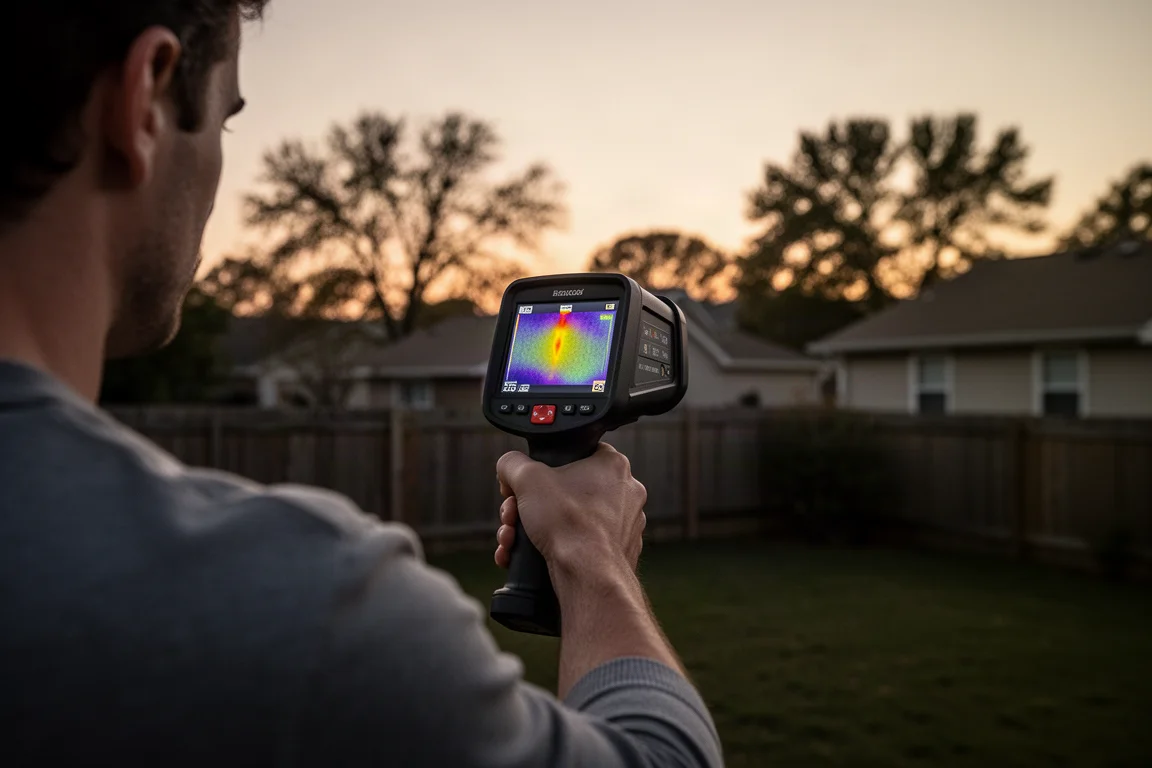
The big screen is both the best and most problematic feature. It makes the device social, letting several people watch the same thermal view at once instead of taking turns at a monocular eyepiece, and tapping icons beats fumbling with buttons in the dark. But in bright daylight the screen picks up glare, which is exactly when a monocular-style eyepiece is more comfortable. Other quirks worth knowing before buying:
- Startup is slow. Pressing the power button brings up a load screen that lingers long enough to be frustrating when you spot something and want the camera ready immediately.
- The 4x zoom costs too much clarity to be useful, so most viewing happens at 1x.
- Small birds at a distance are genuinely hard to resolve, especially in warm summer conditions. Winter should improve contrast.
Who Should Buy the Thermal Master DV2
This is a great entry point for anyone curious about thermal imaging who wants to have fun scanning a backyard or local green space for wildlife. It excels at finding mammals, works for roosting and perched birds when you are close enough and the conditions cooperate, and the shared touchscreen makes it easy to enjoy with friends or family. It captures what it was asked to do, including successfully locating sleeping songbirds at night.
If your goal is serious, tactical birding, spotting every tiny bird at range with maximum clarity, an expensive high-end thermal like the Zeiss DTI4 is the better investment. But as an affordable way to dip your toes into thermal technology without spending thousands, the DV2 is a solid, well-rounded choice for its price range.
Conclusion
The Thermal Master DV2 lands roughly where you would hope: a clear step above blobbier budget thermals, a visible step below premium units, and a genuinely fun tool for backyard wildlife discovery. Its massive touchscreen, photo and video capture, laser pointer, and swappable battery make it easy to live with, while slow startup and struggles with small warm-weather birds are the main caveats. For mammal spotting in particular, it delivers night after night, and for anyone wanting a first taste of thermal birding on a budget, it earns a recommendation.
Product link
View more details for Thermal Master DV2
This product is mentioned in the review. Check the specifications, options, and compatibility before buying.
View more details for Thermal Master DV2Further reading
Related Reviews
Thermal Optics
Thermal Master Flip Thermal Review: A Pocket-Sized Thermal for Nighttime Wildlife Watching
A flip-screen thermal imager aimed at birders and wildlife watchers, with useful modes, easy focus, and some real field limitations to weigh before buying.
Thermal Optics
Teslong TTS 260 Thermal Monocular Review: Affordable Heat Detection for Birders and Backyard Explorers
A $600 thermal monocular that spots rabbits, killdeer, woodcocks, and deer in the dark, with a few trade-offs worth knowing before you buy.
Dash Cams
Vantrue Nexus Lineup and Pilot 2 Thermal Dash Cam: What's New
A look at Vantrue's updated Nexus dash cams with LTE connectivity and the upcoming Pilot 2 with a thermal camera channel.