Ski Resorts
Tamarack Resort Review: Idaho's Underrated Ski Destination
A modern lift network, strong cruisers, and limited crowds make Tamarack an appealing value pick, with a few trade-offs worth knowing before you book.
Introduction
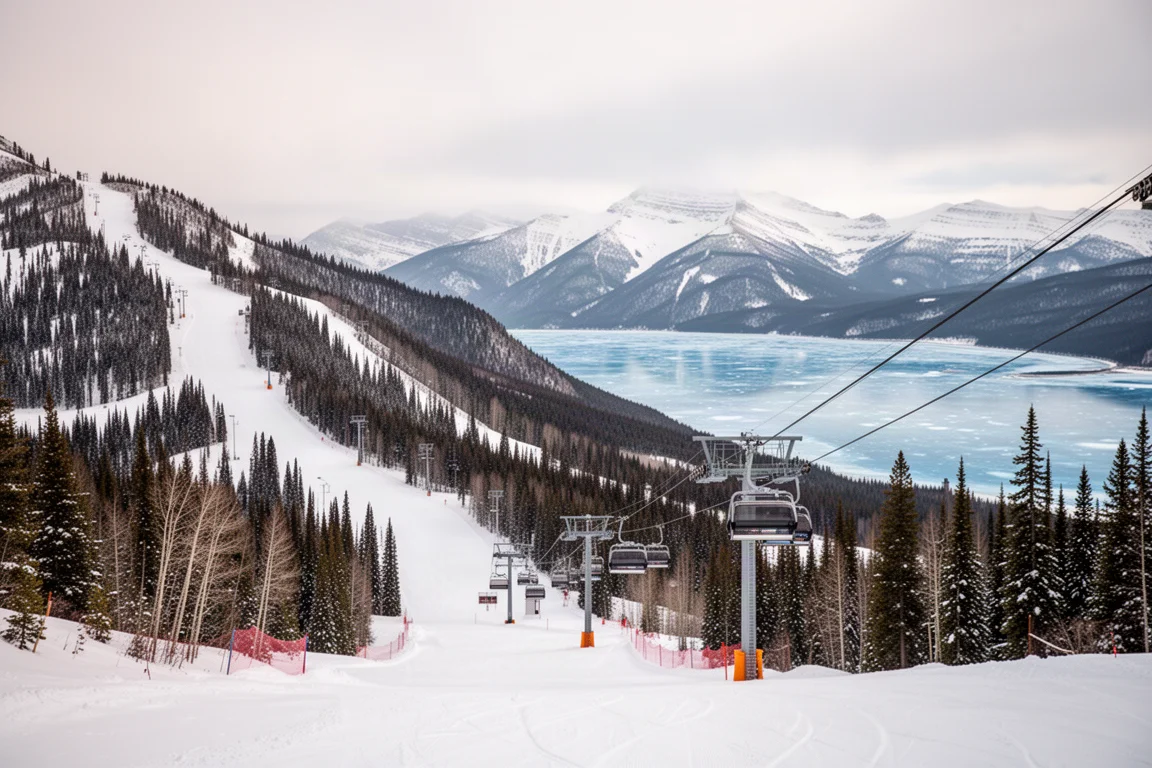
New ski resorts in the United States have been rare since the early 1980s, and the lone destination exception might be Idaho’s Tamarack Resort, which first opened in 2004. Its timing came with consequences: after the 2008 housing crisis, Tamarack declared bankruptcy and one of its ski lifts was even foreclosed on and removed by a bank. Now almost a decade removed from that crisis, the resort has made real strides, and it is worth asking whether Tamarack is the right fit for your next ski vacation. This review covers the overall mountain experience and how the resort stacks up across ten ranking categories.
The Mountain Experience
Tamarack was founded in the early 2000s with the intention of competing with the best ski resorts in the American Rockies, opening for its first season in 2004 with plans to expand to over 3,000 acres of skiable terrain. Those first few years showed significant lift expansion plans on the trail map, and out-of-bounds backcountry routes were heavily implied to soon be integrated into the resort. But the resort bit off more than it could chew. Following the 2008 financial crisis, it was forced to close entirely for over a year due to lack of funds, and when the mountain reopened in 2010, it did so on a hobbled footprint: a bank foreclosed on its Wildwood Express lift, removing that terrain from the resort boundary for an entire decade.
Within the past few years, Tamarack has returned to better financial footing and reinstalled a lift to replace the original Wildwood lift, though it remains significantly underdeveloped compared to the master plan. A reintroduced master plan aims to get back to the 3,000-acre footprint, but today the skiable terrain is confined to a fraction of that original vision, with the rest of the envisioned terrain, located adjacent to the resort on both sides of the mountain rather than above or below it, still out of bounds.
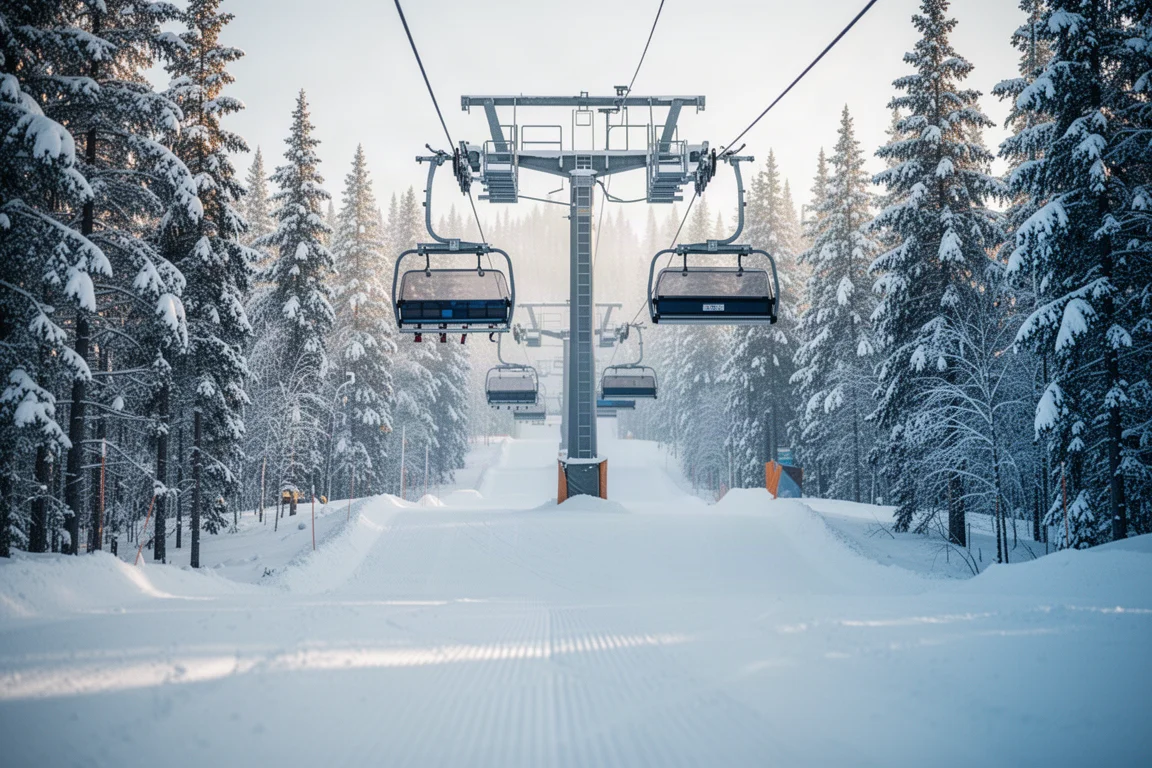
With today’s roughly 1,400-acre footprint and a 2,800-foot vertical drop, Tamarack is a decently tall resort, if not the biggest by raw size. Despite that, it offers terrain for all abilities in most categories, from bowls to trees to moguls and groomed runs. The groomers are arguably the resort’s most standout feature: long, rolling cruisers, many with great views of Lake Cascade below. Some runs require multiple lift rides to lap, but a modern lift network keeps chair time manageable.
Snow Conditions and Reliability
Tamarack sees admirable snowfall, typically averaging around 200 inches per year. Snow quality is on par with other Idaho resorts south of the panhandle, and the resort averages higher snow quantities than Sun Valley, though still relatively dry as far as western destinations go.
Two factors work against snow preservation. The resort largely faces east, so it gets much more sun than the typical northern exposure found elsewhere, and it sits at a lower base elevation than most competitors, bottoming out just under 4,900 feet. As a result, snow quality deteriorates faster than at nearby Bogus Basin or Brundage, especially in lower mountain areas, and Tamarack is more susceptible to freeze-thaw cycles, potentially losing conditions after a few days without new snow. The upper mountain fares better, but its exposed location means the summit lift closes due to wind relatively often, and when that happens about a third of the terrain is cut off from access.
Terrain by Ability Level
Beginner terrain exists, though with caveats. The base area offers great learning terrain served by a dedicated carpet and lift, plus beginner-focused tree runs marked as a kid zone that make for more interesting runs than the typical green groomer. Outside the base, however, the green runs are either too flat or too steep. Two of the three main mountain lifts offer green trails, but most are flat cat tracks, and the Summit green trail likely requires more skating or pushing than beginners will be comfortable with, especially snowboarders. The one main mountain green run that is not flat, Hootenanny, is one of the steepest and narrowest green trails anywhere and is not recommended for true beginners.
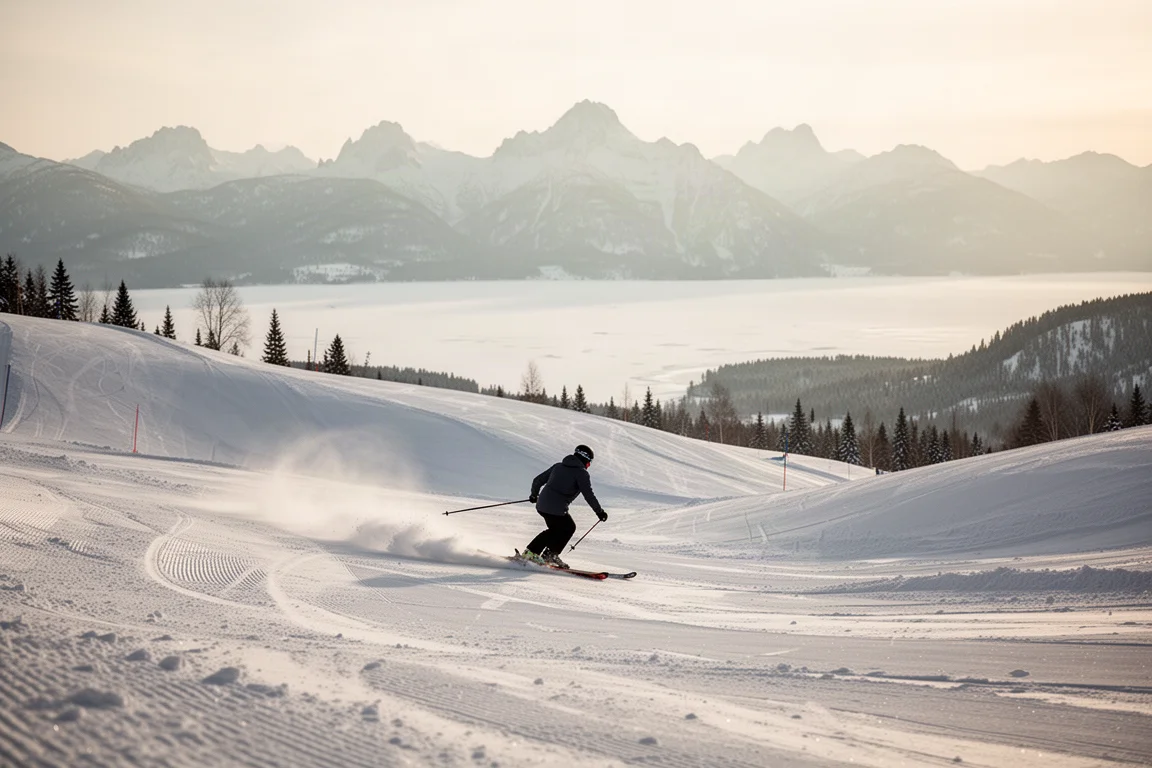
Once you progress to the intermediate level, Tamarack becomes a pretty great ski area. Multiple blue trails cascade from every lift, offering fantastic cruising from top to bottom. One standout is the Bliss trail, which runs from the top of the Summit lift all the way to the base, winding from near-alpine slopes down through the woods with great grooming and fun rollers along the way. Some blues have little pockets of trees mid-run, adding small adventures on the way down.
There is also a typical terrain park setup for a western destination resort: a couple of parks, one focused on beginner features and the other on advanced riders, each with boxes and rails, and the large park including a halfpipe in bigger snow years.
Advanced and Expert Terrain
For advanced skiers and riders, Tamarack offers small bowls, tight glades, and steep groomers throughout the footprint. Some glades pass through groves of the resort’s namesake tree, which loses its needles in winter, making for a unique experience. Off the summit lift, steep groomers enable high-speed runs, and lightly spaced trees allow great powder runs when conditions allow. If moguls are what you want, the Wildwood lift line hosts a long mogul line, though the pitch is not sustained throughout. Note that the glades to the far skier’s right were damaged by a wildfire this past summer; the resort has done significant glade clearing work, introducing three new marked black trails in the process.
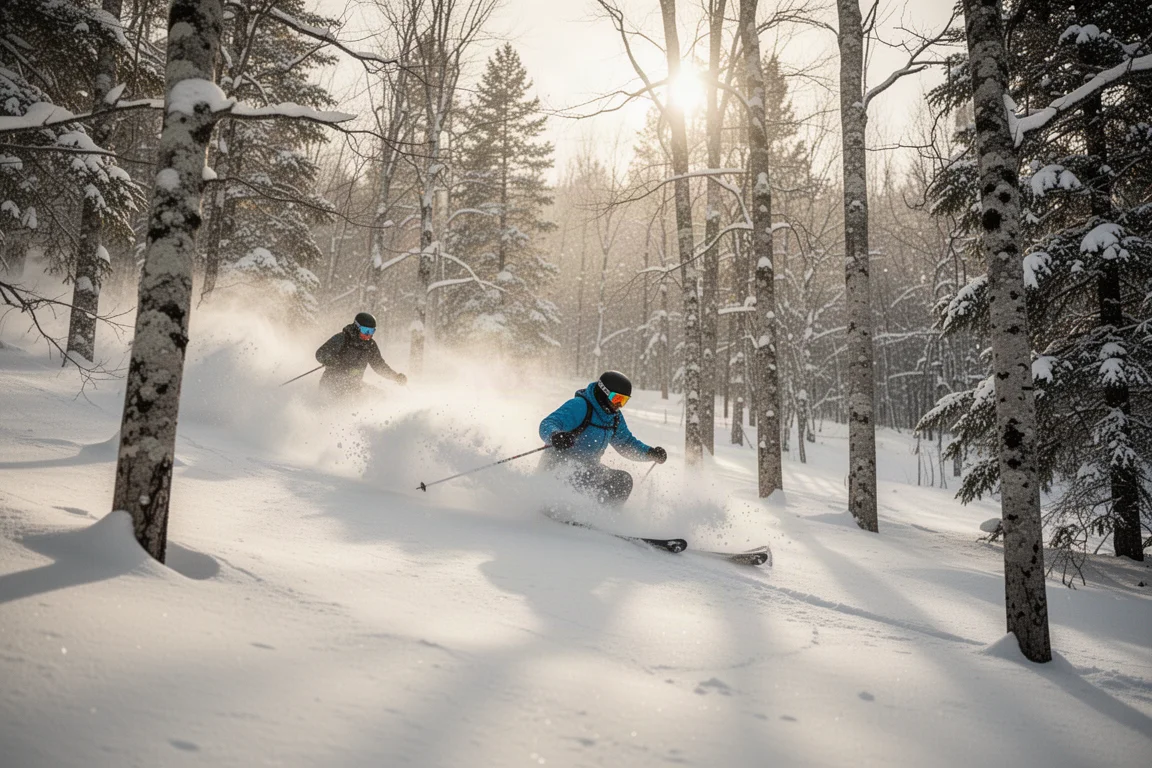
For true experts, there is not a huge amount, but a few runs get the blood pumping: cliffs and rock features next to the top of the Wildwood lift, though quite short, and cornice drops in the bowl to the far looker’s left of the summit, though the pitch mellows quickly.
One unexpected standout is backcountry access. Because the adjacent terrain remains undeveloped, multiple backcountry gates make lift-accessed backcountry runs easy and popular with locals. These areas are completely unpatrolled and unmarked for hazards, so venture out only with proper knowledge and a plan, plus an avalanche beacon, probe, shovel, and partner. The backcountry terrain to the skier’s right, including Grouse Bowl, was heavily damaged in that same wildfire and may still carry serious hazards.
Getting Around and Crowds
Tamarack is relatively straightforward once you know it, but there are frustrations for newcomers. A few flat catwalks sneak up on you, including two separate traverses back to the summit chair needed to lap the skier’s right and skier’s left runs. The catwalk from the top of the Wildwood chair to the mid-mountain lodge is flat or uphill in parts and is best avoided: it is much easier to head down to the base and take the Tamarack Express up to mid-mountain. Another quirk is that the base of the Tamarack Express starts below the main base village, so if you are at the lift line and need to return to the base area, you must take the long lift back up and ski down to the correct area.
On the plus side, lift lines are never too long. Due to its fairly isolated location, Tamarack does not see the crowds of destinations in Utah or Colorado, though it is getting better known. There is only one main out-of-base lift, and the summit lift’s occasional wind holds put more pressure on the other lifts, but visitation is low enough that you will not wait in serious lines compared with other western destination resorts.
Food and On-Mountain Facilities
Tamarack has one on-mountain restaurant and an extensive base village. The on-mountain lodge is very convenient for those lapping the Summit Express or Tamarack Express, located right between the bottom and top terminals of those two respectively, with a sizable eating area, plenty of options, large windows, and panoramic patio views. As noted, the lodge is a pain to reach from the top of the Wildwood lift due to the flat and uphill catwalk.
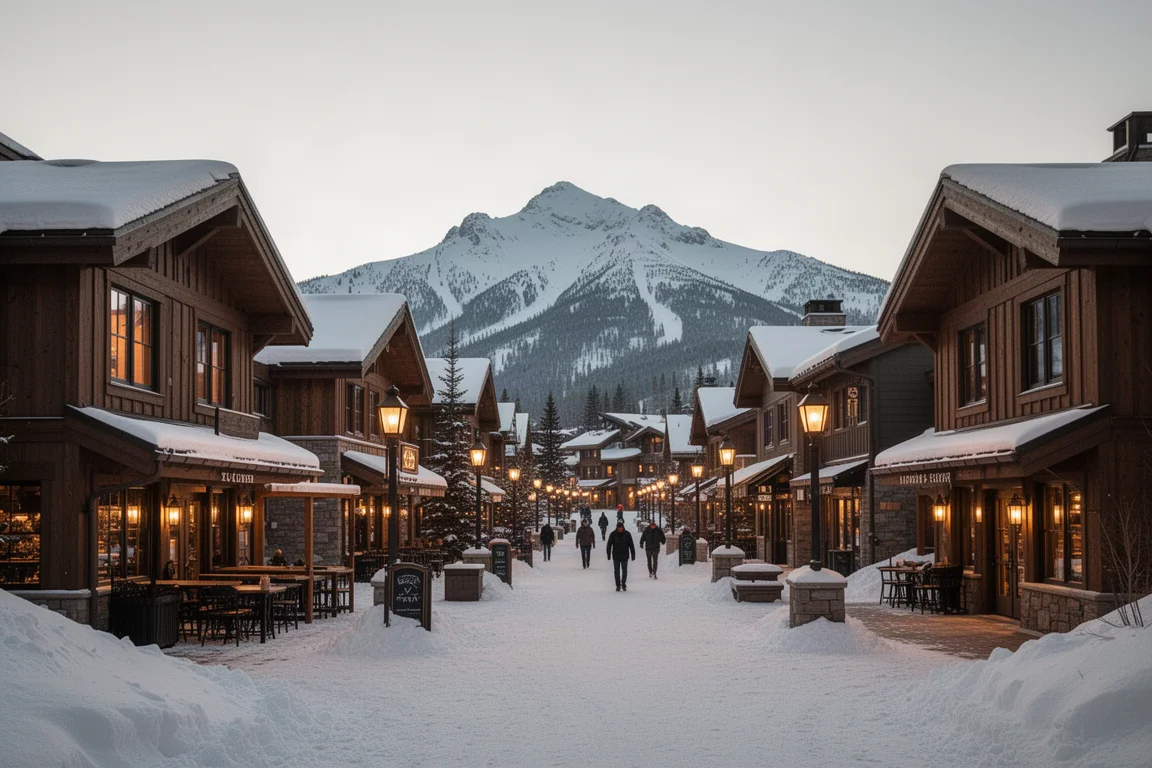
The base village is the most impressive part. It is surprisingly extensive for such an unassuming resort, with multiple restaurants, shops, and bars lining the pedestrian mall at reasonable prices for a ski area, let alone one with a village. There is even a small convenience store for those hoping to save as much as possible. Food quality is pretty average for a ski area, but the variety is far beyond what most would expect from a resort of Tamarack’s size.
Atmosphere and Getting There
Tamarack is not the most feature-rich-looking resort, but its location on the shores of Lake Cascade in the Long Valley of the Payette makes for uniquely beautiful views. With the lake frozen, the views are in some ways akin to those from Jackson Hole, another east-facing resort in the Northern Rockies. Across the valley are striking peaks, and during cloud inversions the views are spectacular. Toward the base, views are more typical, and quite a few ritzy mansions near the bottom may not fit the mountain’s unassuming Idaho vibe for everyone.
The resort is around 2 hours north of Boise, home to the nearest large airport. Other flight options are Spokane, 5 hours away, or Salt Lake City, 7 hours away. Drivers can use a ski bus from Boise for $25 round trip. Parking is quite convenient despite the base village: one lot is directly slopeside, and while it can fill on busier days, the other lot is walking distance from the slopes. For lodging, there are desirable options both on and offsite. McCall, about 30 minutes south, is a tourism-focused town with plenty of lodging and things to do, and many visitors stay there for the nightlife. The base village has its own lodging and rental options, and nearby Donnelly offers small inns and vacation rentals close to the mountain at reasonable rates.
Pricing and Pass Access
Tamarack is generally more affordable than larger destination resorts. A holiday day ticket runs a steep $167 this year, but advanced purchases go for much more affordable rates close to $100. The resort is also a bonus mountain on the Ikon Pass, offering 2 days of access with holiday blackouts, though only on the full pass. It is available as a 2-day partner on the Indy Pass, which also covers nearby Brundage, making McCall popular among Indy Pass holders. Unlike many resorts of its size, there are no holiday blackouts for Tamarack on the Indy Base Pass and no reservations required on either tier.
How Tamarack Stacks Up
Tamarack earns an eight for snow, with totals and quality that are decently strong for the west but not as strong as better-known regional resorts due to elevation and aspect. Resiliency scores a six: reasonably reliable overall, but upper mountain wind issues and lower mountain snow variability can impact openings. Size scores a six, with the measured skiable footprint around 1,420 acres despite the massive master plan. Terrain diversity also scores a six, thanks to strong intermediate-to-advanced variety but somewhat limited beginner and expert inbounds options. Challenge is a six, with decently challenging steeps that are not the most sustained despite an impressive vertical drop, and limited technical features like cliffs.
Lifts score an eight, with high-speed lifts in most areas and only a few small beginner and homeowner areas on older service. Crowd flow also scores an eight, reflecting little in the way of lift redundancies but rarely terrible traffic. Facilities score a seven: not the fanciest, with the mid-mountain lodge awkward to reach from Wildwood, but a good overall experience with plenty of base village options. Navigation scores a six: hard to get truly lost, but with a few annoying quirks, mostly around flat cat tracks. Finally, mountain aesthetic scores a six: not the craziest-looking resort, but offering a special sense of isolation with beautiful upper mountain views.
That adds up to an overall score of 67, placing Tamarack seventh in the Northern Rockies as of early 2026. The resort pairs solid terrain with a standout lift network and limited crowds, but it is not as impressive as the region’s best when it comes to expert terrain, snow quality, and raw footprint size. Still, for an enjoyable vacation for the value if you book in advance, Tamarack is one of the best mountains you can find.
Conclusion
Tamarack suits skiers and riders who want long cruisers, fast lifts, and low crowds at a fair price, and who can accept variable lower mountain snow, limited expert terrain, and a footprint still far short of its original master plan. If that description fits your next ski trip, this hidden Idaho gem deserves a spot on your shortlist.
Product link
View more details for Tamarack Resort
This product is mentioned in the review. Check the specifications, options, and compatibility before buying.
View more details for Tamarack ResortFurther reading
Related Reviews

Ski Resorts
Alyeska Resort Review: Alaska's Largest Ski Resort, Worth the Journey?
A deep look at Alyeska Resort: heavy snowfall, expert terrain, an Icon Pass connection, and the trade-offs of a near-sea-level mountain in the Last Frontier.

Ski Resorts
Bear Valley Ski Resort Review: Northern California's Quiet Sierra Alternative to Tahoe
A lesser-known Sierra resort with over 1,300 skiable acres, surprisingly strong expert terrain, and crowd levels Tahoe can only dream of. Here is what to know before you go.

Ski Resorts
Colorado Ski Resorts Ranked: The Best Destination Mountains for Overall Experience
A ranked guide to Colorado's destination ski resorts, covering terrain, snow, logistics, crowds, and cost so you can pick the right mountain for your trip.