Hi-Fi Amplifiers
Sugden Masterclass IA-4 Review: Pure Class A, 33 Watts, and a Glorious Midrange
A close look at Sugden's flagship integrated amplifier, a 33 watt pure Class A design built in Yorkshire, and what it does better than almost anything at its price.
Introduction
The Sugden Masterclass IA-4 is the flagship integrated amplifier from a British company that still builds its products by hand at its premises in Yorkshire, England. It is a pure Class A design rated at 33 watts per channel into 8 ohms, and it retails for £6,670 in the UK. Sugden’s lineage reaches back to 1967, when James Edward Sugden introduced what is considered the world’s first transistor-based pure Class A amplifier, the original A21.
That heritage is not the reason to buy the IA-4, but it does explain the character. This is an all-analog amplifier built around a saturated, harmonically rich presentation rather than the last word in bass grip or transient snap. If the midrange is what you listen for, that trade-off is the whole point.
The IA-4 sits at the top of Sugden’s range, and the company remains an independent UK hi-fi manufacturer. It has continued to build amplifiers through a difficult period that included the loss of Patrick Miller, who worked there for 41 years and took over the business when his father, Tony Miller, passed away in 2017. Patrick Miller passed away in 2023 at the age of 58.
Who this product is for
This is an amplifier for listeners who keep a predominantly analog system and who care most about how voices and acoustic instruments are rendered. It has no digital inputs at all, so it expects a separate source chain, whether that is a turntable or a streaming transport feeding an external DAC.
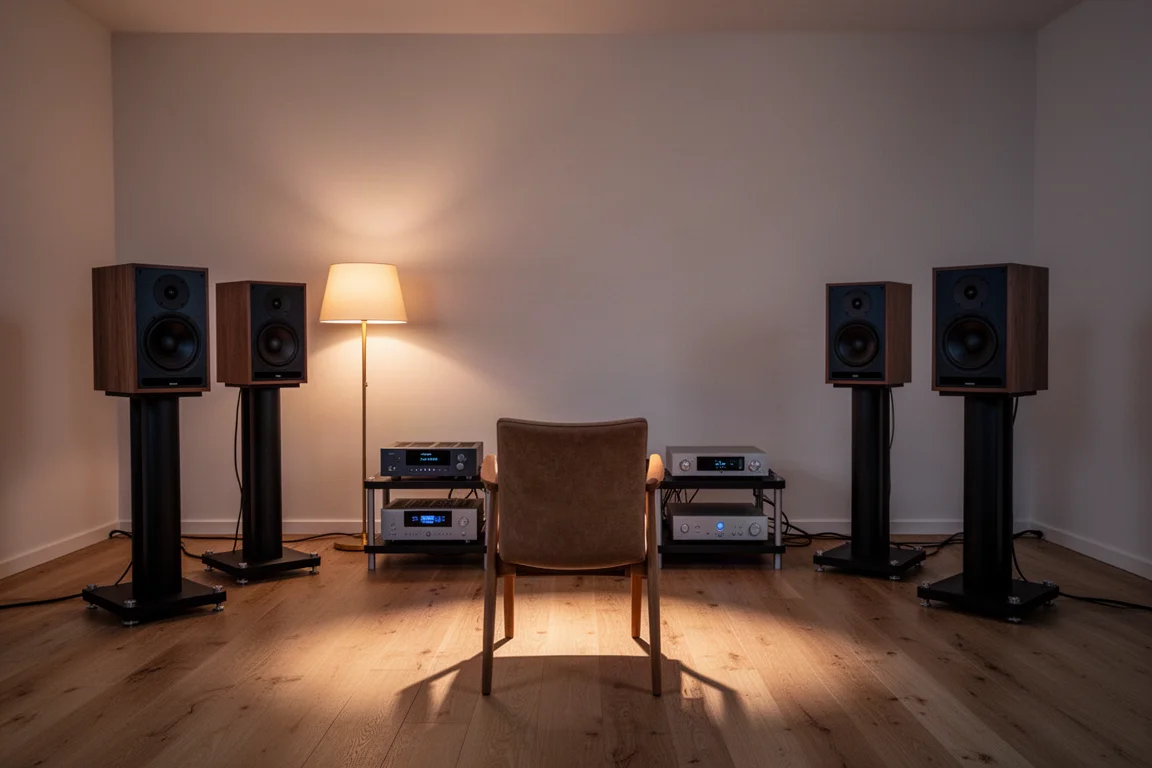
It suits owners of moderate-sensitivity speakers in a normal-sized room. In a space measuring roughly 7.5 metres by 4 metres, with speakers rated in the mid 80s for sensitivity and average listening levels up to about 85 dB, the 33 watts on offer proved sufficient. Buyers with very inefficient speakers or very large rooms should think carefully about whether 33 Class A watts will be enough.
It is also a natural fit for someone who has been circling the brand for years. Sugden’s cheaper integrated models sit well below it in price, so the IA-4 is the choice for a listener who has already decided that this particular voicing is what they want and is ready to pay for the fullest version of it.
Design, build, and connections
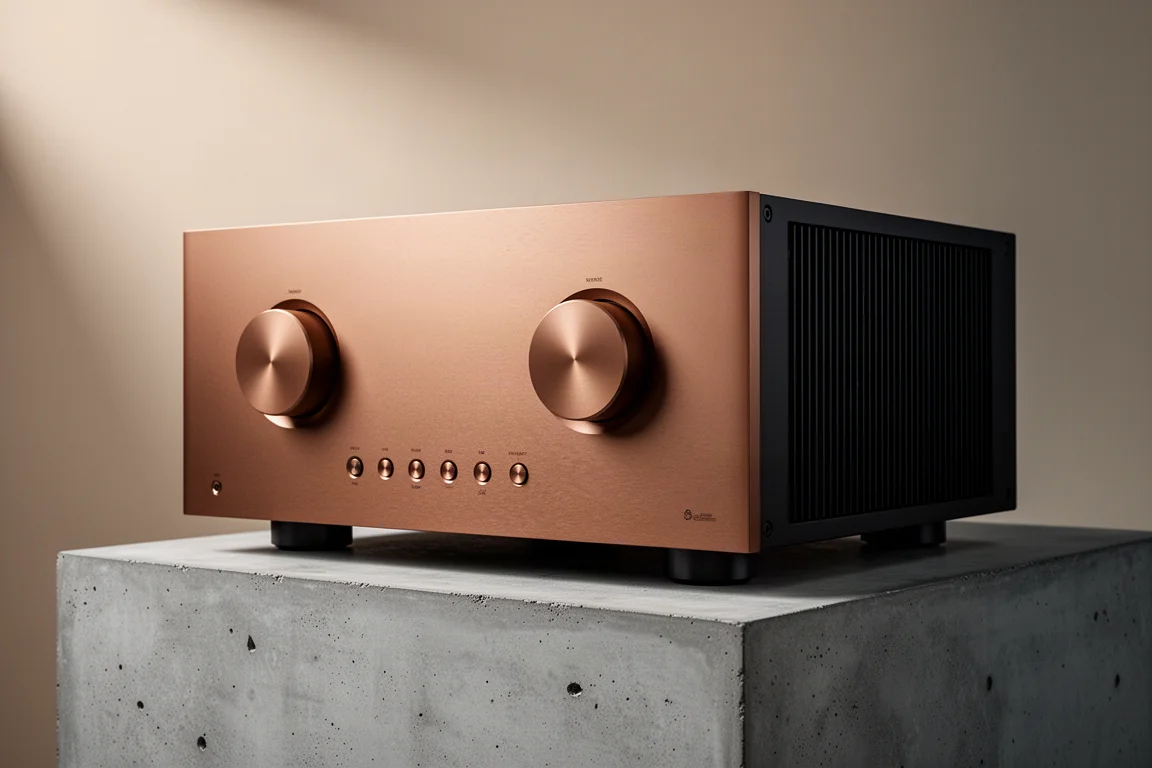
Physically, the IA-4 is substantial: 430 x 165 x 440 mm, or roughly 16.9 x 6.5 x 17.3 inches, and 20 kg, about 44 lb. The chunky anodized aluminium front panel is available in 13 custom colour finishes alongside the standard titanium silver and graphite black, and the unit supplied for this assessment came in the Bronze finish.
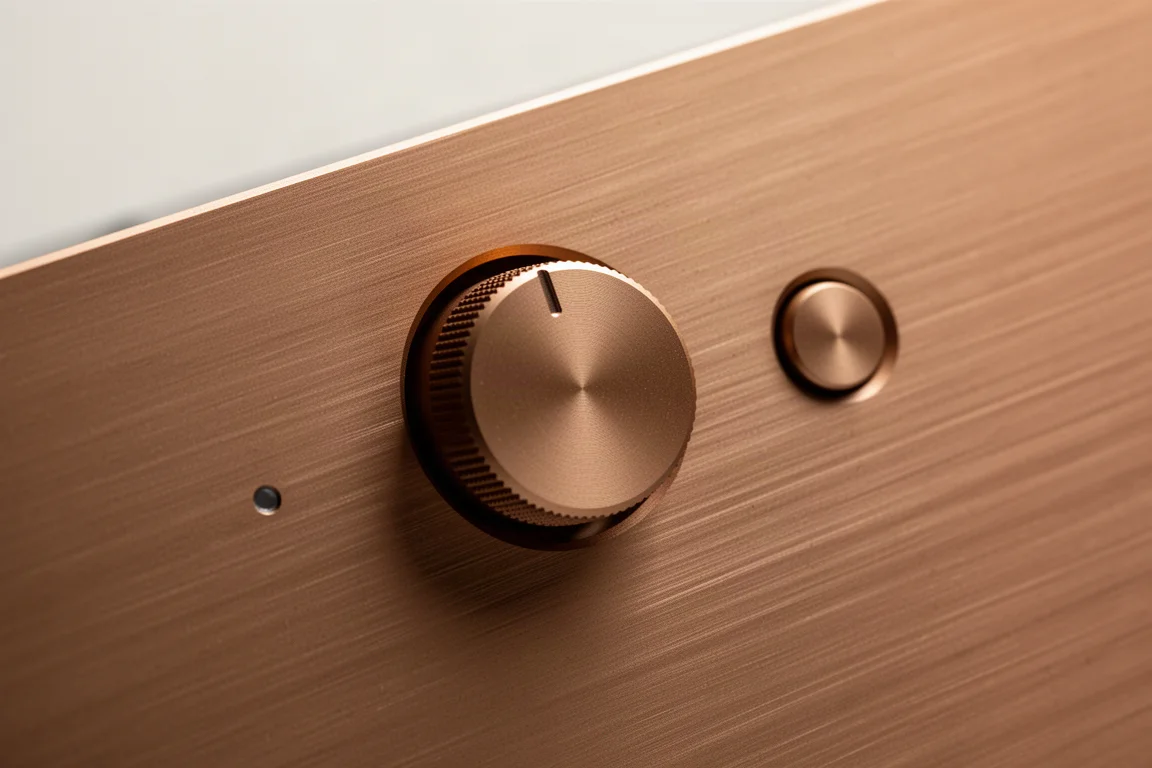
The layout is deliberately symmetrical. The power button is the same size as the rotary dial used for input selection, and volume is handled by an output potentiometer with a smooth feel. To either side sit buttons for a monitor switch and a recording loop, sometimes called a tape loop, with the power indicator and IR sensor further out.
The supplied remote control is slick looking but purely for volume, because input selection is not motorized. Its three up and three down buttons adjust the volume by different sensitivities. As a pure Class A design it runs warm, though after a long session it stays warm rather than hot: warmer than many Class A designs, but not uncomfortable. Only listeners in very warm climates and very small rooms would treat it as a space heater.
Connections on the rear are reassuringly above standard quality. There is a balanced XLR input, a moving magnet phono input, three line-level inputs, a tape loop and a set of preouts, and the speaker binding posts are gold plated. Inside, a custom 350 VA toroidal transformer is encased in a pot for extra shielding, feeding four very large 10,000 microfarad filter capacitors. Their physical size, roughly double to four times what is typical, is there to help them dissipate heat under continuous maximum current draw. The output devices are NPN transistors running in pure Class A in single-ended mode, with two devices operating in parallel, and the boards use through-hole components throughout, gold-plated boards, Nippon capacitors in key positions and silver wiring running between boards. Input switching relays handle source selection.
Sound character and performance
The midrange is the headline. There is detail, body and texture here, and the presentation balances a little fullness in the lower midrange against real energy in the upper midrange, the presence region, so the result is rich without sounding slow or thick. Resolution and instrument separation are excellent, and the soundstage is both wide and deep. Male vocals, female vocals, trumpets, saxophones and pianos all came across convincingly.
The frequency extremes are where the limitations show. Bass has genuine weight, is plump and meaty, and has plenty of drive, holding composure at any sensible listening level. What it does not have is absolute sharpness: the leading edges of low-frequency notes are slightly softened, and the same applies to midrange instruments with transient snap, such as brass, strings and keyboards. Treble is not as detailed as the best amplifiers in this class either.
One area that surprises is low-volume behaviour. Speakers with large moving mass can sound flat until they receive enough current, and the IA-4’s linearity at low volumes meant it had no trouble waking them up, with no issues at the other end of the volume range either. The overall character is warm, and it is the combination of traits rather than any single one that pulls a listener into the performance and makes the amplifier’s shortcomings easy to forget.
How it compares with other amplifiers
Against the obvious alternatives, the IA-4 trades precision for midrange magic. The Hegel H400, at £5,995, offers the best bass control encountered in this class, marginally better top-end resolution, a slightly wider soundstage and laser-precise imaging, and it sounds very neutral until its ability to reproduce harmonics is compared directly. The Accuphase E-280, at £4,995, delivers great detail and a wonderful sense of timing but has a lean sounding midrange. The Trilogy 921 integrated, at £5,900, is another very resolving amplifier with better bass control. The NVA P50 SA preamplifier with M600 monoblocks, at £3,925, pulls more information from recordings than any of these and presents it naturally, but is dynamically polite.
Sugden’s own range offers cheaper routes into the same family: the A21 Signature is around £3,000, the SE version around £4,000 and the 50th Anniversary around £5,000. For a tighter budget, the Musical Fidelity A1 at £1,499 is another Class A amplifier that shares some of the same sonic profile, though it will not compete with the IA-4 on resolution or drive.
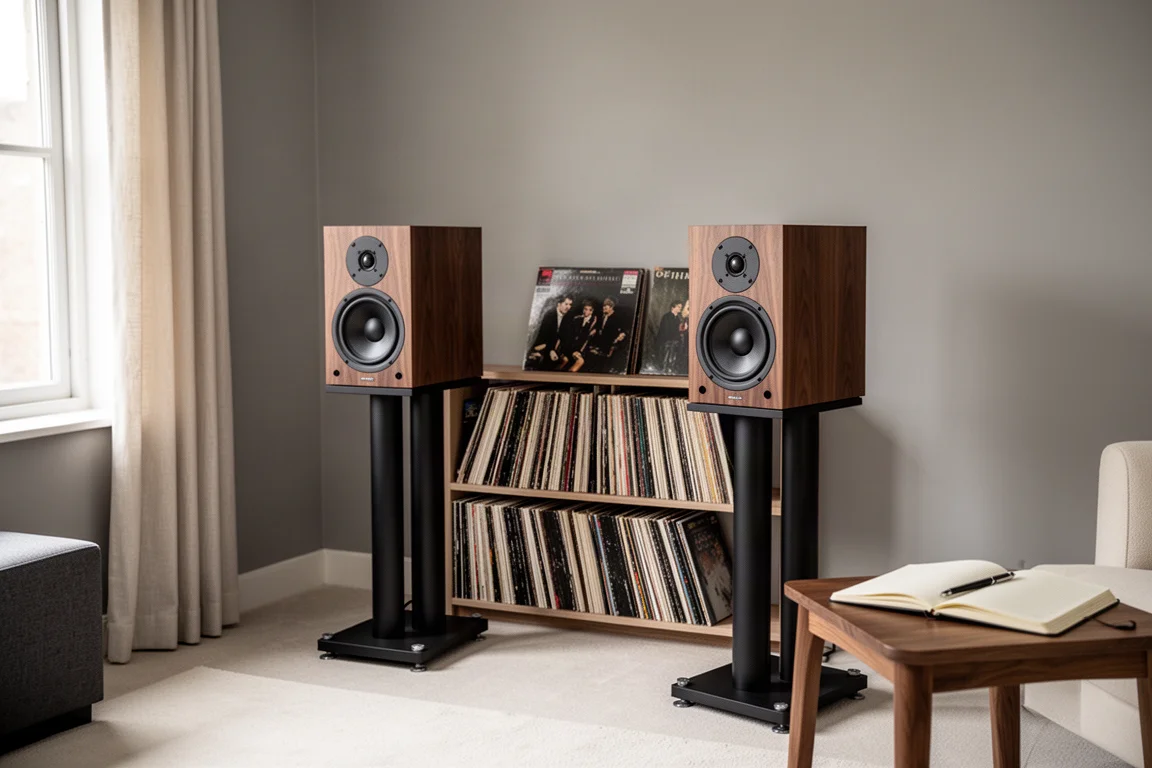
Speaker pairing matters as much as the amplifier choice. The IA-4 sounded excellent with £1,500 standmount speakers, and with ProAc Response 1 SC speakers it produced such texture and subtlety in vocals and acoustic instruments that the slight softening at the edges of notes barely registered on all but the liveliest recordings. More revealing speakers expose both sides of its character: greater detail across the board and deeper soundstages, but also the softer bass control.
Things to consider before buying
The IA-4 is an all-analog amplifier, and it rewards a source chain that is resolving enough and, just as importantly, faithful to harmonic structure. That is the harder part to get right. A streaming transport and DAC at a comparable level are a sensible starting point, and R2R ladder DACs are worth favouring over delta-sigma designs if you want to hear that saturated harmonic presentation at its best.
The internal moving magnet phono stage is difficult to judge without a turntable in the system, and it is probably fine, but a good quality external phono stage is still worth considering: any phono stage bolted next to a large power amplifier is working at a disadvantage.
Two practical points round this out. There are no digital inputs and no motorized input switching, so source selection is a hands-on affair and the remote covers volume only. And because the bass and transient behaviour are softer than the most clinical rivals, anyone who prioritises grip and snap over tone and texture should audition carefully before committing.
Buying advice
At £6,670 in the UK, the Masterclass IA-4 asks a serious price, and it delivers a serious version of a very specific sound. The 33 watts of Class A power, backed by a hefty power supply, proved enough to drive the speakers described here to levels that matter in a normal room, so the wattage figure should not be read as a limitation on its own.

The decision comes down to priorities. If you want the last word in bass control and transient snap in the midrange, this is not the amplifier for you, and the alternatives noted above will serve you better. If you can hear past that, or simply do not weight it heavily, the midrange is a masterclass in how a high-end amplifier should sound. Buyers who love the voicing but cannot stretch to this price should look at the A21 Signature, the SE or the 50th Anniversary, which share the family character at lower cost.
Conclusion
The Sugden Masterclass IA-4 is big, bold and beautifully made, with a muscular appearance matched by a sound that is genuinely engaging. Its combination of detail and texture renders vocals and instruments in a way that keeps attention on the music rather than the equipment, and 33 watts of pure Class A power is enough to avoid running out of puff with most speakers in most rooms.
It is not a neutral, all-rounder amplifier, and it does not pretend to be. Judged on its own terms, as an analog integrated built for harmonic richness and midrange insight, it earns a strong recommendation. Listeners who know that is what they want will find very little else that does it quite this way.
Product link
View more details for Sugden Masterclass IA-4
This product is mentioned in the review. Check the specifications, options, and compatibility before buying.
View more details for Sugden Masterclass IA-4Further reading
Related Reviews
Hi-Fi Amplifiers
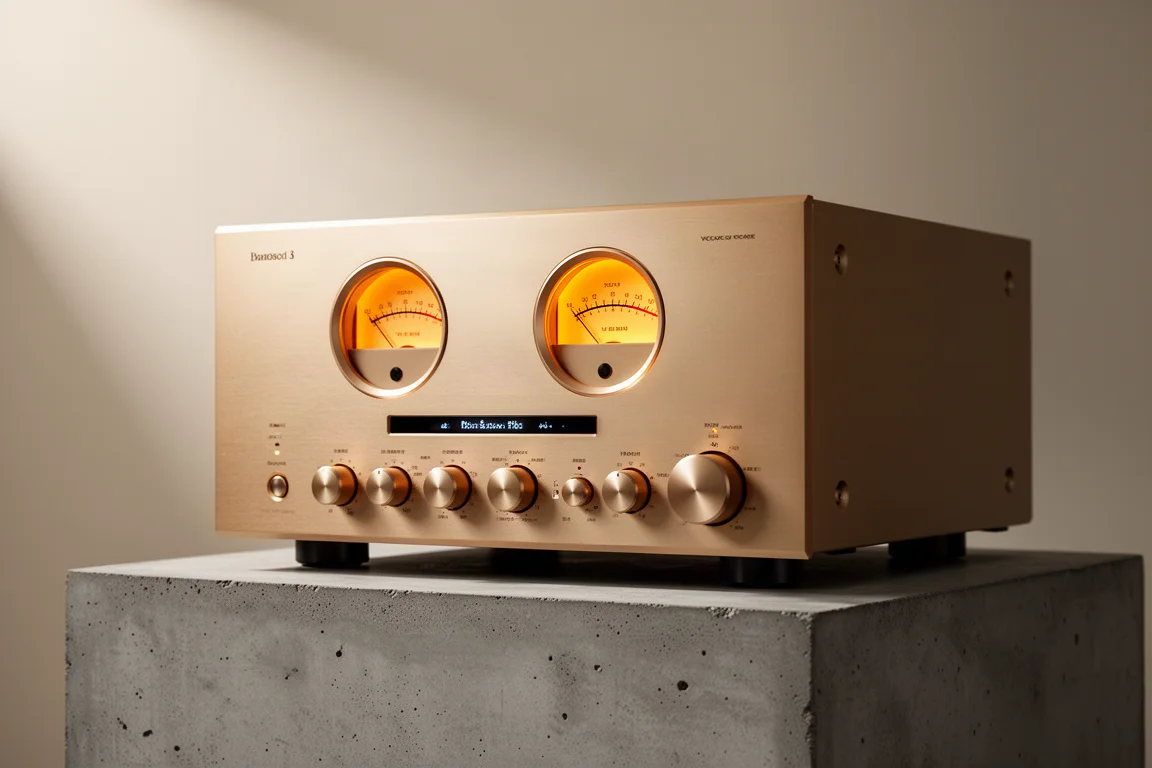
Accuphase E-280 Review: Entry-Level Accuphase With Flagship Attention to Detail
A close look at the Accuphase E-280 integrated amplifier, covering its champagne build, AAVA volume control, sound quality, and the speakers and sources that suit it best.
Hi-Fi Amplifiers
Advance Paris A10 Classic vs Yamaha A-S301: Two Integrated Amplifiers Compared
A practical comparison of a $350 integrated amplifier and a $2,500 reference model, covering the differences that matter and the ones that do not.
Hi-Fi Amplifiers
Affordable Chinese Amplifiers Worth Buying: Five Budget Hi-Fi Amps Compared
A practical look at five affordable amplifiers, what each one does well, and the trade-offs to weigh before you buy.