Integrated Amplifiers
Sugden Masterclass ANV-50 Review: A Neutral Sugden With Real-World Power
The Sugden Masterclass ANV-50 trades single-ended Class A for a hybrid two-stage design. Here is what it does well, what it leaves out, and who it suits.
Introduction
Sugden Audio is a British company that hand-builds Class A amplifiers in Yorkshire, England, and it has earned a level of customer loyalty that is rare in hi-fi. The firm’s story goes back to 1967, when James E. Sugden developed the A21, described as the first pure Class A transistor-based amplifier. A variant of that design is still in production today.
When Sugden reached its 50th anniversary, the late Tony Miller designed an amplifier to mark the occasion: the Masterclass ANV-50. It is not a single-ended Class A design, and it is not a conventional Class AB design either. Instead it uses a two-stage arrangement intended to keep the qualities listeners associate with Sugden while sidestepping the usual Class A drawbacks of heat, bulk and limited power.
The ANV-50 retails for £4,794 in the UK.
This review covers how it is built, what its unusual topology does, how it sounds next to the rest of the Sugden range and against rival amplifiers, and who should think seriously about buying one.
Who This Amplifier Is For
The ANV-50 is a purist analogue integrated amplifier. There is no built-in DAC and no phono stage, so it assumes you already own a digital-to-analogue converter and a phono stage you are happy with. Its rear panel offers five sets of single-ended RCA inputs, a tape loop and one set of preouts.
That makes it a natural fit for listeners who have settled on their sources and want the amplifier itself to do as little harm as possible. The ANV-50 imparts very little personality on the music, which is exactly the point for some buyers and a disappointment for others. Anyone chasing the classic Sugden Class A romanticism may find it too even-handed, while anyone who wants an amplifier to get out of the way should be pleased.
Design and Build Quality
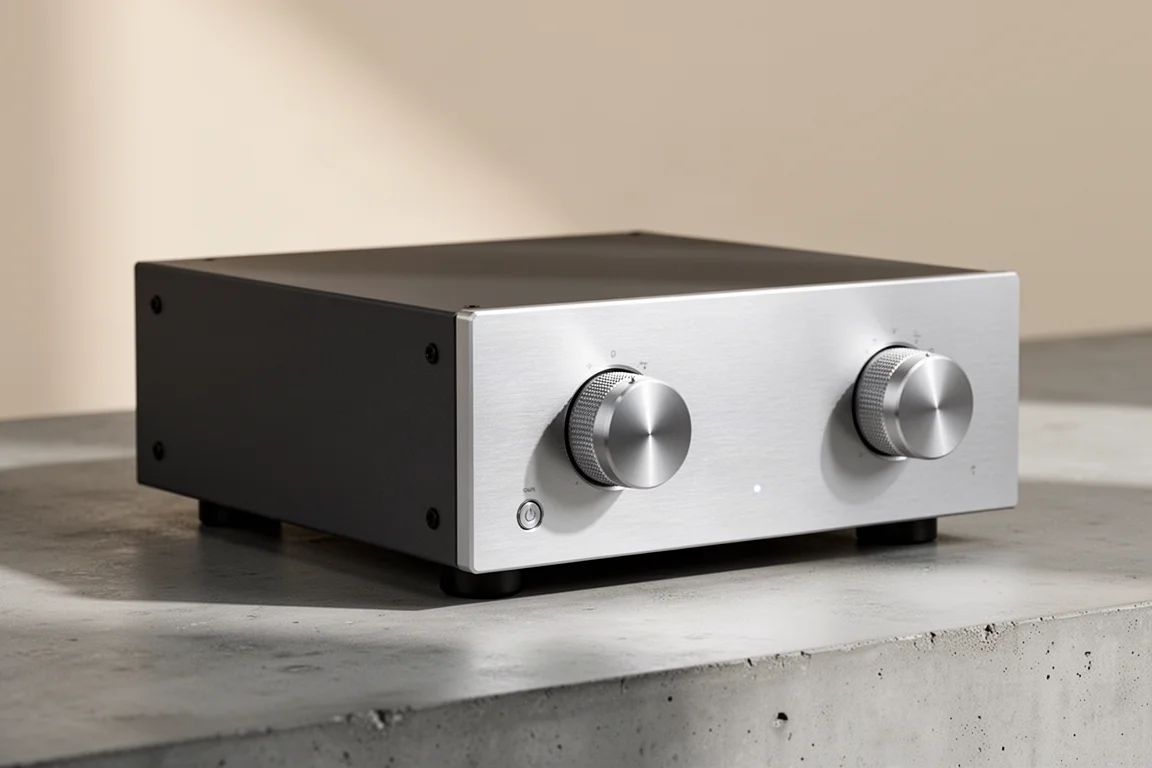
The ANV-50 is a conventional rack-width unit measuring 430 x 143 x 370 mm (16.9 x 5.6 x 14.6 in). It uses a folded steel chassis and a thick anodised aluminium front panel. Charcoal and titanium finishes come as standard, with custom colours available at extra cost.
The front panel keeps things simple: a power button with an LED indicator beside it, a central rotary volume dial with a good amount of resistance, and a second large knob for input selection. That input selector is not motorised, and the six buttons on the supplied remote control adjust volume in small, large and intermediate steps. All the connectors, including the speaker terminals, are of good quality.
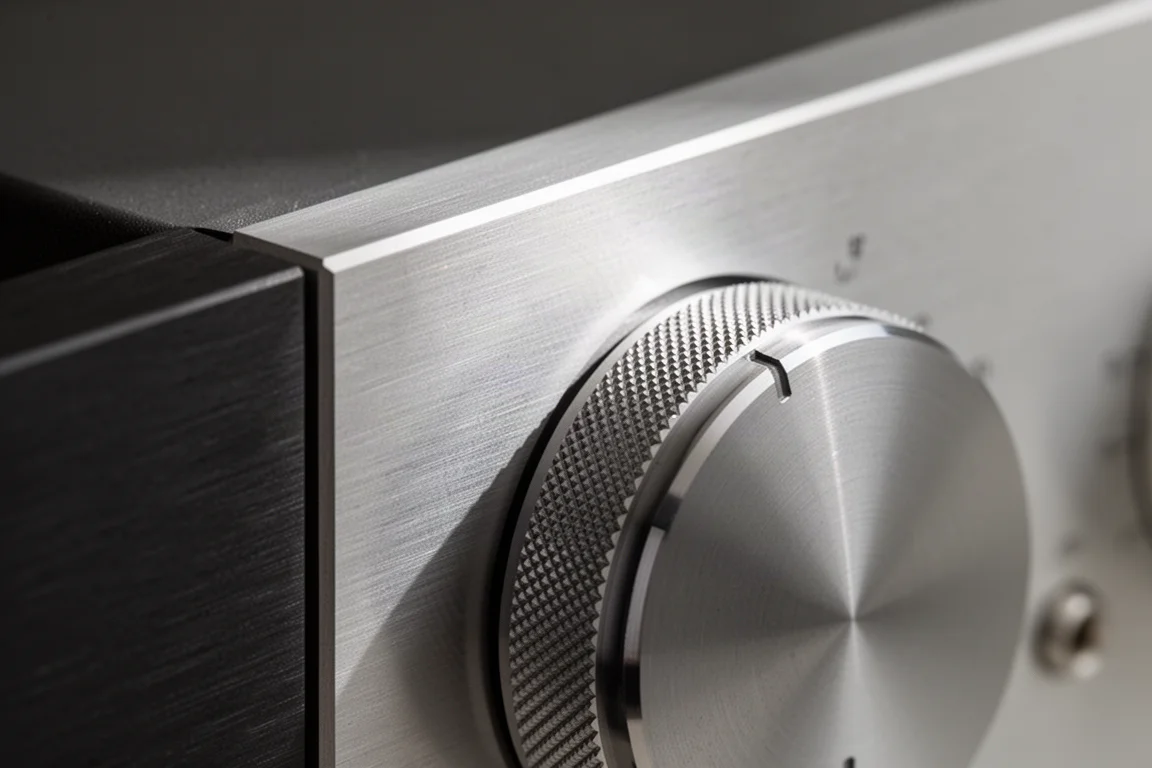
Build quality extends to the internals. The amplifier weighs 11 kg (24 lb), the same as the smaller A21 Signature, despite using a very different power supply arrangement.
Inside the ANV-50
The first thing to notice inside is the absence of a power transformer. The ANV-50 uses a switch mode power supply instead, one per channel, running at 1 MHz. Sugden describes these supplies as high current and very stable, and says they allow the amplifier to deliver power instantly in a manner comparable to its Class A designs, where the transistors are always on.
That supply behaviour is one reason the power amplifier section can double its output from 50 W per channel into 8 ohms to 100 W into 4 ohms. The other is the two-stage power amplifier module: a 4 W per channel pure Class A first stage feeds a Class AB second stage, and a comparator and correction circuit compensates for errors caused by distortion and varying loads. An identical module sits on the other side, making this a dual mono current feedback design.
The construction is deliberately old school. The power amplifier uses all discrete through-hole components, the pre-amplifier is DC coupled to the power amplifier so there are no capacitors in the signal path, and there are no tiny surface mount components in the pre-amplifier section. This fully hand-built through-hole topology is a large part of what the price buys.
Main Strengths: Sound Quality and Control
The ANV-50 does not sound like a typical Sugden Class A amplifier, and that is the most important thing to understand about it. Where the A21 Signature and the flagship Masterclass IA-4 have a distinct character, this amplifier does not. There is still a light dusting of added warmth in the mid-range, but the bass is tighter and lighter, mid-range transients are crisper, and the high frequencies are no less or more resolving.
What it shares with the rest of the Sugden family is an ability to produce a large sound stage. Imaging is not laser etched, and precise placement of performers has never been a Sugden standout feature, but the amplifier is competent in that regard. Its control over speaker drivers is superior to reference amplifiers below £3,000.
Power figures rarely tell the whole story, and 50 W into 8 ohms may not sound like much. The ability to double that output into 4 ohms is a better real-world indication of driving ability, and it is ample for most people, even with lower sensitivity speakers in average sized rooms at listening levels that will not annoy the neighbours.
In practice, that even-handed delivery means the amplifier rarely draws attention to itself. It is very good at pretty much everything rather than spectacular at one thing, and that reads as a deliberate design choice rather than a shortcoming.
Things to Consider Before Buying
The most obvious omissions are a built-in DAC and a phono stage. Buyers who want an all-in-one solution will need to budget for separate components, and the amplifier’s neutrality means partnering equipment has a strong influence on the final result.
The second consideration is character. Listeners who love the weighty bass and rich yet revealing mid-range of Sugden’s Class A models may find the ANV-50 too neutral. The A21 Signature, which retails for just under £3,000, and the Masterclass IA-4 at £6,670 both offer that warmer, more organic presentation.
Third, there is the question of headroom. For roughly £1,000 more, there are amplifiers that deliver a little more scale, more authority and a touch more fidelity. In the most demanding systems the ANV-50 does not quite match their resolution, and 50 W has limits no matter how good the power supply is.
Buying Advice
The ANV-50 is at its best with speakers that are revealing without being ruthlessly lean. Highly resolving speakers with a warm tonal balance played to its strengths, and it is obliging with designs that like a bit of current. Deep bass speakers loaded by a transmission line would ideally be paired with an amplifier offering tighter low-end control and greater resolution, but the Sugden copes well.
Comparisons are where the value case becomes clear. A Hegel H190 at £3,250 cannot match the ANV-50’s ability to separate instruments and extract nuanced information, although it can play louder and has a slightly drier tonality. A Hegel H400 at £5,900 sounds bigger, cleaner and more precise, but it is not as natural sounding. The Luxman L505Z at £5,500 shares the ANV-50’s neutrality and natural tonality but not its fidelity, and despite offering 100 W rather than 50 W, the Sugden holds its composure better at the higher volumes many listeners enjoy.
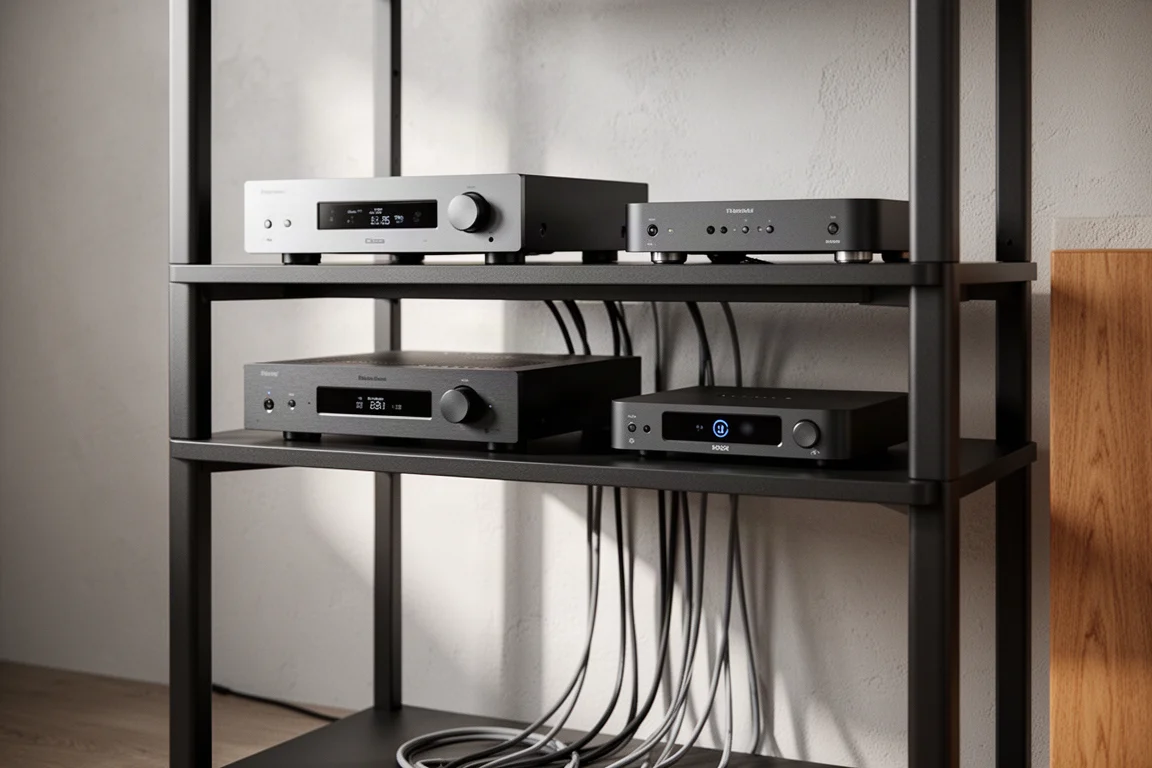
Against those alternatives the ANV-50 is cheaper and arguably the better all-rounder in all but the most demanding systems. Its appeal is broad: it pairs successfully with a wider variety of speakers than Sugden’s Class A models, and it does a better job of getting out of the way and simply delivering the music.
Conclusion
Sugden’s decision to mark its 50th anniversary by moving away from a single-ended Class A design should be counted a success. The Masterclass ANV-50 is well constructed, offers great detail, and remains neutral and natural in its delivery. It has enough real-world power to satisfy all but the most demanding users.
If you want the classic Sugden warmth, the A21 Signature and the Masterclass IA-4 remain the place to look. If you want a hand-built British integrated amplifier that works with a wide range of speakers and stays out of the music’s way, the ANV-50 deserves a serious listen.
Product link
View more details for Sugden Masterclass ANV-50
This product is mentioned in the review. Check the specifications, options, and compatibility before buying.
View more details for Sugden Masterclass ANV-50Further reading
Related Reviews
Integrated Amplifiers
Advance Paris A10 Classic Review: Vintage Looks and a Lively, Punchy Sound
The Advance Paris A10 Classic pairs glowing blue VU meters and a tube stage with one of the widest input sets on any integrated amplifier. Here is what it does well and what to weigh before spending $2,500.
Integrated Amplifiers
Advance Paris A12 Apex Review: A Modern Integrated Amplifier With Vintage Character
A dual mono integrated amplifier with 180 watts per channel, a tube front end, VU meters, and a connectivity list that covers turntables, televisions, computers, and headphones.
Integrated Amplifiers
Advance Paris Nova Range Review: AI130, AI190 and Modular Upgrades
A practical look at the Advance Paris Nova range, including the AI130 and AI190 integrated amplifiers and the modular streaming, Bluetooth and remote accessories that expand them.