Home Theater
Sony HT-A9 Review: A Four-Speaker Dolby Atmos System That Adapts to Your Room
A four-speaker wireless Dolby Atmos system built for awkward rooms, with one clear caveat: the matching subwoofer is not really optional.
Introduction
Sony’s HT-A9 takes a different route to surround sound. Rather than a single soundbar with a handful of virtual channels, it uses four compact wireless speakers and a hub that maps them to your room. The result is a system that can sit on a credenza, a bookshelf, a speaker stand, or be mounted to a wall, and still build a convincing bubble of sound around the listener.
That flexibility is the whole point. Most surround systems demand that speakers go in specific places. The HT-A9 is designed to work even when they cannot, and it supports Dolby Atmos, DTS:X, and high-resolution audio while doing it. The one thing it does not deliver on its own is deep bass, and that shapes the buying decision more than anything else.
Who the Sony HT-A9 Is For
This system suits anyone who wants genuine, object-based surround sound in a room where cable runs and fixed speaker positions are not realistic. Living rooms with awkward layouts, open-plan spaces, and rooms where the furniture cannot be rearranged all fit the brief. Because the speakers only need power, placement stays flexible and the usual tangle of speaker cable disappears.
It also appeals to viewers who care about dialogue clarity as much as effects. The system creates a phantom center channel that keeps voices anchored to the screen, which matters for anyone who watches a lot of drama and dialogue-heavy film.
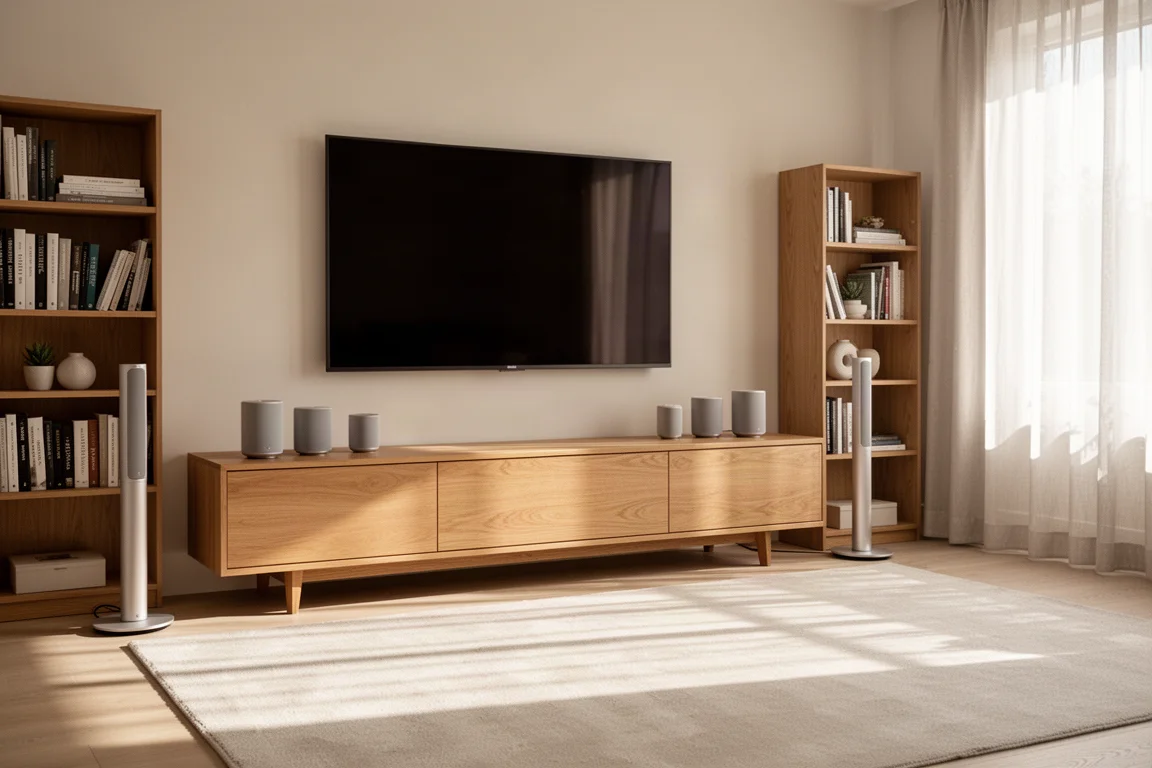
It is less suited to buyers who want the deepest possible low end straight out of the box, or who plan to mix and match components from different brands. The HT-A9 is a closed, self-contained system, and it works best when it is treated that way.
Design, Hub, and Connectivity
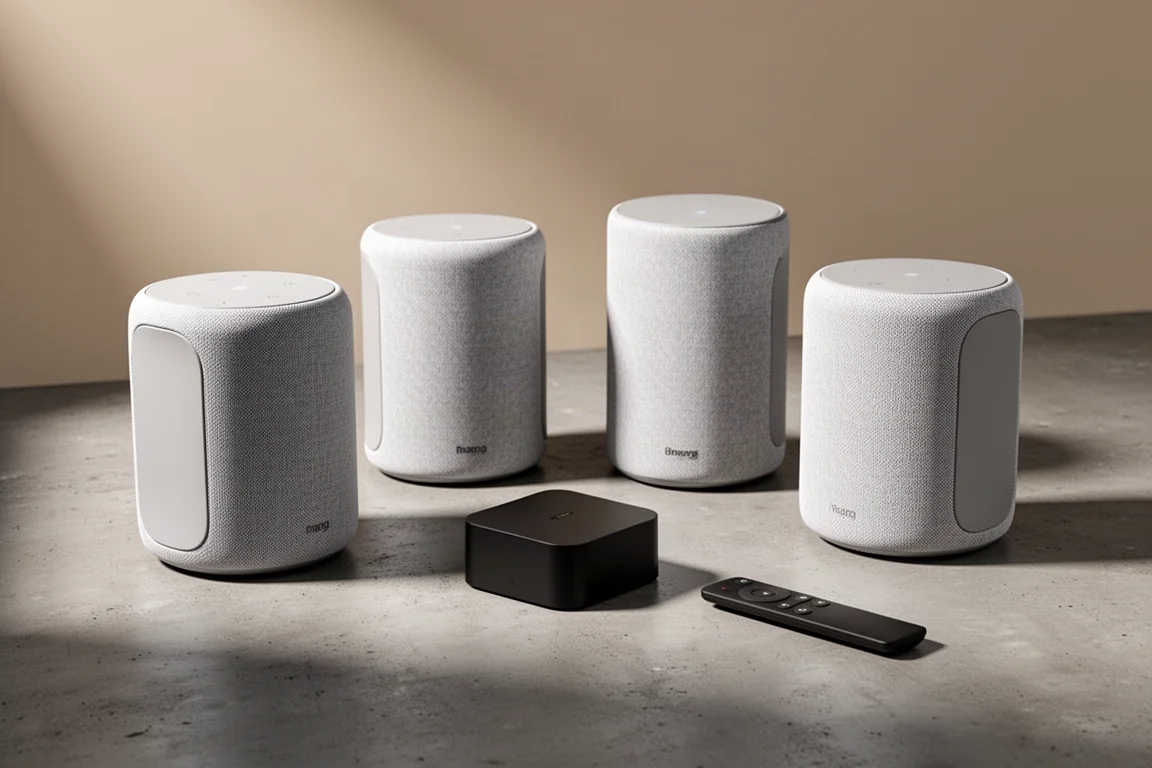
Each of the four speakers is a cylinder with a flat back, finished in light pearl gray with grilles on the top and wrapped around the sides. That shape makes them easy to place against a wall, on a credenza, on a bookshelf, or on a stand, and the finish reads as modern rather than industrial.
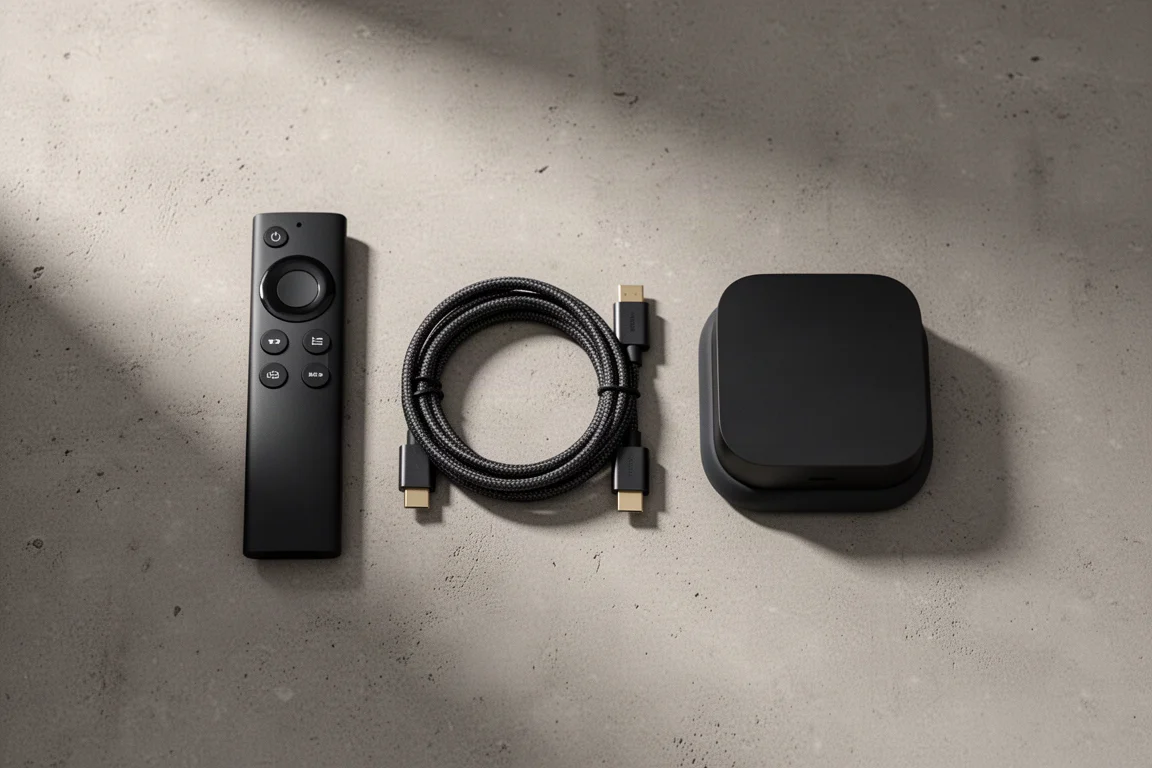
All four speakers connect wirelessly to a hub that acts as the brain of the system. It is a small black box, similar in footprint to a streaming player but roughly an inch taller and wider. On the back you get a LAN port, a USB input for updates, an HDMI output with ARC and eARC, an HDMI 2.1 input, and a center channel output for use with a compatible Sony television.
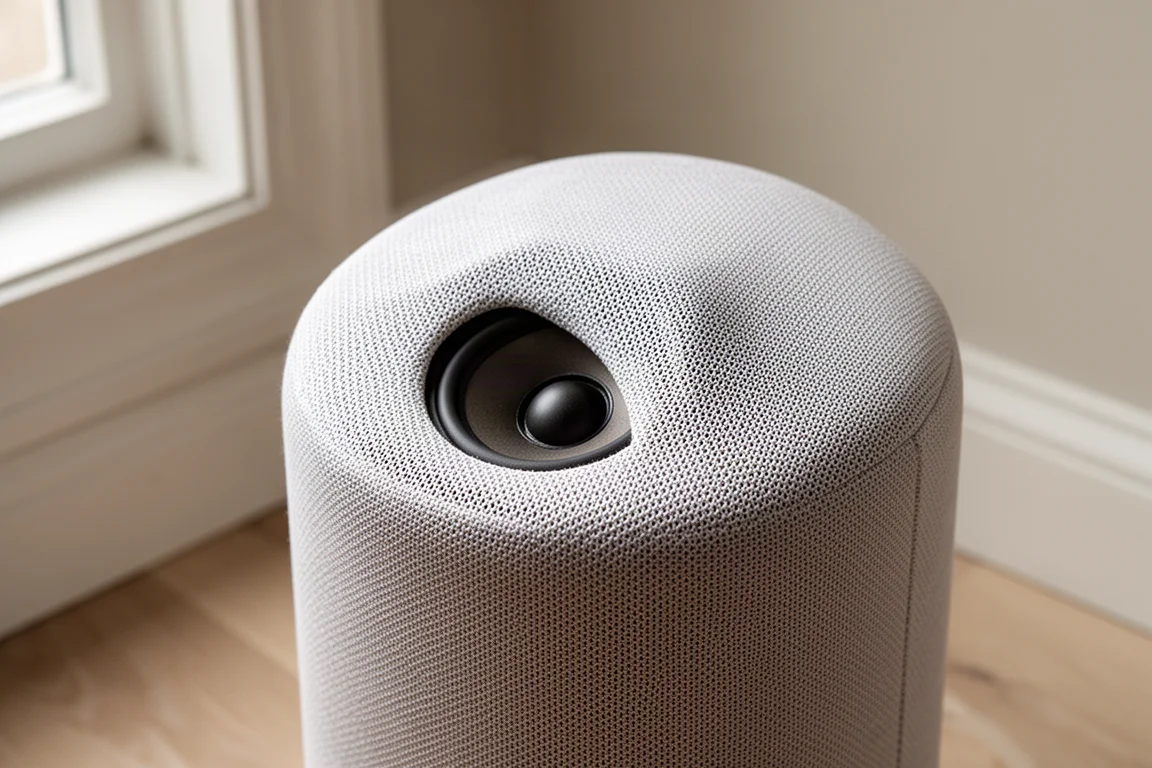
Inside each speaker sits a soft dome tweeter, a mid-bass driver facing forward, and a second driver angled upward to create height effects. Sony’s S-Master HX digital amplification powers them, with twelve amplifiers in total delivering 504 watts across the system. The drivers use an X-Balance design that is more rectangular than a traditional circular driver, which increases diaphragm area for richer bass and lower distortion.
On the video side, the hub passes through 8K and 4K at 120Hz, along with Dolby Vision, HLG, and HDR. Voice assistants, Bluetooth, Wi-Fi, Chromecast built-in, Spotify Connect, and Apple AirPlay are all supported, so the system slots into most streaming setups without extra hardware.
Setup and Room Calibration
Setup is genuinely quick. Each speaker has a label on its underside identifying it as front left, front right, back left, or back right, and the on-screen menu walks through the process step by step. If a speaker is placed in the wrong position, the system flags it and asks for a correction.
The important part is the calibration pass. Sound field optimization plays a series of test tones that detect each speaker’s horizontal and vertical position in the room, then builds a spatial map from that data. Sony’s 360 Spatial Sound mapping uses the map to create up to twelve phantom speakers from the four physical units.
Because that mapping is automatic, moving a speaker later is not a disaster. The system re-measures and adapts, which is what makes less-than-ideal placement workable rather than merely tolerable.
Sound Performance: Movies, Dialogue, and Music
With four speakers and no center channel cabinet, the system relies on processing to place sounds. In practice the effect is convincing. Action sequences move around and behind the listener, height effects bounce off the ceiling and walls, and the room feels far more populated than four speakers should allow.
Those height effects depend on the room. A ceiling around ten feet or lower, with a hard surface and no light fixtures or fans in the way, gives the most natural result. Taller or heavily obstructed ceilings will soften the overhead impression.
Dialogue is a particular strength. The phantom center channel keeps voices locked to the screen and sounds full rather than thin, close to what a dedicated center speaker would deliver. Sony also allows a compatible Bravia television to serve as a physical center channel, which is a clever option, though the television’s own speakers struggle to match the quality of the HT-A9 units, and some scenes end up sounding less consistent as a result.
Standard 5.1 content benefits too. With Immersive AE engaged, ordinary surround mixes take on much of the spaciousness of an Atmos track. The remote makes it easy to raise the bass or rear speaker level for a given film, and the voice button noticeably improves intelligibility during loud action scenes.
For music, the system supports 360 Reality Audio and Dolby Atmos Music, and the enveloping effect is just as striking there as it is with film. Sound modes such as Cinema and Music shape the presentation, though there are no manual treble, mid, or bass adjustments beyond level trims.
Why the Sony SA-SW5 Subwoofer Completes the System
On its own, the HT-A9 is articulate and immersive, but the low end is restrained. Big action scenes lack the weight that makes explosions and impacts land.
Adding the Sony SA-SW5 changes the character of the system. Low frequencies spread more evenly through the room, and the extra headroom lets dialogue and Atmos effects come forward instead of competing with the main channels. It is the difference between a good surround experience and a genuinely convincing one.
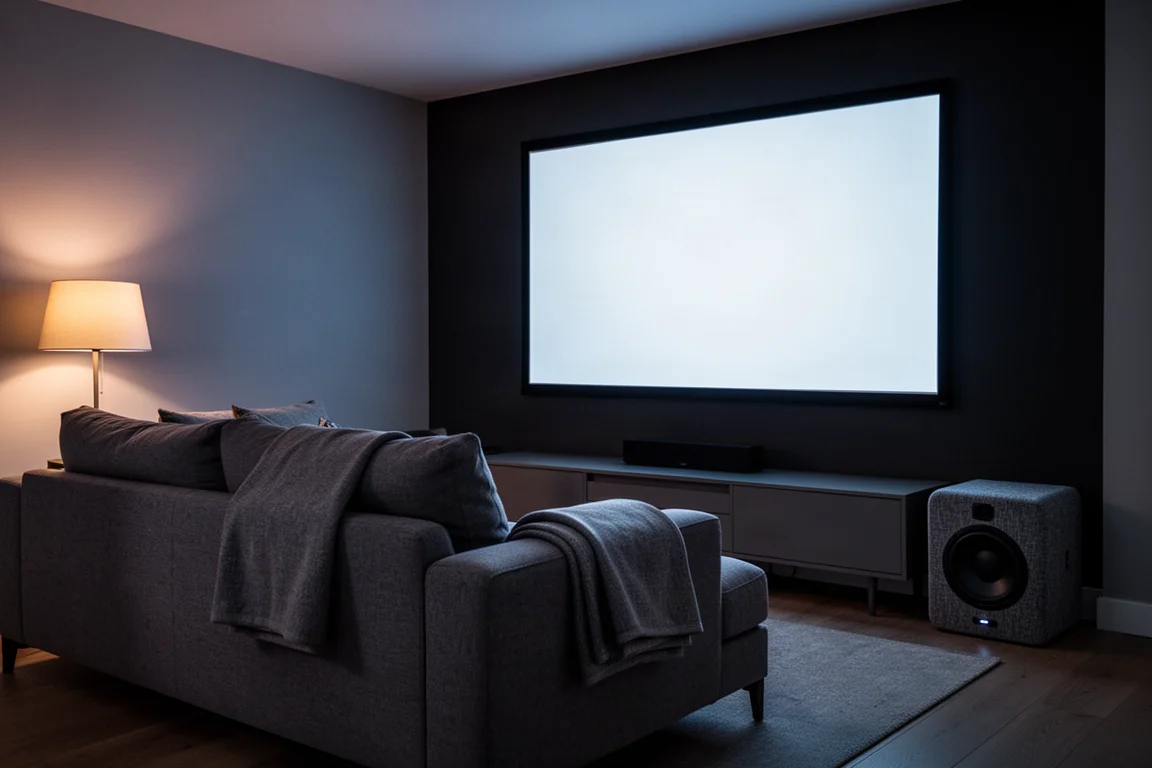
For anyone buying the HT-A9 for film, the subwoofer should be treated as part of the purchase rather than an optional extra. Without it, the system never quite reaches its potential.
Things to Consider Before Buying
Room geometry matters. The overhead effects rely on sound reflecting back down, so a low, hard ceiling gives the best results and a tall or cluttered one will not.
Every speaker still needs a power outlet within reach. Wireless removes speaker cable, not power cable, so plan the positions accordingly.
The absence of a full equalizer is worth knowing about. Bass and rear levels can be adjusted from the remote, and sound modes change the overall character, but there is no manual treble or mid control for fine tuning.
Finally, the subwoofer is effectively required for film use, which pushes the total cost of a satisfying setup above the price of the main system alone.
Buying Advice
The HT-A9 makes the most sense for a room where conventional surround speakers would be impractical, and for a buyer who values immersion and dialogue clarity over raw output. In that setting it competes with far more elaborate separate speaker packages, which is a remarkable thing for a wireless four-piece system to do.
Budget for the SA-SW5 at the same time as the main system. The two together deliver the experience the HT-A9 is capable of, and splitting the purchase tends to leave owners underwhelmed by the bass on its own.
Buyers with a very tall ceiling, a strong preference for manual tuning, or an existing set of high-quality separate speakers may find less value here. Everyone else gets a system that is easy to live with and surprisingly hard to beat for the money.
Conclusion
The Sony HT-A9 solves a real problem. It delivers object-based surround sound in rooms that would normally rule it out, and it does so with a setup that takes minutes rather than an afternoon. Dialogue is clear, Atmos effects are convincing, and the phantom speaker mapping is genuinely impressive.
Add the SA-SW5 subwoofer and the system becomes a complete, immersive home theater solution. That combination, rather than the four speakers alone, is what makes the HT-A9 worth considering.
Product link
View more details for Sony HT-A9
This product is mentioned in the review. Check the specifications, options, and compatibility before buying.
View more details for Sony HT-A9Further reading
Related Reviews
Home Theater
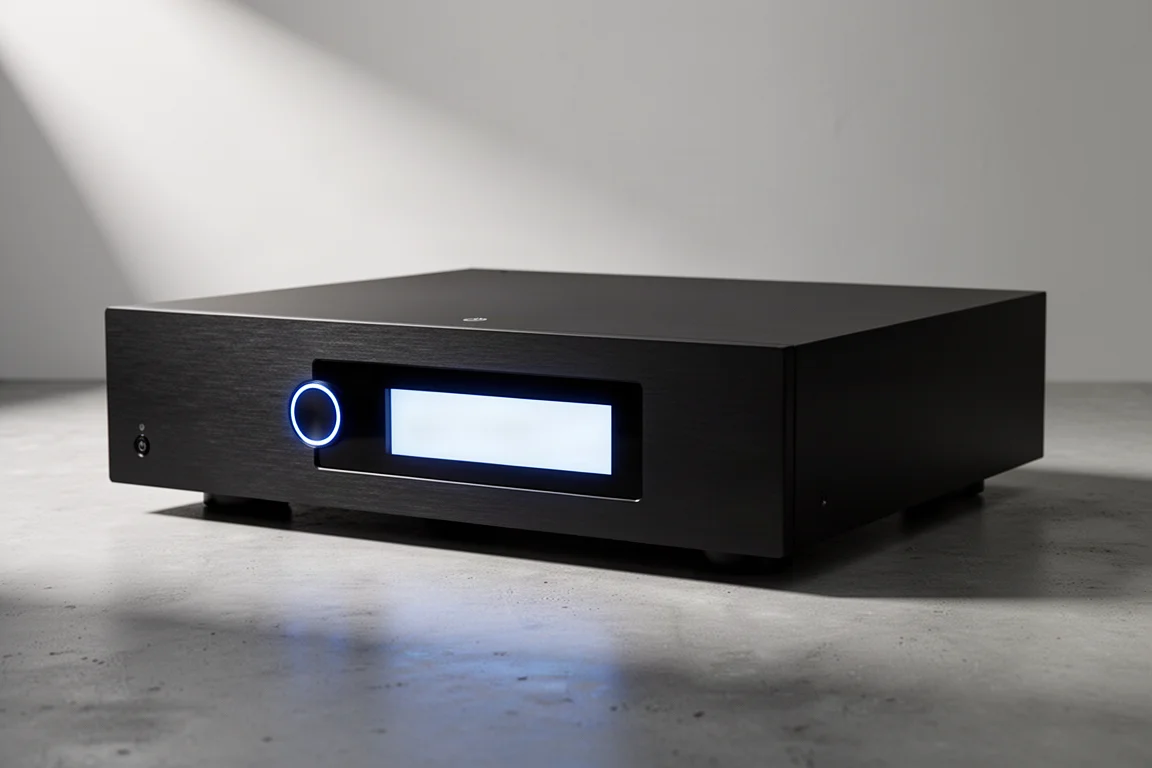
Anthem AVM 90 Review: A 15.4-Channel Flagship Preamp Processor
A close look at Anthem's flagship preamp processor, covering its dual ESS DAC architecture, 15.4-channel layout, ARC Genesis calibration and four independent subwoofer outputs.
Home Theater
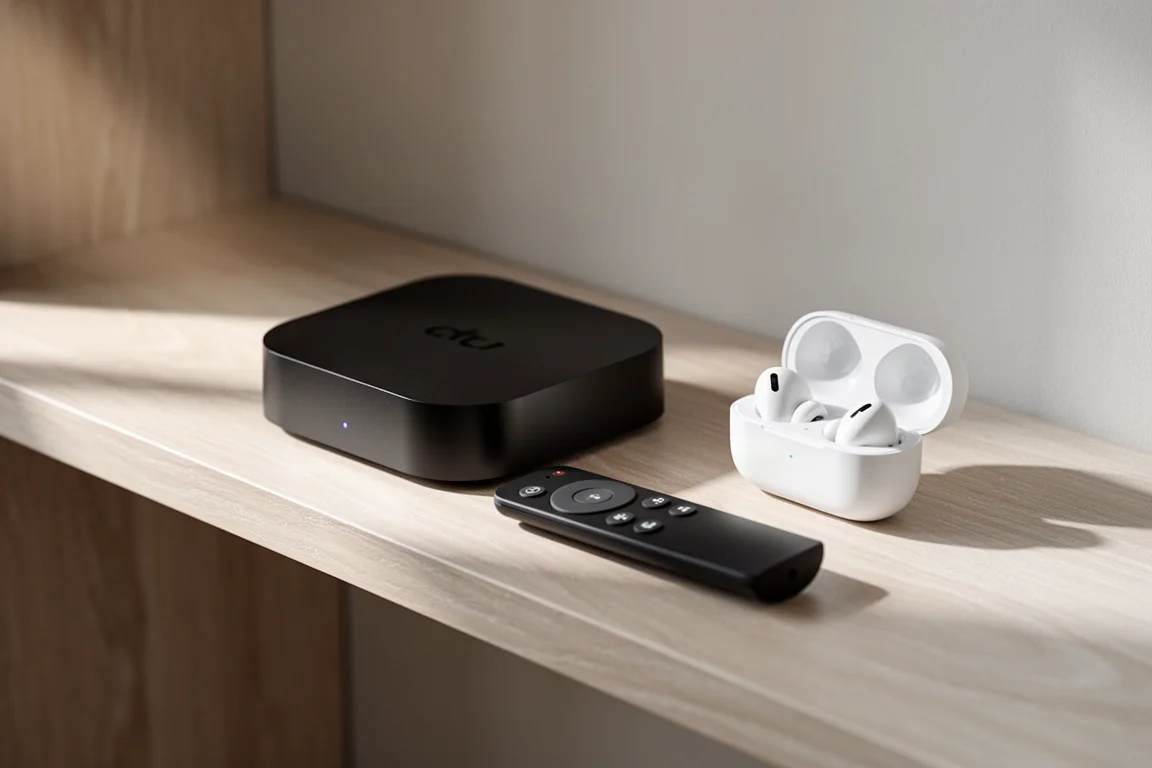
Apple TV 4K With AirPods: A Best-Value Home Theater Setup
An Apple TV 4K paired with AirPods over Bluetooth makes a compact home theater setup for movies, spatial music and late-night viewing, and it can be assembled for as little as $300.
Home Theater
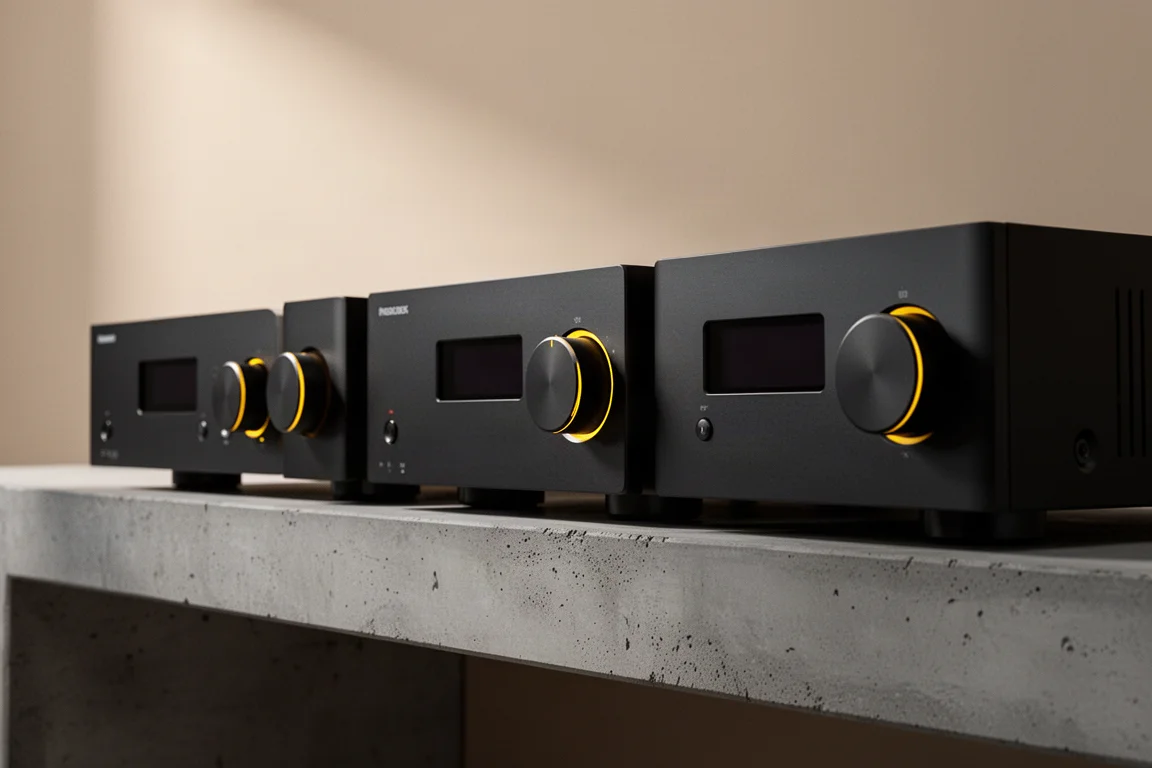
Arcam AVR15, AVR25, AVR35, and AVP45 Compared: Which AV Amplifier Fits Your System?
Four new Arcam home theater components share nine-channel amplification and Dirac Live, but differ in power, processing ceiling, and channel flexibility.