Desktop Audio
Schiit Gjallarhorn Review: A Compact Desktop Speaker Amp With a Clean, Quiet Character
A practical look at the Schiit Gjallarhorn desktop speaker amplifier: 10 W per channel in stereo, 30 W bridged mono, and what that means for a nearfield setup.
Introduction
The Schiit Gjallarhorn is a small speaker amplifier built for desks rather than living rooms. It has no volume control of its own, which tells you a lot about the intent: it is designed to sit at the end of a chain that already has one, whether that is a preamp, a DAC with variable output, or a source you can adjust directly.
That decision keeps the front panel empty and the footprint small, and it lets the amplifier share the same dimensions as Schiit’s other desktop components. It also means the Gjallarhorn only makes sense if the rest of your system is ready for it. At around $600, it is positioned as a premium desktop component rather than a budget first amplifier, so the interesting question is not whether it is loud, but whether it is clean and quiet enough to justify the outlay.
Who the Schiit Gjallarhorn Is For
The Gjallarhorn suits listeners who work at a desk and want a proper speaker amplifier instead of powered speakers or a headphone-only setup. It pairs naturally with reasonably efficient bookshelf speakers used at nearfield distances, and it makes the most sense for people who already own a preamp or a variable-output DAC.
It is also a good match for anyone who wants the option of running a single amplifier in bridged mono, either now or later. Because it lines up with Schiit’s other desktop gear, it stacks neatly with a matching DAC or preamp, which matters if you care about how the desk looks as much as how it sounds.
If your speakers are hard to drive or your room is large, this is probably not the amplifier you are looking for. The Gjallarhorn is at its best in a controlled nearfield environment, where a handful of clean watts goes a long way.
Power, Connections, and Setup
In stereo, the Gjallarhorn delivers 10 W RMS per channel into an 8-ohm load and 15 W RMS into a 4-ohm load. Bridged, using the XLR input in mono, it produces 30 W. Those numbers put it firmly in desktop territory, and they are worth reading next to the efficiency of your speakers rather than on their own.
The output stage is described as a Continuity design: fully discrete, fully complementary current feedback, with no capacitors in the signal path. In practice, that means a simple signal path with fewer parts doing the work.
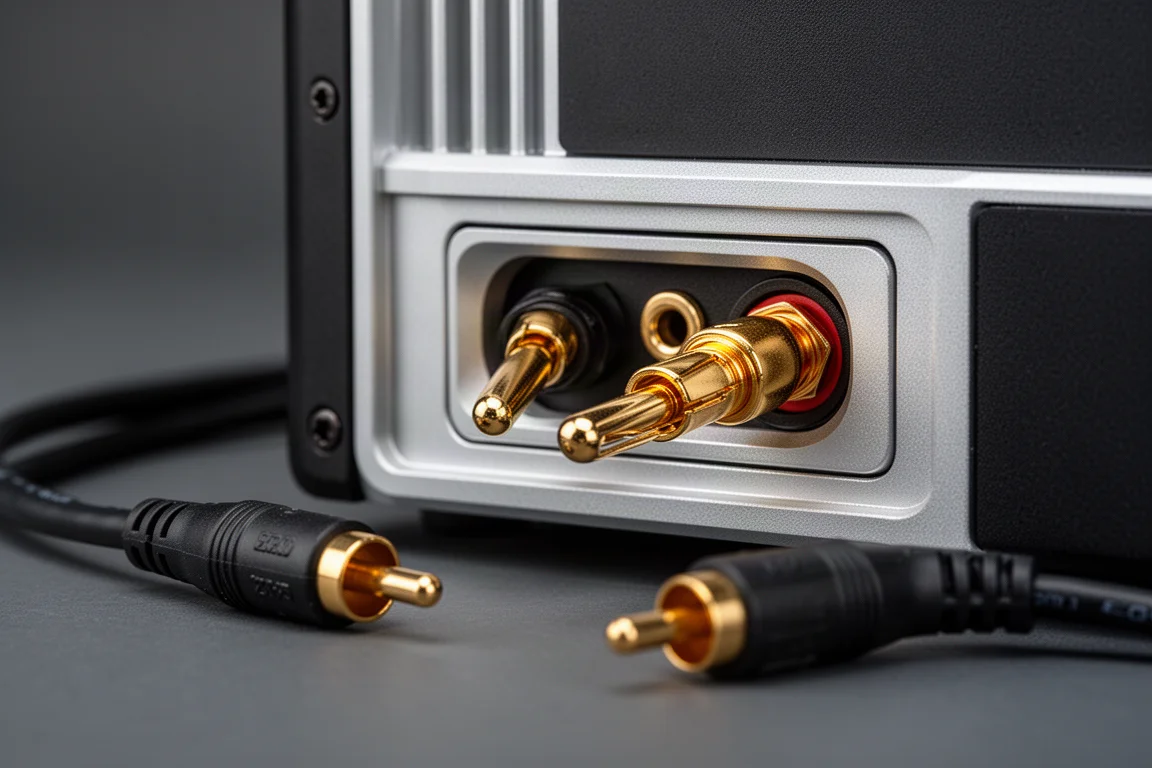
Around the back, the layout is straightforward. Stereo listening uses the pair of RCA inputs, while bridged mono uses the XLR input alone. The speaker outputs are recessed and flush-mounted, which looks tidy but works best with banana plugs, since feeding bare wire into them is awkward. There is also a toggle power switch on the rear panel and a standard IEC socket for the power cable.
Bridging is clearly marked and simple to set up: you use the two positive terminals from both channels along with the corresponding negative connections. It is the kind of thing you do once and then forget about.
Main Strengths: Clean Sound and a Low Noise Floor
The Gjallarhorn does not announce itself with a strong tonal signature. Nothing about it sounds boomy, thin, forward, or harsh on top. It simply gets out of the way, which is a harder trick than it sounds and often exactly what a desktop system needs.
That quality shows up most clearly in the sense of space between instruments and in the quietness of the background. Even when the amplifier is bridged, the noise floor stays low, and the extra headroom makes the presentation noticeably more dynamic without adding grit.
With speakers in the 86 to 87 dB sensitivity range, the amplifier drove both stereo and mono configurations without complaint. It is not a powerhouse, and it is not meant to be, but within sensible desktop listening levels it does not feel strained.
Midrange clarity is the standout trait. If you listen to acoustic material, vocals, or anything where separation matters more than weight, that is easy to appreciate over long sessions.
Bridged Mono: Getting More From the Same Chassis
Bridging turns the Gjallarhorn into a 30 W mono amplifier, which is a meaningful step up from the stereo rating and changes the character of the amplifier more than the numbers alone suggest. Dynamics improve, and the sound gains a sense of drive that the stereo configuration does not quite match.
There is one important caveat: in mono, the amplifier is rated for 8-ohm speakers only. Lower-impedance loads can work at moderate levels, and a 6-ohm speaker may run without shutting the amplifier down, but pushing hard could trigger protection. If you plan to run bridged, matching it to an 8-ohm speaker is the safer approach.
Even bridged, this remains a desktop amplifier. Sustained levels around 90 dB are outside its comfort zone, and most bookshelf speakers start to lose composure around 85 dB anyway. Used as intended, in a nearfield setup, that ceiling is rarely a practical limitation.
How It Compares With Other Desktop Amplifiers
Class D designs offer a very different set of trade-offs. A compact class D amplifier such as the Fosi Audio BT20A Pro, with its included 32 V 5 A power supply, can deliver roughly 40 to 50 W per channel into 8-ohm speakers, and it includes tone controls. In a direct comparison, that extra power translated into a more dynamic presentation, which is what you would expect from two to three times the output.
What the Gjallarhorn counters with is a greater sense of space and instrument separation, plus a very quiet background. Tonality between the two was broadly similar, though tone controls on a class D amplifier are not guaranteed to be perfectly neutral at every setting, which makes the comparison less than exact.
The honest summary is that the Gjallarhorn trades power and flexibility for clarity and quietness, and it asks a higher price for the privilege. Lower-cost class D options from brands such as Fosi and Aiyima will get a desktop system running for considerably less money.
If your priority is headroom and adjustability, class D is the practical route. If your priority is a clean, uncoloured midrange in a nearfield setup, the Gjallarhorn makes a persuasive case.
Things to Consider Before Buying
The first thing to check is volume control. The Gjallarhorn has none, so you need a preamp, a DAC with variable output, or a source with its own level control. Without one of those, the amplifier cannot be used at all.
The second is power. This is a desktop amplifier with modest output, and it will not fill a large room or drive inefficient speakers to high levels. Speakers in the mid-80s dB sensitivity range work well at nearfield distances, but expectations should stay realistic.
The third is the mono rating. Bridged operation is specified for 8-ohm speakers, and while lower-impedance loads may behave at moderate volume, that sits outside the official specification.
Finally, there is the price. At around $600, the Gjallarhorn sits well above most compact class D amplifiers, and the same budget could go toward a more powerful amplifier in Schiit’s own range. What you are paying for is a specific combination of low noise, clean midrange, and a compact chassis that matches the rest of a desktop stack.
Buying Advice
The Gjallarhorn is easy to recommend for the right setup: a desk, reasonably efficient bookshelf speakers, and a preamp or variable-output DAC already in place. In that context it delivers a quiet, natural sound that stays pleasant for hours at a time, and the option to bridge it later adds useful flexibility.
If you need more power for a larger space, or you want tone controls at the lowest possible cost, class D alternatives remain the sensible choice. If you are already invested in a desktop stack from the same brand and want the amplifier to match it in size, finish, and character, the Gjallarhorn is a coherent addition rather than a compromise.
Schiit’s reputation for direct customer support and warranty service is another point in its favour for buyers who care about what happens after the purchase.
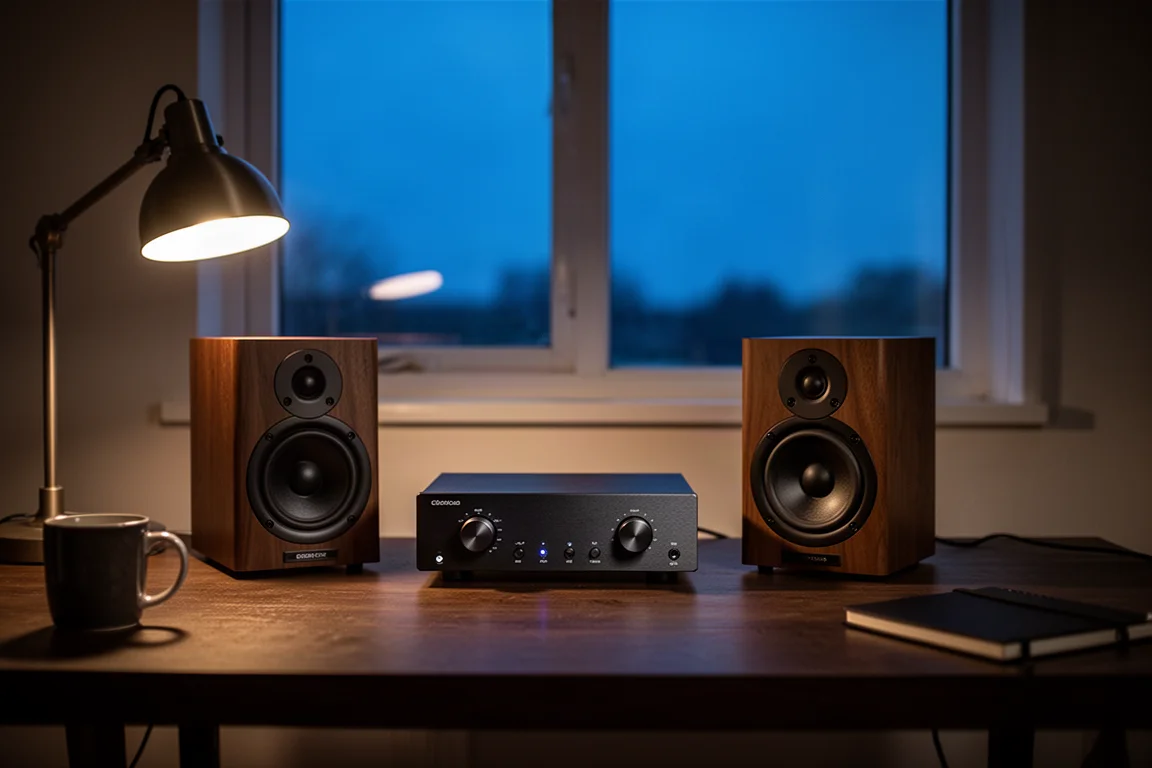
For most people, the deciding factor will be the speakers rather than the amplifier itself. Pair the Gjallarhorn with something efficient and it will sound clean and composed. Pair it with something demanding and its limits will show up quickly.
Conclusion
The Schiit Gjallarhorn is a focused product. It is small, quiet, and clean, with a bridged mode that adds genuine headroom when you want it. It is not powerful, it has no volume control, and it costs more than most of its class D rivals.
Those are not flaws so much as a description of what it is. Buy it for a nearfield desktop system with the right speakers and the right preamp, and it does exactly what it promises.
Product link
View more details for Schiit Gjallarhorn
This product is mentioned in the review. Check the specifications, options, and compatibility before buying.
View more details for Schiit GjallarhornFurther reading
Related Reviews
Desktop Audio
ADAM Audio D3V vs Kali Audio LP-UNF: Two $299 Desktop Monitors Compared
Two compact powered desktop monitors at the same price, compared on bass extension, linearity, placement settings, directivity, and realistic output limits.
Desktop Audio
Aiyima T9 Review: A Compact Tube Desktop Amplifier With a Built-In DAC
A budget desktop amplifier that pairs class D power with two tubes, a full DAC section, Bluetooth, tone controls, and a working VU meter.
Desktop Audio
Aune S9c Pro Review: A Weighty Desktop DAC and Headphone Amplifier With Real Power
A desktop DAC and headphone amplifier with a linear power supply, dual Sabre converters and five watts of balanced headphone output. Here is what to weigh before buying.