Desktop Audio
ADAM Audio D3V vs Kali Audio LP-UNF: Two $299 Desktop Monitors Compared
Two compact powered desktop monitors at the same price, compared on bass extension, linearity, placement settings, directivity, and realistic output limits.
Introduction
Compact powered desktop speakers occupy a narrow but genuinely useful niche. They sit close to the listener, they handle their own amplification, and they let you plug in a source and start working or listening without a rack of extra gear. The ADAM Audio D3V and the Kali Audio LP-UNF both land at roughly $299 per pair, which makes them direct competitors at the same price point.
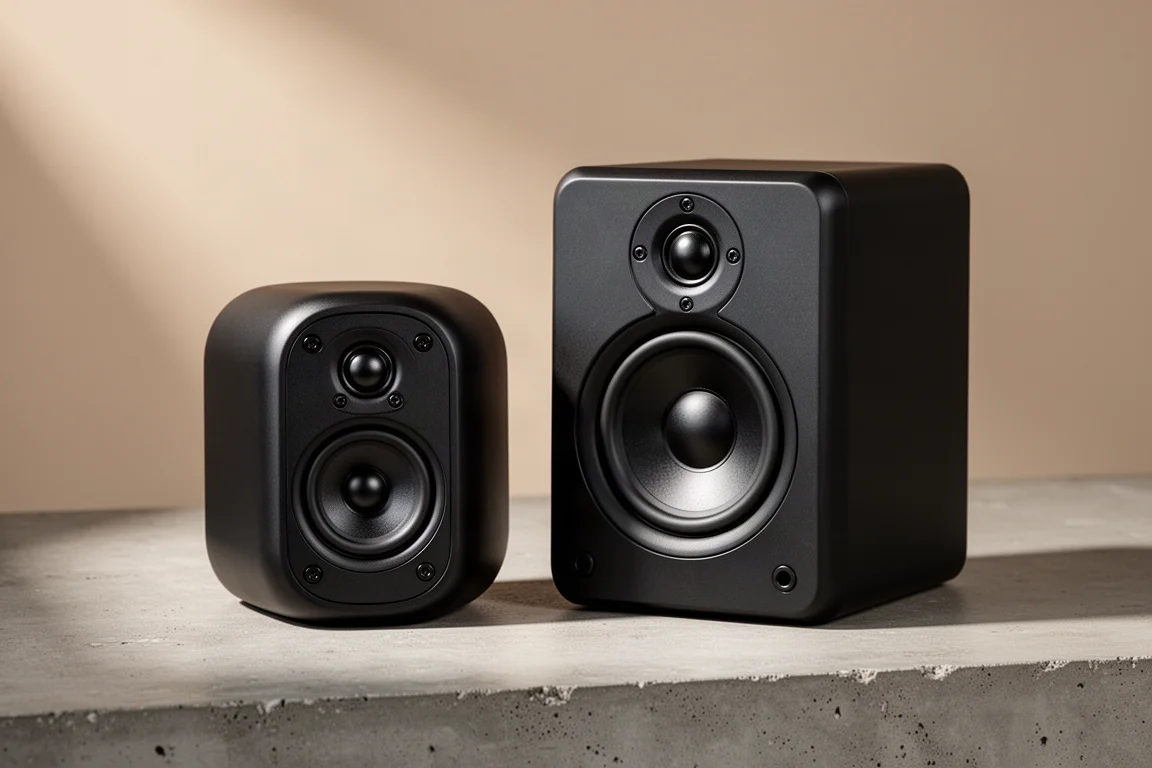
What separates them is not the price tag but the physical design. One is a genuinely small cabinet with a flat on-axis response and a useful set of rear-panel adjustments. The other is a noticeably larger box that trades some linearity for extra bass weight and a little more output. Understanding where each one stops performing well is the difference between a purchase you enjoy for years and one you outgrow in a month.
What These Desktop Monitors Are For
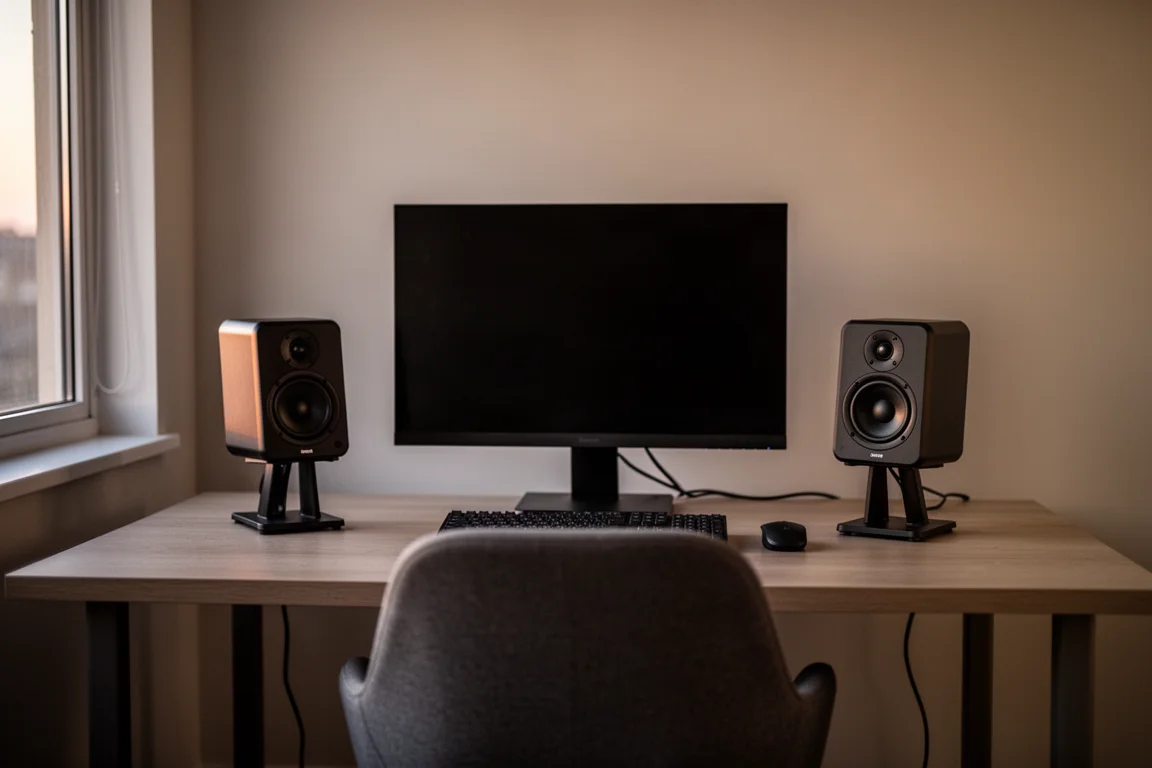
Both speakers are self-powered, so source selection and amplification are handled inside the cabinet. You connect a source and listen. Neither is designed for high output levels, and neither is intended for far-field listening. They are built for a listening distance of roughly a metre, which is the typical spacing between a desk chair and a pair of speakers flanking a monitor.
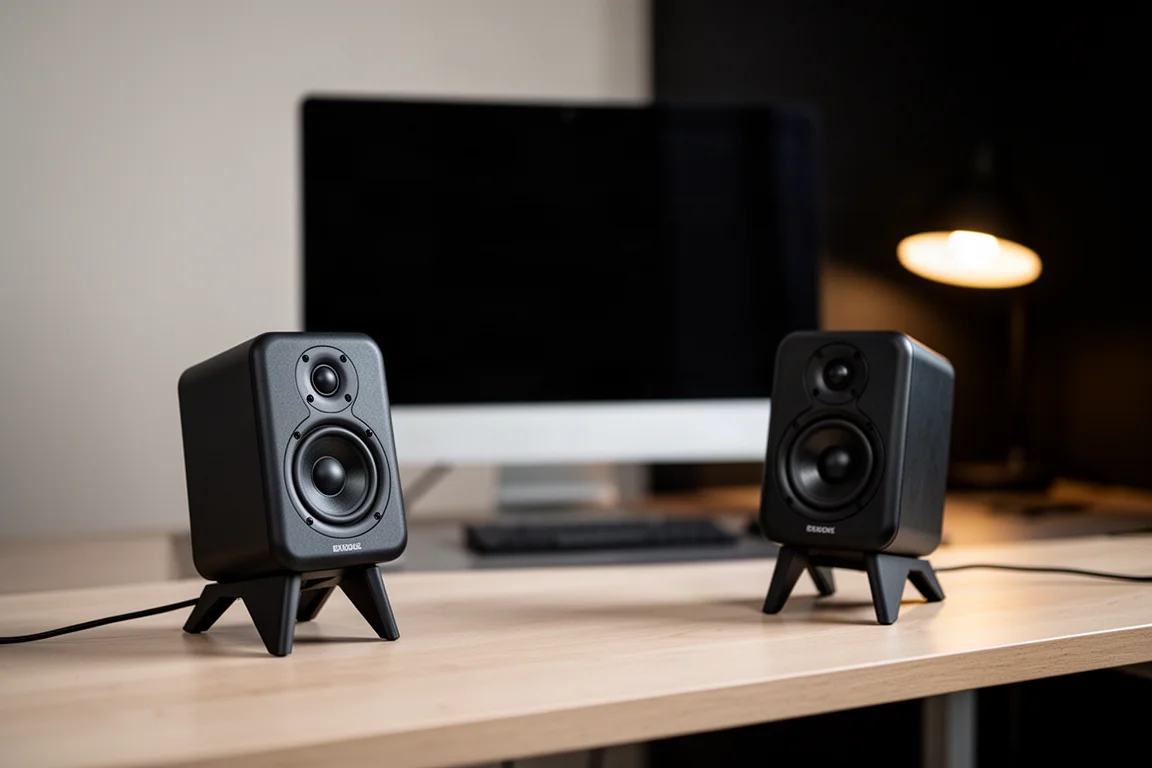
The practical consequence of that short distance is that room reflections matter less, while the speaker’s own directivity and the height of your ears matter more. A speaker that measures well on axis but falls apart a few degrees off axis will still sound uneven at a desk, because small head movements and seating changes move you around that axis. That is why the placement controls, the vertical window, and the horizontal spread discussed below are not marketing details. They are the things that determine whether these speakers work in your specific setup.
ADAM Audio D3V: Compact Powered Desktop Monitor
The D3V is a small two-way powered speaker. The woofer and tweeter sit on the front baffle, and passive radiators on the side panels add a little extra bass extension beyond what the cabinet volume alone would allow. Connectivity is handled on the rear panel, where you get USB-C alongside a couple of analog connections, including a set of balanced analog inputs and a digital audio input. A short cable runs from the main speaker to the secondary speaker, so the pair needs only one power outlet rather than two.
Measured on axis, the D3V is nominally flat, with overall response linearity sitting within roughly plus or minus 2 dB. Output stays flat down to about 50 Hz and then rolls off steeply, which means deep low-frequency content is simply not on the menu without a subwoofer. There is a mild lift across the 4 to 6 kHz region that can read as a slightly tipped-up top end. For nearfield listening at moderate levels, the result is a speaker that sounds composed and even. At about $299 per pair, it is a strong value in a compact cabinet.
Kali Audio LP-UNF: The Larger Alternative
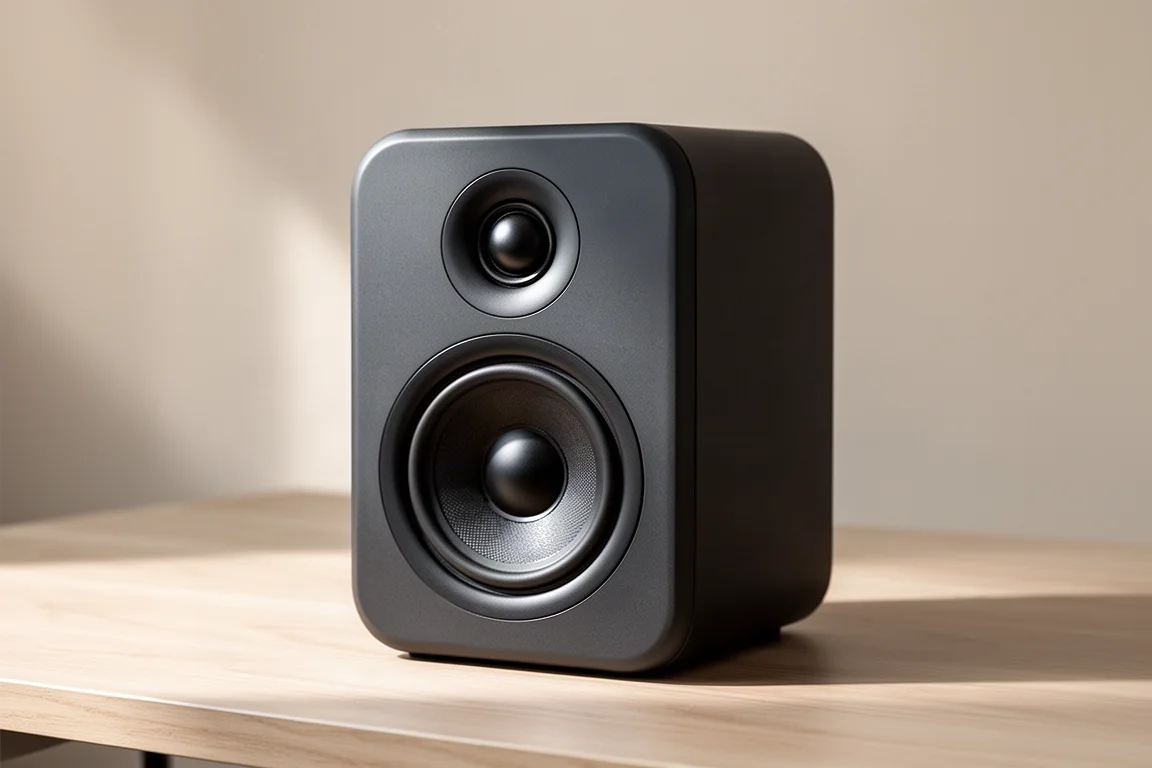
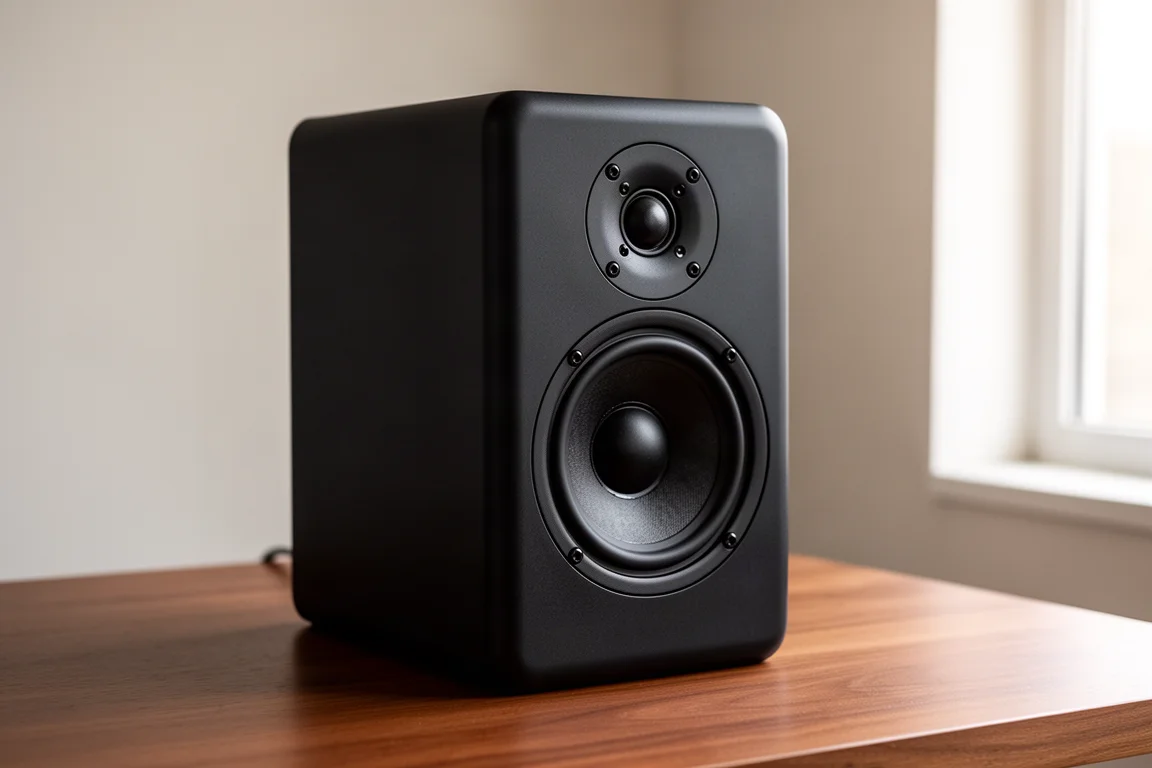
The LP-UNF costs the same roughly $299 per pair but is a good deal larger, and the size difference shows up immediately in the low end. Compared on axis, the Kali carries about 2 to 3 dB more bass, which gives it a punchier low-frequency character. That extra energy comes with a trade-off: it is less linear through that bass region than the D3V, so the added weight is not perfectly even.
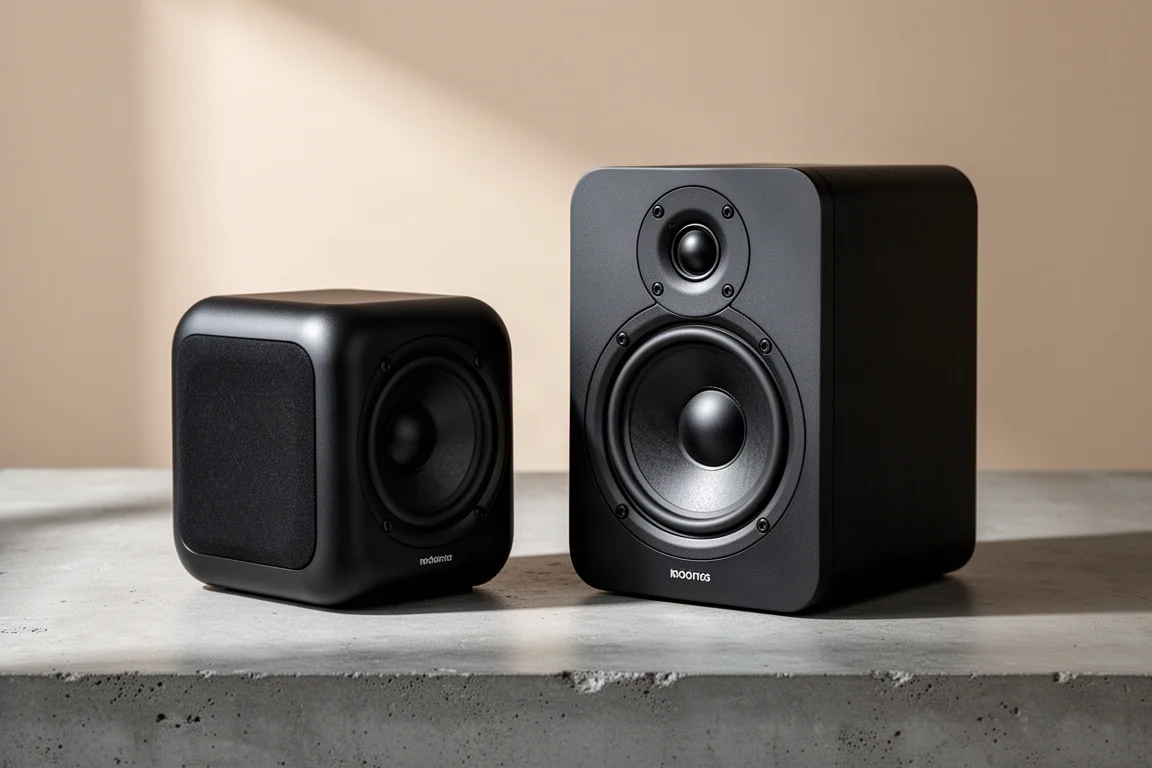
Distortion behaviour separates the two as well. At a mid output level of around 86 dB, the Kali shows considerably less bass distortion, while the D3V performs better through the midrange. On overall output capability the Kali reaches roughly 2 dB higher than the D3V, depending on whether you are measuring maximum long-term or maximum instantaneous level. The Kali also radiates wider, at about plus or minus 70 degrees against roughly plus or minus 60 degrees for the D3V, and its vertical window is a little more forgiving of seating height. Both still want your ears on the tweeter axis, but the Kali gives you slightly more wiggle room.
How the Two Compare
The core difference is straightforward. The Kali is a larger speaker at the same price, it plays a little louder, it rolls off at roughly the same point, and it carries a bit more bass boost. The D3V counters with better overall linearity and a set of rear-panel settings the Kali does not offer.
Where each one wins depends on what you are listening for. If your priority is even, predictable response across the band and you work at modest levels, the D3V is the more neutral tool. If you want more low-end weight and slightly more headroom from a desktop pair, the Kali delivers that, provided your desk can accommodate the larger cabinets. Neither is a compromise purchase at this price. The choice is about which set of strengths matches the way you actually listen.
Room Placement and Built-In Settings
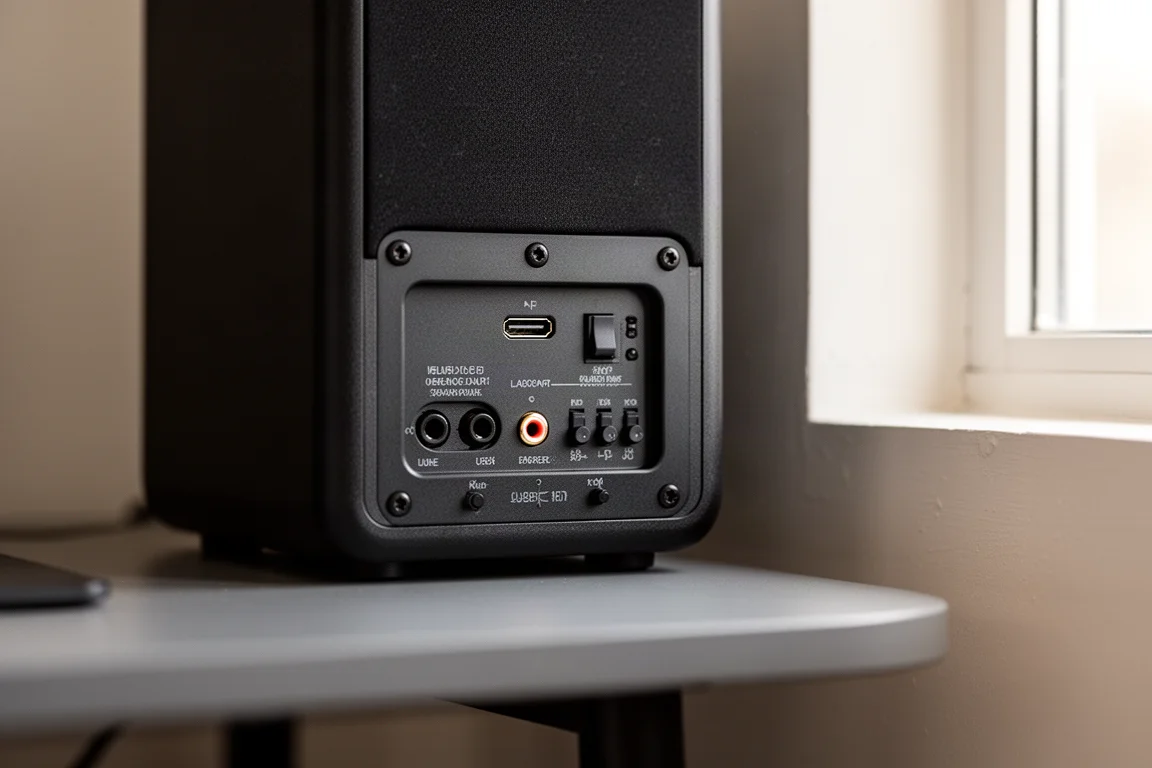
The D3V includes placement controls on the rear panel that let you tailor the response for a desk position, a position near a wall, or a room setting more generally. This matters because the speaker is nominally flat when pointed directly at the listener in an anechoic chamber. In a real room, sitting on a desk, close to a wall, or in a corner changes the balance, and those switches exist to bring the sound back toward the intended response. The balanced analog inputs and digital input on the same panel round out a flexible, tidy connection scheme for a desktop setup.
Vertical placement deserves attention on both speakers. The reference axis sits directly at the tweeter, so if you move too far above or below that line you step outside the intended response and hear less of what the design was tuned to deliver. Horizontally, the D3V’s contour holds up well, with a small deviation through the midrange and a broadening around 4 kHz that is responsible for the brighter character noticed at greater distances. In the near field, that brightness is far less pronounced. The further you sit from the speaker, the more these directivity effects shape what you hear.
Output Limits and Distortion at Higher Levels
Distortion data at increasing levels makes the intended operating window clear. At low levels the picture is clean. At around 86 dB, distortion rises noticeably in the bass region, and at 96 dB it climbs significantly across the board. Multi-tone measurements at 70, 78, and 86 dB point to the same conclusion: staying somewhere between 78 and 86 dB keeps distortion low. That range is measured for a single speaker. Adding a second speaker contributes about 6 dB of additional output, since you gain both radiating surface area and doubled power.
Long-term compression tells a similar story. Running 30 seconds of broadband noise through the speaker produces roughly 7 dB of level loss, which puts maximum SPL at about 89 dB, with instantaneous dynamic range landing around 90 dB. The built-in limiter also steps in and trims low-frequency content, and some midrange content along with it, when the speaker is pushed. Crossing over to a subwoofer at 80 Hz does not change the distortion picture much, so a subwoofer is a bass-extension tool here rather than a way to unlock more clean output. If you need real dynamic range or you listen from further away, a larger monitor with less compression and lower distortion is the better answer.
Buying Advice
Choose the ADAM Audio D3V if your desk is tight, if you value measured linearity and an even midrange, and if you want placement settings that let you tune the speaker to your desk, wall, or room. Choose the Kali Audio LP-UNF if you want more bass weight and a little extra output, and if you have the surface area for a larger cabinet. Both sit at roughly $299 per pair, and both are a meaningful step above the cheap compact powered speakers that cluster around $100. In this category, saving a little longer and buying either of these is the more sensible move.
One shared limitation is worth repeating. Neither speaker replaces a subwoofer for genuinely deep bass, and neither is built for loud, far-field listening. If you work at about a metre and keep levels moderate, both handle the job comfortably, and the decision comes down to footprint and how much low-end weight you want from the desk itself.
Conclusion
The ADAM Audio D3V and the Kali Audio LP-UNF prove that $299 per pair can buy a genuinely capable desktop monitor. The D3V is the smaller, more linear option with useful rear-panel adjustments and a footprint that disappears on a crowded desk. The Kali LP-UNF is the larger, punchier option with more bass weight, slightly more output, and wider radiation. Match the cabinet to your space, respect the listening distance these speakers were designed for, and either one will serve a desktop setup well for a long time.
Further reading
Related Reviews
Desktop Audio
Aiyima T9 Review: A Compact Tube Desktop Amplifier With a Built-In DAC
A budget desktop amplifier that pairs class D power with two tubes, a full DAC section, Bluetooth, tone controls, and a working VU meter.
Desktop Audio
Aune S9c Pro Review: A Weighty Desktop DAC and Headphone Amplifier With Real Power
A desktop DAC and headphone amplifier with a linear power supply, dual Sabre converters and five watts of balanced headphone output. Here is what to weigh before buying.
Desktop Audio
Budget Desktop Audio System: Five Components for Around $250
A complete desktop audio chain for around $250: two amplifier options, two pairs of bookshelf speakers, and a DAC with a built-in headphone amplifier.