Hi-Fi Amplifiers
Roksan Attessa Review: A Warm, Full-Bodied Streaming Amplifier With BluOS
A close look at Roksan's first streaming amplifier: a strong amplifier section, one of the best streaming interfaces available, and an internal DAC that is the clearest compromise in the package.
Introduction
Roksan has been building hi-fi in Britain since the 1980s, and its reputation was built on turntables. The Xerxes arrived in 1985 with a belt drive and no sprung sub-chassis, a design that challenged the suspension conventions of the time. The Caspian and Kandy amplifier ranges followed and remain in the lineup today, supported by a loyal following of owners and dealers. In 2016 the company was acquired by Monitor Audio, the British speaker manufacturer.
The Attessa is Roksan’s first streaming amplifier, and it comes in two versions. The non-streaming amplifier sells for £1,099 and includes a DAC. The streaming variant costs £1,599 and adds the BluOS module developed by Lenbrook, the same platform used across NAD, Bluesound and PSB products.
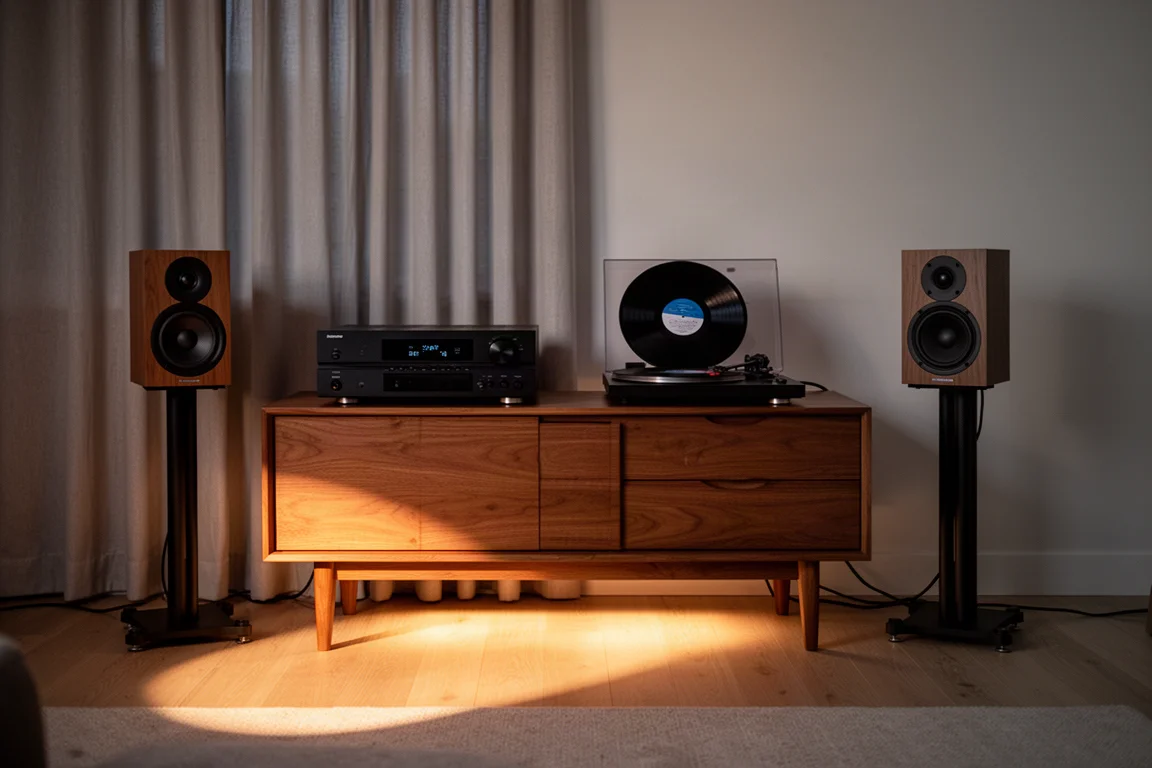
The result is an amplifier that is solidly built, easy to live with in a shared room, and genuinely competitive at its price. Its amplifier section is the strongest part of the package, and the decision to license BluOS for streaming is a smart one. There is one clear compromise to understand before buying, and it sits in the digital-to-analogue conversion stage.
Who the Roksan Attessa Is For
The Attessa makes most sense for listeners who value body and warmth over forensic precision. Its presentation is full and generous, with plenty of weight behind vocals and instruments, which makes it a comfortable long-term partner for bright or forward-sounding speakers.
It is also a strong choice for households where more than one person uses the system. The all-metal chassis is clean and understated, with a look that is easy to accommodate in a living room, and the BluOS app gives anyone in the house a straightforward way to control playback without hunting for a remote.
Finally, it suits buyers who want a phono input, a headphone output and pre-outs for a subwoofer or external power amplifier in a single box, rather than assembling those features from separate components.
Design, Build, and Everyday Controls
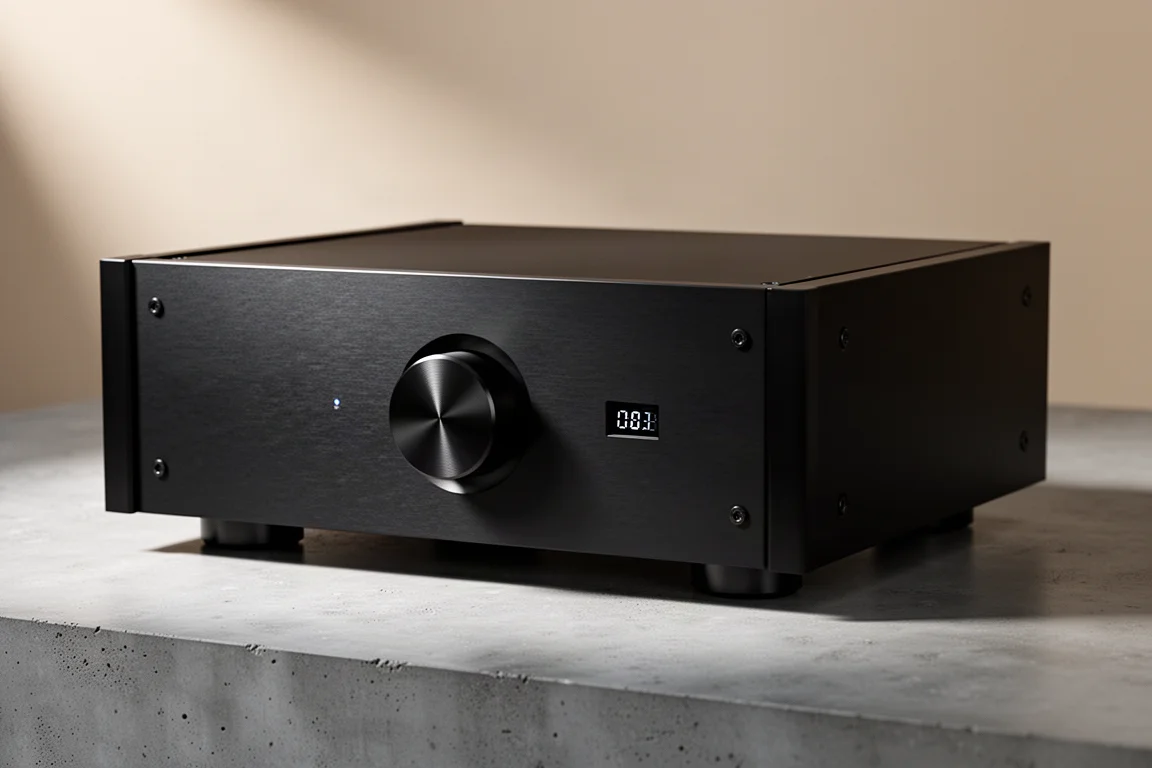
The chassis is all metal and measures 432 by 346 by 76 millimetres, or 17.0 by 13.6 by 3.0 inches. At 10.4 kilograms, or 22.9 pounds, the weight gives an early indication that nothing has been skimped on the amplifier itself.
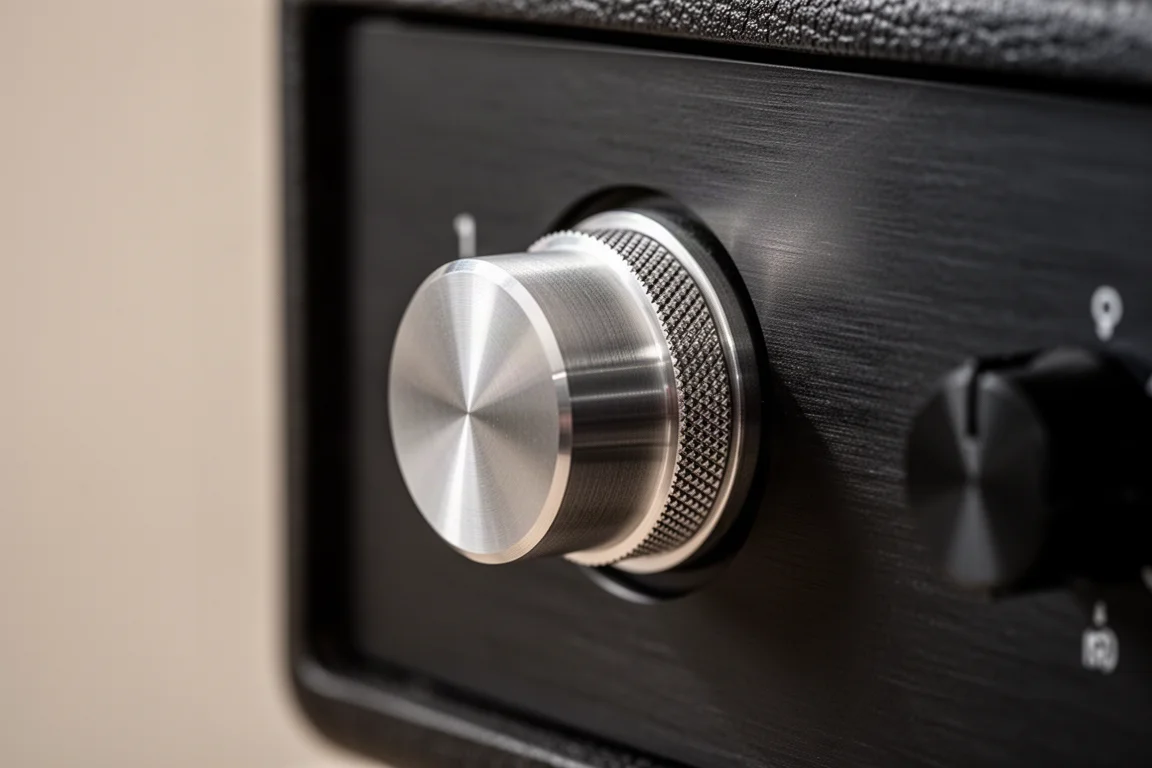
The front panel is deliberately clean. The volume dial dominates, and its LED display sits in the centre of the knob and shows volume as a number rather than a row of bars. A button takes the unit out of standby, and three discreetly hidden buttons handle play, pause, advance and track retrieval.
Input selection is the one interaction that takes practice. You press and hold the central knob to move between the analogue and digital inputs, and a short press mutes or unmutes the amplifier. It is an exercise in dexterity, and it is easy to mute the unit by accident when you meant to change input. A fourth button to toggle between input selection and attenuation would have been welcome. Because the app covers most day-to-day control, the remote is optional in practice.
Around the back, the speaker binding posts sit fairly close together, so it is worth checking clearance if you use chunky spade connectors. There is a moving magnet phono input, two line-level RCA inputs, and pre-outs for an external power amplifier or a powered subwoofer. Two optical inputs accept signals up to 24-bit/96kHz, while the coaxial inputs handle up to 24-bit/192kHz PCM. Network connection is either wired through the Ethernet port or wireless using the supplied Wi-Fi dongle, and the USB inputs can read music stored on external drives. System control connections are provided as well.
Amplifier Performance and Sound Character
Inside, the amplifier uses a 400VA toroidal transformer from the Norwegian manufacturer Noratel, a larger part than is typical at this price. The power supply filter capacitors are rated at 6,800 microfarads each, giving 13,600 per side and 27,200 in total, which is modest alongside a transformer of that size. Eight Toshiba output devices are mounted to the heatsink, twice the number usually found in this class, each rated at 15 amps of peak current. With two PNP and two NPN devices per side, that points to a potential peak current capability of around 30 amps. For context, the Audiolab 7000A uses half the number of devices and carries a 9 amp peak current rating.
That headroom shapes the way the Attessa sounds. Its character is full and warm, and it has no trouble keeping small standmount woofers under control. Detail is there in abundance, but the presentation draws your attention differently than a precision-first amplifier does: bass is not as tightly defined, transients are softer, and the top end is every bit as revealing. The soundstage is wide with a modest sense of depth.
Set against the Audiolab 7000A, the two amplifiers are close in overall performance but have clearly different personalities. The Audiolab majors on detail and precision, with superb bass definition, crisp midrange transients and a quiet enough background for notes to decay naturally. The Attessa answers with greater bass weight and more body to vocals and instruments. On some recordings the Roksan sounds free-spirited where the Audiolab sounds restrained; on others the Audiolab’s greater control reveals more of the recording while the Roksan softens and obscures. One listener’s organic is another listener’s muffled. Choosing between them comes down to system matching and personal preference rather than an outright winner.
Streaming with BluOS
Setup runs through Monitor Audio’s MaestroUnite app on Android or iOS. You name and select the amplifier, a code appears on the amplifier’s screen, and you type it in to pair the device. If you connect wirelessly, you will also be asked for your Wi-Fi password. Once configured, the MaestroUnite app is unlikely to be needed again, though it does offer useful extras such as input sensitivity adjustment to match volume between sources, custom input icons, and left/right balance. There are no tone controls.
Day to day you will use the BluOS app, and it is one of the slickest streaming interfaces available. It is well integrated with the amplifier, so you can adjust volume and switch between analogue and digital inputs even when you are not streaming. The layout is intuitive, the app loads quickly, and the graphical display is genuinely good to look at. The only real gap is power control: neither app offers a way to shut the unit down or take it out of standby.
Licensing BluOS rather than developing a platform in-house is a sensible move, since building proprietary streaming software takes considerable time and resources. The platform also keeps the Attessa consistent with a much wider family of streaming products, which makes the learning curve almost non-existent for anyone who has used one before.
The Internal DAC and Digital Inputs
The streaming Attessa uses a Texas Instruments Burr-Brown PCM5242 DAC chip. It is known for a full-bodied sound that appeals to plenty of listeners, and it gets the job done, but it has never been regarded as the last word in resolving detail. Compared with the very capable amplifier section around it, it is a little pedestrian. The soundstage narrows to the space between the speakers and some resolution is lost.
That gap matters most if you plan to use the Attessa as a complete one-box digital hub. If you feed the amplifier section from a separate digital front end instead, the limitations of the internal DAC stop being part of the equation.
The Marantz Model 40n offers a useful comparison here. At £2,199 it looks considerably more expensive, though it is regularly discounted to under £2,000. The Marantz is similar in power, similar in resolving ability and similar in tonality, with both amplifiers sitting on the warm side of neutral. The main difference is the internal DAC, which is superior on the Marantz. The Attessa counters with its user interface, where the Model 40n cannot compete.
Speaker Pairings and System Matching
The Attessa responds strongly to the speakers it is paired with. Monitor Audio’s Silver 50, at £699, delivers extraordinary clarity for the money and the amplifier has plenty of drive to keep its small woofers in check. These are small speakers with limited bass and a touch of dryness, and the warmer Attessa balances them neatly. The two belong to the same parent company, and it shows.
The Amphion Argon 1, at £1,300, sits slightly on the cool side of neutral with surprising bass and a more open midrange than the Silver 50. This is the calibre of speaker that gets the most from the Attessa’s amplifier section, though reaching that level means choosing the non-streaming version, saving £500 and putting it toward an external DAC, which in turn raises the budget for an external streamer.
Speakers that lean warm themselves are more likely to struggle. The Elac Uni-Fi Reference UBR62, at £749, sounded soft and muddled with this amplifier. The DALI Menuet SE, at £1,499, fared better, but its highly revealing midrange exposed the amplifier’s limits even when fed from an external digital front end. There are levels to this game, and the Menuet SE deserves an amplifier capable of passing on more micro-detail and subtlety. The newly launched Q Acoustics 5020, at £599, paired very well indeed.
Buying Advice
Which version to buy depends on how you intend to use it. If your priority is the amplifier section and you already own, or plan to buy, a separate DAC and streamer, the non-streaming Attessa at £1,099 is the better use of money. You save £500 and put it toward a digital front end that does justice to the amplification.
If convenience matters more, the streaming version at £1,599 earns its premium. BluOS is one of the best streaming platforms in the business, and having it built in makes the Attessa a genuinely simple system to live with. Just be realistic about the internal DAC: it is the weakest link in an otherwise strong package.
Looking ahead, a future version with a higher-quality internal DAC would address the one real weakness, and HDMI eARC would make the amplifier far easier to integrate with a television. If Roksan could deliver both and keep the price below £2,000, that would be money very well spent.
Conclusion
The Attessa is Roksan’s first streaming amplifier, and it shows a lot of promise. It is solidly built, its looks and feature set are likely to win approval in a shared living space, and its amplifier section stands with the best in its category. Choosing BluOS instead of proprietary streaming software was an inspired decision, and the result is one of the most enjoyable control experiences at this price.
The internal DAC is the compromise. It is not a bad converter, but it is the part of the design that most obviously trails the rest. Buyers who understand that, and who either accept it or route around it with an external DAC, will find the Attessa offers good value for money and is easy to recommend.
Product link
View more details for Roksan Attessa
This product is mentioned in the review. Check the specifications, options, and compatibility before buying.
View more details for Roksan AttessaFurther reading
Related Reviews
Hi-Fi Amplifiers
Accuphase E-280 Review: Entry-Level Accuphase With Flagship Attention to Detail
A close look at the Accuphase E-280 integrated amplifier, covering its champagne build, AAVA volume control, sound quality, and the speakers and sources that suit it best.
Hi-Fi Amplifiers
Advance Paris A10 Classic vs Yamaha A-S301: Two Integrated Amplifiers Compared
A practical comparison of a $350 integrated amplifier and a $2,500 reference model, covering the differences that matter and the ones that do not.
Hi-Fi Amplifiers
Affordable Chinese Amplifiers Worth Buying: Five Budget Hi-Fi Amps Compared
A practical look at five affordable amplifiers, what each one does well, and the trade-offs to weigh before you buy.