Hi-Fi Audio
RME ADI-2 FS DAC Review: Studio-Grade Conversion Under £1,000
A compact, measurement-led DAC with a five-band parametric EQ, six digital filters and a natural, resolving sound that holds its own under £1,000.
Introduction
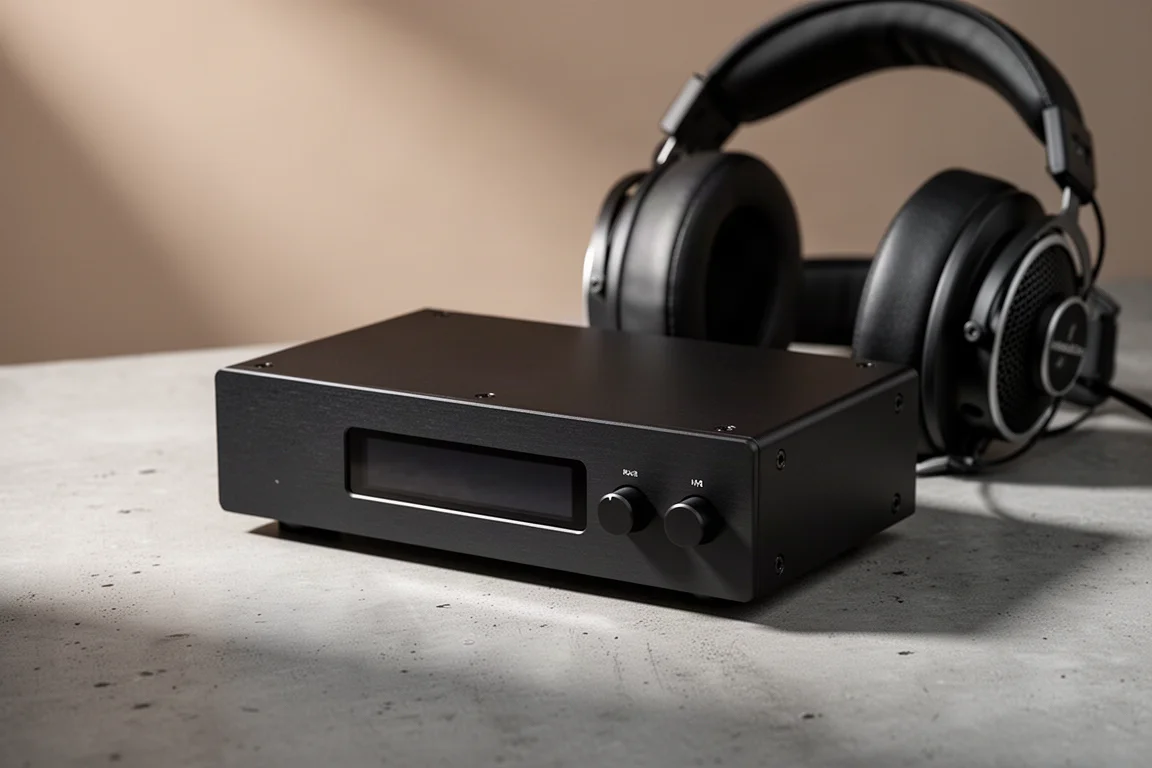
The RME ADI-2 FS DAC comes from a company with one foot planted firmly in the professional recording studio camp, and that heritage shapes almost everything about it. It is a compact, measurement-led converter that has built a reputation for reference-grade performance without the audiophile embellishments that usually surround products at this level. In the UK it retails for £979.
That price puts it squarely against the SMSL VMV D1se, a converter costing a couple of hundred pounds less and specifying a signal-to-noise ratio of 130 dB against the RME’s 120 dB. Both are exemplary measuring designs, and the two are close enough in price to be treated as direct competitors. The differences between them come down to priorities rather than outright quality, so it is worth working through what each one actually does well.
Who this product is for
This is a DAC for listeners who want one small box to handle conversion, volume control and headphone amplification without adding a rack of separates. Its footprint is barely larger than a pencil case at 215 x 52 x 150 mm (8.5 x 2 x 5.9 inches), and the all-metal casework feels solid despite a weight of just 1 kg (2.2 lb).
Headphone listeners get the most obvious benefit. There is a 6.25 mm jack on the front panel alongside a dedicated 3.5 mm low-noise 40 mW output intended for very sensitive in-ear monitors, plus a crossfeed function that feeds a little of the left channel into the right and vice versa. The result is a presentation closer to listening on stereo speakers, which many people find less fatiguing over long sessions.
All-digital listeners are equally well served. The digital preamp is good enough that a separate preamp is not necessary, so the unit can be connected directly to a power amplifier or a pair of active speakers.

It also appeals to anyone who wants to shape sound rather than simply accept it. The five-band parametric EQ is unusual at this price, and it becomes genuinely useful once paired with room measurements.
Main strengths
The ADI-2 FS DAC is highly resolving, neutral in tonality and, unusually for this market segment, natural in the way it presents music. Those last two qualities are not the same thing. Neutral means the frequency response is even and does not draw attention to any one region. Natural means acoustic instruments and voices are reproduced in a way that sounds real.
Sound quality
The bass is exemplary. There is usually a trade-off between agility and definition on one hand and weight and dynamics on the other, but here the balance is judged to perfection. Complex rhythms do not trip the converter up, and it maintains a sense of authority that gives music a proper foundation. In this specific regard it stands alongside far more expensive designs.
The mid-range is where chip-based DACs around this price often drift off course. They sound clean and detailed and pull out plenty of information, yet they can fail to convince when vocals and acoustic instruments are played through a highly resolving system. The ADI-2 avoids that trap. It has plenty of body, an acoustic mass that makes recordings feel solid, while retaining good clarity and resolution.
The SMSL VMV D1se is the more analytical of the two, with super-etched leading edges of notes and slightly more prominent decays. It retrieves a little more detail overall, but only just, and it can come across as lightweight next to the more organic, fluid presentation of the ADI-2. The RME has the wider sound stage, while the D1se locks imaging down more precisely. Both have limited sound stage depth, a characteristic shared by chip-based DACs in this bracket. A Chord DAC, even something like the Mojo at around £400, offers greater depth, though it cannot match either of these two on resolution.
At the top end the two diverge again. The D1se goes for more extension and a sense of air, which feeds its detail-focused character without sounding over-bright. The ADI-2 sounds more refined, but does so at a slight cost in detail and top-end airiness. Which approach suits you will depend on system matching and personal taste.
Stepping up in price changes the picture. The Denafrips Pontus II costs more than double and justifies that outlay with an improvement in class across the board: a more enveloping feel, far greater sound stage depth, precise imaging, and a deeper unearthing of fine micro details and timbral information. There is no giant-killing here, and that is entirely reasonable given the price gap.
Features and functionality
Inside, this is a fully balanced design built around an ES-9028 QTM converter chip, a change from the AK-4493 used in the earlier version of the unit. Because the filter set depends on the chip, the six available digital filters also changed with that revision. Measured performance is exemplary, with a signal-to-noise ratio of 120 dB, pushing noise below what is accepted as the threshold of human hearing.
Connectivity is generous. USB handles PCM up to 768 kHz and DSD up to 256, while the coaxial and optical inputs are limited to 192 kHz by the bandwidth of those connection types. Outputs are single-ended RCA and balanced XLR, and since the design is fully balanced, the XLR connection may be preferable in many systems.
The front panel is where the feature set becomes obvious. A high-resolution IPS panel displays peak levels across a 30-band analyzer while music plays, and a central volume control doubles as a mute. Four buttons alongside the display unlock a deep menu of options when used with the two rotary knobs on the right. Used on their own, the buttons serve as bass and treble adjustment and volume and left-right balance control. A remote control covers basic functionality.
The I/O button does more than toggle between the three outputs and the various inputs; it also configures each output to your requirements. Further down the menu there is an adjustment to dim the display. The setup button is where settings are loaded and stored.
The digital filters deserve a short explanation. Two of them, labelled short delay sharp and short delay slow, are infinite impulse response designs. They avoid pre-ringing but produce post-ringing, the ripple that trails a note. The other two, labelled sharp and slow, are finite impulse response filters. They reduce post-ringing but introduce pre-ringing, a ringing that arrives before the note is struck and which many listeners consider artificial. These two are also linear phase, meaning the time taken to reconstruct any frequency is the same. The two filters with the cleanest impulse response have the least flat frequency response, rolling off the high frequencies. A NOS-labelled filter is not a true non-oversampling mode on a delta-sigma design and has the least linear response along with the highest levels of aliasing. A brick wall filter has the best anti-aliasing properties but heavy pre-ringing and post-ringing. No digital filter is perfect, and this set makes the compromises visible rather than hiding them.
Things to consider before buying
Power delivery is the first thing to note. The unit runs from an off-board 12 V, 2 A switching supply rated at 24 W, and the case weighs only 1 kg despite its all-metal construction. Buyers who prefer a linear supply will need to budget for one separately.
Sound stage depth is the second consideration. It is limited here, as it is on most chip-based DACs at this price. If a deep, enveloping sense of space matters more to you than resolution, a Chord design is the more sensible route, and even the Mojo at around £400 delivers more depth.
Detail retrieval is the third. The SMSL VMV D1se extracts marginally more information and offers more top-end air, while the ADI-2 trades some of that for refinement. The gap is small, but it exists, and it is the main reason to choose one over the other.
Finally, the parametric EQ only pays off fully if you are willing to measure your room. Free software such as REW plus an affordable measurement microphone, with options costing under £150, is enough to get started. Used that way, the EQ can flatten the in-room frequency response, and it is particularly effective at low frequencies where room problems are most audible.
Buying advice
If you want a DAC that is highly resolving and neutral while still sounding natural, and you want more functionality than anything else near the price, the ADI-2 FS DAC is the more accomplished all-round product of the two compared here. Its reputation as one of the finest sounding converters in the sub-£1,000 category is deserved.
If detail retrieval is your single priority, the SMSL VMV D1se edges ahead, but only just. If sound stage depth matters most, look at a Chord DAC. If your budget stretches, the Denafrips Pontus II is a genuine step up in class rather than a sideways move.
Because the ADI-2 imposes little to no character of its own, it works in a wide range of systems. Pairing it with a price-appropriate amplifier makes sense, and a tube amplifier around £1,000 such as the Wilsington R8 is a natural match, particularly since that amplifier has no internal DAC of its own.
Matching the ADI-2 to a system
System matching matters less here than with most converters. A revealing chain of Exposure 21 preamplification and 18 super mono blocks driving ProAc Response 1SC speakers showed what the DAC was capable of, and it held up well.
Against the optional ESS DAC fitted inside an Atoll IN80 Signature, differences were slight. The ADI-2 sounded a touch more open, while the internal converter offered a little more sound stage depth. The warm, rich character of that amplifier came through regardless, which is a useful reminder that the DAC is rarely the dominant voice in a system.
For most buyers the practical path is simple: connect the ADI-2 directly to a power amplifier or active speakers, use the digital preamp for volume, and add a separate preamp only if you need analogue inputs.
Conclusion
The RME ADI-2 FS DAC earns its standing as one of the finest sounding converters under £1,000. It is highly resolving, neutral in tonality and natural in its presentation, a combination that few rivals at this price manage. It is not flawless: the SMSL VMV D1se retrieves marginally more detail, and sound stage depth is modest by the standards of more expensive designs. But as an all-round package, and especially on functionality, nothing at this price comes close. If you want a five-band parametric EQ, six selectable digital filters, a capable headphone output and a digital preamp in one compact box, this is the one to buy.
Product link
View more details for RME ADI-2 FS DAC
This product is mentioned in the review. Check the specifications, options, and compatibility before buying.
View more details for RME ADI-2 FS DACFurther reading
Related Reviews
Hi-Fi Audio
Accuphase C-57 vs Allnic H-7000V: Two High-End Phono Stages Compared
A fully balanced solid-state phono stage with a pitch-black noise floor meets a tube design built for well-loved records. Here is how to choose between them.
Hi-Fi Audio
Active vs Passive Hi-Fi: Five Components for a Modern System
Five components that define modern active and passive hi-fi systems, with the strengths, trade-offs and setup details worth weighing before you buy.
Hi-Fi Audio
Advance Paris A10 Apex Review: A Hybrid Integrated Amplifier That Covers a Lot of Ground
A French hybrid integrated amplifier with a class A tube preamp stage, analogue power meters, and an internal DAC and phono stage good enough to make extra boxes unnecessary.