Hi-Fi Amplifiers
Rega Brio Mark 7 Review: A Compact Integrated Amplifier With a Class-Leading Midrange
The Rega Brio Mark 7 returns with more power, a built-in DAC, and a moving magnet phono stage. Here is what it does well and what to weigh before buying.
Introduction
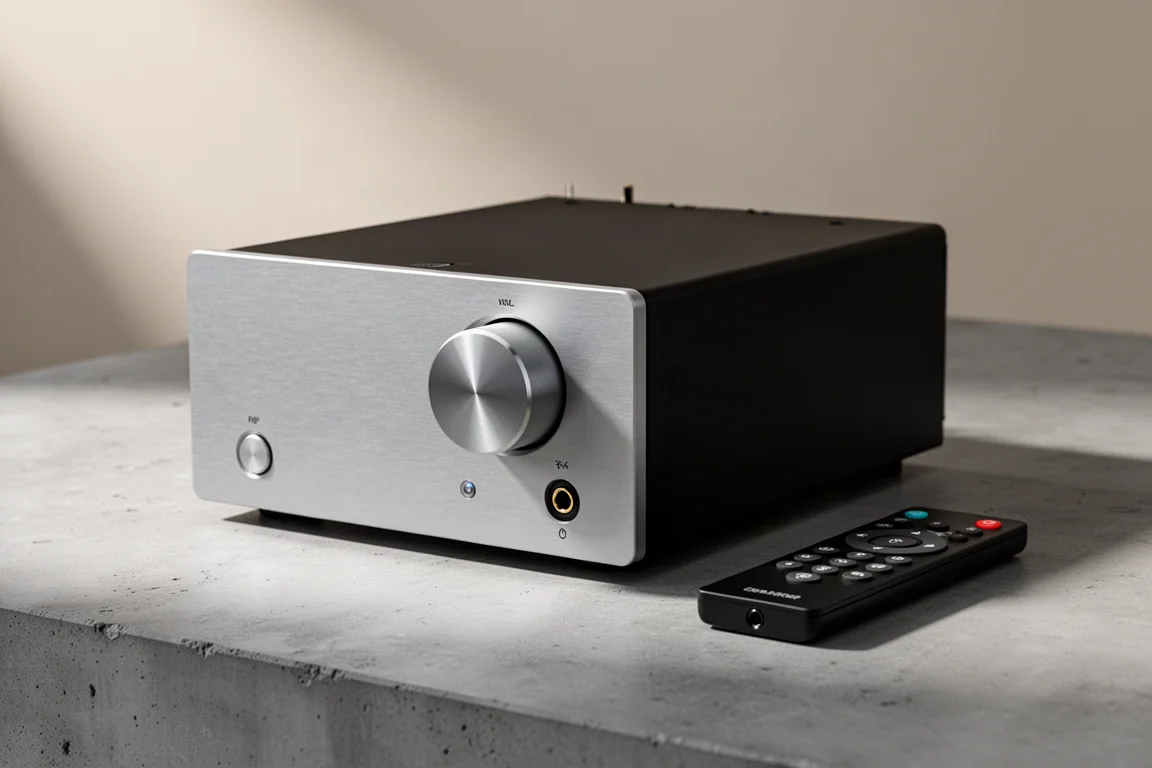
Rega’s Brio has been the company’s most successful amplifier across its 52-year history, and the Mark 7 marks its return after the Mark 6 was retired in the face of supply chain difficulties. The new model keeps the compact half-rack-width footprint the range is known for, replaces the curved gloss fascia of the Mark 6 with a more industrial front panel that echoes the smaller Rega IO, and adds something no Brio has offered before: a built-in digital-to-analog converter.
At £799 it lands in one of the most competitive parts of the hi-fi market, where several well-regarded integrated amplifiers trade on price, features, or both. What the Brio Mark 7 brings to that fight is a 50 W per channel power stage, a moving magnet phono input, four analog and two digital inputs, and a midrange that punches well above its price bracket.
Who the Rega Brio Mark 7 Is For
This is an amplifier for listeners who care most about how voices and instruments are rendered. The Brio’s strongest quality is the detail and texture it extracts from the beginning, middle, and decay of notes, and it presents that detail against an unusually dark background for the money.
It also suits anyone building a compact system. At 216 by 79 by 365 mm and 4.9 kg, it is not much larger than a shoebox, which makes it easy to place on a small shelf or inside a narrow cabinet. The built-in moving magnet phono stage means a turntable can be connected directly without an external phono preamp, and the new DAC opens the door to a streamer or disc player over optical or coaxial.
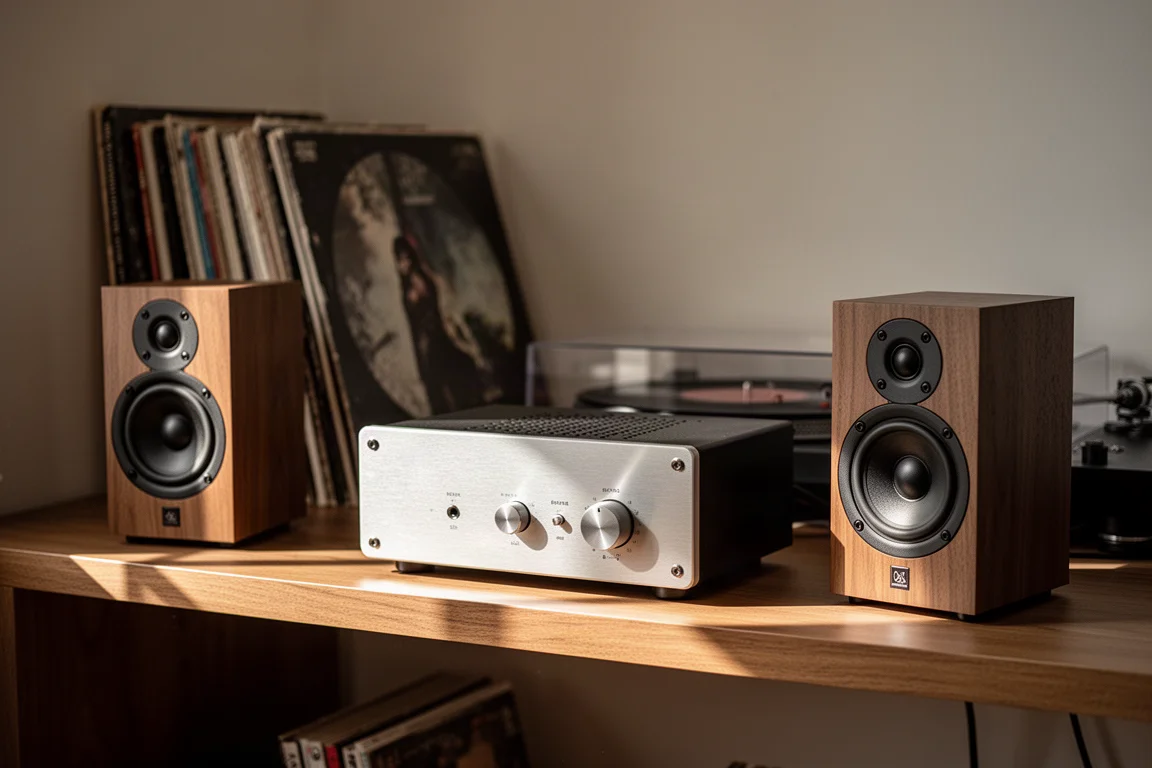
Compared with the smaller Rega IO, which is rated at 30 W per channel into 8 ohms, the Brio Mark 7 adds output and the ability to drive a wider range of speakers. Listeners who already own efficient standmounts in a small to medium room are the natural audience, while those running large, demanding floorstanders should read the power section below carefully before committing.
Design, Inputs, and Everyday Use
The fascia is deliberately plain. There is a power on/off button, a 3.5 mm headphone socket, and an input selector button that toggles between the four analog and two digital inputs. The volume dial has a satisfying weight and a smooth action, and a remote control is included. That remote carries a high button count because it is shared with other products in the range.
Around the back you get an input for the built-in moving magnet phono stage, three RCA line-level inputs, and two SPDIF digital inputs, one optical and one coaxial. The speaker binding posts are all metal, where most competing amplifiers at this price use terminals with plastic casings. It is a small detail that speaks to how the unit is put together.
One quirk is worth knowing about. When a connected source is powered down, the amplifier detects that there is no signal and the digital input indicator keeps blinking until the unit drops into standby roughly an hour later. It does not affect sound quality, but it is noticeable in a quiet room.
Inside the Chassis: Power, Phono, and DAC
For a half-rack-width amplifier there is a lot packed in: a 160 VA toroidal transformer and two power supply filter capacitors rated at 10,000 microfarads each. The power amplifier circuit is essentially the same as the Brio 6, with component upgrades and a revised layout intended to lower distortion, and it uses two Sanken STD03 output devices per side in a regular push-pull configuration. Those Darlington transistors include built-in temperature-compensating diodes that help hold biasing stable.
The headline figure is 50 W per channel into 8 ohms, rising to 72 W into 6 ohms. No 4-ohm rating is published, which is worth noting for anyone with speakers that dip low. The moving magnet phono stage carries over from the previous generation and uses MUSES op-amps, the same family used in the preamp and DAC stages.
The DAC chip itself is a Wolfson WM8742, a part with a long history in hi-fi that some manufacturers still prefer for a more organic character. It is the first time a Brio has included one, and it has been implemented with care so that it does not compromise the amplifier’s sound.
Main Strengths: Midrange Clarity and Tonality
The midrange is the reason to buy this amplifier. Notes arrive with exquisite detail and texture, and the tonal balance leans slightly mid-centric, which pulls vocals and lead instruments forward of the speakers while the rhythm section sits in line with them. On a dense rock recording, a gravelly voice and a rich electric guitar take centre stage without the accompanying players collapsing into a blur.
Bass is nicely balanced between weight and definition. It has a juicy quality while still moving along at a good pace, and the high frequencies are well expressed without ever feeling thin or incomplete. The overall presentation is intimate and engaging rather than aggressive or fatiguing, and there is enough body in the bass and midrange to keep long listening sessions comfortable.

The main criticism is soundstage width and depth. The Brio does not throw the widest or deepest image, and listeners who prioritise a big, layered presentation may find it modest. What it lacks in scale it makes up for in the way it draws you into the music, which is the quality that tends to matter most over months of ownership rather than minutes of comparison.
How It Compares With Other Amplifiers
The Brio Mark 7’s limitations become clearest against cheaper rivals. A £349 Cambridge Audio AXA35 produces a wider soundstage with more conventional front-to-back layering, yet it falls short of the Rega on resolution and bass control. A £449 Iota VXSA3 has slightly better bass control but a thinner midrange, a flatter stage, and less timbre to notes. Both are capable amplifiers that do not disgrace themselves, and the Rega justifies its extra outlay through better fidelity overall.
At the £699 mark, the Cambridge Audio CXA61 is a more natural competitor and is regularly discounted below its list price. Like the Brio Mark 7 it includes a built-in DAC, which the junior AXA35 omits. It does not match the Rega’s midrange resolution, but it sounds bigger and has a distinctly warmer tone. The Audiolab 7000A at £1,100 goes further still, delivering increased scale and dynamics along with significantly better control of bass and midrange transients, though it imparts a drier tone.
Buyers weighing this price band are also likely to consider the Audiolab 6000A Mark II at £699. There may be amplifiers that offer more grip and authority over a pair of speakers, or a wider and deeper soundstage, but few in this bracket pull a listener into the music the way the Brio does.
Speaker Pairings and Source Advice
Speaker choice matters more than usual here. With 86 dB sensitive standmounts on a nominal 8 ohm load, the Brio made a respectable account of itself, but there was some softening to the leading edges of notes. That is likely down to limited maximum current capability in a very compact chassis. The leaner tone of those speakers did, however, match well with the amplifier’s fuller bass and midrange.
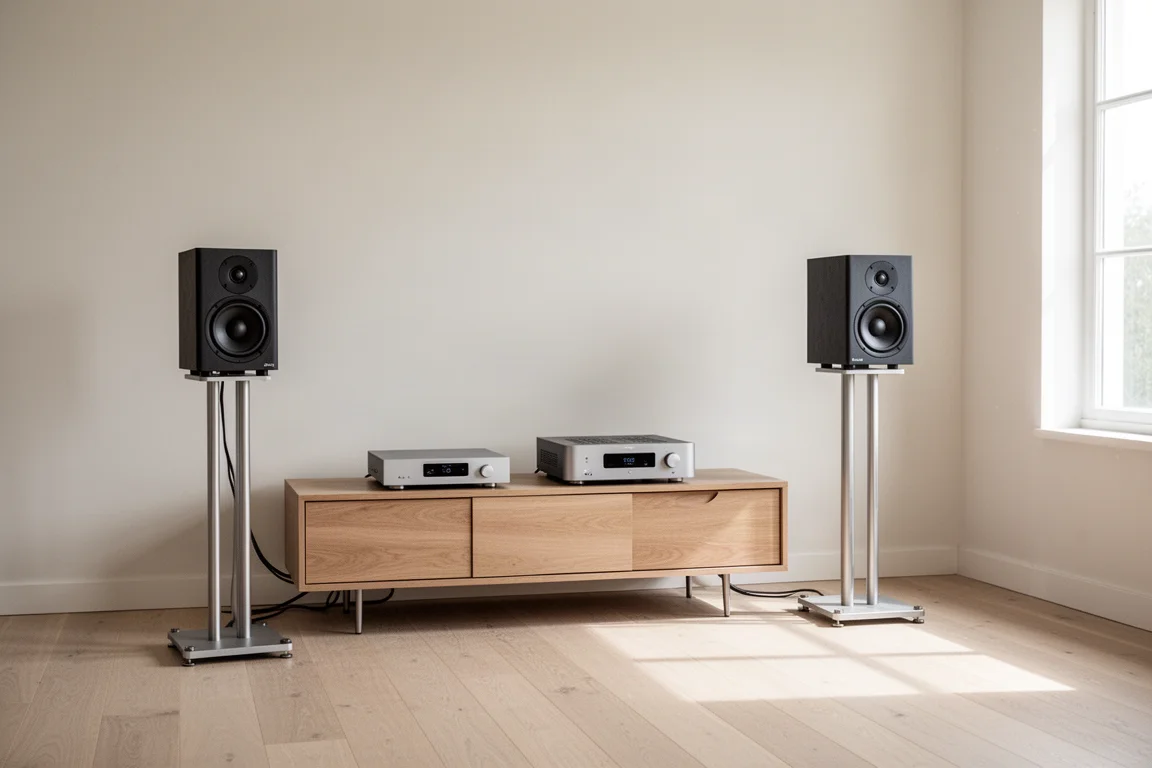
With highly resolving, easy to drive mini monitors, the pairing was inspired, and the amplifier’s midrange quality was on full display. For larger rooms and tighter budgets, a pair of £799 standmounts with a generous cabinet and a 200 mm mid woofer, specified down to 35 Hz in room, proved an ideal partner; their tendency to sound clinical with some amplifiers simply did not appear here. A smaller version of the same speaker would suit rooms where space is at a premium.
Source quality is the other half of the equation. A £299 network streamer makes an ideal digital front end at this price, and in that arrangement the cleaner, more focused result came from running an analog RCA cable between the streamer and the amplifier and letting the streamer handle conversion. For more modest digital sources, the Brio’s internal DAC is well implemented and more than enough to get a system started. The blanket advice is simple: do not skimp on the source, and choose the most resolving speakers you can justify as long as they are fairly easy to drive.
Things to Consider Before Buying
Three points deserve attention before ordering. First, the soundstage is the amplifier’s weakest technical attribute, so anyone who values a wide, deep image above midrange texture should audition alternatives. Second, no 4-ohm rating is published and the compact power supply has limits, which makes it worth checking how demanding your speakers are. Third, the blinking digital input indicator after a source is switched off is a minor but real annoyance in a quiet room.
It is also worth noting what the Brio does not try to be. It is not a powerhouse, and it does not chase scale and grip in the way some more expensive integrated amplifiers do. Buyers who need to fill a large room at high volume should look at amplifiers with more current on tap.
Buying Advice
For listeners with efficient standmounts in a small or medium room, the Brio Mark 7 is straightforward to recommend. It brings together a well-built compact chassis, all-metal speaker terminals, a genuinely useful moving magnet phono stage, and a DAC that adds flexibility without being a token addition. The midrange clarity, body, and texture are the class-defining elements, and the bass and treble are no slouch either.
If your priorities lean toward a wider soundstage, more bass authority, or greater dynamic scale, the alternatives at and above this price are worth hearing. If your priority is being pulled into the performance and staying there, the Brio Mark 7 makes a strong case for itself, and the reintroduction of the Brio name benefits buyers in what is a very competitive sector.
Pair it with a decent source and speakers that are resolving and reasonably easy to drive, and the result is a system that rewards long listening rather than short comparisons.
Conclusion
The Rega Brio Mark 7 builds on the strengths of the smaller Rega IO and adds power, control, and digital flexibility. Its midrange is the standout quality, the build and connectivity are thoughtful for the money, and the compromises are limited to soundstage dimensions and the current demands of difficult speakers. For the right room and the right pair of speakers, it is an easy recommendation at £799.
Product link
View more details for Rega Brio Mark 7
This product is mentioned in the review. Check the specifications, options, and compatibility before buying.
View more details for Rega Brio Mark 7Further reading
Related Reviews
Hi-Fi Amplifiers
Accuphase E-280 Review: Entry-Level Accuphase With Flagship Attention to Detail
A close look at the Accuphase E-280 integrated amplifier, covering its champagne build, AAVA volume control, sound quality, and the speakers and sources that suit it best.
Hi-Fi Amplifiers
Advance Paris A10 Classic vs Yamaha A-S301: Two Integrated Amplifiers Compared
A practical comparison of a $350 integrated amplifier and a $2,500 reference model, covering the differences that matter and the ones that do not.
Hi-Fi Amplifiers
Affordable Chinese Amplifiers Worth Buying: Five Budget Hi-Fi Amps Compared
A practical look at five affordable amplifiers, what each one does well, and the trade-offs to weigh before you buy.