Turntables
Pure Fidelity Harmony Turntable Review: A High-End Vinyl System Built for Serious Collections
A close look at the $8,000 Pure Fidelity Harmony turntable, the Origin Live Illustria SE tonearm, and the $2,000 Stratos cartridge that completes the system.
Introduction
Vinyl playback is a mechanical process, and it is unforgiving about it. A stylus reads a groove measured in fractions of a hair, converting movement into an electrical signal thousands of times smaller than what a CD player or a streamer produces. Dust, footfall, and even sound pressure from the speakers can interfere with that reading.
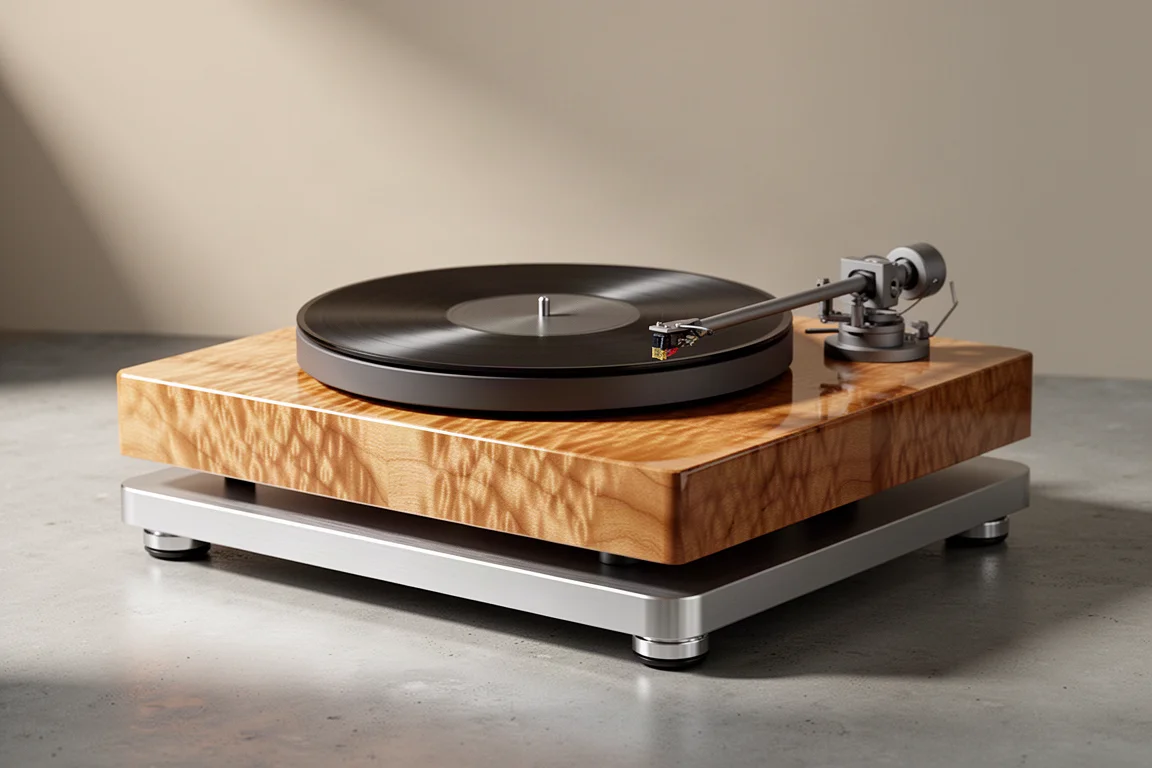
The Pure Fidelity Harmony is built around that problem. It costs $8,000 for the turntable alone, before a tonearm and cartridge are added, and every part of its design is aimed at keeping the mechanical path as stable and as quiet as possible. It is a serious piece of equipment for listeners who already have a serious record collection.
This article covers the turntable itself, the Origin Live Illustria SE tonearm and the Pure Fidelity Stratos cartridge that are recommended as its natural partners, and the reasons that combination deserves consideration.
Who the Pure Fidelity Harmony Is For
At $8,000 for the deck alone, the Harmony is not aimed at anyone testing the waters of vinyl. It is for listeners who already own a large collection, play records often, and care about how those records sound. Collections built over decades, including records passed down within a family, are a common motivation here, because a great deal of older material never made it to streaming services at all.
That is the case for many owners: the records that matter most are the ones that cannot be streamed. Owning a turntable at this level is a way of actually using that collection rather than storing it.

The Harmony is not the right choice for someone who finds vinyl appealing but wants to start with a few hundred dollars, and there is nothing wrong with that route. This is a turntable for someone who has already committed to the format and wants a deck that will not be the weak link in the chain.
Price is only part of the reason. The engineering inside this deck is unusual at any price, and the next section explains what that engineering actually does.
Main Strengths: Isolation Platform and Plinth Design
The Harmony begins with an isolation platform machined from aircraft aluminium. Underneath it sit four adjustable IsoAcoustics Gaia 4 feet. IsoAcoustics is a specialist in isolation products, and the Gaia 4 is unusual: it does not appear in the standard Gaia range, because it was developed specifically for this turntable.
The platform also has three precision-machined holes that accept three further Gaia 4 feet between the platform and the plinth, so the isolation sits flush and out of sight rather than stacked up in a visible tower.
The plinth itself is a deliberate middle ground. Very heavy plinths tend to deliver strong bass but can sound dull or dead; very light plinths offer speed and dynamics but can turn bright and brittle. Pure Fidelity calls its approach a hybrid design and builds the plinth from Ultra MDF, a denser and stronger material than standard MDF, to land between those two extremes.
Further down, the details stay unusual. The bearing uses ruby rather than steel, chosen because ruby is extremely hard: it sits at nine on the Mohs scale, with only diamond harder. The bearing shaft is bronze rather than brass, for greater strength, better durability, and lower friction. The subplatter, made from aircraft aluminium and steel, is oiled and inserted into that bronze shaft, and the deck runs two belts where most turntables use one.
The platter is 48mm of Delrin. Delrin costs more than the acrylic used on many turntables, and the reasons are practical: it is more durable, less prone to cracking and wear, lower in friction, and lower in resonance, so it does not ring. It also shares some properties with the vinyl record sitting on top of it, though it is denser and tougher.
A custom stainless steel record weight of roughly 760g comes with the deck. Its underside is Delrin and it carries small steel bearings, all intended to keep micro vibrations out of playback. Weight like that demands a motor built to carry it, and the Harmony’s custom AC motor is designed for exactly that. A quartz-locked speed controller holds speed to 0.003% accuracy and switches between 33.3 and 45 RPM with a single click.
The Arm and Cartridge Match
The tonearm paired with the Harmony here is the Origin Live Illustria SE, built in the UK and recommended as a strong match for this deck. Matching an arm to a turntable is its own discipline, and this is the pairing the turntable was demonstrated with.
The cartridge is the Pure Fidelity Stratos, priced at $2,000. It uses an aluminium, copper, and magnesium body, a solid aluminium cantilever, and a micro-elliptical diamond stylus. There are no exotic materials here, which makes the results more interesting rather than less: this is a carefully designed cartridge rather than an expensive collection of rare metals.
It also needs time. Early on, the Stratos sounds bright and a little thin, and it takes a few hundred hours of break-in before it settles into a thicker, warmer, richer presentation while keeping its detail.
Pure Fidelity claims the Stratos competes with cartridges costing twice as much when it is fitted to the Harmony. That claim was put to the test with cartridges priced from $500 up to $20,000 on the same turntable, and the $2,000 Stratos came out ahead. It was the most neutral and balanced of the group, with none of the bass, treble, or midrange exaggerated, and it was the quietest. Its soundstage was the widest and deepest of the group, described as holographic and hemispheric.
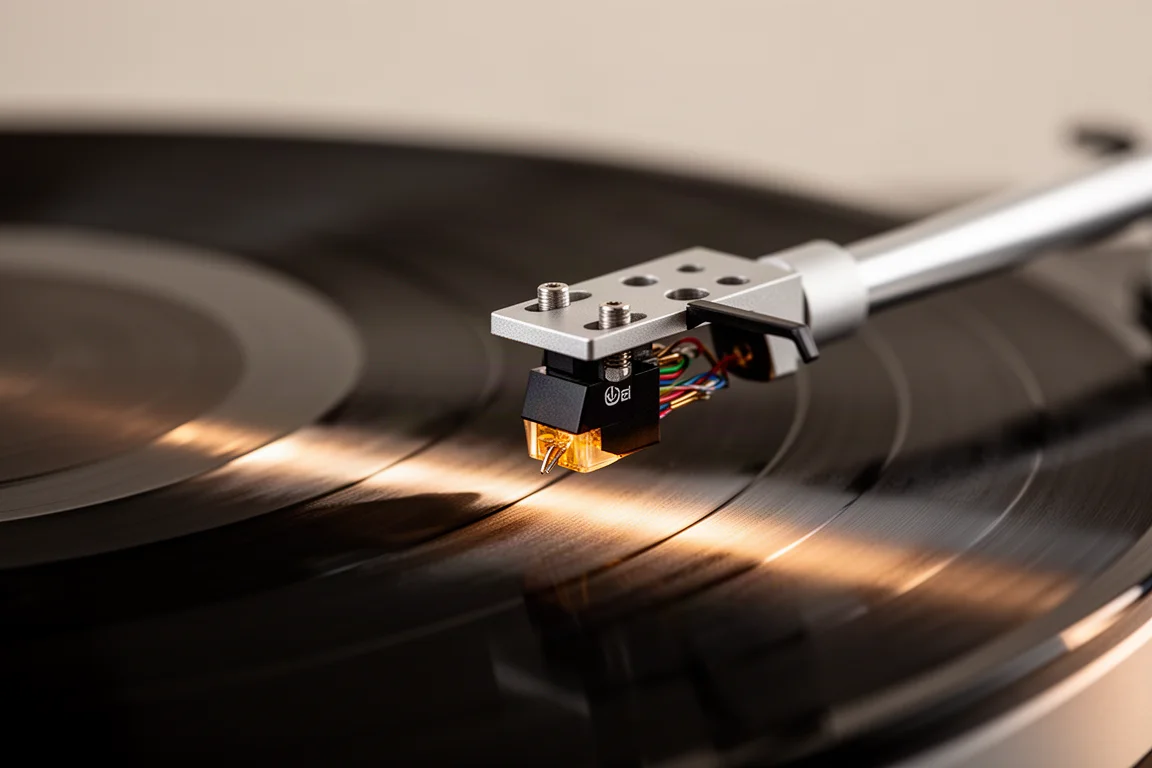
One qualification is worth stating plainly: that result is specific to the Harmony. The same cartridge has not been confirmed to perform at that level on other turntables, so the pairing itself is the point.
Sound and Listening Experience
The Harmony is not a hyper-detailed, analytical turntable, and that is a design choice rather than a shortcoming. Analytical decks can dissect a recording so aggressively that poorer pressings turn thin and lifeless, which is a problem for anyone whose collection includes older or imperfect records.
This deck goes the other way. Poorly recorded material keeps its body and warmth, and the musicality that vinyl is known for comes through clearly. Detail is still there, and on well-loved tracks it can reveal things that a high-end streaming setup does not.
There is a specific behaviour worth noting. Bright, sibilant passages that are baked into a recording, and which are simply endured on a digital system, are far less bothersome here. The high hats and snares that sound sharp through a streamer sound natural on the Harmony, without being softened or less detailed. It is one of the clearest descriptions of the difference between digital edge and analogue ease.
The practical effect is that records get played from beginning to end. Albums stay on the platter, tracks are not skipped, and a listening session becomes a full-album experience rather than a playlist. For anyone used to skipping through a streaming library, that shift is a significant part of the appeal.
Build Quality and Finishes
The Harmony is available in natural walnut semi-gloss, Santos rosewood semi-gloss, quilted maple high gloss, piano black high gloss, and white high gloss. The finish shown here is quilted maple high gloss.
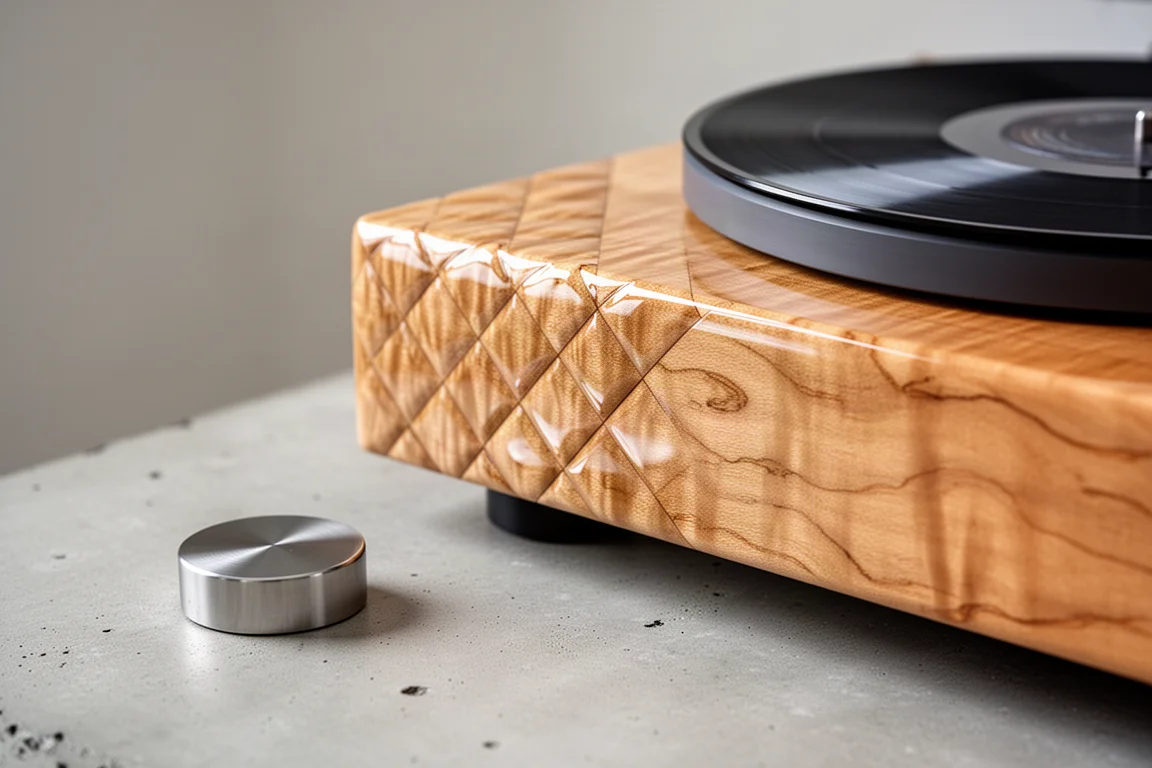
Build quality is a genuine part of the price. The deck is assembled with the kind of care that suggests it is meant to be kept for decades and passed on, which is a reasonable expectation for a component at this level and a meaningful counterweight to the initial outlay.
A turntable that lasts generations also has to look like something worth keeping on display. The finish options matter more than they might on a cheaper deck, because this is furniture as much as it is electronics.
Things to Consider Before Buying
The Harmony costs $8,000 before the tonearm and cartridge, and the recommended Stratos cartridge adds $2,000. That is the full system cost, and it is the number that matters.
The heavy record weight deserves a note. The Harmony’s motor is designed to carry it, but heavy weights are not automatically safe on motors that were never built for the extra load, so third-party weights should be chosen with care.
The presentation is not analytical. If maximum dissection of a recording is the goal, this is not the turntable’s character.
Break-in takes patience. The Stratos needs a few hundred hours before it sounds its best, so first impressions are not the final word.
The cartridge advantage observed here is specific to the Harmony. It has not been verified on other turntables.
Finally, this is not a beginner’s deck. Buyers who want an affordable first step into vinyl are better served elsewhere, and the Harmony will not reward that use case.
Buying Advice
Buy the system, not just the deck. The Harmony, the Origin Live Illustria SE tonearm, and the Stratos cartridge are designed to work together, and the results described here come from that combination rather than from any single component.
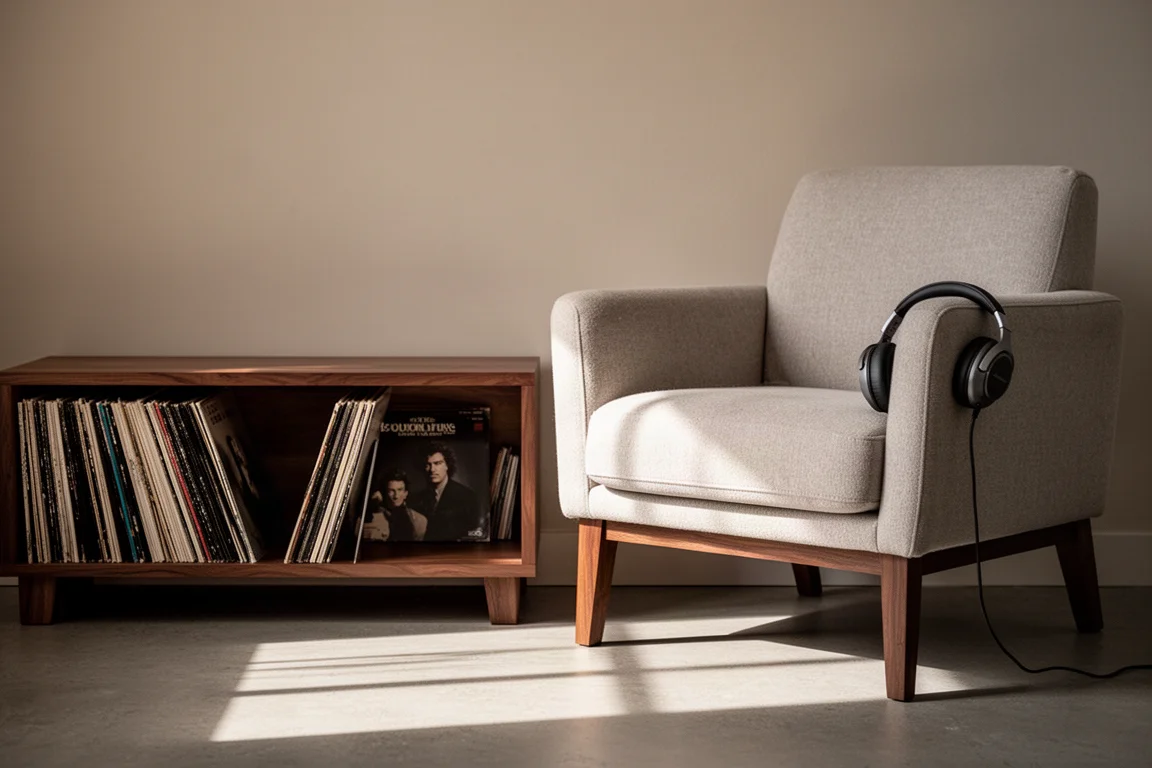
If your collection is large, and especially if much of it is older or inherited material that never made it to streaming, the case for a turntable at this level is straightforward: it is the only way to hear those records at their best.
If your collection is small, or your interest in vinyl is still forming, start smaller. A budget deck and a modest cartridge will tell you whether the format suits you, and the Harmony will still be there later.
Choose the finish as a long-term decision. These are heirloom components, and the version you live with for twenty years should be the version you actually like looking at.
Conclusion
The Pure Fidelity Harmony is a specialised instrument. Its isolation platform, hybrid-mass Ultra MDF plinth, ruby bearing, dual belts, and 48mm Delrin platter exist to solve the specific mechanical problems that vinyl playback creates, and the $8,000 price reflects how thoroughly they are addressed.
Paired with the Origin Live Illustria SE tonearm and the $2,000 Stratos cartridge, it delivers a sound that favours warmth, balance, and a wide soundstage over clinical detail, which makes it unusually kind to older and imperfect records. For a listener with a collection worth playing, that combination is the argument.
Product link
View more details for Pure Fidelity Harmony
This product is mentioned in the review. Check the specifications, options, and compatibility before buying.
View more details for Pure Fidelity HarmonyFurther reading
Related Reviews
Turntables
Best Turntables 2026: Seven Standout Picks From Entry Level to Premium
A practical roundup of seven turntables worth considering, from a US-made budget deck to small-batch premium models with a clear upgrade path.
Turntables
Best Turntables Under $1,000: Five Fully Manual Picks Worth Considering
Five fully manual turntables under $1,000, compared on build quality, cartridges, upgrade potential, and the character of sound each one brings to a system.
Turntables
Best Turntables Under $2,000: Six Vinyl Decks Worth Building a System Around
Six turntables under $2,000, from a value-focused belt-drive deck to a fully balanced design, with the strengths and trade-offs that matter before you buy.