Ski Resorts
Portillo Ski Resort Review: Chile's One-of-a-Kind Andes Icon
Slingshot lifts, a turquoise alpine lake, and relentless expert terrain make Portillo one of the most distinctive ski resorts in the world. Here is what to know before you go.
Introduction
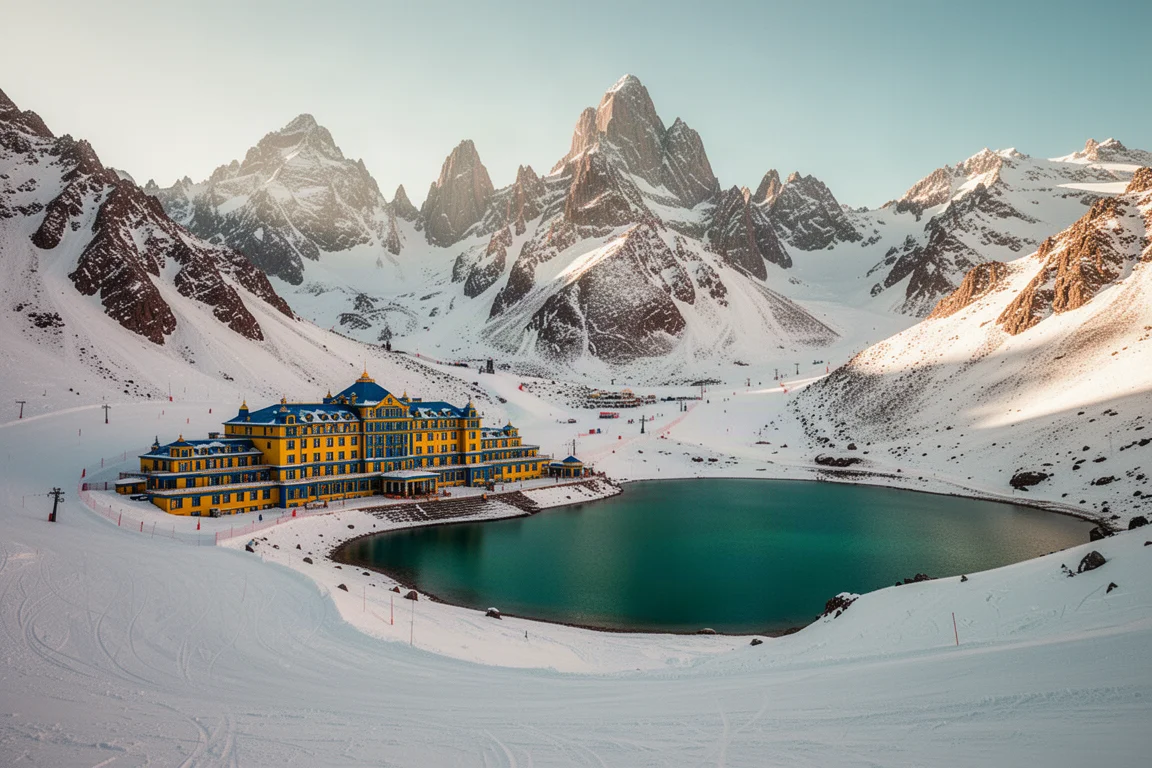
Portillo, located in the central Andes of Chile near the Argentinian border, is one of the most in-your-face ski resorts in the world. A brash slopeside hotel, a pristine deep blue lake, and some of the tallest mountains in the southern hemisphere make a statement before you even click into your skis. It is not the biggest or most modern resort, and it is a lot to handle for less experienced skiers and riders, but its one-of-a-kind infrastructure, striking aesthetic, and unique vibe make it a must-hit destination for a South American ski trip, provided you can handle it.
The Setting: Peaks, Lake, and a Yellow-Blue Hotel
The first thing that stands out about Portillo is just how much is going on. The resort sits in a canyon boxed in by massive peaks on every side, and there is not a single spot on the mountain without an imposing, rock-riddled mountain facade in immediate view. The highest peak, Ojos del Salado’s neighbor in the resort skyline, summits nearly 3,000 feet above where the highest lift will take you. On clear days, several mountains topping out above 15,000 feet sit directly north of the resort, and Aconcagua, the tallest mountain in both the southern and western hemispheres at 22,841 feet, is a short distance northeast. Very few resorts in North America or Europe can offer views of peaks this high.
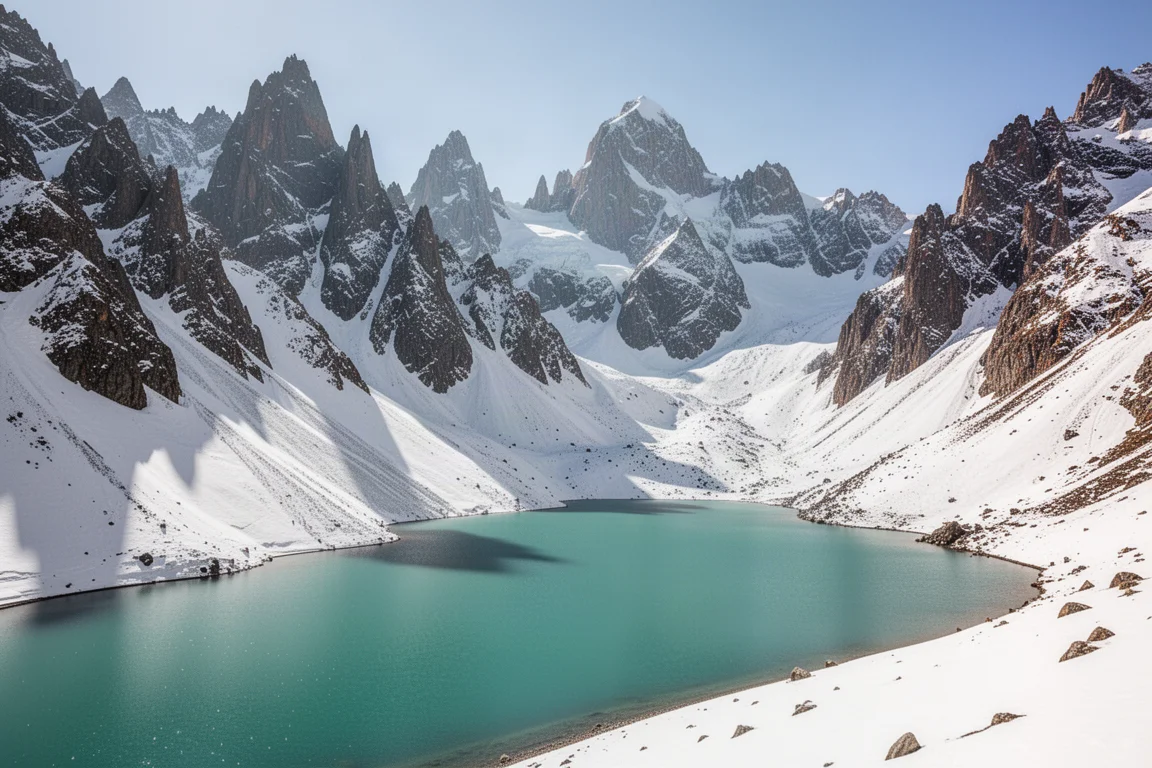
Then there is the Laguna del Inca on the north side of the resort. When unfrozen, its deep turquoise hue offers a stunning contrast to the jagged snowcapped peaks around it, and adventurous guests can ski right down to the lake’s edge on either side of the resort. In the coldest months of certain winters, part or all of the lake freezes, and guests can sign up for guided snowshoe tours.
All of this is complemented by what might be the most distinctive on-mountain architecture in the Andes: Hotel Portillo, a brightly colored yellow-blue structure sitting directly adjacent to the lake. Nearly everything at the resort revolves around the hotel. It houses the lift ticket office, ski rentals, a cafeteria, and guest services, and staff often open the slopes to hotel guests before the ticket window, giving on-site guests priority slope access. The resort also attracts many tourists and sightseers from Chile, Argentina, and Brazil who come for the lake views, sledding, and snowman building; they are not allowed on the slopes and typically gather along a lake viewing deck.
Terrain: Built for Experts
Portillo’s unique topography creates two terrain sides, east and west, linked by a traverse below the hotel. The west side catches sun early in the morning while the east side stays shaded until early afternoon, so guests usually ride west in the morning and east after lunch, following the sunshine. At just over 900 skiable acres, Portillo is not large, but the two sides are reasonably similar in size, making for a natural midday transition.
Portillo is not the best resort for lower-ability skiers. Only two green trails exist on the main mountain, both on the morning-shaded east side, meaning conditions start out hard. One requires a surface lift to reach, and both converge into a single run that filters through a tunnel that used to host a transcontinental train service. At least one bunny hill is served by a magic carpet, distinguishing it from the other Santiago-area resorts that rely exclusively on T-bars and button lifts for their learning areas.
Intermediates fare somewhat better. Most lower-mountain west-side trails and about half of the east-side trails are rated blue, and they are consistently groomed, allowing for a good cruising rhythm and incredible views. But Portillo’s blues run a lot steeper than blues at many competing mountains, and many could easily be rated advanced elsewhere. The Hunk Leo run on the west side extends below the hotel’s base elevation, offering rolling hills and, at roughly 1,400 feet, the longest single-trail vertical descent at the resort.
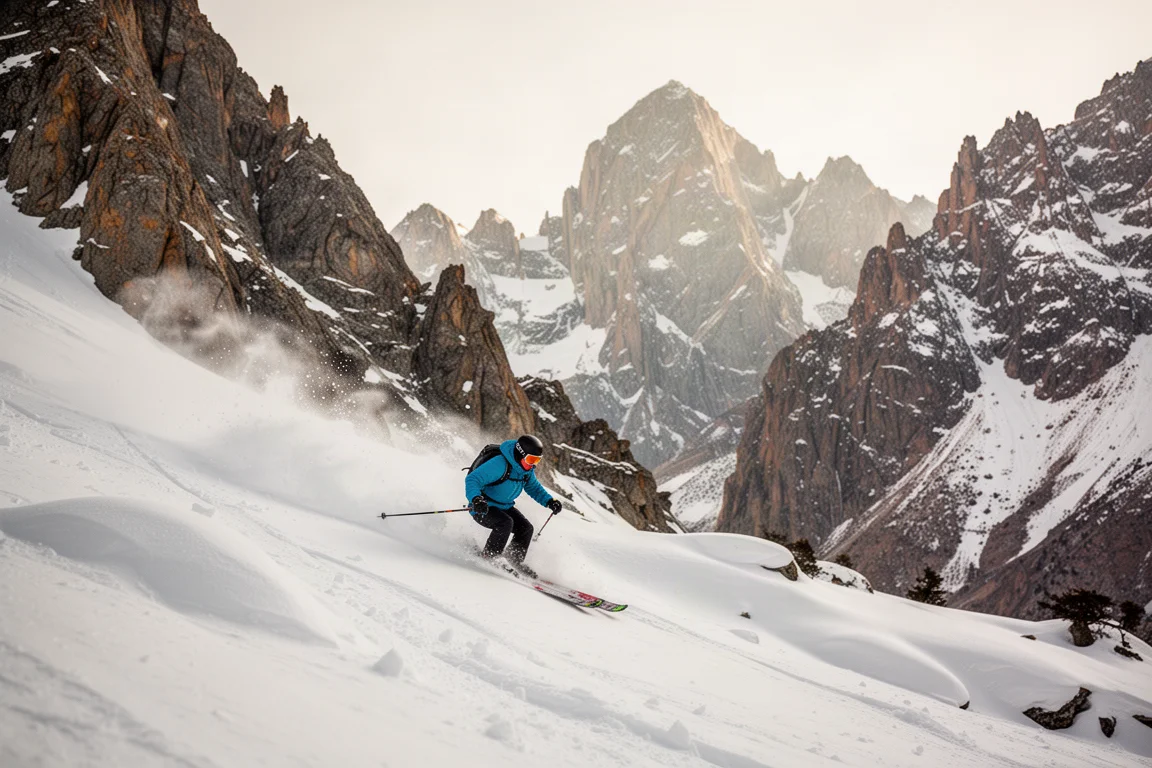
What you really want to be at Portillo is an expert. Only two red-rated trails exist in the entire resort, roughly equivalent to a black groomer at a typical North American resort, and the Plateau run off the east-side quad of the same name is the easiest way down from that area. Portillo’s black runs are relentlessly steep and ungroomed, making for demanding mogul terrain and a high risk of an uncontrollable fall. A handful of the gnarliest lines are not even on the trail map: rock-lined chutes, mostly on the east side, with extremely narrow routes, no room for error, and depending on snow conditions, mandatory air sections.
A couple of the steepest runs lead directly toward the lake, with no barriers between the slopes and the water. Since the lake can freeze in part or entirely, the edge is less clear than you might expect. These trails are absolutely beautiful but involve significant work to get out of: a formal east-side traverse with side-stepping and ducking under low-clearance gates and rock faces, or from the Primavera area on the west side, a brief hike no matter where you cut back. There is no signage warning of these hike-outs, so stay aware of your surroundings.
Lifts: Four Slingshots and Some Slow Chairs
Most of Portillo’s expert runs are served by slingshot lifts, one-of-a-kind contraptions found nowhere else in the world, and Portillo has four: two on each side. Because of the extreme steepness of their lines, these surface lifts have no towers and are anchored to the tops of their trails. The gradient does not mellow at the top, so unloading is technical, involving a brief moment travelling backwards and a quick catch of an edge to avoid an uncontrollable fall down the slope.
Slingshots hold three to five riders at a time, and unloading order matters to avoid collisions; the resort recommends ejecting from the middle out to keep weight distribution even. Warning signs are posted in Spanish, Portuguese, and English, but the resort does not read warnings aloud before loading, so do not hesitate to ask the lift operator for advice. First-timers should start with the east-side slingshots, which have slightly shorter rises and more forgiving gradients than the west-side versions.
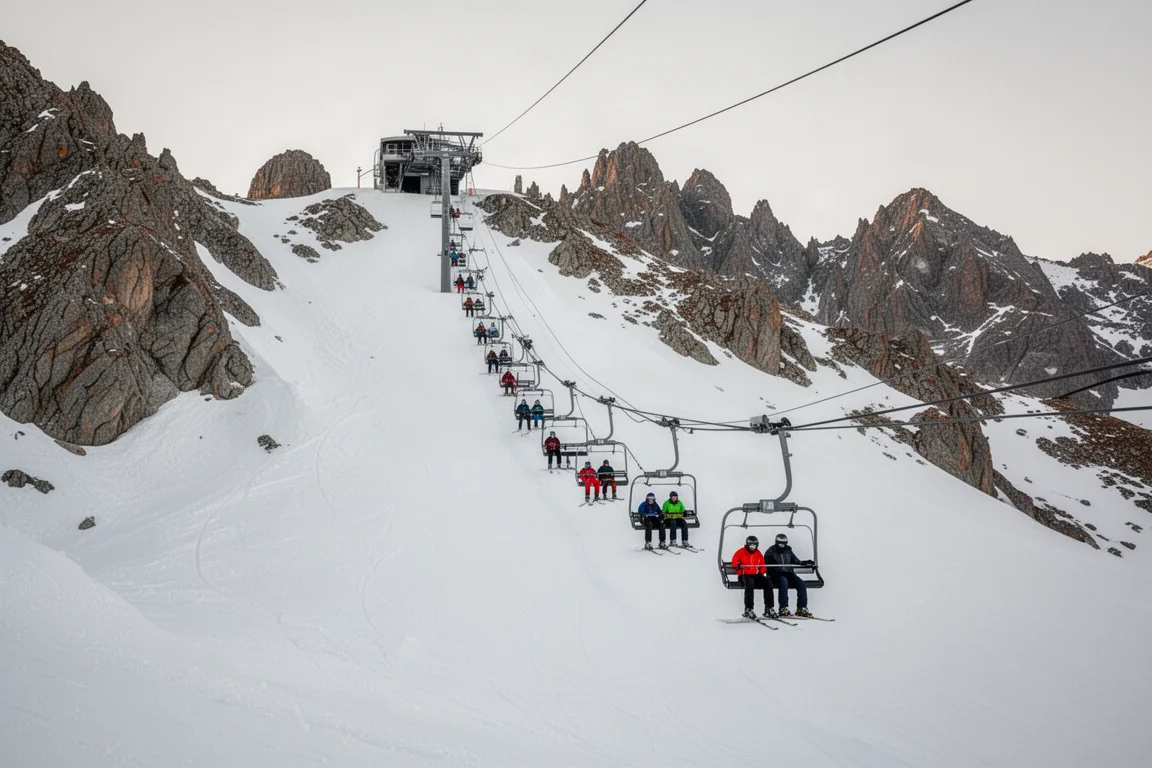
The rest of the lift fleet is fairly standard for Chile: slow fixed-grip doubles, triples, and quads, though the chairs are comfortable and well maintained. Nearly all lower-mountain runs are served by chairs rather than surface lifts. A few chairs cross hair-raising spans, including a very high section on the Plateau lift and stretches above the busy transcontinental highway on the Roca Jack lift. There are no nets if you drop something, so hold onto your poles.
Snow, Weather, and Crowds
Portillo is the northernmost lift-served ski resort in South America, sitting about the same distance from the equator as the US border with Mexico. Despite a top lift-served elevation of 10,860 feet, snow conditions can be quite variable. The resort can go weeks without significant new snow during the core season, producing icy or slushy conditions depending on the time of day, and it does not usually see the quantity of accumulation of the resorts closer to or south of Santiago. When storms do hit, though, the accumulation tends to be very light and enjoyable.
The mountain faces are steep and prolonged, creating considerable avalanche risk, especially on powder days or warm afternoons. The terrain served by the slingshot lifts regularly slides, particularly on the west side, and Portillo will close those lifts early when danger rises. Wild and unpredictable weather, including extreme temperature swings, intense winds, and sudden storms, can force some or all lifts to close.
On the plus side, thanks to its remote location, difficult access road, and limited lodging and lift tickets, on-mountain crowds are rare. Serious lift lines are unlikely even at peak times, even with everyone migrating between the two sides of the mountain. Figuring out conditions is straightforward too: there is a detailed status board inside the hotel, and each chairlift has a board for major runs and connector lifts. Above tree line, trails are bounded by colored sticks indicating difficulty, some numbered to show your distance from the bottom. The one real navigation headache is that the east and west sides are poorly integrated: the sole connecting traverse is quite flat, requiring pushing or side-stepping, especially going east to west.
On-Mountain Facilities
Beyond the hotel’s public cafeteria, the resort has a small restaurant above the east side’s bunny hill and a mid-mountain restaurant overlooking stunning lake views at the top of the east-side Plateau chair, though you will want to be at least an advanced skier to ride down from it. Portillo offers lift tickets with a lunch add-on that includes a 15,000 peso (roughly $15) credit at the main hotel cafeteria. The credit covers food but not drinks, and while not as cheap as eating in Santiago, the quality is high for a ski resort cafeteria. The cafeteria line can get long at peak hours, so if queues are not your thing, the lunch add-on may not be worth it.
One quirky detail: the public restroom before ticket control costs 500 Chilean pesos (around 50 US cents) to use. Your best options are to see if staff will let you into the hotel, which is not guaranteed, or wait until after you have bought your ticket.
Getting There and Lodging
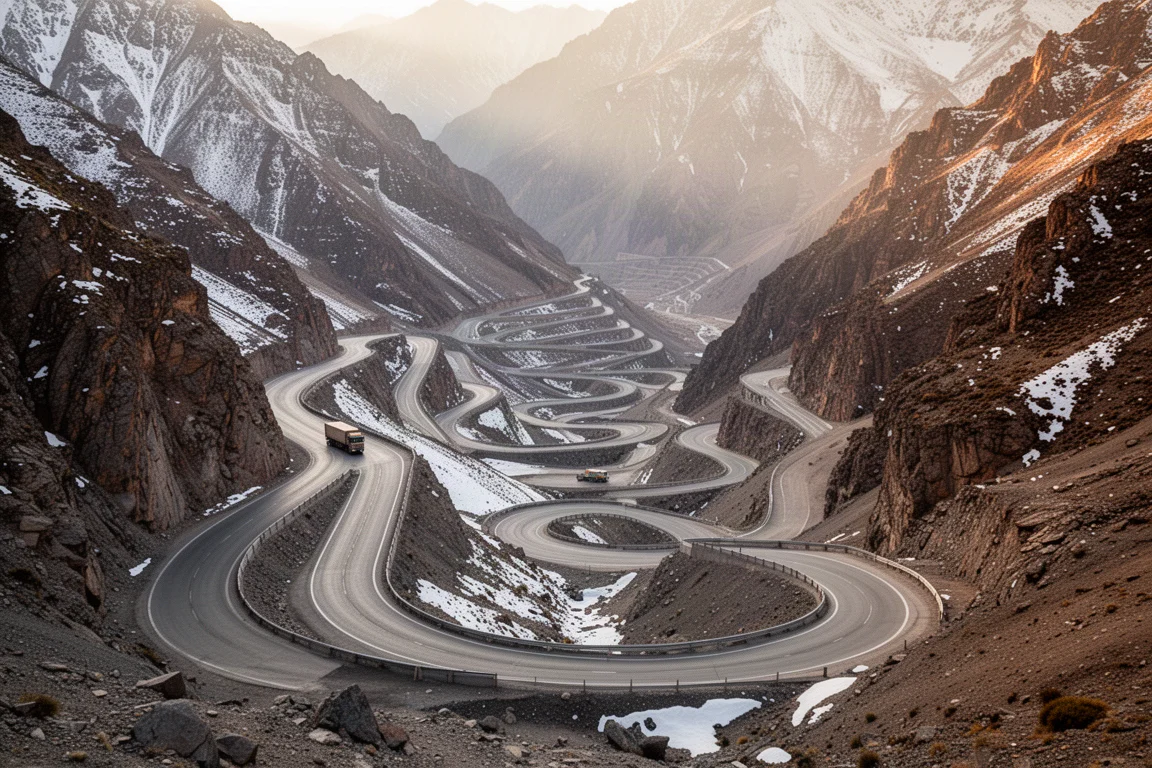
Portillo is tricky to reach. With no traffic it is about three and a half hours from Santiago, but the narrow, winding access road regularly sees significant slowdowns from cautious transcontinental truck traffic heading to Argentina, Uruguay, and Brazil. The route gains over 7,000 feet of elevation, with dozens of tight switchbacks on the last leg. The road gets sketchy quickly in bad weather, and chains are required unless conditions are totally clear. Chilean rental cars do not come with chains, so you will need to obtain them before the police checkpoint, and the road can close entirely in severe weather. A helicopter charter is an option, but at several thousand dollars it is impractical for most people.
On-site lodging is limited. Hotel Portillo houses roughly 400 guests and offers guest-exclusive restaurants, an exercise room, a spa, and some of the most stunning outdoor pools and hot tubs in the world, directly overlooking the lake. Adjacent boutique chalets provide ski-in, ski-out convenience, especially from the west side, plus lake views and hotel amenities. Cheaper options include the Octagon Lodge, bookable hostel-style in shared rooms with all hotel amenities, and the Inca Lodge, which offers only limited amenities. Note the strict arrival rules: check-ins and departures are only allowed on Wednesdays and Saturdays, meaning stays of three, four, or seven nights. All accommodations come with a lift ticket and meal plan as standard.
Day-tripping from Santiago is doable, if tiring, provided you leave very early and the road is clear. Parking is free and first come, first serve. Après-ski is communal rather than wild: the hotel bar is the place to wind down, and some outdoor restaurants have nice patios, but there are no dance clubs or live music. What is decidedly a thing is heli-skiing: drops go for $480 for the first run and $240 for each following run, a far more accessible entry price than at many competing operations. Requests can be made at the hotel or by email, though weather and demand mean a spot is not guaranteed.
Pricing and Overall Score
Portillo is not on any multi-resort pass, but most visitors traveling this far are going to Portillo and Portillo alone. One-day adult lift tickets run $62 during peak times at the ticket window without the lunch add-on, or $76 with it, and drop as low as $47 in low season. Reasonable tickets offset lodging that can be quite pricey with minimum-stay requirements.
In our category-based scoring, Portillo earns a 6 for snow (high quality but hit-or-miss quantity, just under 150 inches across a three-month season), a 4 for resiliency, a 5 for size (roughly 900 skiable acres of its 1,235-acre claim), a 6 for terrain diversity, a perfect 10 for challenge, a 3 for lifts, an 8 for crowd flow, a 6 for facilities, a 6 for navigation, and a perfect 10 for mountain aesthetic, for an overall score of 64.
Buying Advice
Portillo rewards a specific kind of traveler. If you are a confident advanced or expert skier or rider who values iconic views, extreme inbounds terrain, and a truly unique atmosphere over modern lift infrastructure and family-friendly terrain, it is hard to find a better inbounds experience in the southern hemisphere. If you are a beginner or looking for a big, modern resort, look elsewhere in the Santiago area. Staying on site with the mandatory meal plan and lift ticket is the classic experience, while a day trip works for shorter visits if you start early and the road cooperates.
Conclusion
Portillo is not perfect, but it has so many unique features that it lands firmly in the top tier of must-hit South American destinations. Between the slingshot lifts, the Laguna del Inca, the unforgettable hotel, and terrain that demands real skill, an Andes ski trip built around Portillo is one you will not forget.
Product link
View more details for Portillo Ski Resort
This product is mentioned in the review. Check the specifications, options, and compatibility before buying.
View more details for Portillo Ski ResortFurther reading
Related Reviews

Ski Resorts
Alyeska Resort Review: Alaska's Largest Ski Resort, Worth the Journey?
A deep look at Alyeska Resort: heavy snowfall, expert terrain, an Icon Pass connection, and the trade-offs of a near-sea-level mountain in the Last Frontier.

Ski Resorts
Bear Valley Ski Resort Review: Northern California's Quiet Sierra Alternative to Tahoe
A lesser-known Sierra resort with over 1,300 skiable acres, surprisingly strong expert terrain, and crowd levels Tahoe can only dream of. Here is what to know before you go.

Ski Resorts
Colorado Ski Resorts Ranked: The Best Destination Mountains for Overall Experience
A ranked guide to Colorado's destination ski resorts, covering terrain, snow, logistics, crowds, and cost so you can pick the right mountain for your trip.