Bookshelf Speakers
Polk R100 Review: A Compact Bookshelf Speaker That Shines at Moderate Volumes
A detailed look at the Polk R100 bookshelf speaker, covering its linear on-axis response, its tweeter-forward balance at higher volumes, and how to place and power it well.
Introduction
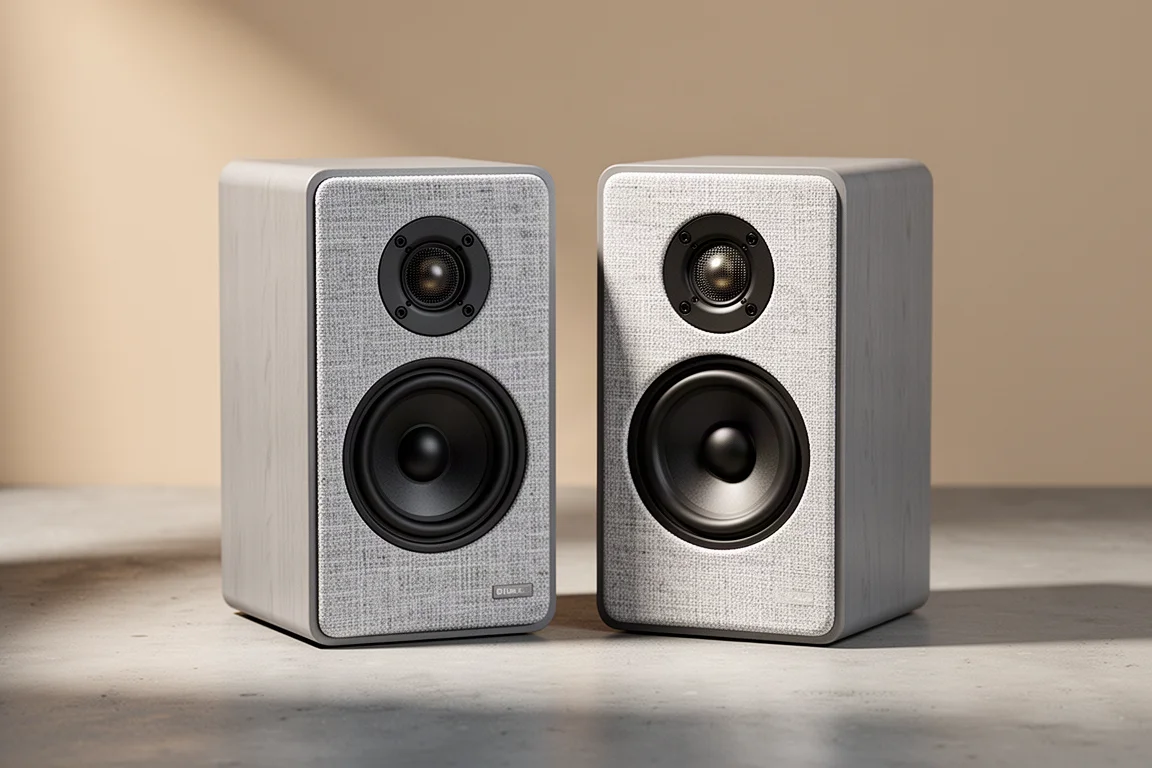
The Polk R100 is a compact two-way bookshelf speaker that sells as a pair for around $650. It is a small, neatly finished cabinet with a gray cloth grille that attaches magnetically, and its proportions suit a shelf, a sideboard, or a surround position without drawing attention to itself.
Its strengths are clear: a linear on-axis response, a well-controlled midwoofer, and genuinely detailed sound at ordinary listening levels. Its compromises are equally clear, and they mostly appear when the volume climbs or when listeners sit well off to the side. Understanding both sides is the key to deciding whether this speaker belongs in a given room.
Who the Polk R100 Is For
The R100 makes the most sense for listeners who listen at moderate levels in a small or medium room and who are willing to add a subwoofer. With an F3 around 68 Hz and an F10 around 49 Hz, it does not reach the bottom octave on its own, so a subwoofer is a practical requirement for anyone who wants weight behind kick drums and bass lines rather than a lean approximation of them.
It is also a sensible candidate for home theater surround duty. The compact cabinet and small form factor make it easy to place on a wall or a stand behind and beside a seating position, and the limited low-frequency extension that makes it less than ideal as a standalone full-range speaker matters far less when a subwoofer is already handling the low end.
Listeners who mainly want a detailed, unfatiguing speaker for background and evening listening will get the most out of it. Those who like to push a system to high output levels for long sessions should look carefully at the trade-offs described below.
Design and Driver Technology
Polk calls the midwoofer a turbine cone, and the name refers to the concentric ridges molded into the cone surface. Those ridges exist to break up the cone’s breakup modes, the nonlinear behavior that occurs when a cone stops moving as a rigid piston and starts to deform, which spreads unwanted energy unevenly on and off axis. The cone itself uses a foam layer sandwiched between two layers of polypropylene, a construction that adds rigidity while smoothing the breakup behavior across roughly an octave rather than concentrating it into a single sharp peak. Measured breakup on the midwoofer sits around 5 dB, which is a modest figure for a raw driver.
The tweeter is a ring radiator design, and the small element protruding from its center is the ring radiator itself. It acts as a waveguide and also changes the effective radiating diameter of the dome, which pushes the tweeter’s own breakup mode higher in frequency, above the audible range. The speaker is marketed with high-resolution audio in mind, though extension far above 20 kHz has little practical value for human listeners.
Around the back, the port is shaped to reduce turbulence. A measured resonance appears in the midrange region around 800 Hz, and it shows up at the port. Whether the port itself causes it or whether it comes from internal cabinet behavior is not certain; an accelerometer placed on the enclosure did not reveal strong cabinet resonances.
Main Strengths
The most impressive number here is linearity. On-axis response stays within about plus or minus 1.5 dB until roughly 10 kHz, which is a strong result for a speaker at this price. The listening window is similarly well behaved, so the speaker does not demand a rigidly fixed listening position. Best results come from sitting near the midpoint between the tweeter and the midwoofer, and the speaker tolerates roughly 10 degrees of movement up, down, left, or right from that point without falling apart.

At low to moderate levels, roughly 70 to 80 dB, the sound is detailed and enjoyable. The tweeter contributes sparkle and texture without dominating, and the midrange holds together well. The magnetic grille is a small convenience that makes a real difference in daily use, and the cabinet’s compact size and clean finish make it easy to live with in a shared space.
Things to Consider Before Buying
The crossover is the source of the main criticism. The midwoofer runs with a very shallow slope, on the order of a first-order 6 dB per octave roll-off, and the tweeter enters higher than the midwoofer has fully handed off. On axis and in the listening window this is not obvious, but the directivity index shows a discontinuity between the two drivers, and the estimated in-room response shows a step of roughly 3 dB between the trend line of the midrange and the trend line of the tweeter.
That step is audible as a slightly bright, tweeter-forward character, and it becomes more pronounced as volume rises. Above roughly 80 to 85 dB, the detail that sounds appealing at lower levels starts to read as edgy and aggressive. This is not a distortion problem; distortion does not explain it, and the effect is consistent with how human hearing changes with level, since sensitivity to high and low frequencies increases as playback gets louder. Whatever the cause, the practical result is the same: this is a speaker that rewards a moderate hand on the volume knob.
Placement, Dispersion, and Listening Levels
The ring radiator tweeter narrows horizontal dispersion as frequency rises. Beam width is wide at a few kilohertz, roughly plus or minus 70 degrees around 3.2 kHz and a little over plus or minus 60 degrees at 5 kHz, but it tightens to about plus or minus 50 degrees by 8 kHz and to roughly 30 degrees at 13 kHz. The practical guidance is to keep the listening position within about 10 to 20 degrees off axis and not to go beyond 30 degrees, which means aiming the speakers toward the listener rather than pointing them straight out into the room.
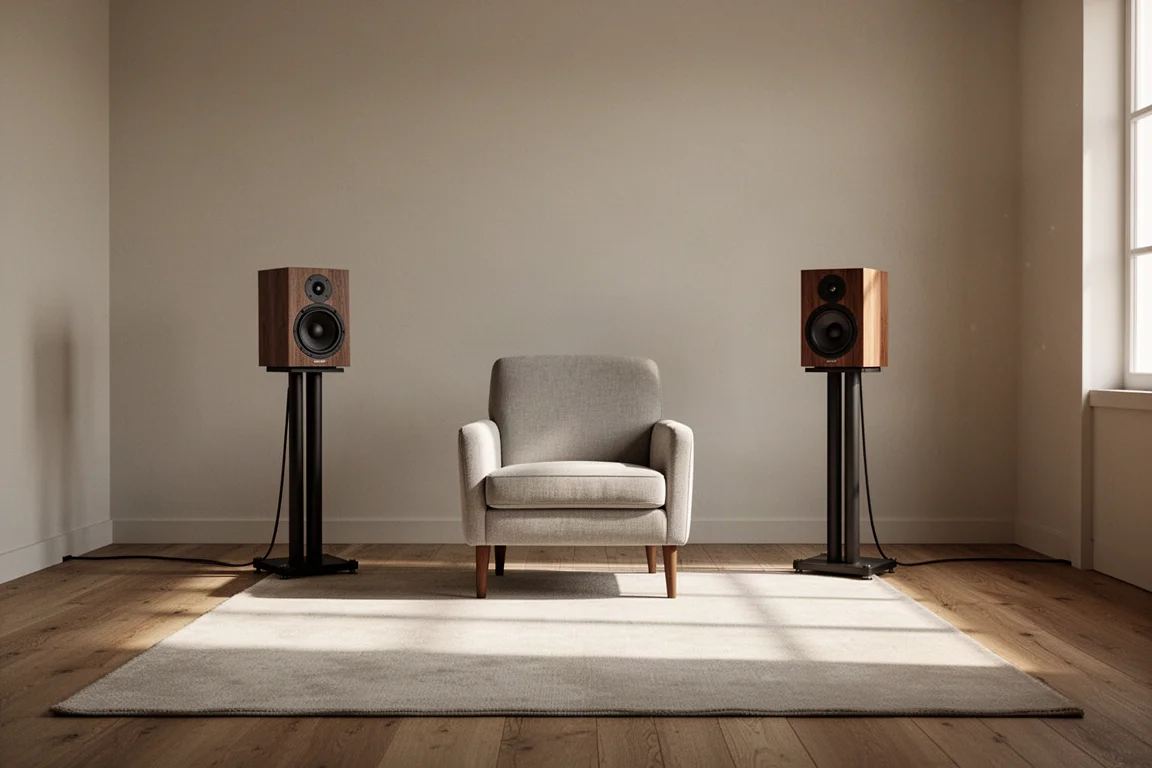
Vertically, the speaker is more forgiving below the tweeter axis than above it. Sitting about 10 degrees below the midpoint between the tweeter and the midwoofer is acceptable, and up to about 20 degrees above it also works. The distance between the two drivers contributes to a dip in the crossover region on the vertical axis, and closer spacing would have pushed that dip higher in frequency and reduced its effect.
Higher output levels also expose the speaker’s limits. At 96 dB, distortion rises above 3 percent in places, with second-order distortion prominent at high frequencies and distortion approaching 1 percent below 200 Hz. That high-frequency distortion sits high enough in the spectrum that it is unlikely to be the cause of the brightness described earlier, but the overall picture is a speaker that is not built to play extremely loud.
Low-Frequency Limits and Amplifier Matching
The rear port should stay clear. Blocking it creates a bump in the midbass rather than a cleaner low end, so the better path is to leave the port open and let a subwoofer cover the lowest octaves. If the speaker is pushed hard, a high-pass filter around 200 Hz takes pressure off the midwoofer and keeps the sound cleaner.
Impedance is the other consideration. The speaker dips below 4 ohms, with a stated minimum of 3.6 ohms, and sensitivity is rated at 85 dB. That combination makes the R100 less forgiving of modest amplification than its size suggests. Some amplifiers handle a 4-ohm load without difficulty; others do not. Anyone planning to drive the R100 from an AV receiver should confirm the receiver’s capability with the manufacturer before committing. A dedicated amplifier is a reasonable option for listeners who want more headroom, particularly for two-channel listening in a larger room.
Buying Advice
The R100 is worth considering if the priorities line up: a small, attractive cabinet, a linear on-axis response, and detailed sound at everyday volumes. Pair it with a subwoofer, keep it within a tight listening window, and it delivers a lot of what makes a compact speaker enjoyable.
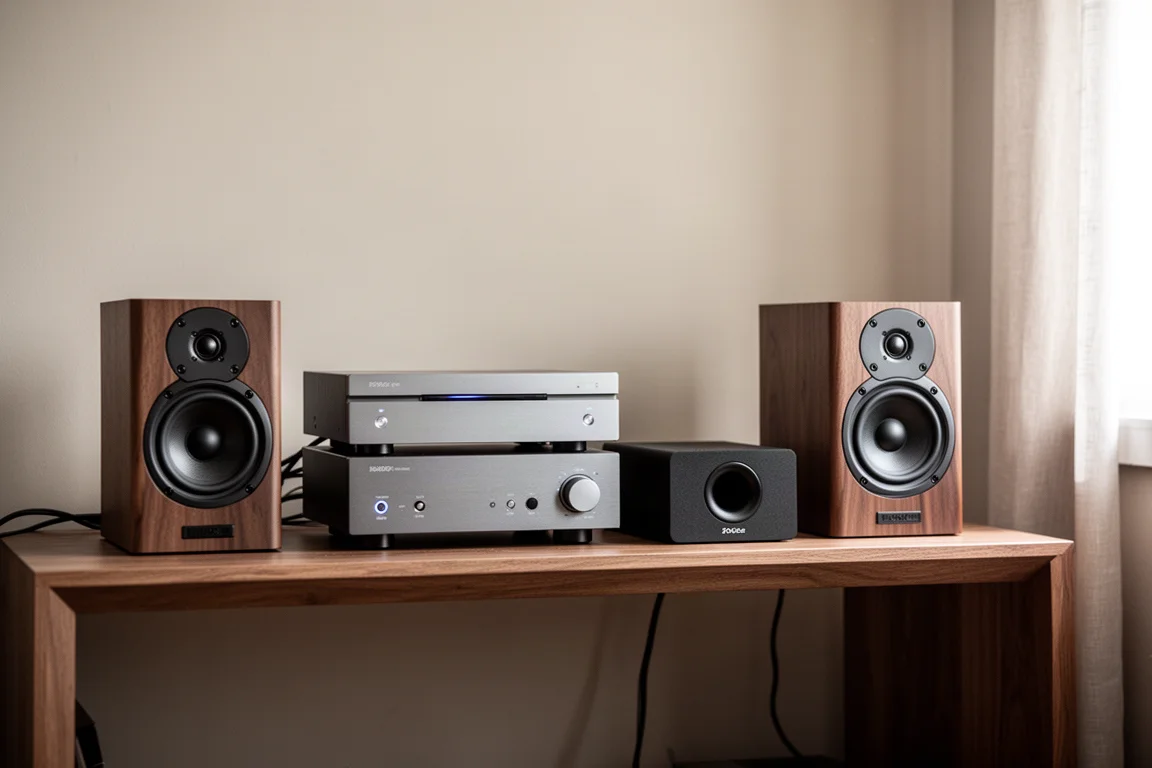
Listeners who want to run a system loud for long stretches, or who sit far off axis, will find the tweeter-forward balance harder to live with, and the limited low-frequency extension means a subwoofer is not optional in that scenario. Buyers who already own an AV receiver should confirm it can handle a load that dips to 3.6 ohms before ordering, and anyone planning a two-channel setup should budget for amplification that suits an 85 dB speaker. Approached with those expectations, the R100 is a well-engineered compact speaker with a specific, and quite pleasant, comfort zone.
Conclusion
The Polk R100 gets the fundamentals right. The cabinet looks good, the grille is magnetic and easy to remove, the midwoofer keeps its breakup behavior under control, and the on-axis response is impressively flat. Its weaknesses are equally specific: a step between the midrange and tweeter levels that makes higher volumes sound edgy, a narrow sweet spot that rewards careful aiming, and bass that stops well short of a full-range presentation.
For a listener who wants a compact bookshelf pair for moderate-level music and movies in a small room, with a subwoofer doing the heavy lifting and the speakers aimed at the seat, the R100 is a confident recommendation. Buyers who need high output or who plan to sit far off axis should weigh those trade-offs carefully first.
Product link
View more details for Polk R100
This product is mentioned in the review. Check the specifications, options, and compatibility before buying.
View more details for Polk R100Further reading
Related Reviews
Bookshelf Speakers
Acoustic Energy A100 Mark II Review: A Compact Standmount With an Expansive Soundstage
The Acoustic Energy A100 Mark II brings clarity, natural tonality and a wide soundstage to an entry-level standmount, with a few setup details worth knowing first.
Bookshelf Speakers
Acoustic Energy AE-100 Mark II Review: Compact Bookshelf Speakers With Standout Imaging
A compact British two-way bookshelf speaker with deep, layered imaging, fast bass, and a slight treble lift to weigh against a crowded $500 field.
Bookshelf Speakers
Acoustic Energy AE100 MK2 Review: Measured Performance and Four Alternatives
A close look at the Acoustic Energy AE100 MK2 bookshelf speaker, what its measured performance reveals, and four alternatives with different trade-offs.