PA Speakers
Point Source vs Line Array Speakers: Yamaha DHR12, Bose L1 Pro16, and QSC K12 Compared
A practical comparison of three powered speaker systems and how point source and line array designs shape coverage, distance behaviour, and clarity.
Introduction
Two speaker designs dominate portable and installed sound: the point source cabinet and the line array column. They look different, they behave differently as you move around a room, and they suit different jobs.
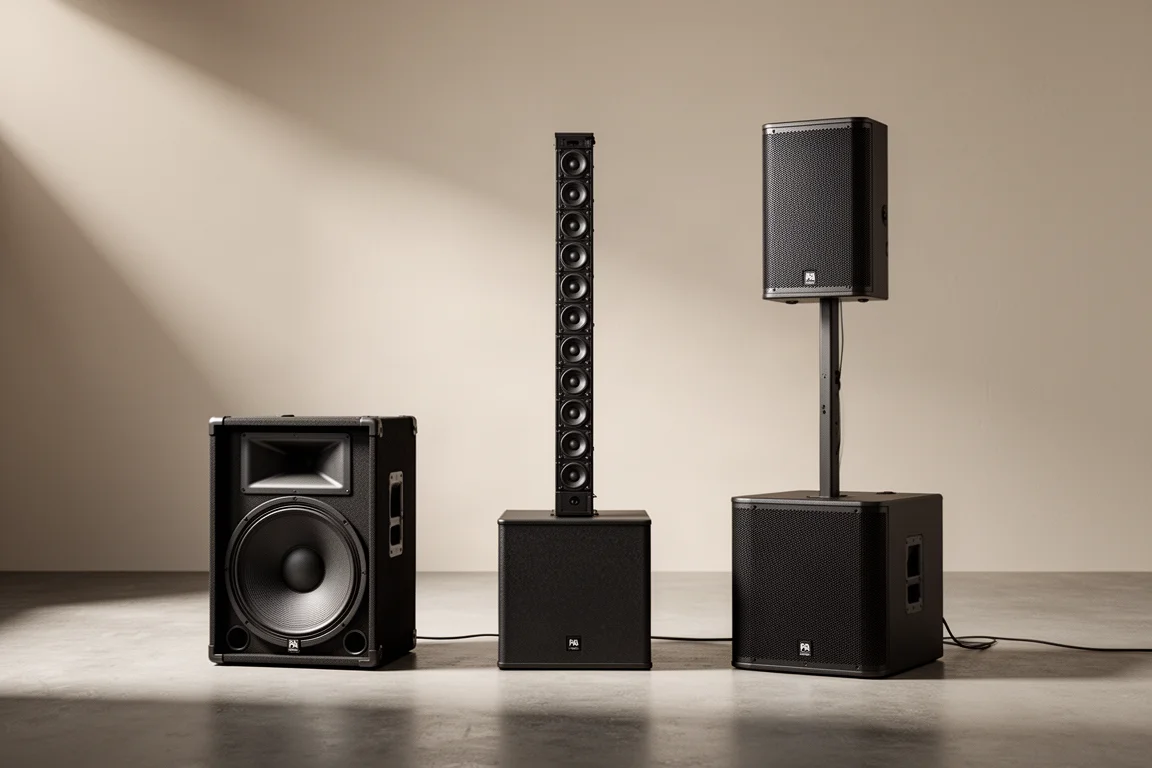
This comparison looks at three powered systems that represent both approaches. The Yamaha DHR12 is a conventional two-way point source cabinet. The Bose L1 Pro16 is a genuine line array. The QSC K12 borrows the column form factor while operating much closer to a point source than its shape suggests.
How Point Source and Line Array Designs Differ
A point source speaker sends sound out from a single cabinet. In theory a point source is infinitesimally small and radiates evenly as a sphere in every direction. No physical loudspeaker is a true point source, but the idea is useful: stand a few feet back from a cabinet and it behaves far more like one than it does up close.
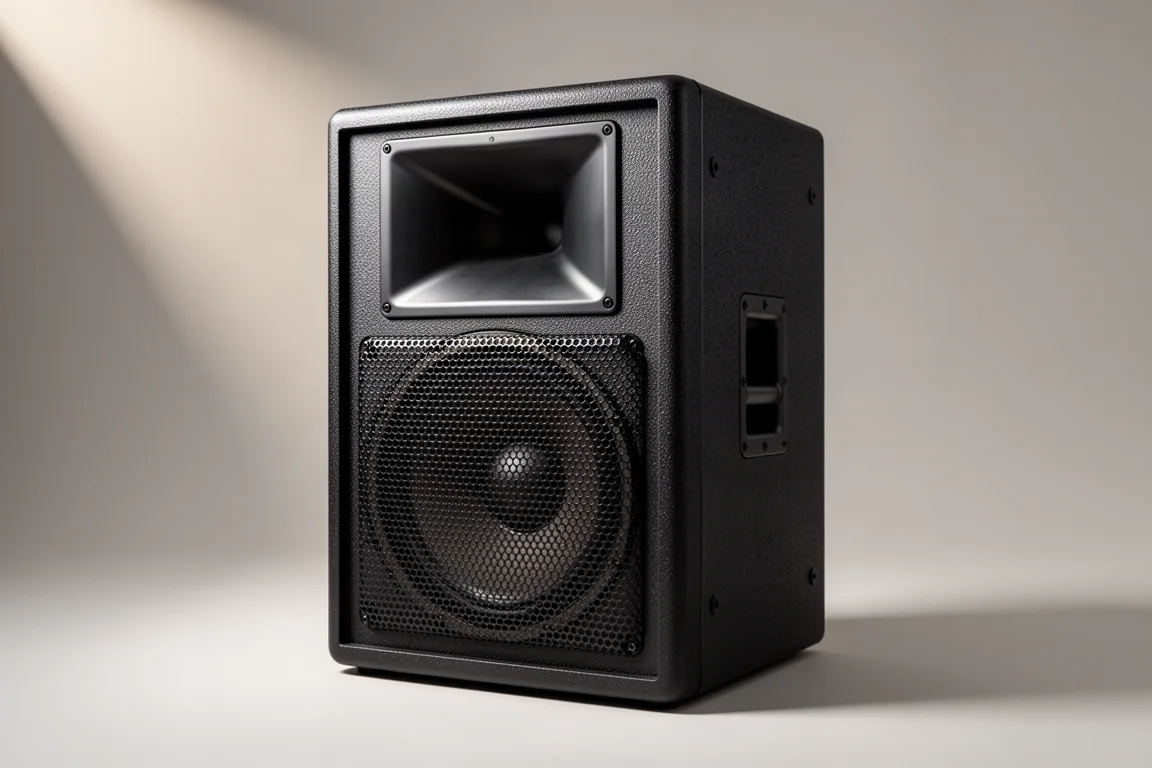
The Yamaha DHR12 illustrates this well. It is a two-way cabinet with a 1.4-inch compression driver and a 12-inch woofer, and at a normal listening distance those two elements blend into what sounds like one source.
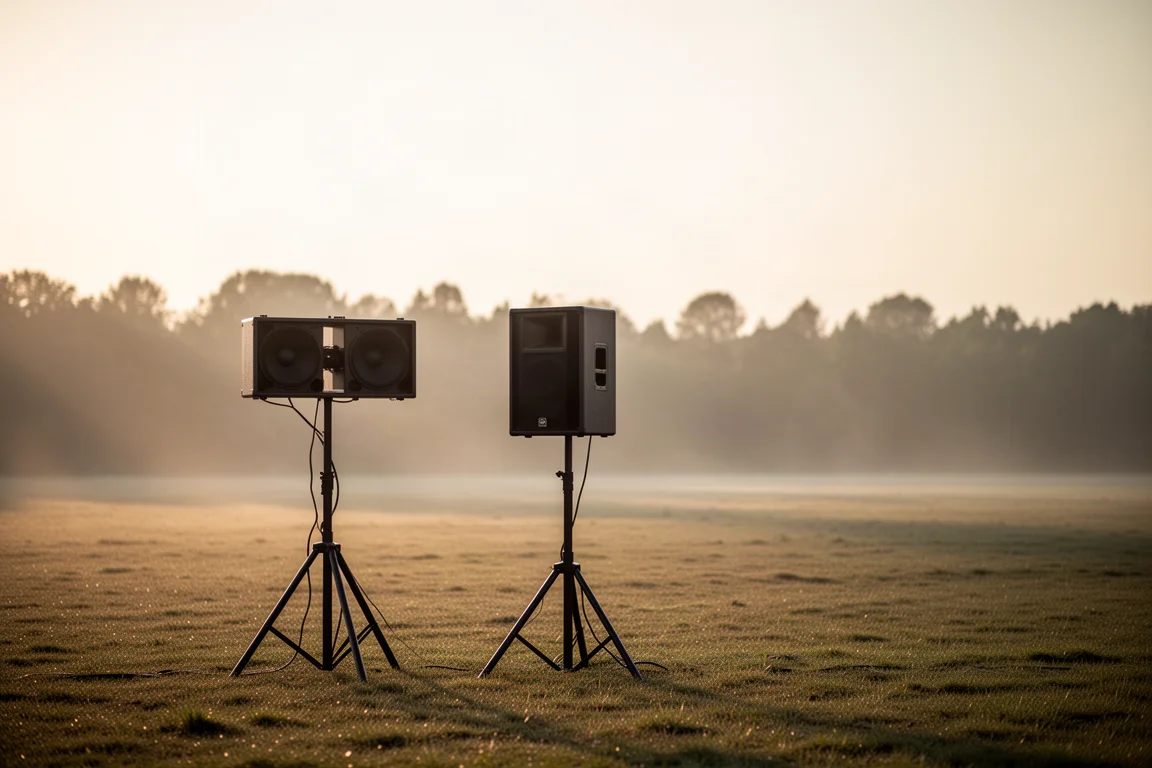
Because that energy spreads outward as a sphere, it thins out as it travels. In a free field with no walls, floor, or ceiling, a point source measures roughly 6 dB quieter each time you double the distance, which follows from the inverse square law. The reason is geometric: doubling the radius of a sphere spreads the same energy over four times the surface area. A probe placed close to a source reads a noticeably higher amplitude than one placed further away.
A line array takes the opposite approach. Instead of one source, many small drivers are stacked and work together to steer energy into a beam, with noticeably less energy leaving the ends of the array. Even two sources placed close together interfere with one another, and the beam reshapes as frequency and spacing change. Add more sources and directivity increases at that frequency. Lower the frequency and the array starts behaving more like a point source.
The lowest frequency that can be steered depends on the length of the array. To steer a longer wavelength, you need a longer array. At the frequencies an array can steer, a perfect line source would lose only about 3 dB per doubling of distance, because its energy radiates outward as a cylinder, so the surface area only doubles as the radius doubles. In practice, a perfect cylindrical wave is difficult to create.
Yamaha DHR12: The Point Source Reference
The Yamaha DHR12 is the most traditional of the three. Its coverage is specified at 90 degrees horizontal and 60 degrees vertical, and a rotatable high frequency horn means you can lay the cabinet on its side and keep the same coverage pattern you would get standing it vertically.
That flexibility is the main argument for this design. The cabinet works on a speaker stand, at the front of a stage, or as a front fill, and a monitor-form variant exists in the same family for stage monitor duty. The 12-inch woofer also has more surface area and more excursion than the smaller drivers in the other two systems, so it can move more air when you need output and reach over distance.
Bose L1 Pro16: A True Line Array
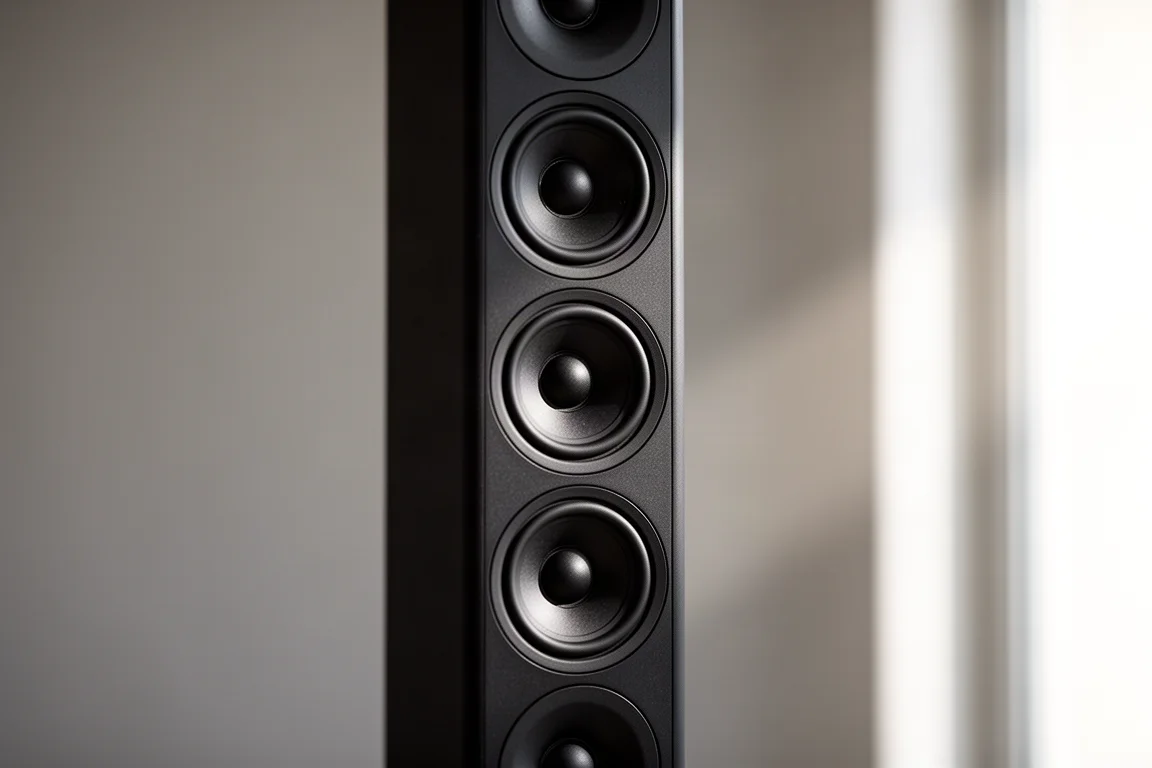
The Bose L1 Pro16 is built differently from the other two. Its vertical J-shaped array holds sixteen 2-inch drivers and stands about 38 inches (roughly 96 cm) tall, with a 10 by 18-inch low frequency driver in the base. Each of those small drivers is essentially a little point source, and they alternate with approximately 90-degree offsets, with less offset between the drivers at the bottom of the array.
The result is a very wide horizontal pattern. Coverage is specified at 180 degrees horizontally and 30 degrees vertically. A useful guideline for line array directivity is that the wavelength equal to the length of the array can be steered at 72 degrees, which for a 38-inch array points to a frequency of about 355 Hz that can theoretically be steered vertically.
The practical consequence is that mid and high energy is directed forward rather than up into the ceiling or down into the floor. The trade-off is that vertical coverage is narrow, and because steering depends on array length, the lowest frequencies are not steered at all and behave much like a point source.
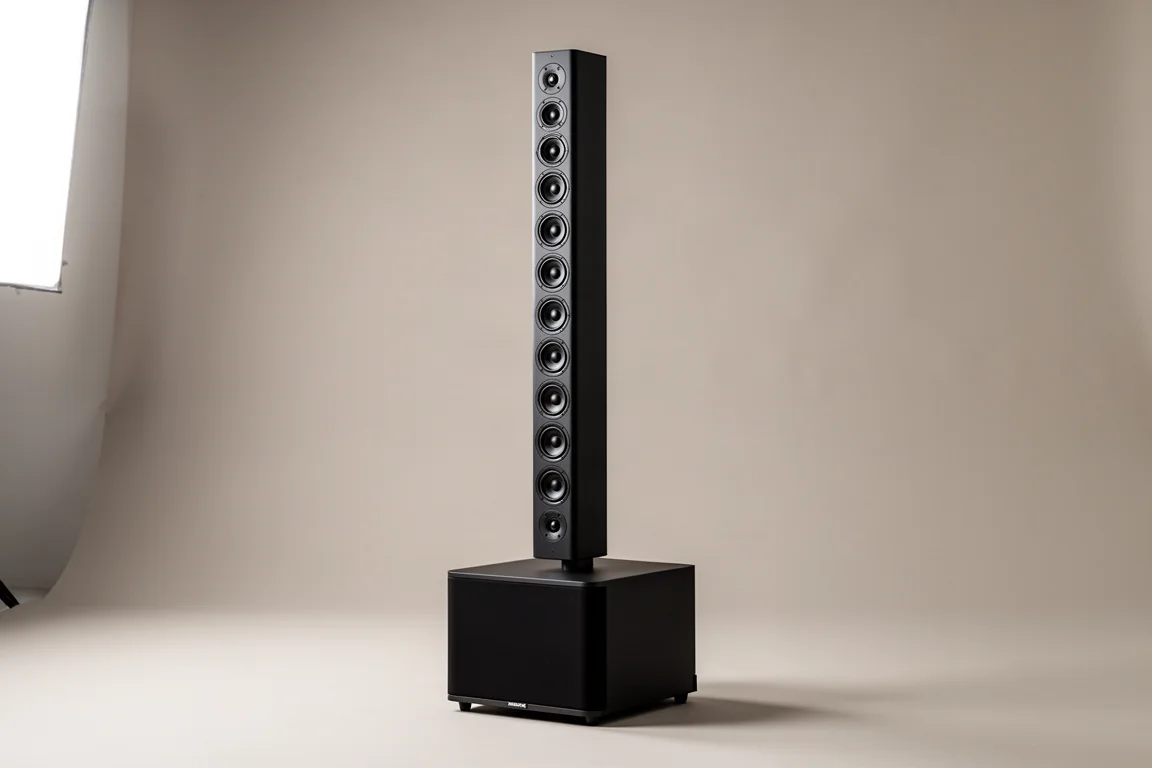
QSC K12: Column Form, Point Source Behaviour
The QSC K12 looks similar to a column line array, but it does not use the same operating principle. Its radiation pattern is much closer to the Yamaha DHR12.
The top section pairs a 1-inch compression driver with the QSC leaf waveguide, short for length equalized acoustic flare, alongside two 4-inch mid frequency drivers. A 12-inch low frequency driver sits in the base. The purpose of the waveguide is to optimise frequency balance across the coverage pattern, keeping the listening experience consistent throughout the specified angle. Coverage is specified at 145 degrees horizontal and 35 degrees vertical.
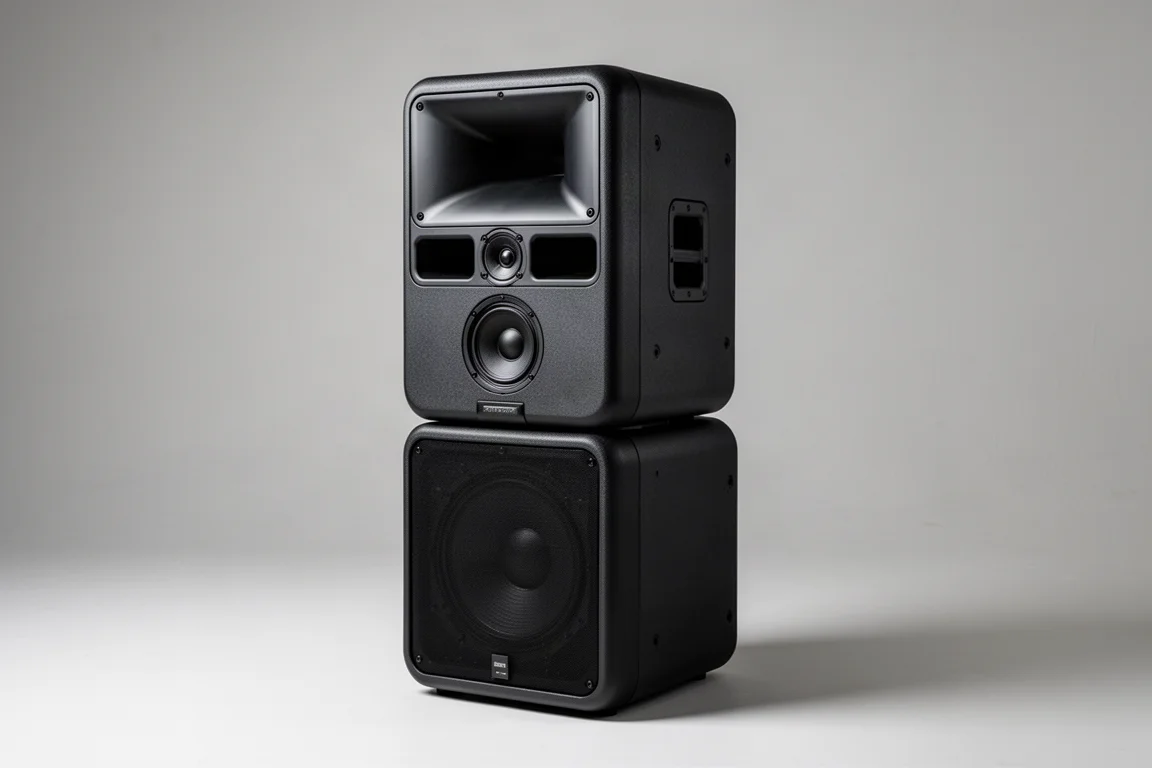
Coverage Angles and What They Mean in Practice
There is a helpful rule of thumb for cone drivers: assume a dispersion pattern of about 90 degrees at the wavelength equal to the diameter of the cone. That means the 12-inch driver in the Yamaha DHR12 naturally steers roughly 1,125 Hz at 90 degrees, both horizontally and vertically. It also explains why smaller ceiling speakers tend to have wider coverage patterns and larger ones narrower patterns. For the 2-inch drivers in the Bose L1 system, the same rule applies at around 6.75 kHz.
Low frequencies are a different story. They are far less directional, which is why the low frequency drivers in all three systems behave like simple point sources. Walk around any of these speakers while low notes play and the level stays more or less even all the way around.
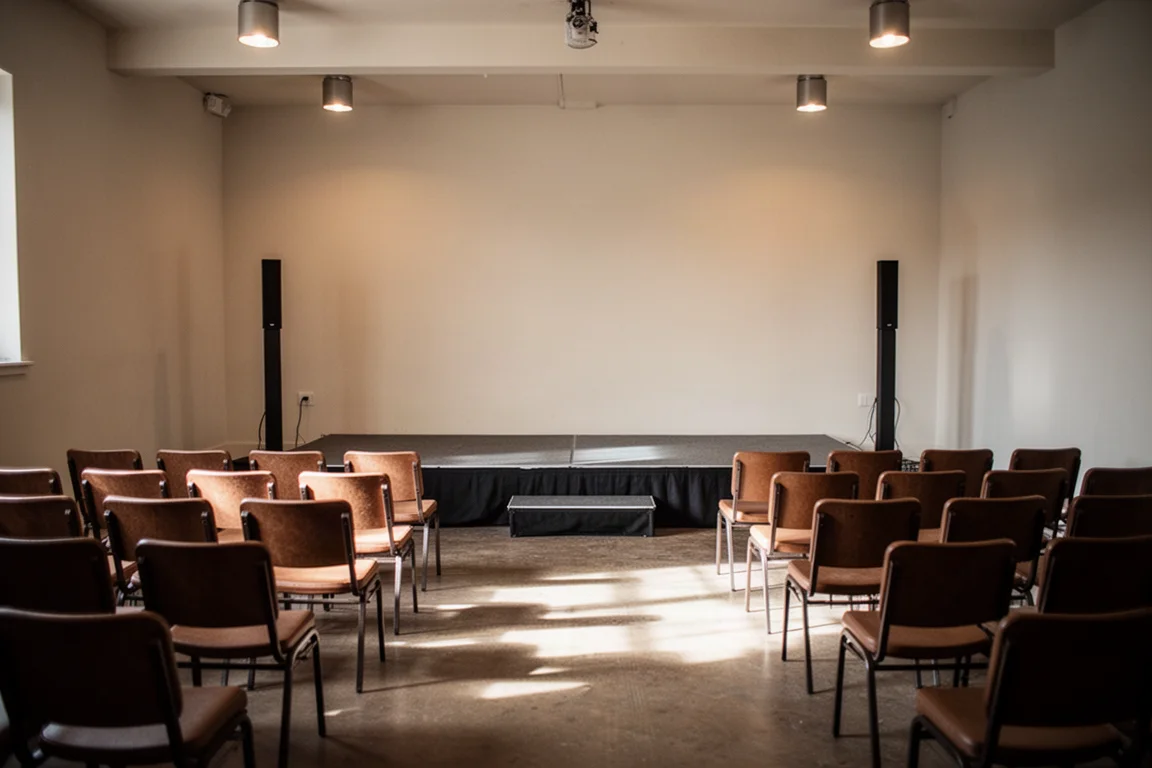
For the mids and highs, each system solves the problem its own way. The Bose uses the line array method to keep energy directed forward. The QSC relies on its waveguide to even out frequency balance across the pattern. The Yamaha uses a rotatable horn so the coverage pattern stays intact in either orientation.
One caution matters here: published coverage figures can be based on different measurement techniques, so comparing specifications alone tells you very little.
How Sound Drops Off With Distance
Distance behaviour is where the two designs diverge most in theory, and where real rooms complicate things.
In an outdoor, near free-field test, both point source designs attenuated close to the expected 6 dB per doubling of distance, but not exactly. Part of that gap comes from the ground plane, which reflects some energy back up toward the listening position. The line array did not hold its level outdoors as strongly as expected. Indoors, the same system seemed to hold up better as the listener stepped back, and one likely reason is that less energy is reflecting off the ceiling when the array directs sound forward.
A related indoor observation: close to the L1, the bass seemed louder relative to the mids and highs. Stepping back, the bass fell away more than the mids and highs did, which changes the perceived balance with distance. Phase interference at certain frequencies also remains visible even once you move away from the array.
Buying Advice
Start with the job rather than the spec sheet. Directing sound toward the audience does three things at once: it wastes less energy, it can reduce the amplifier power needed for a given result, and it reduces the reflections off walls and ceilings that muddy clarity and add reverberation.
If you need a utilitarian speaker that works in many positions, the point source approach is the safer bet. The Yamaha DHR12 covers a stand, a stage front, and a front fill role, and its larger woofer gives it the edge when you need high output and reach to listeners far from the speaker. If you want point source behaviour but a lower visual profile and better sightlines, the QSC K12 is the middle path.
If a single speaker has to cover a very wide space from side to side, the Bose L1 Pro16 offers the widest horizontal coverage here, at 180 degrees, and it is a strong choice when visual aesthetics are a priority. Accept the narrower vertical angle and the fact that its lowest frequencies are not steered.
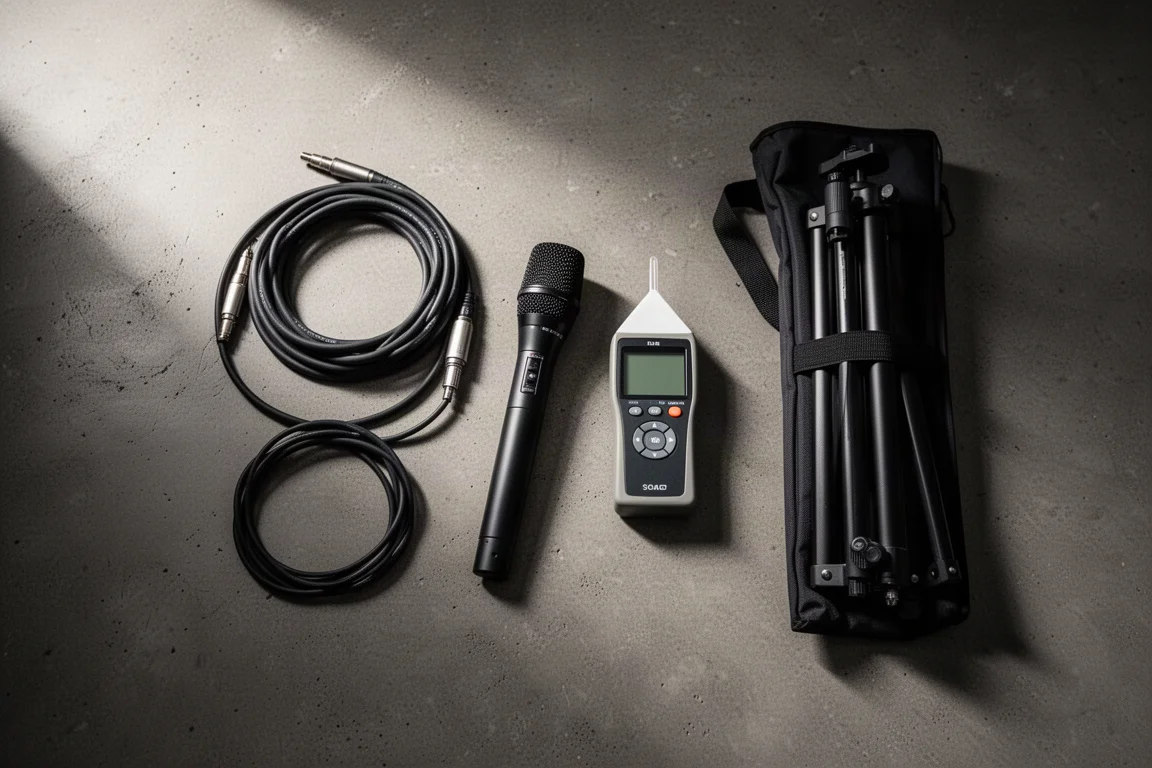
Whichever direction you choose, treat the stated coverage angle as one of several specs worth checking. It tells you how a speaker distributes energy, not how it will sound in your specific room.
Conclusion
Point source cabinets and line arrays are not competing answers to the same question. Point source designs radiate broadly and predictably, and they reward flexibility and high output over distance. Line arrays steer energy forward into a controlled beam, which pays off in wide rooms and reflective spaces.
Match the design to the room and the job, and any of these three systems will do exactly what it was built to do.
Further reading
Related Reviews
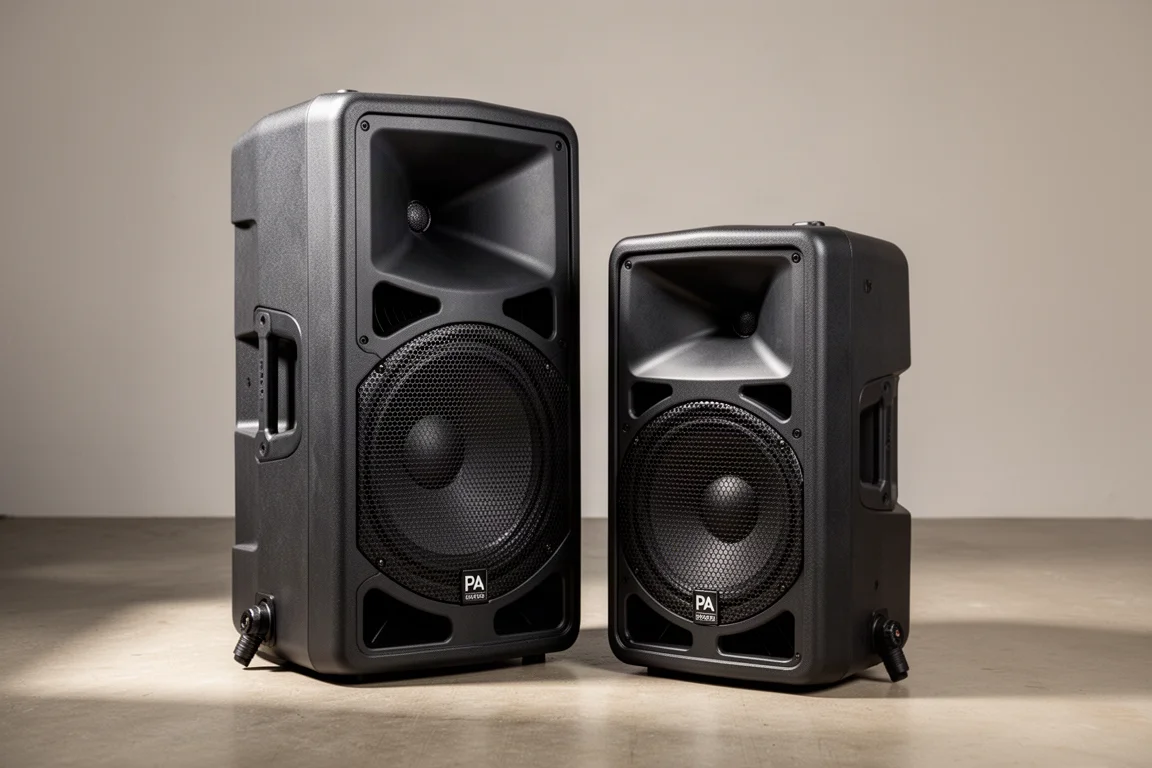
PA Speakers
Behringer B215XL and B212XL Review: Budget PA Speakers With Real Limits
A close look at the Behringer B215XL and B212XL, two inexpensive PA cabinets whose resonant enclosures and early roll-off limit them to casual outdoor use.

Backpacking Gear
Building a 10 lb Base Weight: An Ultralight Backpacking Gear List
A practical walkthrough of the ultralight pieces behind a 10 lb base weight, from a 765 g pack and a roomy one-person tent to a full camp chair and a dependable water filter.

Road Bikes
10 New Road Bikes Worth Watching: Aero, Titanium, Steel and Endurance Standouts
A practical roundup of 10 new road bikes, from aero flagships chasing single-watt gains to titanium, steel and endurance platforms built for real roads.