Astrophotography
Player One Camera Tilter: A Practical Fix for Newton's Rings in Solar Imaging
Why a camera tilter is the smart first step against Newton's rings in H-alpha solar imaging, and when an ADC deserves a look instead.
Introduction
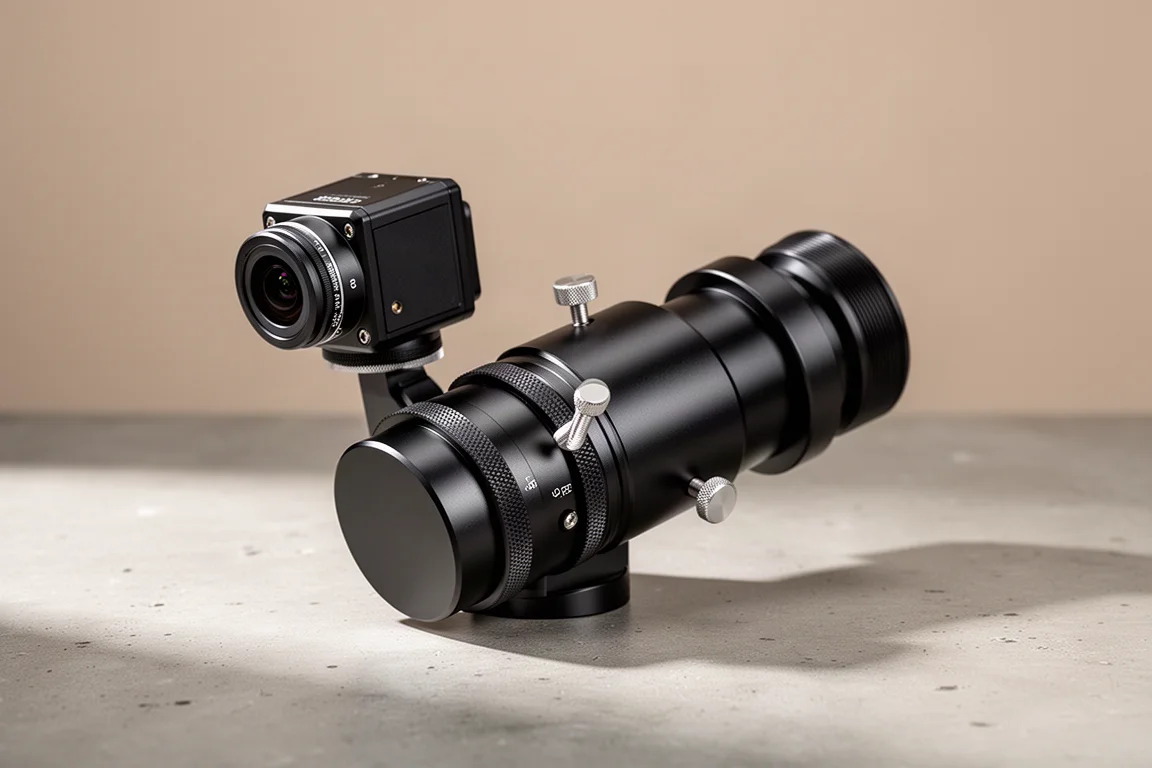
Few things are more deflating in narrow band solar imaging than capturing what looks like a beautiful image, only to find alternating light and dark bands running across the disc. These are Newton’s rings, an optical interference pattern, and they are among the most frustrating artifacts in H-alpha imaging. Two devices are commonly used to mitigate them: a camera tilter and an atmospheric dispersion corrector (ADC). One is a relatively inexpensive mechanical accessory; the other is an optical device originally designed for planetary imaging. Testing across H-alpha configurations from F17.5 to F45 produced a clear takeaway: the right fix depends entirely on your specific setup, and a tilter is usually the best place to start.
What Are Newton’s Rings?
Newton’s rings are an optical interference pattern, not a real feature on the Sun. Processing such as sharpening and contrast boosting does not create them, though it can make them far more visible. Despite the name, they do not always appear as circular rings; in solar images they often show up as nearly straight or gently curved bands.
They originate from a small amount of incoming light being reflected by optical surfaces associated with the camera sensor, particularly its protective window and the sensor itself. When reflected light waves overlap, some reinforce each other and some partially cancel, producing the bright and dark bands. In broadband imaging, a wide range of wavelengths averages the interference patterns together, making them inconspicuous. Narrow band H-alpha imaging is different: an etalon transmitting an extremely narrow range of wavelengths around 656.3 nanometers makes the pattern much easier to see. That is why the same camera can show rings in H-alpha and none in broadband photospheric imaging.
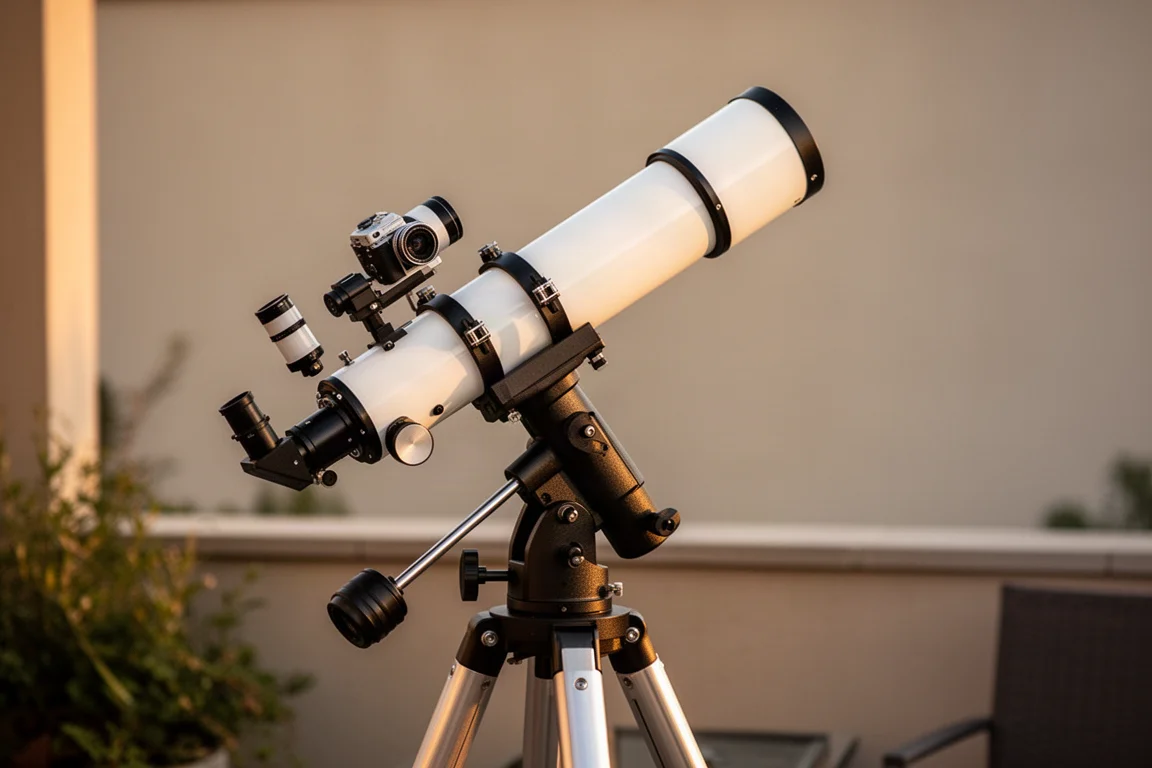
Focal ratio matters enormously. Below about F10, the light cone is wide enough that interference patterns rarely form or remain noticeable. The problem typically appears when focal ratio is pushed using Barlows, Powermates, or telecentric amplifiers, or with etalon systems like a DayStar Quark that includes a built-in 4.2x telecentric. As the light cone narrows at F15, F20, F30 and beyond, the interference reflections become more distinct and stubborn.
How a Camera Tilter Works
A camera tilter physically tips the camera slightly relative to the incoming light, changing the geometry of the reflections responsible for the interference pattern. As you adjust the tilt, the rings may move, become more closely spaced, weaken, or disappear completely.
The advantages are straightforward: tilters are generally inexpensive, contain no additional optical glass, and can be very effective. The trade-off is that tilting the camera also tilts the sensor relative to the telescope’s focal plane. Too much tilt can introduce uneven sharpness and illumination across the image. The goal is always the minimum tilt needed to suppress the rings, not the maximum the device allows.
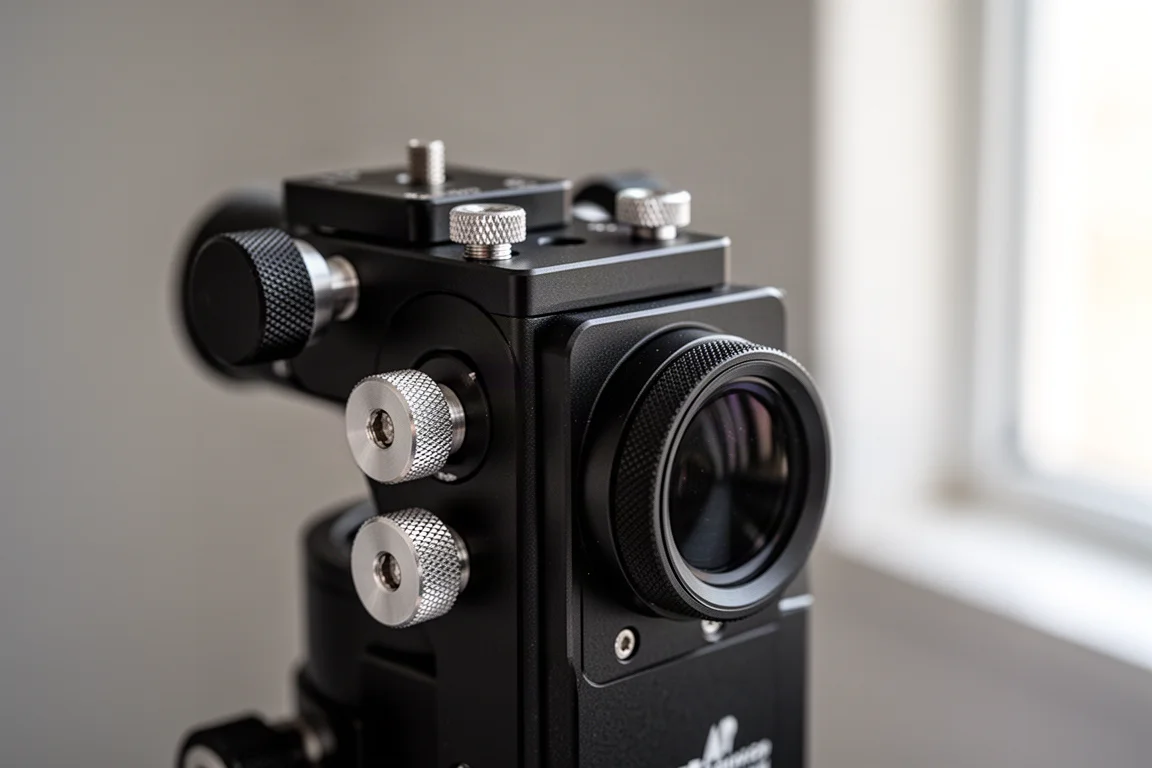
An ADC works differently. Its adjustable prisms redirect the incoming light, changing the angle at which light reaches the sensor without physically tipping the camera. A simple way to remember the difference: a tilter changes the camera angle, an ADC changes the direction of the light. Because H-alpha uses such a narrow wavelength, the color separation prisms normally correct is not a concern, but an ADC does introduce additional glass surfaces into the optical train.
Tested Across Three Focal Ratios
Testing covered three H-alpha configurations: a Lunt 100 MT with a 2.5x PowerMate at F17.5, a TEC 160 refractor with a 4x telecentric amplifier and a Solar Spectrum H-alpha etalon at F28, and the same TEC 160 setup with a Seibert 1.6x amplifier at roughly F45. Comparisons used both defocused recordings, which make the interference patterns easier to identify, and normal focused solar captures, using the IMX174 camera with some IMX432 tests at F45.
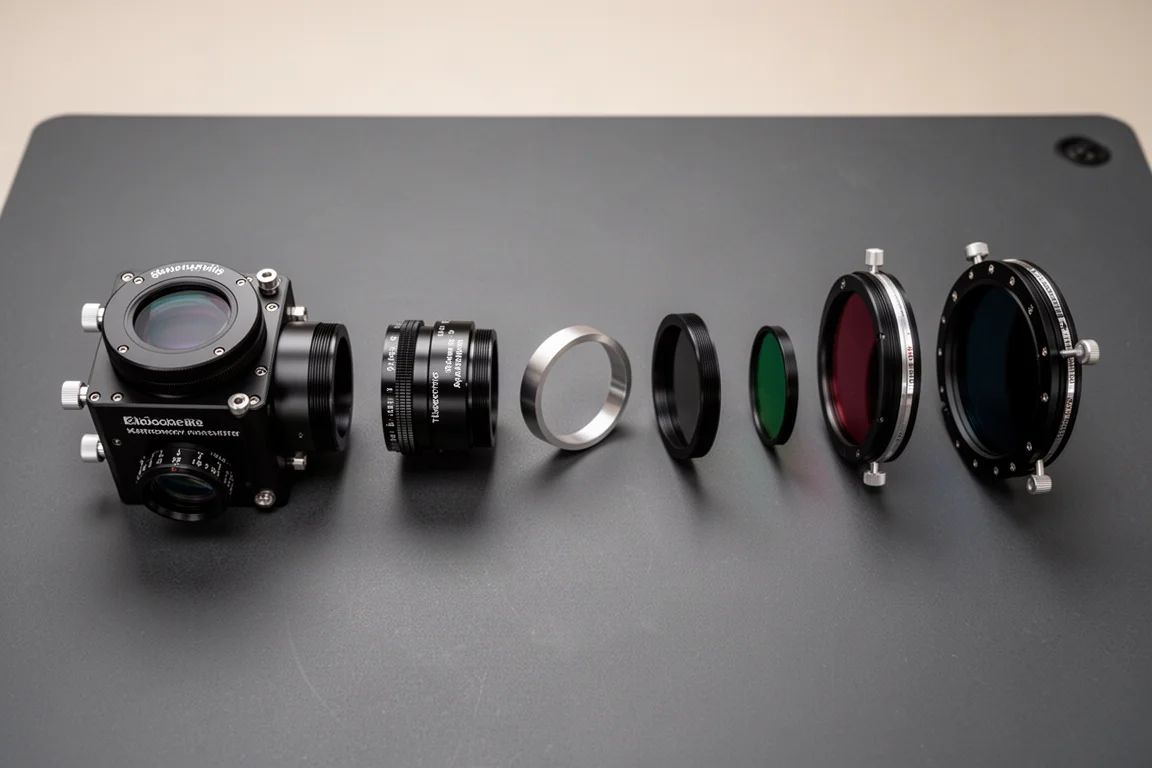
At F17.5, no detectable Newton’s rings appeared, so there was nothing for either device to mitigate. At F28, rings were clearly visible, and both the tilter and the ADC eliminated them completely. The interesting difference showed up in the final processed images: the tilter consistently produced slightly better resolved fine detail in filament and active region structures. The difference was not enormous but repeatable enough that the tilter was preferred at this configuration.
At F45, the pattern became more persistent and neither device eliminated it in every defocused recording. With the IMX174, the ADC generally mitigated the rings more effectively, and the processed images generally showed better detail with the ADC than with the tilter. That does not make the ADC universally superior at F45; it simply suited that particular combination of telescope, etalon, amplifiers, camera, and optical spacing.
Practical Considerations Before Buying
Not all tilters are equally convenient. Some require small hex wrenches to adjust and lock their screws, which is awkward when fine-tuning while watching a live solar image. Some also expose gaps between tilting plates during adjustment, potentially letting unwanted light into the camera. The Player One design addresses both issues, which makes it the tilter worth recommending for field usability.
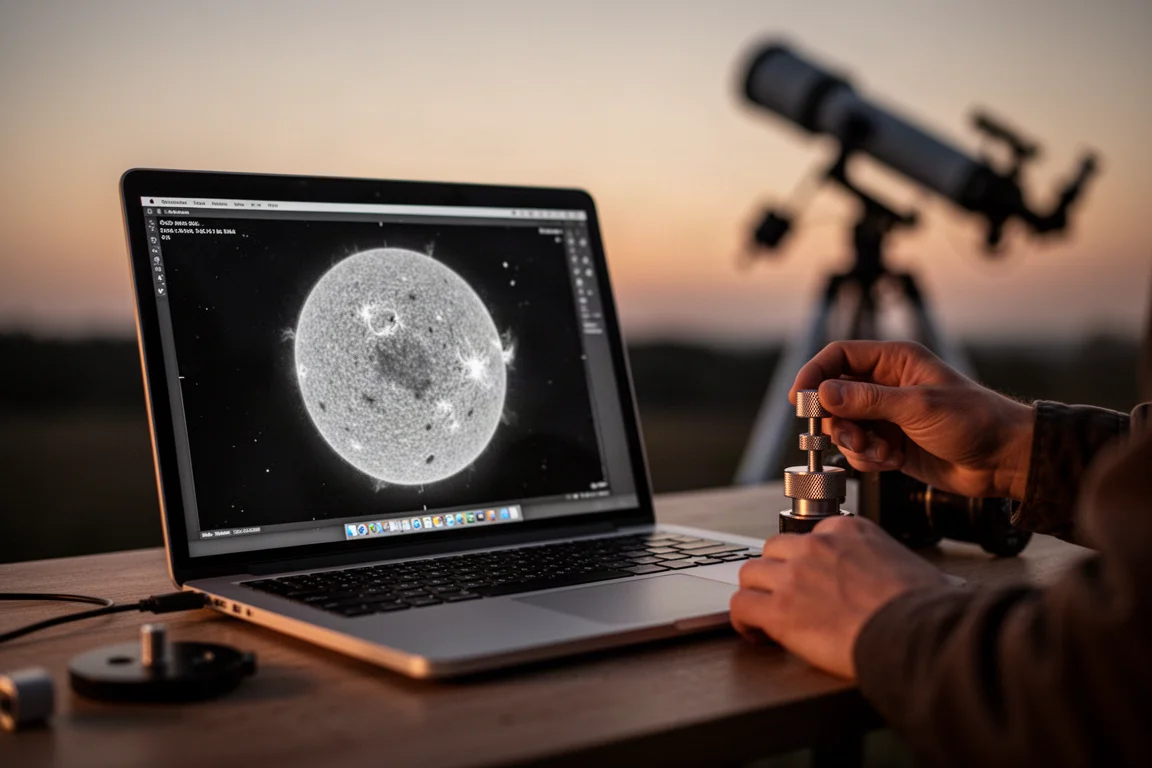
Both devices extend the optical train. A tilter adds mechanical length, and an ADC occupies space as well, which can increase leverage on the focuser, change available back focus, and alter optical spacing. For telecentric and narrowband etalon users, treat the correction device as part of the complete optical train rather than an isolated accessory. A tilter has no optical glass and adds no transmission losses, while an ADC’s prisms are not 100% transmissive even with good coatings, potentially requiring slightly longer exposures or more gain. With dim double-stacked H-alpha images, that is worth remembering.
Buying Advice
First, establish whether you actually have Newton’s rings. Do not buy a correction device simply because you image in H-alpha. If you image below F10 and see clean captures, you likely need neither device.
If rings are a problem, start with a camera tilter. It is comparatively inexpensive, contains no optical glass, and may be all you need. Adjust it while examining a defocused image, using only as much tilt as necessary to suppress the pattern, then return to sharp focus and evaluate a normal solar capture.
If the tilter does not deliver a satisfactory result, consider an ADC, which proved particularly useful in the difficult F45 configuration with the IMX174. But do not treat that as a universal rule; your camera, sensor, focal ratio, amplifiers, etalon, optical spacing, and telescope all change the outcome. Whatever device you use, examine the complete image, not just the rings: look for uneven sharpness, vignetting, reflections, displaced images, and illumination changes. If the rings disappear but fine solar detail deteriorates, the result has not really improved.
Conclusion
Newton’s rings are a capture-time problem best solved at capture time, since sharpening, denoising, and ordinary contrast adjustments do not remove the underlying interference pattern and flats often cannot correct something that shifts with camera orientation and spacing. For most H-alpha imagers, the Player One camera tilter is the sensible first purchase: affordable, glass-free, field-friendly, and capable of producing measurably cleaner and sharper solar images. Keep an ADC in mind for the most extreme focal ratios where a tilter alone falls short.
Product link
View more details for Player One Camera Tilter
This product is mentioned in the review. Check the specifications, options, and compatibility before buying.
View more details for Player One Camera TilterFurther reading
Related Reviews
Astrophotography
ASKAR FRA400C Review: A Versatile 400mm Refractor for Astrophotography and More
The ASKAR FRA400C is a compact 72mm refractor that balances reach, versatility, and portability for astrophotographers and visual observers.
Astrophotography
Askar SQA106 Review: A Premium 106mm Astrograph With Exceptional Optics
The Askar SQA106 is a premium 106mm quintuplet astrograph with impressive sharpness across full-frame sensors, though its price and weight demand careful consideration.
Astrophotography
Astro Imaging Gear 2026: Eight New Products Worth Watching
A look at the most interesting new astrophotography and astronomy products announced this year, from fast telescopes to smart cameras and wireless accessories.