Hi-Fi Speakers
Pitt & Giblin Superwax Mini Review: Full-Range Sound From an Active Two-Way
An in-depth look at the Pitt & Giblin Superwax Mini, an active two-way speaker with a 15-inch woofer, a bronze waveguide, and internal Hypex amplification with DSP tuning.
Introduction
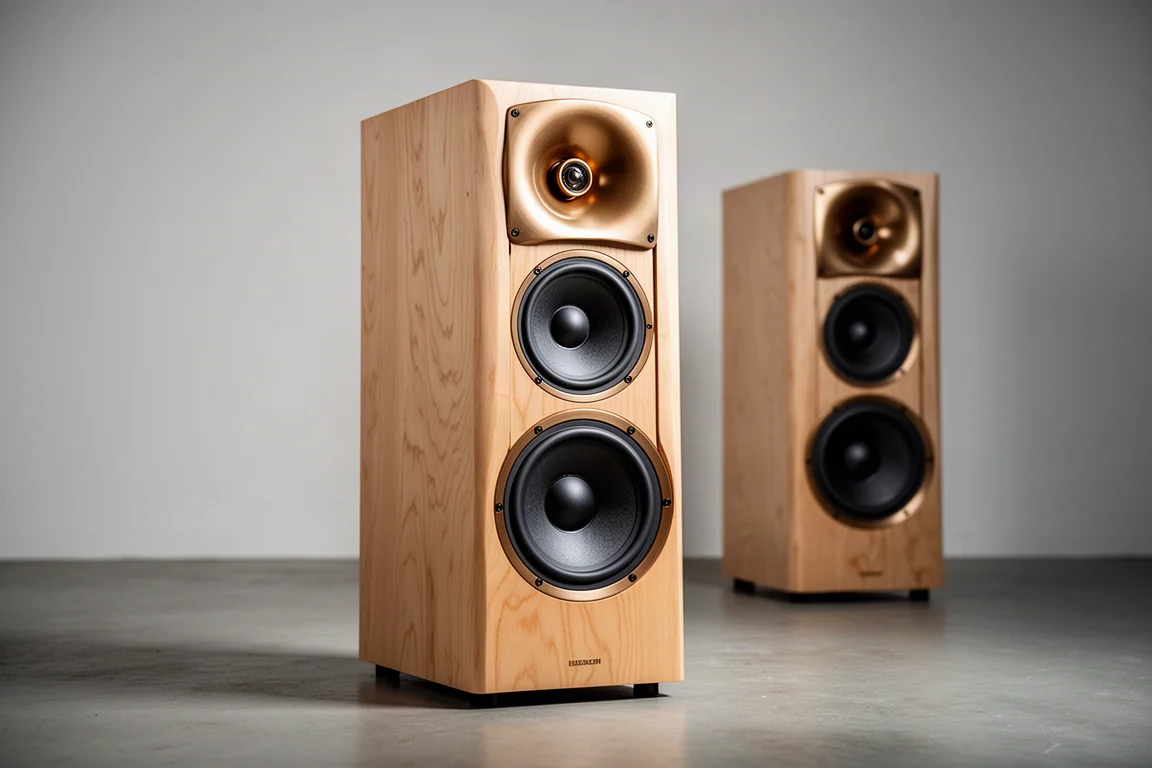
Pitt & Giblin builds the Superwax Mini in Hobart, Tasmania, and the design brief is unusual: pair the immediacy of a high-efficiency horn-style speaker with the convenience of active electronics. The result is an active two-way loudspeaker with a 15-inch woofer and a 1-inch compression driver mounted in a solid bronze waveguide. Internal Hypex amplification delivers 350 watts of total power per speaker, and the cabinet is CNC-machined from birch plywood with a rear-facing port. Reported frequency response spans 32 Hz to 25 kHz, which supports the claim that most listeners will not need a subwoofer in the room. Because the amplifiers and the DSP tuning are built in, there is no separate amplifier to buy and no speaker cable to match.
Who the Superwax Mini Is For
This is a speaker for listeners who want a short signal chain without giving up scale or dynamics. A pair can be fed from a streamer, a DAC, or a preamp, and the speakers handle amplification and tuning internally.
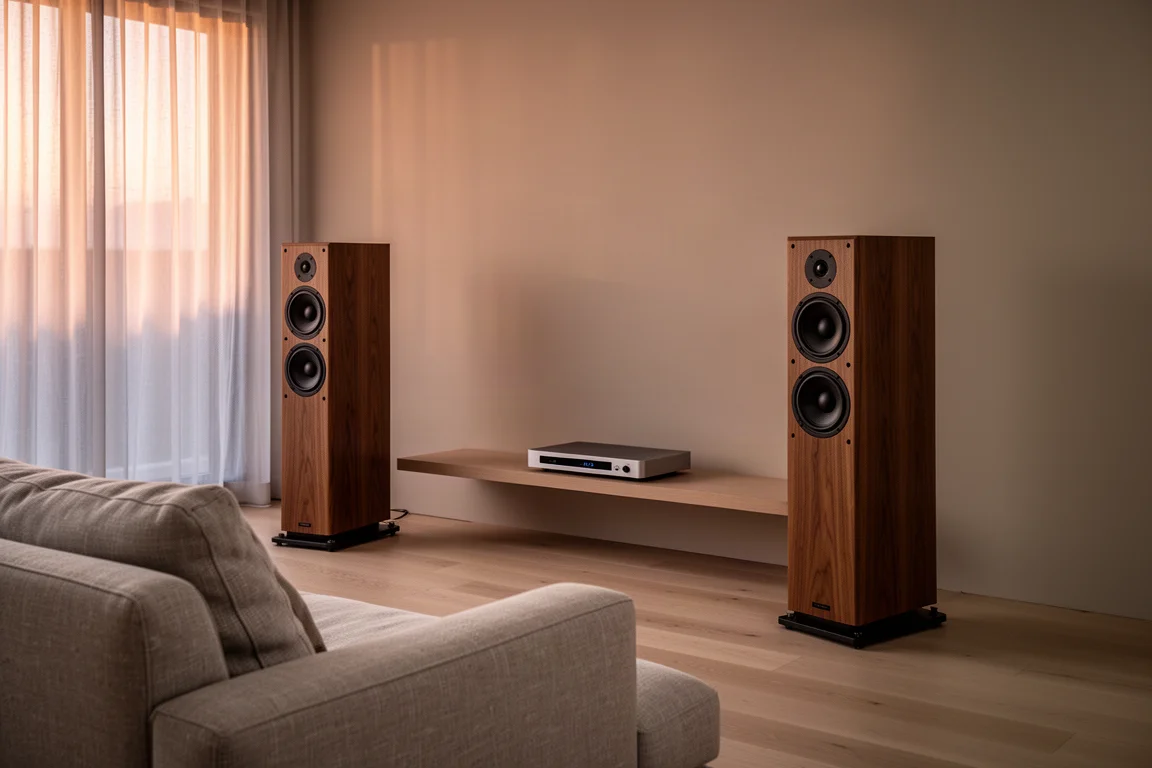
It also suits anyone who values efficiency and headroom, and who is comfortable with a design that is deliberately not a smart speaker. There is no built-in streaming, no voice control, and no phono preamp, so a turntable or a network player needs its own path into the system. Buyers who want an all-in-one, app-driven experience will find more complete packages elsewhere, and that is the trade for what the Superwax Mini does well.
Design, Connections, and Setup
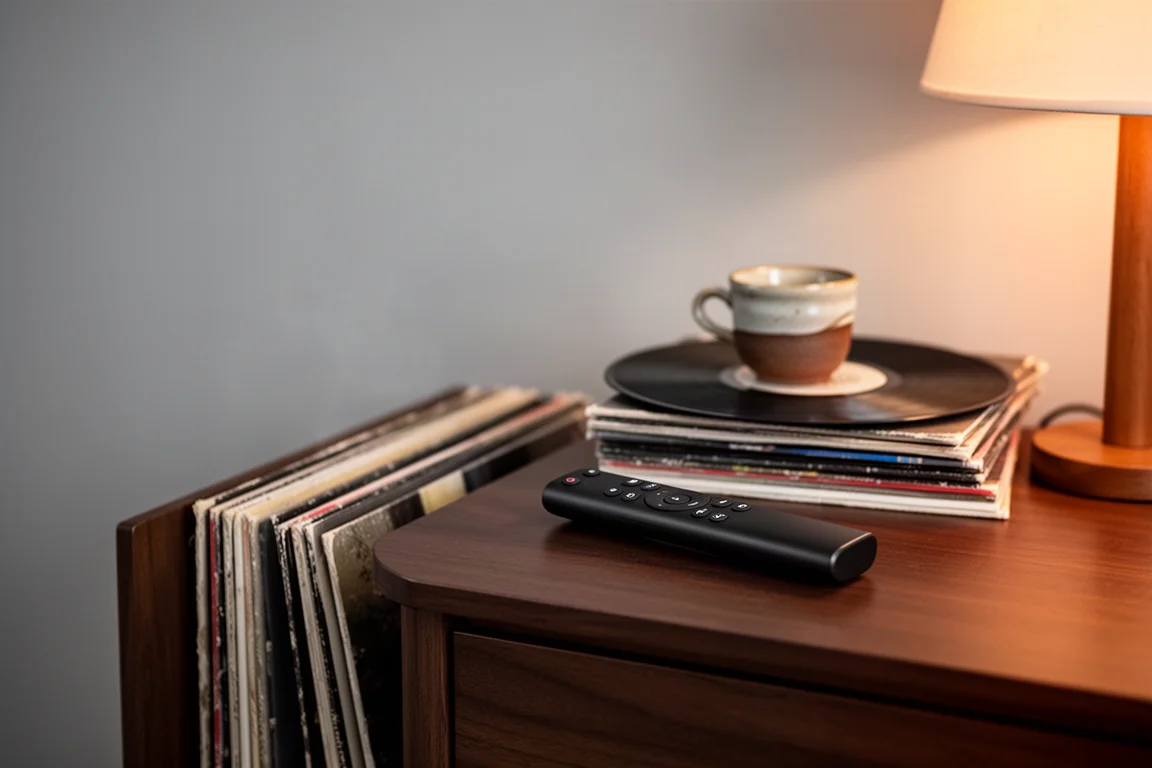
The rear panel covers more ground than most active speakers: balanced and unbalanced analog inputs, optical and coaxial digital inputs, and a digital XLR (AES3) input. The included remote switches between inputs, adjusts volume, and cycles through three preset tuning profiles.
One detail shapes how the system is used. Every incoming signal, analog included, is converted to digital by the Hypex amplifier modules and processed through DSP before being converted back to analog and amplified. That means an external DAC is not required, and adding one may not deliver obvious benefits, since it introduces another conversion step in the chain.
The left speaker is the primary unit and the right speaker acts as a slave. A supplied digital coaxial cable links the two and carries right-channel information without extra wiring. Analog sources are handled more conventionally, with the left output going to the left speaker and the right output to the right speaker. Setup itself is straightforward: roughly 18 inches from the front wall and about 9.5 feet between the speakers worked well, and a slight toe-in sharpened the imaging. In-room output reached close to 20 Hz at the listening position at volumes well above normal listening levels.
Main Strengths: Sound Quality and Dynamics
Bass is the first thing that registers. The 15-inch woofer is quick and punchy, with a heft that is more typical of a dedicated subwoofer than of a two-way speaker, yet it never turns one-note or bloated, even on synthetic bass lines.
The real achievement is the transition from bass to midrange and on into the treble. Tonality is linear and neutral rather than warm or cool, and DSP tuning keeps timbre consistent across genres and at nearly any volume. There is a presence to the sound that is reminiscent of far more expensive active designs, though the character leans toward a live venue rather than a holographic rendering. Clarity and intelligibility are excellent, to the point where vocal performances feel present in the room.
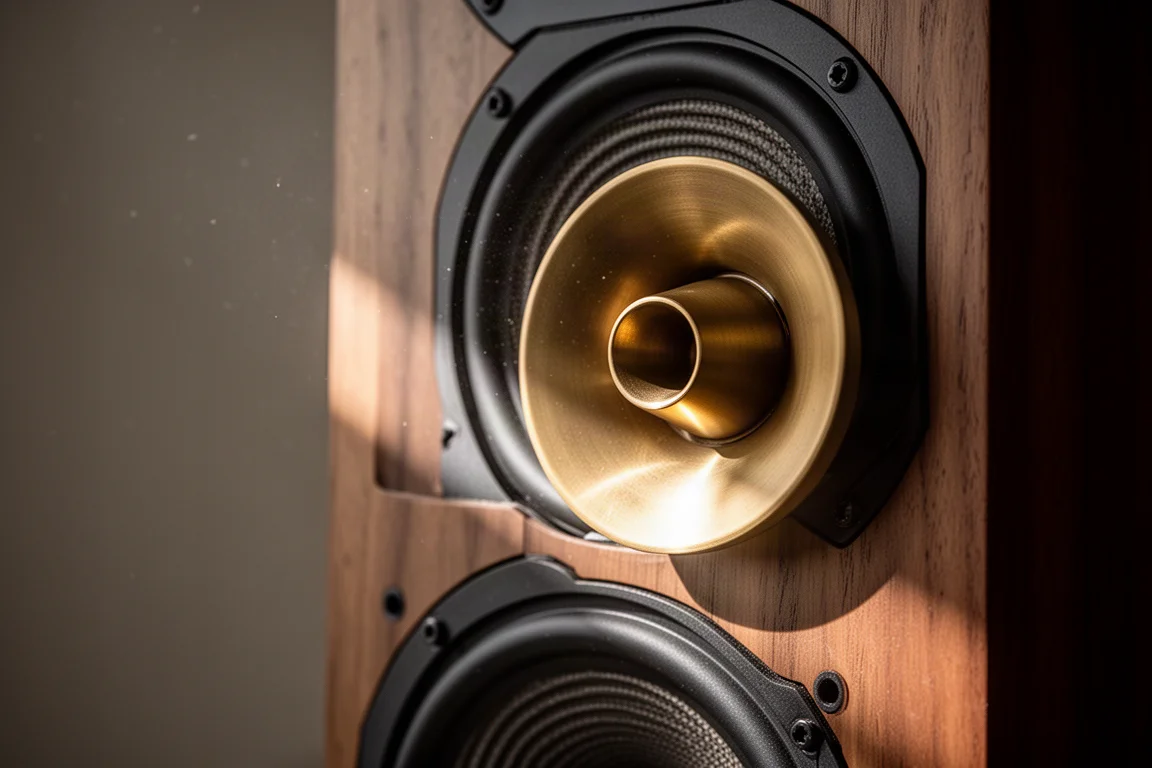
Treble is where the bronze waveguide earns its keep. It is controlled, effortless, and extended, never beamy or shouty, and the rolloff is smooth enough that difficult live recordings remain enjoyable rather than piercing. Measurements showed a very linear response from about 100 Hz upward. Scale and dynamics are the other headline: the speaker is difficult to tax, and most listeners will run out of appetite for volume long before the speaker runs out of headroom. The soundstage is broad and live sounding rather than surgically precise, with very good center imaging and a sonic plane that sits around seated ear height. Speakers exist that separate individual instruments more sharply, but few convey a live performance with this little setup effort.
Living With the Superwax Mini: Control and Quirks
Day-to-day ownership is mostly pleasant, with a few rough edges. The included remote does its job but feels basic, and because the amplification comes from a third-party Hypex module, occasional issues carry a slightly DIY flavor.
One example: since the right speaker depends on a signal from the left, it can fail to wake from standby. The quick fix is pressing mute twice on the remote to toggle mute on and off, after which both speakers output sound. Signal sensitivity can also be fussy with some sources, particularly analog or variable-volume devices. Auto signal sense may need a higher volume to wake the speakers, which is awkward for quiet listening or late-night sessions.
Pitt & Giblin are aware of these behaviors and state that the internal amplifiers are configured to work with the broadest possible range of third-party products, with adjustments available when a specific source causes trouble. The company can also retune a pair remotely for a given room, provided there is a decent internet connection, a Windows laptop, and a USB cable. That process works, though most listeners will likely stay with the factory tuning.
Adding a streaming DAC with HDMI switching and app control improved the overall experience considerably, to the point that the included remote was rarely needed. No meaningful difference in sound quality was detected with that device in the chain.
Things to Consider Before Buying
Build and finish are first rate, better than what the Klipsch Heritage line typically offers, including costlier models such as the Cornwall IV and La Scala. What the Mini does not match is the prestige and polish that comes with spending this kind of money on a Bang & Olufsen system, and the everyday living experience does not completely outclass the Klipsch Heritage speakers either.
Cost is the other factor for the Superwax Mini. The Cornwall IV sells for around $6,500 a pair, which is less than the roughly $11,000 landed cost of the Minis in the US. The catch is that the Cornwall needs electronics: building a system around it that approaches what the Superwax Mini delivers can add somewhere between $6,000 and $12,000 in components. One such setup, Cornwall IVs driven by Musical Fidelity amplification and fed by an EverSolo A8, has a street price around $18,000, which is well above the Mini.
Where the Superwax Mini Sits in the Market
Value questions come up quickly at this price. The KEF LS60 Wireless, at just under $5,000, remains the value leader among hi-fi leaning smart speakers and offers a more complete end-to-end experience with a different sound signature, while the Klipsch The Sevens, at $1,200 a pair, are remarkably good and fun for the money without approaching what the Mini can do. Those are different products for different buyers, and neither undercuts what the Superwax Mini is: a bespoke speaker with internal amplification, DSP tuning, and a machined cabinet. It is also a way to keep a classic, less software-driven hi-fi experience while keeping the setup simple. Pitt & Giblin is not yet a household name, but on this evidence it is positioning itself as a high-end disruptor.
Buying Advice
The Superwax Mini makes the most sense for listeners who want a compact number of boxes, a full-range presentation without a subwoofer, and a speaker that stays composed across genres and volume levels. Budget for the source side: a streamer or a streaming DAC will make daily use far easier than relying on the supplied remote.
Consider the room as well. The design rewards a placement with some space behind the speakers and a listening seat roughly level with the drivers, and the three factory tuning profiles cover most situations. If a room proves difficult, remote tuning support is available. Buyers who prioritize absolute imaging precision or a fully app-driven ecosystem should look at other options. Buyers who want scale, dynamics, and a live feel from a two-piece system with no external amplification will find a lot to like here.
Conclusion
The Superwax Mini is a genuinely distinctive active two-way speaker: a 15-inch woofer, a bronze waveguide, and internal Hypex amplification with DSP tuning, all in a CNC-machined birch plywood cabinet. It delivers deep, fast bass, a neutral and consistent tonal balance, and effortless treble, with the kind of scale that makes the name feel ironic. The trade-offs are real, including the absence of streaming and voice control, a basic remote, and occasional standby quirks. For the right listener, though, it is a compelling way to simplify a high-end system without giving up performance.
Product link
View more details for Pitt & Giblin Superwax Mini
This product is mentioned in the review. Check the specifications, options, and compatibility before buying.
View more details for Pitt & Giblin Superwax MiniFurther reading
Related Reviews
Hi-Fi Speakers
1723 THX Tower vs 1528 Bookshelf: Which Speaker Fits Your Room?
Two speakers at roughly the same price, built very differently. How the 1723 THX tower and the 1528 bookshelf compare on construction, bass, power needs, and sound.
Hi-Fi Speakers
Acoustic Energy AE 300 Review: Deep Bass From a Compact Standmount
A two-way standmount with real wood veneer, surprising low-end weight, and a warm, easygoing character. Here is what to know before buying.
Hi-Fi Speakers
Acoustic Energy AE1 40th Anniversary Review: A Modern Take on a British Classic
A compact standmount that revives a 1980s favorite with all-new parts, a warm mid-centric balance, and a price of £1,499 per pair.