Bookshelf Speakers
Philharmonic True Mini Review: A Compact Speaker With Genuine Hi-Fi Ambition
The Philharmonic True Mini is a $380-per-pair passive bookshelf speaker with SB Acoustics drivers, a fourth-order crossover and a piano gloss finish. Here is what it does well and what it asks of your system.
Introduction
The Philharmonic True Mini is a small passive bookshelf speaker that sells for $380 a pair, not per cabinet. In a market where the overwhelming majority of loudspeakers demonstrated at hi-fi shows cost more than $2,000, a genuinely musical speaker under $500 is a rare find, and the True Mini is one of the few that earns the description.
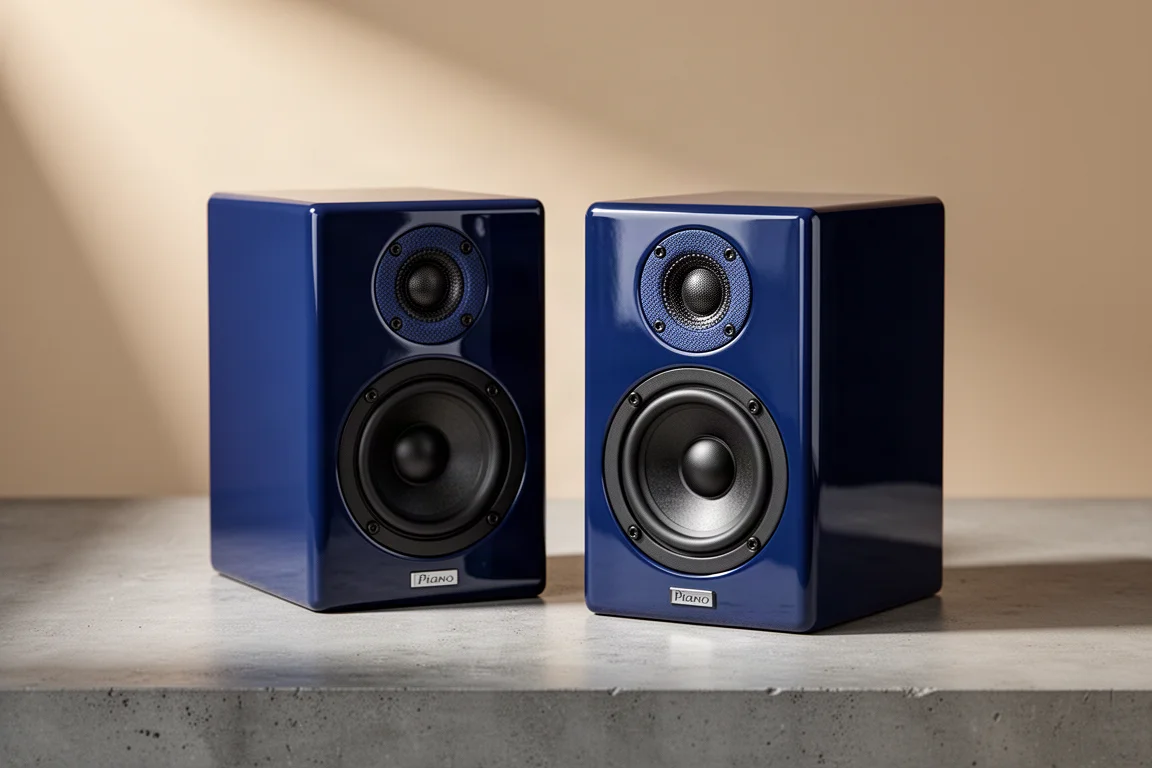
It is a two-way design built around SB Acoustics drivers and a fourth-order crossover, wrapped in a piano gloss cabinet available in blue, black or white. The physical footprint is modest, but the component choices suggest the money went into the parts that shape the sound.
Who This Speaker Is For
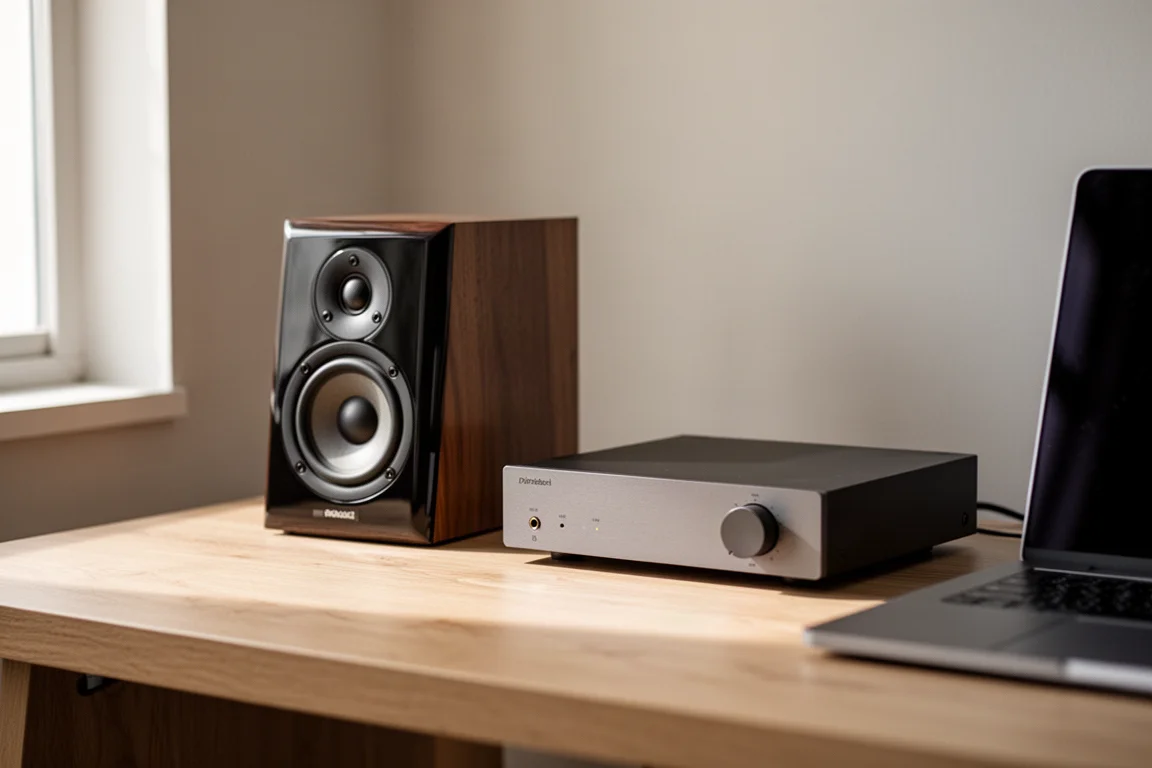
The True Mini is aimed at listeners who want a neutral, mid-range-forward presentation in a small space. That means desktop systems, near-field setups and smaller rooms where a large floorstanding speaker would overwhelm the room.
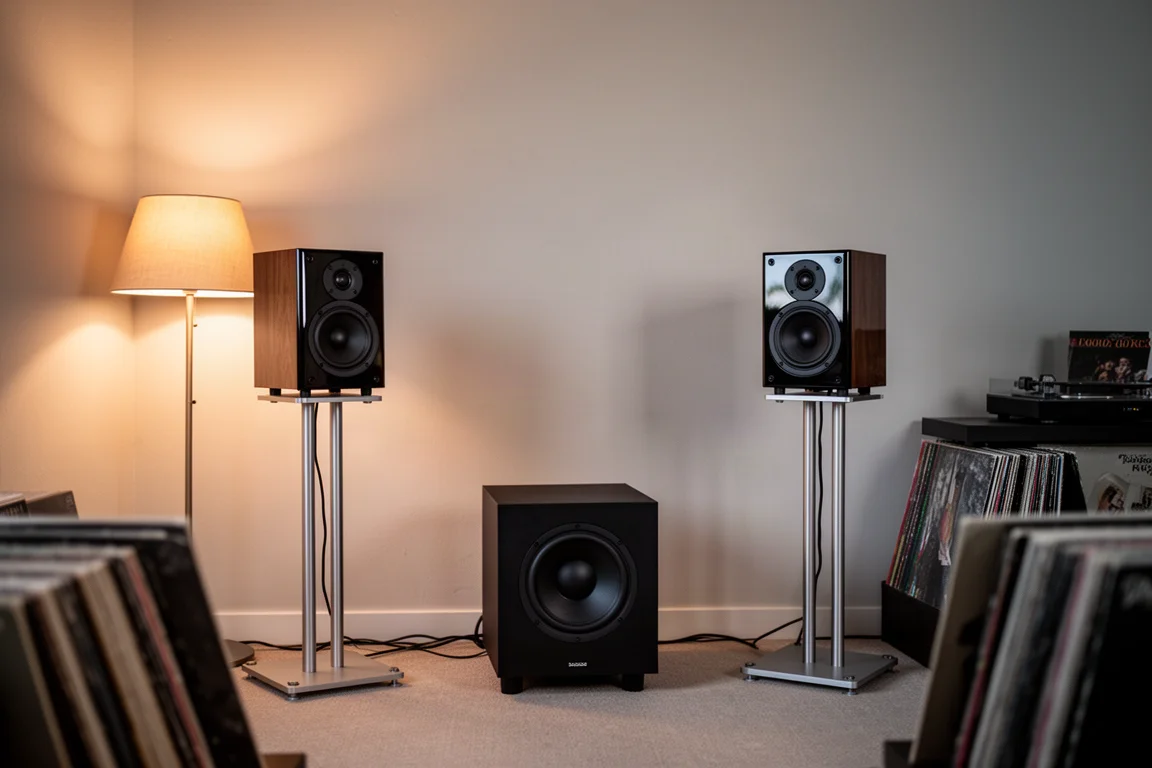
It is also a natural fit for anyone who already runs a subwoofer, or who is willing to add one. The shallow cabinet makes placement easy, and the rear keyhole mount means wall mounting is a realistic option rather than an afterthought.
It is not the right choice for someone looking for a single pair of speakers to deliver full-range bass on its own.
Design and Build Quality
The cabinet measures roughly 6 inches wide, 7.5 inches deep and 11 inches tall. Despite the small dimensions, the speaker has a reassuring weight to it, and the piano gloss finish is the standout visual feature. Three finishes are offered: blue, black and white.
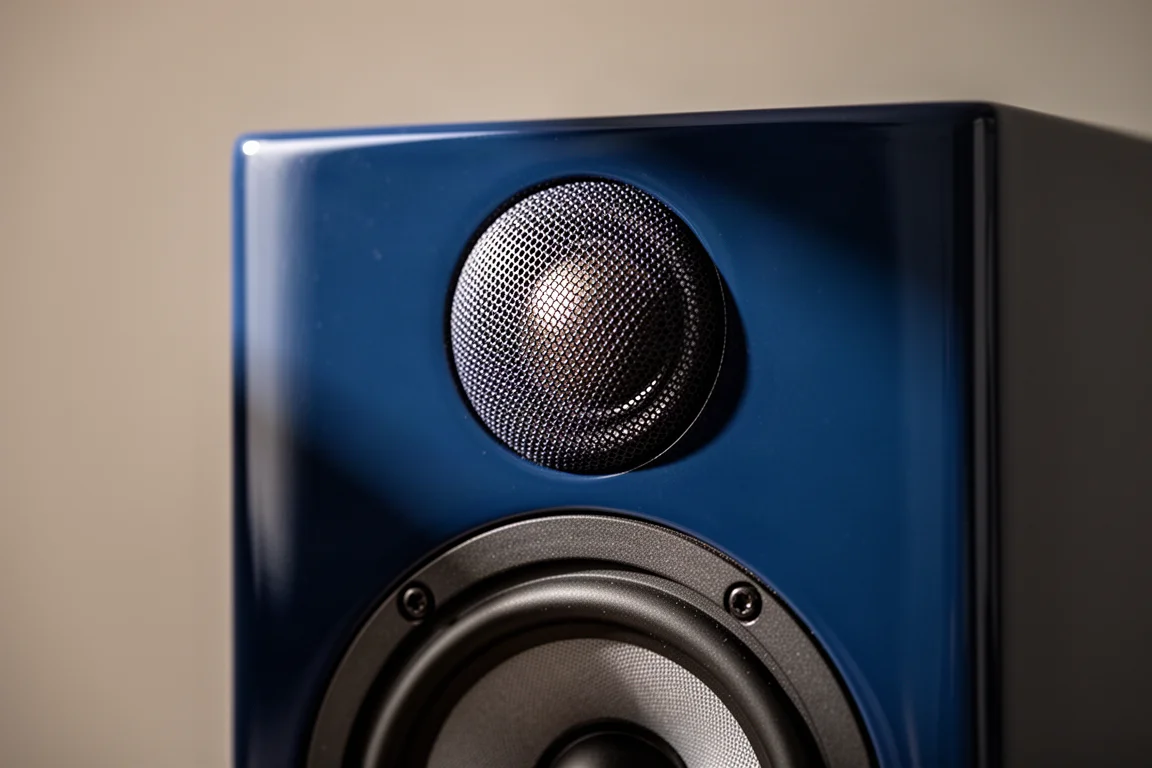
On the back you will find a bass port, a keyhole mount and a pair of binding posts. The driver complement is a 3/4 inch fabric dome tweeter paired with a 4 inch woofer, both from SB Acoustics, crossed over with a fourth-order Linkwitz-Riley network at 2,100 Hz.
Manufacturer specifications list a frequency response of 70 Hz to 20,000 Hz in the ported configuration and 90 Hz to 20,000 Hz when the port is sealed. Sensitivity is 85 dB, and the nominal impedance is 4 ohms with a dip to 3 ohms.
Main Strengths
The most striking quality of the True Mini is how linear and neutral it sounds across most of its range. There is a gentle lift of around 3 dB after 1 kHz, with a slight dip just before 2 kHz, which gives the speaker a mildly mid-range-forward character rather than a bright or recessed one.
The treble is detailed and agile, with good air and extension. It stays fairly flat, falling away only slightly around 10 kHz. For a speaker this size, the soundstaging is genuinely impressive, and the shallow cabinet gives it more room to interact with the space around it.
Dense material holds together well. Layered recordings with a lot of simultaneous instrumentation stay separated, and bass clarity is good for what a 4 inch woofer can realistically deliver.
Sound Quality and System Matching
The True Mini responds strongly to amplifier quality. With more power behind it, the speaker becomes noticeably more dynamic, which is consistent with its 85 dB sensitivity and its 4 ohm nominal load that dips to 3 ohms.
The most satisfying results come from a system with a subwoofer output, a variable crossover and some form of equalisation. Bringing the region around 1 kHz down by about 3 dB, trimming 2 kHz and 500 Hz slightly, and adding a little bass lift produces a fundamentally neutral balance. Without that flexibility, the mid-range can feel a touch forward at higher near-field volumes, and female vocals in particular can sound intense between 75 dB and 85 dB. Percussion can also come across as slightly snappy.
Acoustic and jazz material is where the speaker feels most at home, and the same separation and detail carry over to busier rock and metal recordings.
Things to Consider Before Buying
Bass extension is the clearest limitation. Ported, the speaker reaches down to 70 Hz; sealed, that figure rises to 90 Hz. A subwoofer is not optional for most listeners, regardless of what they listen to.
The mid-range lift is a matter of taste rather than a fault. Many listeners actively prefer that kind of response, but it is worth knowing about if you are sensitive to forward vocals or plan to listen at high levels in the near field.
Power requirements deserve attention too. An amplifier that cannot deliver current into a 3 ohm dip will not let the speaker show what it can do, and an amplifier without subwoofer integration makes it much harder to build a balanced system around it.
Finally, ordering works differently from a conventional retail checkout. Buying is handled by contacting the manufacturer directly, and the website is functional rather than polished, though it does publish unusually detailed frequency response graphs at 0, 20, 45 and 80 degrees off axis.
Buying Advice
At $380 a pair, the True Mini competes directly with entry-level favourites such as the ELAC Debut series. Its top end is more capable than that of the ELAC B6.2 or B5.2, and it carries some of the character of the Polk R100 with less low-end output.
Budget for two things beyond the speakers themselves: a subwoofer, and an amplifier with enough current to drive a 4 ohm load that dips to 3 ohms. Sealing the port, mounting the speakers relatively close to the wall for boundary reinforcement and using only a small amount of toe-in is a practical starting point, and listening slightly off axis tends to sound better than sitting directly on the tweeter axis.
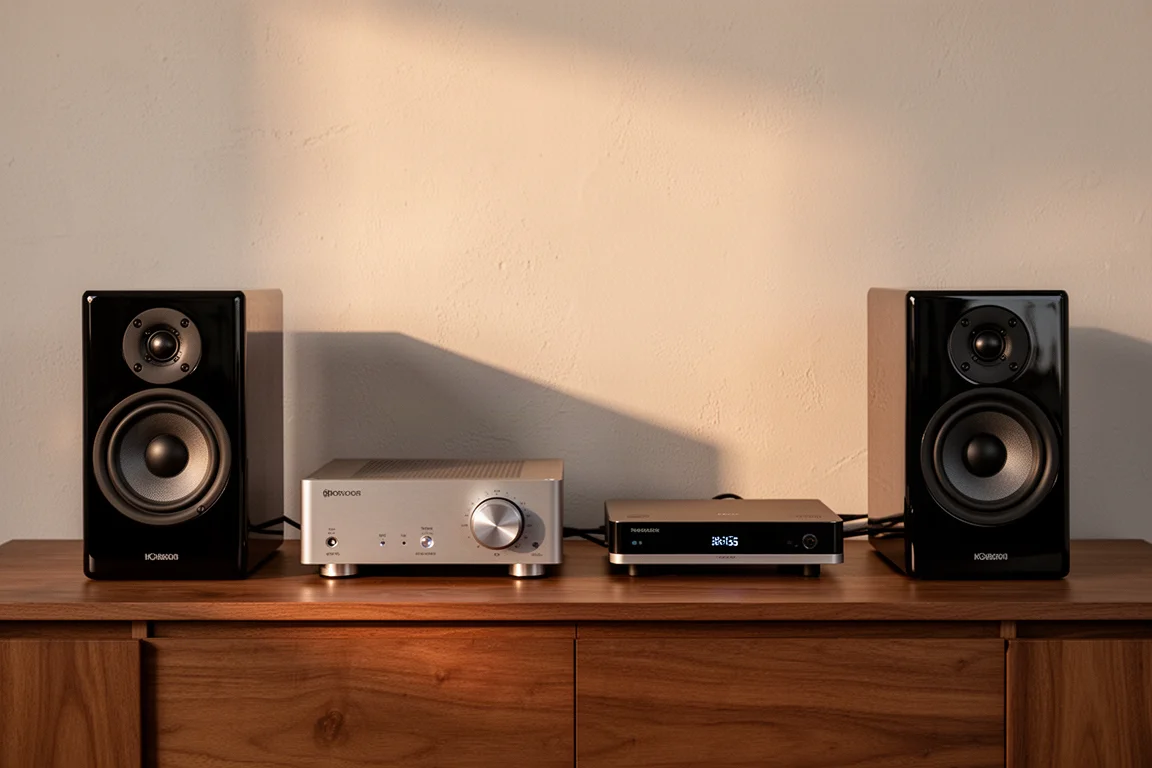
Choose the finish that suits your room, and treat the piano gloss as a genuine part of the value. For a small room or a desktop system built around a mid-range-forward presentation, this is a difficult package to beat at the price.
Conclusion
The Philharmonic True Mini is a high-end sounding speaker in a very small box. Its frequency response will not suit every taste, and it will never produce deep bass on its own, but the driver quality, the crossover design and the finish all point to a product that was built with care.
For listeners who want detail, separation and a neutral mid-range in a compact package, and who are prepared to pair it with a subwoofer and a capable amplifier, the True Mini is an easy recommendation.
Product link
View more details for Philharmonic True Mini
This product is mentioned in the review. Check the specifications, options, and compatibility before buying.
View more details for Philharmonic True MiniFurther reading
Related Reviews
Bookshelf Speakers
Acoustic Energy A100 Mark II Review: A Compact Standmount With an Expansive Soundstage
The Acoustic Energy A100 Mark II brings clarity, natural tonality and a wide soundstage to an entry-level standmount, with a few setup details worth knowing first.
Bookshelf Speakers
Acoustic Energy AE-100 Mark II Review: Compact Bookshelf Speakers With Standout Imaging
A compact British two-way bookshelf speaker with deep, layered imaging, fast bass, and a slight treble lift to weigh against a crowded $500 field.
Bookshelf Speakers
Acoustic Energy AE100 MK2 Review: Measured Performance and Four Alternatives
A close look at the Acoustic Energy AE100 MK2 bookshelf speaker, what its measured performance reveals, and four alternatives with different trade-offs.