Subwoofers
Perlisten D212s Review: A Reference Subwoofer Built to Disappear Into the Music
A close look at the Perlisten D212s, a dual 12-inch reference subwoofer with THX Dominus certification, three room modes, and deep integration controls for music and film.
Introduction
The Perlisten D212s is a dual-driver reference subwoofer built around a specific goal: deep, clean bass that never announces its own presence. It is the smaller of Perlisten’s two flagship D-series models, and it carries THX Dominus certification, the largest certification class THX offers. That rating is intended to bridge the gap between large home theaters and commercial movie houses, and the design is rated to pressurize spaces over 6,000 cubic feet with usable output 20 feet from the listening area.
That combination of certification, driver count, and amplifier power puts the D212s squarely in reference territory. The more interesting question is how it behaves when it is asked to do something harder than shake a room: disappear into a two-channel system.
Who the Perlisten D212s Is For
Perlisten sizes its subwoofers by room volume, so the D212s is best understood as a match to the space rather than a match to a budget. In a large open room, a single unit will deliver the extension and control the design is known for, while very large spaces benefit from multiple units. As a reference point, a room measuring roughly 34 feet by 24 feet needed four subwoofers to pressurize the space properly.
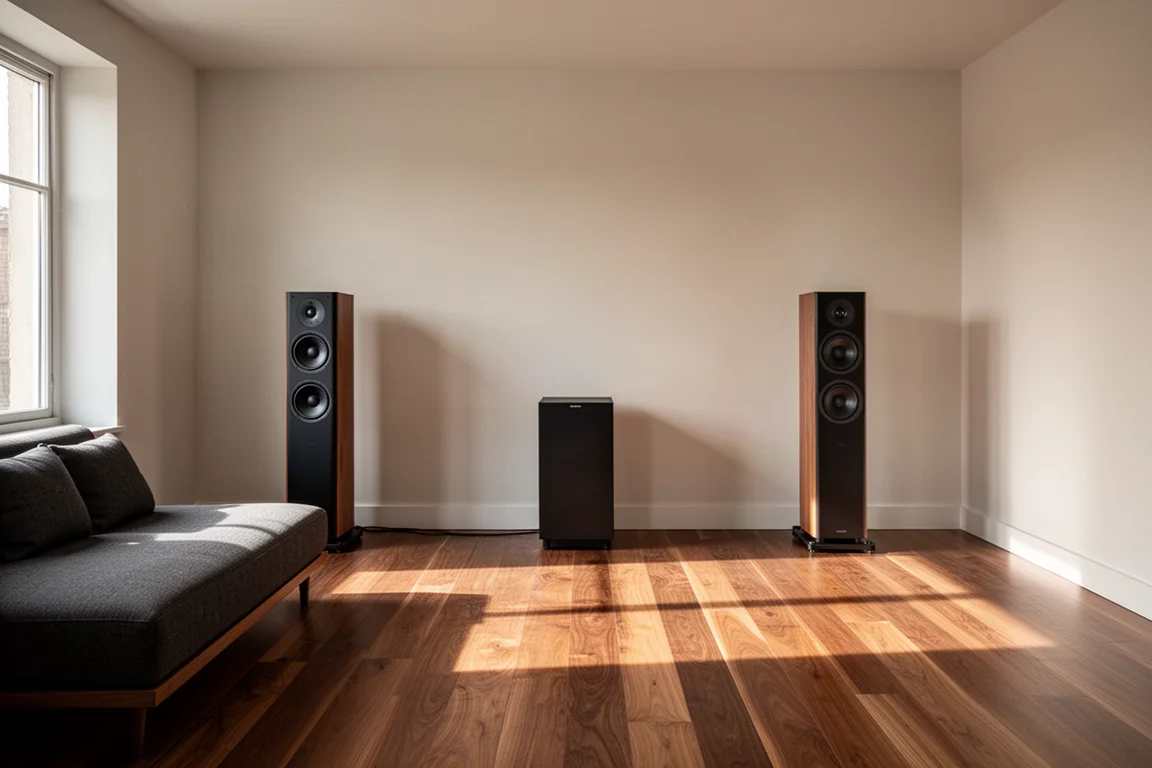
The D212s also assumes a particular kind of system. It does not include on-board room correction. Instead, it provides the power, the control, and the independent parametric EQ filters, and it expects to be paired with a high-performance preamplifier or processor that handles automated room correction. Owners running a processor with multiple independent subwoofer outputs can calibrate each unit separately, including phase and polarity, which is where a multi-sub array starts to pay off.
Design and Engineering: Two 12-Inch Carbon Drivers
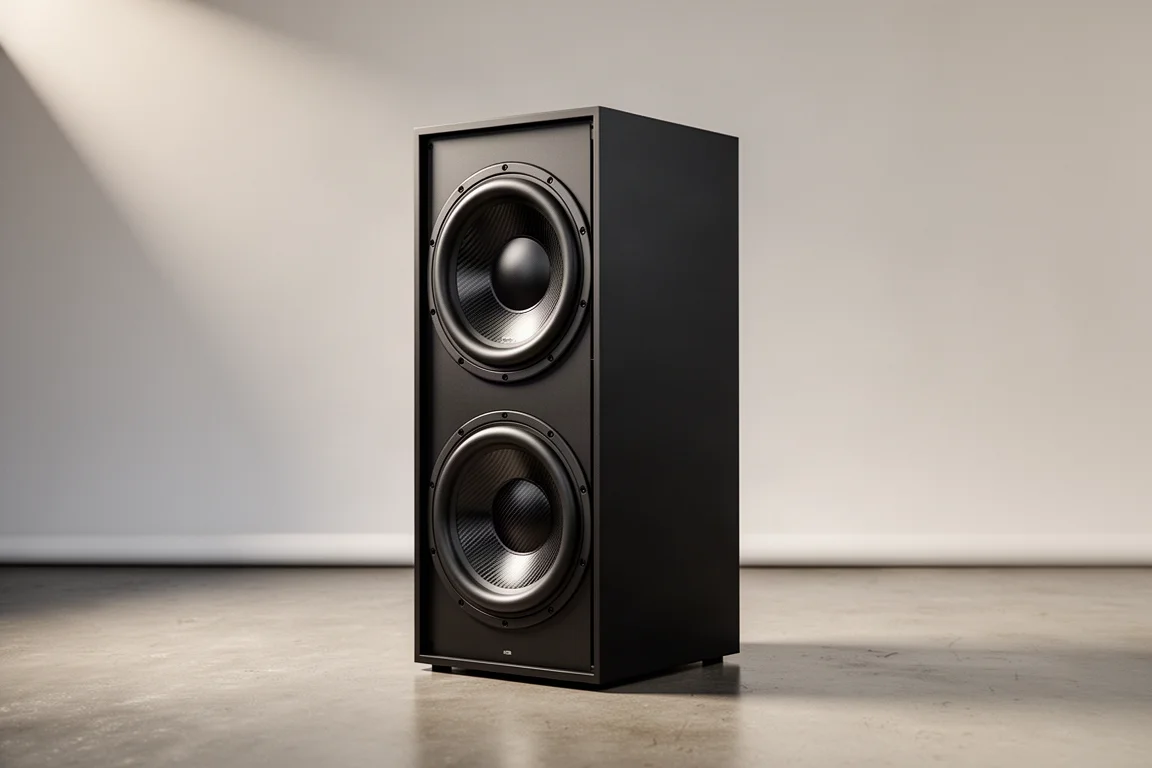
The naming is literal. The D212s uses two 12-inch, 300 mm carbon fiber drivers, each capable of 30 mm of linear excursion, arranged in a push-pull acoustic suspension. The second driver is mounted internally, where it works to cancel cabinet vibration and keep output linear. Perlisten’s larger D215s uses two 15-inch drivers, and measured performance between the two models is close.
Power comes from a 3 kW amplifier, with a 32-bit Arm Cortex M4 processor and 48-bit DSP handling the signal path. The cabinet stands 26.3 inches tall, 16.5 inches wide, and 21.6 inches deep, and it weighs 150 pounds. The vertical, narrow proportions are deliberate: the design reads as smaller in a room than a squarer single-driver cabinet of similar internal volume, which makes it easier to place in a theater or a living space.
Finishes include piano gloss black, gloss white, and matte black. The matte black option is aimed at dark theater rooms where reflections are a concern, while the gloss white and gloss black finishes suit visible living spaces. A front grille is available as an optional extra rather than standard equipment. Perlisten also ships sliders in the box, so the subwoofer can be moved and repositioned during setup before being locked into its final spot.
Room Modes, DSP, and App Control
Three room modes do most of the tuning work. The default THX mode delivers output from 20 Hz to 231 Hz at minus 6 dB, and 16 Hz to 245 Hz at minus 10 dB. Large room mode adds low-end boost, reaching 15 Hz at minus 6 dB and 13.5 Hz at minus 10 dB. Small room mode applies a slight cut and produces the lowest group delay of the three, with output from 24 Hz to 231 Hz at minus 6 dB and 18 Hz to 245 Hz at minus 10 dB.
For music listening, small room mode is the setting to use, because the lowest group delay is what preserves timing and texture through the bass. THX remains the sensible default for movie systems that want the extra low-end extension.
Beyond the presets, the D212s offers a 10-band parametric EQ across three user presets, a low-pass filter that can be bypassed or set anywhere from 30 to 160 Hz with 6, 12, 18, or 24 dB per octave slopes, phase adjustment from 0 to 270 degrees, and switchable normal or inverted polarity. Balanced XLR and unbalanced RCA inputs and outputs are both provided, which means a two-channel owner can route a source through the subwoofer and handle bass management inside it using the on-board crossover, phase, and EQ controls.
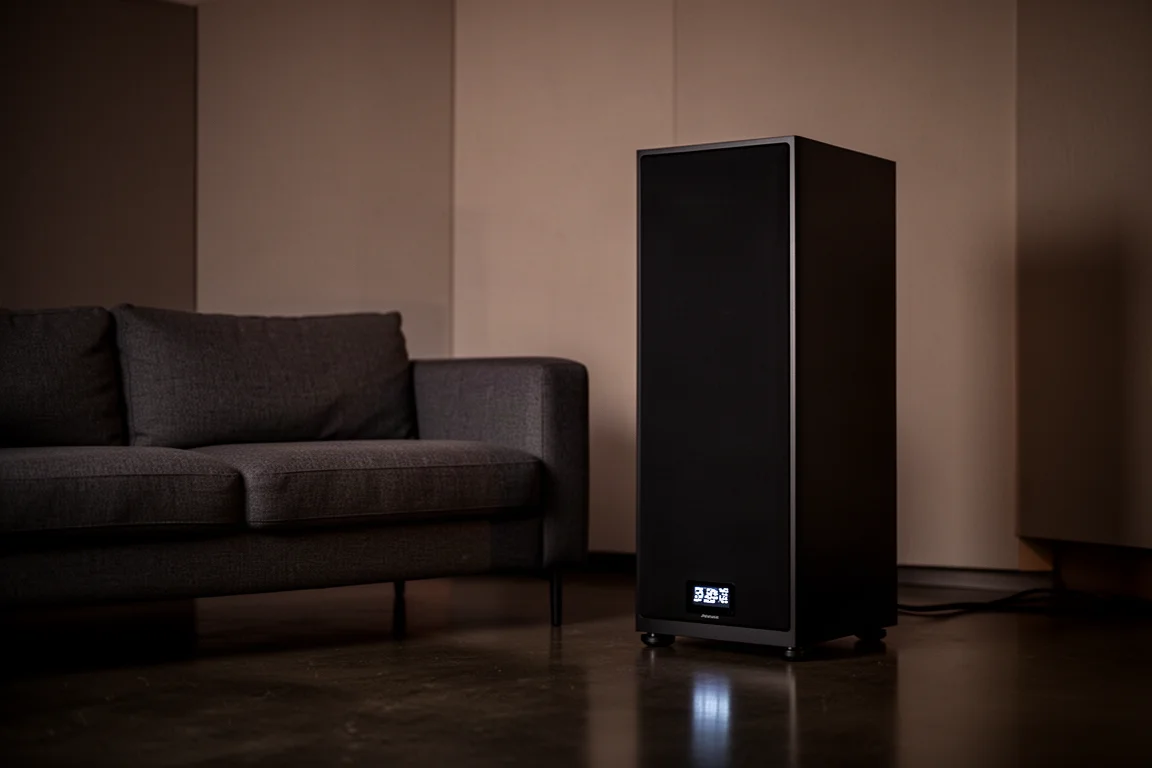
A small touch-sensitive LCD on the cabinet handles master level, trims, EQ mode, input selection between RCA and XLR, trigger options, and status readouts. It can also play test tones directly, with amplifier status displayed while a tone runs. The companion app extends control across every subwoofer in a system, with group volume for the whole array, individual control per unit, memory banks for EQ settings, and options for auto power on, 12 volt trigger behavior, power off timing, and input sensitivity.
Main Strengths: Texture, Control, and Seamless Integration
The defining quality of the D212s is what it does not do. It does not thicken the bass, smear transients, or pull attention toward the low end. On well-recorded material, individual bass notes arrive clearly defined and textured rather than as a general rumble. That linearity, combined with very low distortion and low group delay, is what makes the subwoofer read as musical rather than merely powerful.
Integration is the other headline. Subwoofers frequently interfere with the performance of the main speakers, and it is common for a subwoofer to call attention to itself at some point in the crossover region. Paired with large tower speakers that already reach 20 Hz in-room, an 80 Hz crossover leaves nothing missing. The bass simply adds weight and dimension to the recording without changing the character of the speakers above it.
Consistency across a seating area matters too. In a multi-subwoofer arrangement, bass stays even across a wide couch rather than concentrating in one listening position, which is one of the strongest arguments for running more than one unit in a larger room.
Living With the D212s: Music and Movies
On two-channel material, the effect is a wider, more dimensional presentation. Bass articulation improves the sense of staging, and tracks known for heavy low end gain depth without becoming bloated. The result is a system that encourages long listening sessions rather than quick demonstrations.
For film, the D212s delivers the physicality of a good commercial cinema in a home room. Engine roars, subterranean effects, and the low-frequency swell of a large-scale score all arrive with control and authority rather than boom. Scenes built around deep, sustained effects reverberate through the room while dialogue and upper-frequency detail stay untouched, which is exactly the behavior a reference subwoofer is supposed to provide.
Things to Consider Before Buying
The D212s is not designed for infrasonic output, and it will not deliver the extreme sub-20 Hz response that some dedicated effects tracks are built around. Its purpose is to mate seamlessly with high-quality speakers and deliver clean, articulate bass across music and film, and it does that within the extension limits of its room modes.
Room correction is another consideration. There is no automated correction built into the subwoofer, so the system needs a processor or preamplifier that provides it. The on-board parametric EQ filters are designed to work alongside that correction, not replace it.
Physical size is worth planning for. At 150 pounds and roughly two feet in each direction, the D212s needs a considered position, though the included sliders make experimentation far easier than the weight suggests. The front grille is also an optional purchase rather than a standard inclusion.
Buying Advice and Setup Notes
Start with room volume. Perlisten’s approach to sizing means the right number of subwoofers depends on the space, and large open rooms are better served by two or more units than by one pushed harder. A processor with multiple independent subwoofer outputs, such as a flagship unit running Anthem’s ARC Genesis correction, allows each subwoofer to be calibrated separately with its own phase and polarity settings, which is where the design’s flexibility becomes most useful.
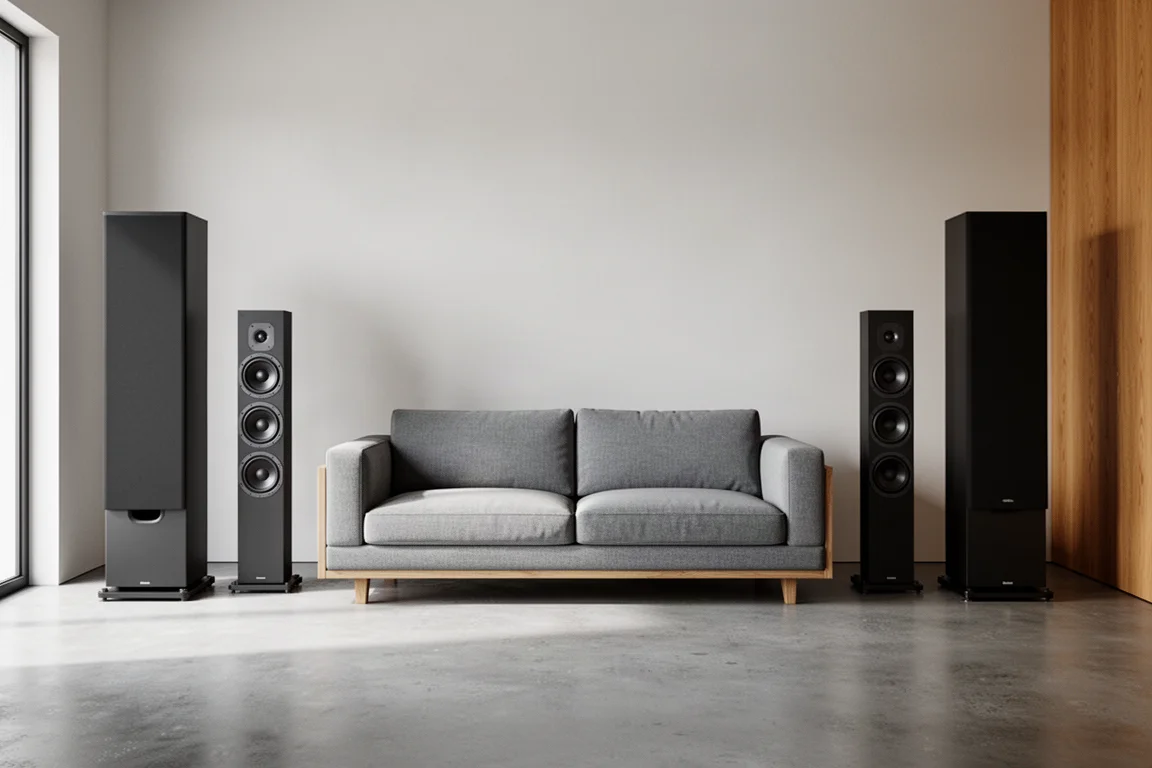
For setup, choose the room mode that matches the job. Small room mode for music, because it produces the lowest group delay and the cleanest timing through the bass. THX mode for movie systems that want the deepest extension the subwoofer offers. Then use the app’s memory banks to store separate PEQ profiles, so a music configuration and a film configuration can coexist without re-tuning.
Finish selection is worth a moment of thought as well. Gloss white and gloss black suit visible living spaces, while matte black keeps a dark theater room free of reflections. If the drivers will be exposed, budget for the optional grille.
Conclusion
The Perlisten D212s is a reference subwoofer in the fullest sense: two carbon fiber drivers in a vibration-cancelling push-pull arrangement, a 3 kW amplifier, three room modes, and an integration toolkit deep enough to satisfy a two-channel purist or a dedicated theater builder. It does not chase the lowest possible numbers. It chases transparency, and in a system built around high-quality speakers, that is the harder and more valuable target.
Product link
View more details for Perlisten D212s
This product is mentioned in the review. Check the specifications, options, and compatibility before buying.
View more details for Perlisten D212sFurther reading
Related Reviews
Subwoofers
Arendal 1961 Subwoofer 1S Review: Beautiful Build, Modest Punch at $1,000
A sealed $1,000 subwoofer with a gorgeous cabinet, plus three lower-priced alternatives that deliver more impact for movie nights.
Subwoofers
Arendal Sound 1723 2V Subwoofer Review: Dual 13.8-Inch Drivers Under $3,000
A flagship ported subwoofer with dual opposing 13.8-inch drivers, a 1,200W RMS amplifier, app-based DSP, and a 10-year warranty.
Subwoofers
Ascendo 16 Sub Active Sealed Review: Sealed Bass Built on Real Engineering
A close look at the Ascendo 16 Sub Active Sealed, a 16-inch sealed home theater subwoofer with independently verified measurements, a purpose-built driver, and genuinely controlled output.