Hi-Fi Speakers
Pearl Acoustics Sibelius CG Review: A Single-Driver Speaker With Serious Bass Definition
A crossover-free full-range floorstander with outstanding bass and midrange articulation, plus the placement, amplifier and volume limits to weigh before buying.
Introduction
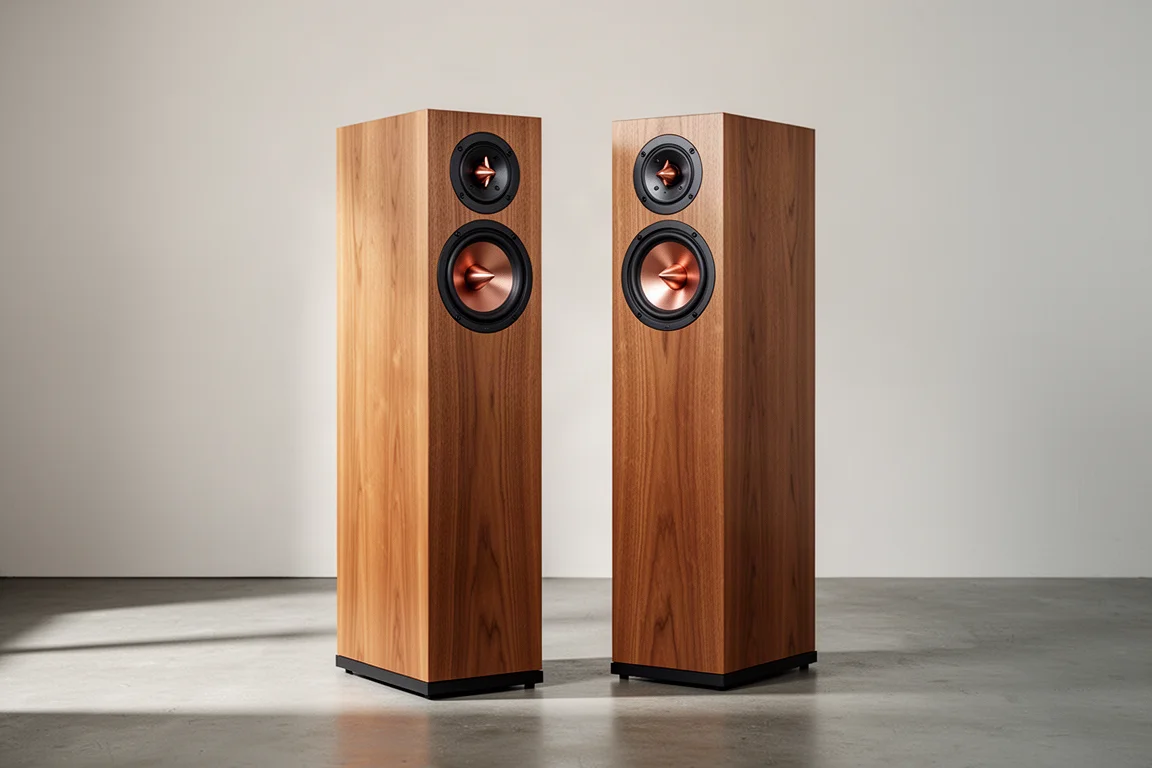
The Pearl Acoustics Sibelius CG is a tall, slim floorstanding speaker built around a single full-range driver and no crossover at all. There are no capacitors, inductors or resistors between the amplifier and the drive unit, because the amplifier couples directly to the back of the driver. Pearl Acoustics founder Harley Lovegrove designed the Sibelius as a simple, pure speaker tuned more like a musical instrument than a conventional box, and the CG version covered here uses a copper-finished 100 mm metal alloy cone.
Pricing starts at EUR 4,950 excluding taxes and shipping, or GBP 5,100 including VAT but excluding shipping to the UK. The optional Sibelius stands add EUR 395 or GBP 405. Standard finishes are stained matte varnish and wax oil applied to a solid 32 mm French oak cabinet, slow grown and sourced sustainably. Coloured matte and gloss painted options use a 30 mm Baltic birch plywood cabinet and cost around EUR 1,000 more, at EUR 5,950 or GBP 6,100.
This review looks at what the Sibelius CG does exceptionally well, where a single-driver design still shows its limits, and how to get the best from it in a normal room.
Who the Pearl Acoustics Sibelius CG Is For
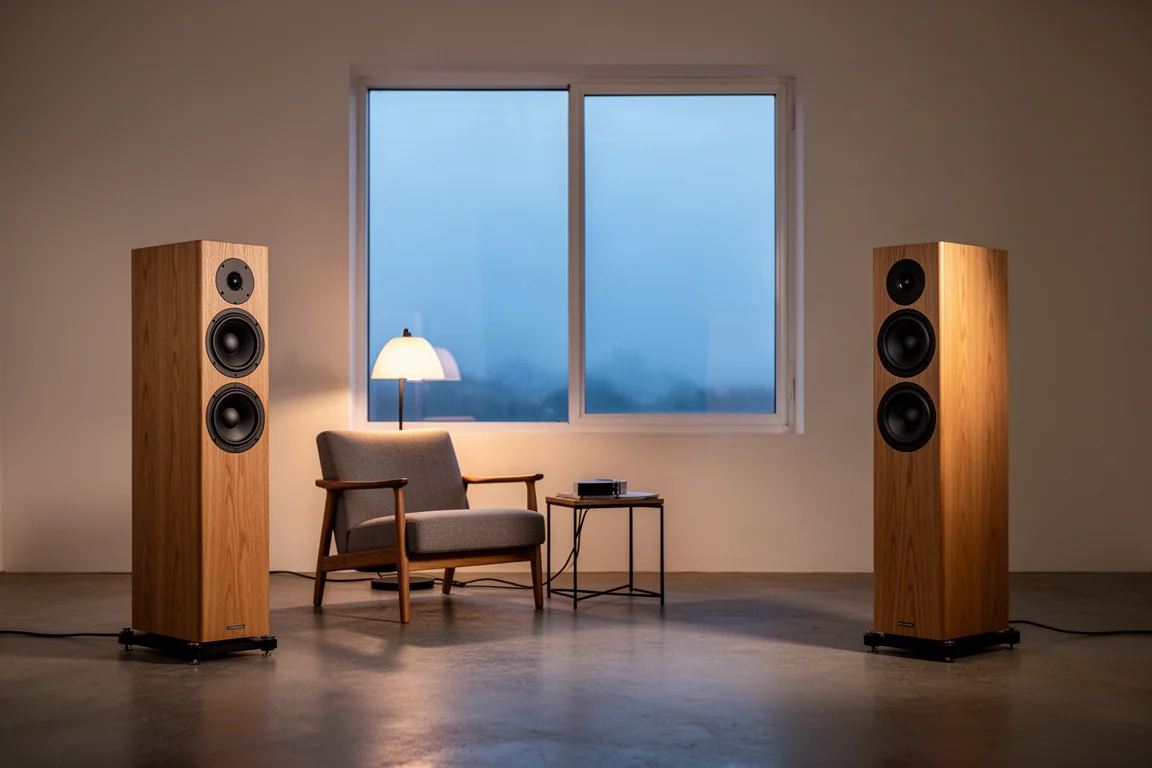
This is a speaker for listeners who care most about articulation, texture and definition in the bass and lower midrange, and who are willing to trade ultimate loudness and top-octave air for coherence. It suits low-volume listening, small to medium rooms, and anyone who likes music to stay consistent while moving around the room rather than only in a single seat.
It is not the right choice if you want forceful deep bass at high levels or the last word in treble airiness and upper-harmonic transparency. Listeners chasing maximum macrodynamic swing from a compact floorstander will find ported designs more obliging. The Sibelius rewards a different set of priorities.
Main Strengths
Three areas stand out: bass and lower-midrange definition, a genuinely present midrange, and imaging that holds up well beyond the speakers themselves.
Bass and Lower Midrange Definition
The bass loading is unconventional, closer in concept to a transmission line than to a ported design. It follows the tapered quarter wave tube principle pioneered by Paul Voigt, sometimes called a Voigt pipe. Both approaches exploit a quarter wave resonance to absorb the back wave of the driver, but where a transmission line generally narrows toward a vented output, this pipe widens, which gives it some horn characteristics as well. A small amount of air generated by the back wave excites a much larger column of air inside the chamber, and the result is a far wider operating bandwidth than a ported design, with pipe output intended to stay in phase with the driver.
Pearl Acoustics reports an anechoic -6 dB point at 38 Hz, and in a real room boundary gain should let the speaker dig a little lower still. The practical payoff is remarkable. Play a double bass, a drum solo or a fast hand-percussion passage and there is clarity, a sense of correct mass and sheer definition. Ported floorstanders can deliver a more impressive mid-bass thud, but not the same degree of definition. The cabinet was tuned through years of iteration, and the driver voice coil geometry was amended to suit the impedance of the cabinet, which is part of why the speaker is built in house rather than by a third party.
Midrange Presence and Realism
There is a modest uplift in the presence region between roughly 2 kHz and 4 kHz, and it is what makes vocals and lead instruments step forward. On live recordings it creates a real sense of being there, a liveliness that never tips into brightness or aggression. The mid-band is also highly resolving, with excellent transient attack, good body and natural decay, so micro details surface and add to the sense of realism. Horn-loaded designs share some of that immediacy, but this speaker is significantly more resolving through the middle. A three-way floorstander with a dedicated midrange driver can flesh out massed performers a little more, yet it gives up nothing to the Sibelius in clarity or instrument separation.
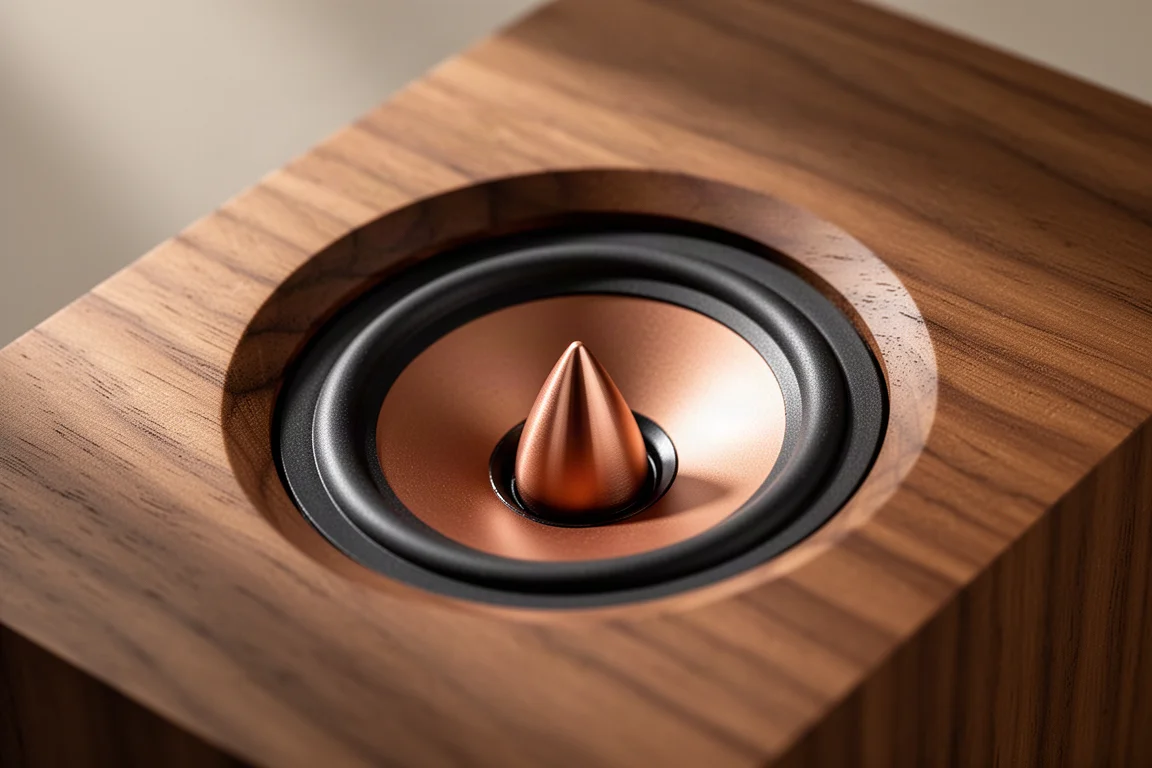
That combination of presence and resolution is the heart of the design. It is also why the speaker copes with ordinary recordings without becoming harsh, while making well-made ones sound special.
Treble and Imaging
The high frequencies are where the limits of a single driver become more apparent, and correct setup matters a great deal. Get it right and the Sibelius is neither dark nor bright, with treble sitting in balance with the rest of the spectrum. It will not match the transparency, upper-harmonic reveal or airiness of the best compact standmounts, including AMT-tweeter designs and expressive soft-dome models. In the lower octaves, though, few standmounts come close for definition and depth.
Imaging is a case of job done. As long as the information is in the recording, instruments spread well beyond the boundaries of the cabinets, with good soundstage depth and performers securely located. It is not quite the reach-out-and-touch presentation of the very best small speakers, but it is as good as any compact floorstander. Once dialled in, the sweet spot is wider than most multi-driver speakers, and the even loading of bass and midrange makes casual listening while walking around the room genuinely enjoyable.
Things to Consider Before Buying
The Sibelius responds to care with placement, stands and amplification more than most speakers at this level. None of the caveats are deal-breakers, but they are real.
Room Placement and Toe-In
Wall distance influenced bass clarity noticeably in practice. The supplied user guide suggests the speakers will work well close to walls, and while that scenario was not tested here, keeping a minimum distance of 90 cm (about three feet) between the wall and the front baffle is the safer starting point for reducing time-smearing effects. Even then, the speakers ended up no further into the room than many standmounts, so overloading a medium-sized room with bass energy is unlikely.
Toe-in matters too, which is to be expected from a full-range driver whose dispersion narrows as frequency rises. The standard recommendation is to fire the speakers straight into the room, but wider spacing combined with significant toe-in worked better in a domestic setting. Toe-in changes the treble energy arriving at the listening position more than it would with wide-dispersion designs. Aim for an equilateral triangle, with the speakers at least two metres apart and the listening position at a similar distance, roughly seven feet.
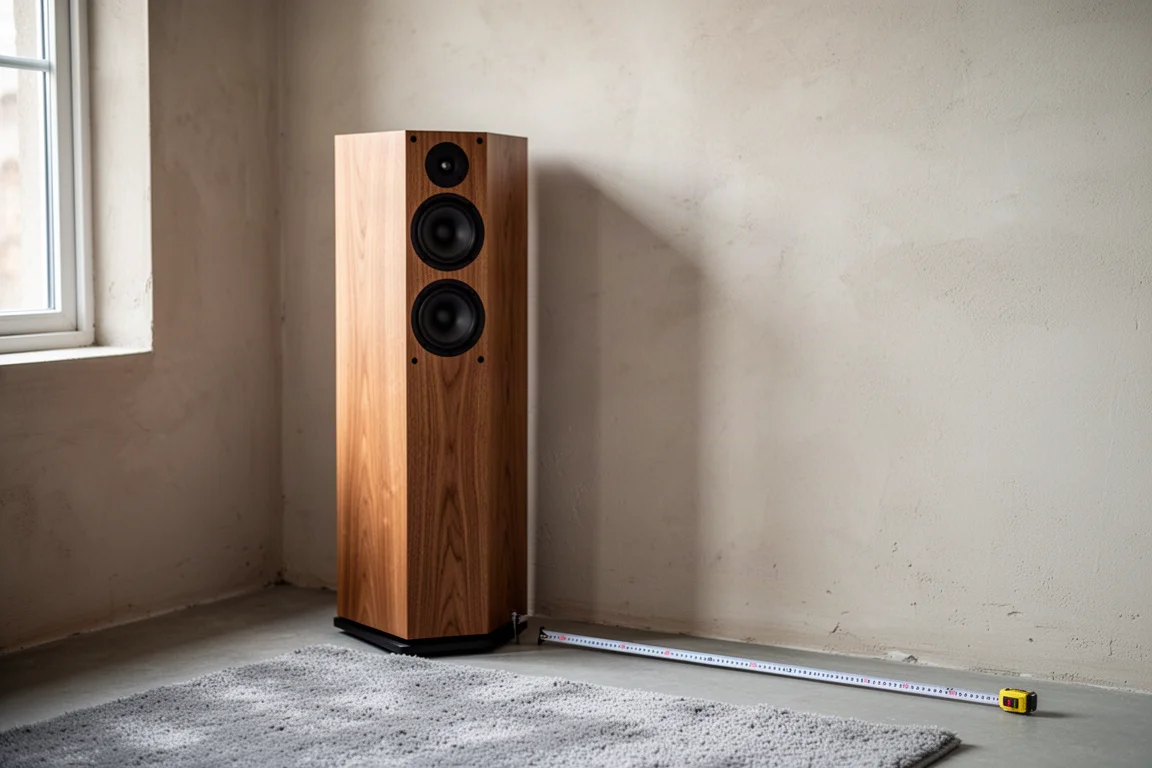
Get these basics right and the reward is a broad, stable sweet spot with bass and midrange that load the room evenly rather than pooling in one corner.
Stands, Height and Volume Limits
The optional stands are essentially bases, and at EUR 395 or GBP 405 they are worth considering for two reasons. First, they considerably improve protection from accidental impact and reduce the likelihood of the speakers toppling over, which on its own may justify the outlay. Second, raising the speakers produced a noticeable improvement in bass definition, most likely because the low frequencies leaving the horn disperse better when the cabinet is lifted off the floor. The trade-off is height: the stands add 45 mm, almost two inches, and because the top two octaves are fairly directional, you do not want the driver sitting much above ear height.
On power, the Sibelius is rated at 87 dB sensitivity into a 7.2 ohm impedance, so a powerhouse amplifier is unnecessary. A single 100 mm driver simply needs good quality rather than brute force. The design also plays beautifully at low volumes, which is a direct benefit of having no crossover, but it is wise not to push much beyond an average listening level of around 85 dB.
Amplifier Matching
Because the bass and midrange are so revealing, the Sibelius lays bare the character of whatever sits upstream. A rich-sounding budget integrated was enjoyable in tone but lacked the resolution and bass control to do the speaker justice. A GBP 1,750 integrated proved a better starting point, covering tonality, clarity, refinement and drive convincingly. A tube amplifier of around GBP 1,500 with upgraded tubes sounded bold and rich and was thoroughly enjoyable, though a more powerful and more expensive design would almost certainly control the bass better.
A drier-sounding solid-state integrated opened up the soundstage and improved instrument separation, yet its dry character was more obvious here than usual, as though the driver were being over-damped, with the pipe loading emphasising it. Think of suspension set too stiff: you feel every bump instead of gliding over them. A 25-year-old preamplifier and monoblock pairing threw the widest and deepest stage with precise imaging and just enough added richness, although with some softness in the bass. Finally, a modest preamplifier with its matching 35 W per channel power amplifier, around GBP 830 and GBP 885 respectively, showed that big power is not the answer: cleaner, better timed and more neutral, as long as volumes stay moderate.
Buying Advice
If your priorities are bass and midrange articulation, texture and a crossover-free midrange that lets vocals and lead instruments step forward, the Sibelius CG is a compelling purchase. Budget for the stands if there is any risk of knocks or if you want the extra bass definition, and plan for a speaker cable run long enough to reach the high-mounted binding posts on the rear.
Finish choice is worth thinking through. The solid French oak is the standard option and the less expensive one. The painted Baltic birch costs around GBP 1,000 more, and while the finish involves many hand-polished and rubbed-down layers, the premium is steep. The wood finish is arguably the better match for a cabinet built with this much craft in it.

Be honest about what you are not buying: not maximum loudness, not the deepest bass, and not the last word in top-octave air. Buy the Sibelius for what it does in the bass, the lower midrange and the midrange, and it will keep rewarding the recordings you care about.
Conclusion
The Pearl Acoustics Sibelius CG is the realisation of a clear idea: a single driver covering almost the entire frequency range, with no crossover or filters in the signal path, handcrafted from sustainably sourced slow-grown oak or multi-layer Baltic birch plywood, and tuned as much like a musical instrument as a speaker. The caveats are obvious and worth repeating. The price is significant, the volume ceiling is modest, placement and toe-in need patience, and treble transparency trails the best small speakers. What remains is bass, lower midrange and midrange performance that few conventional designs can match for clarity, definition and tonality, and a speaker that sounds excellent at low volumes. Nearly a century after the tapered quarter wave tube was invented, the approach still pays off, and for the right listener this is an easy recommendation.
Product link
View more details for Pearl Acoustics Sibelius CG
This product is mentioned in the review. Check the specifications, options, and compatibility before buying.
View more details for Pearl Acoustics Sibelius CGFurther reading
Related Reviews
Hi-Fi Speakers
1723 THX Tower vs 1528 Bookshelf: Which Speaker Fits Your Room?
Two speakers at roughly the same price, built very differently. How the 1723 THX tower and the 1528 bookshelf compare on construction, bass, power needs, and sound.
Hi-Fi Speakers
Acoustic Energy AE 300 Review: Deep Bass From a Compact Standmount
A two-way standmount with real wood veneer, surprising low-end weight, and a warm, easygoing character. Here is what to know before buying.
Hi-Fi Speakers
Acoustic Energy AE1 40th Anniversary Review: A Modern Take on a British Classic
A compact standmount that revives a 1980s favorite with all-new parts, a warm mid-centric balance, and a price of £1,499 per pair.