Bookshelf Speakers
Paradigm Founder 40B Review: A Bookshelf Speaker Built Around Imaging
A close look at the Paradigm Founder 40B, a Canadian-built bookshelf speaker whose pinpoint imaging and spatial realism set it apart, plus the amplifier matching and room placement it needs to shine.
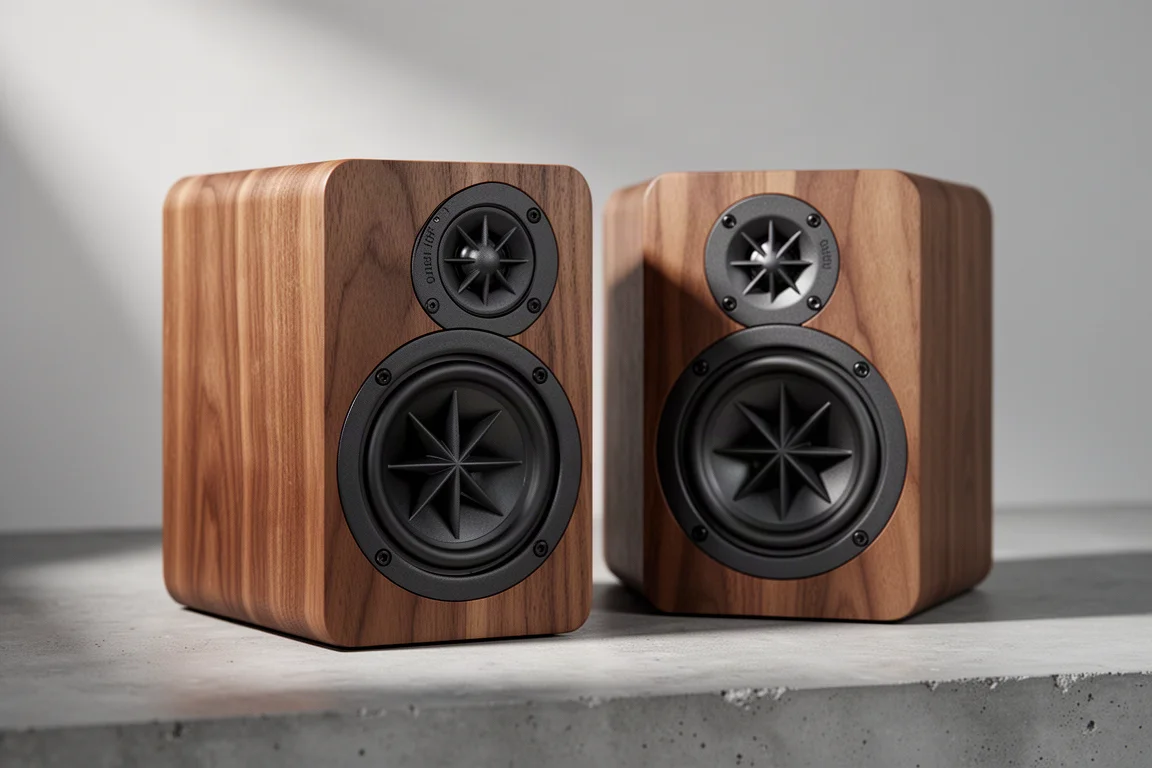
Introduction
The Paradigm Founder 40B is a compact bookshelf speaker designed and built in Canada, and it comes from a company that takes both measurement and listening seriously. Paradigm operates an in-house measurement chamber lined with acoustic foam, keeps a dedicated room for blind listening tests, and develops its drivers and acoustic lens components locally. The cabinets are even drop tested to see how they survive impact.
At roughly 2,600 CAD, which works out to about 2,020 USD, the Founder 40B lands in a crowded part of the market. Plenty of speakers at this price promise neutrality. This one delivers something rarer: a level of image specificity that makes a two-channel system feel like it has more speakers in it than it actually does.
That effect does not announce itself in the first two minutes of a shop demo. It shows up after you have lived with the speakers, moved them around, and played recordings you know well.
Who This Speaker Is For
The Founder 40B suits listeners who care most about imaging, detail retrieval, and the sense of a performance being laid out in the space in front of them. It is a strong candidate for a two-channel system in a small to medium room, and it works well in a home theater setup where a subwoofer handles the low end.
It is not the right choice for someone who wants deep bass from a bookshelf cabinet alone. It is also a poor fit for nearfield or desktop use, where the high frequencies become too forward at close range.
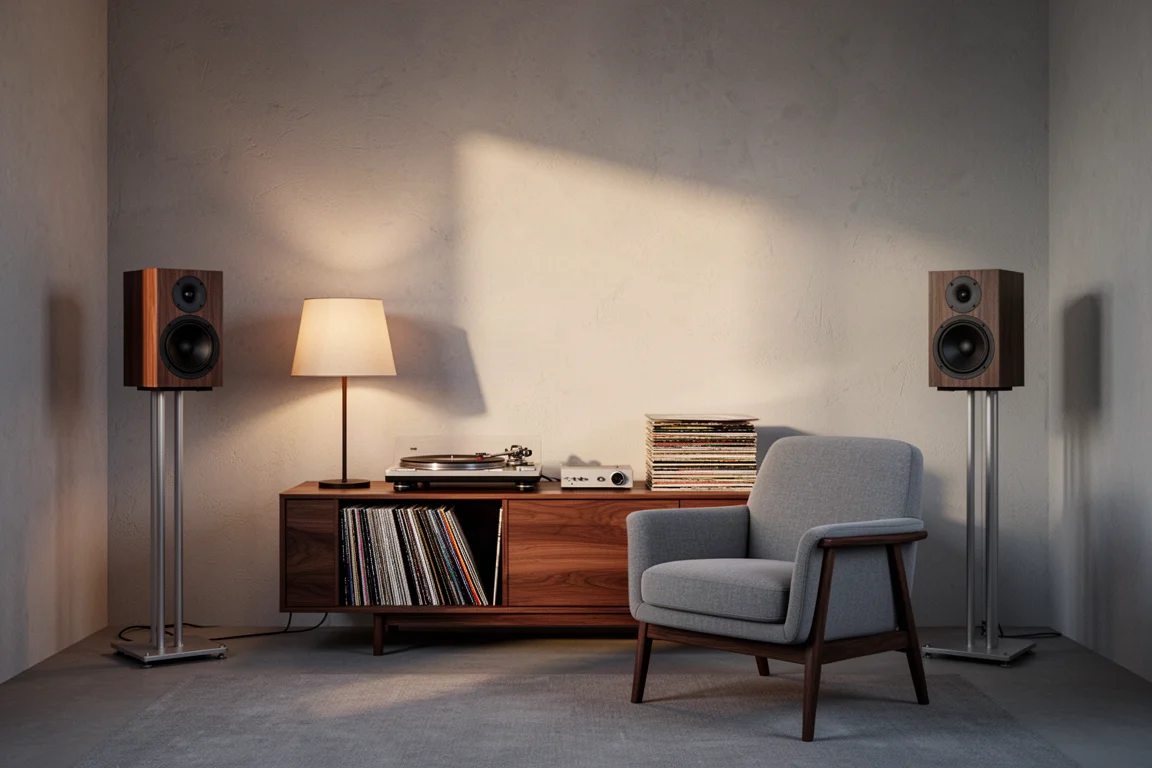
The buyer who will get the most from this speaker is the one who values spatial accuracy over bass weight, and who is willing to spend time on placement rather than simply dropping two boxes on a shelf.
Build Quality and Canadian Engineering
The cabinet is heavy and rigid. A knuckle test is not a measurement, but the enclosure feels rock solid, and the drop testing suggests a real confidence in the construction. Drivers, acoustic lens, and the rest of the design elements are produced in Canada.
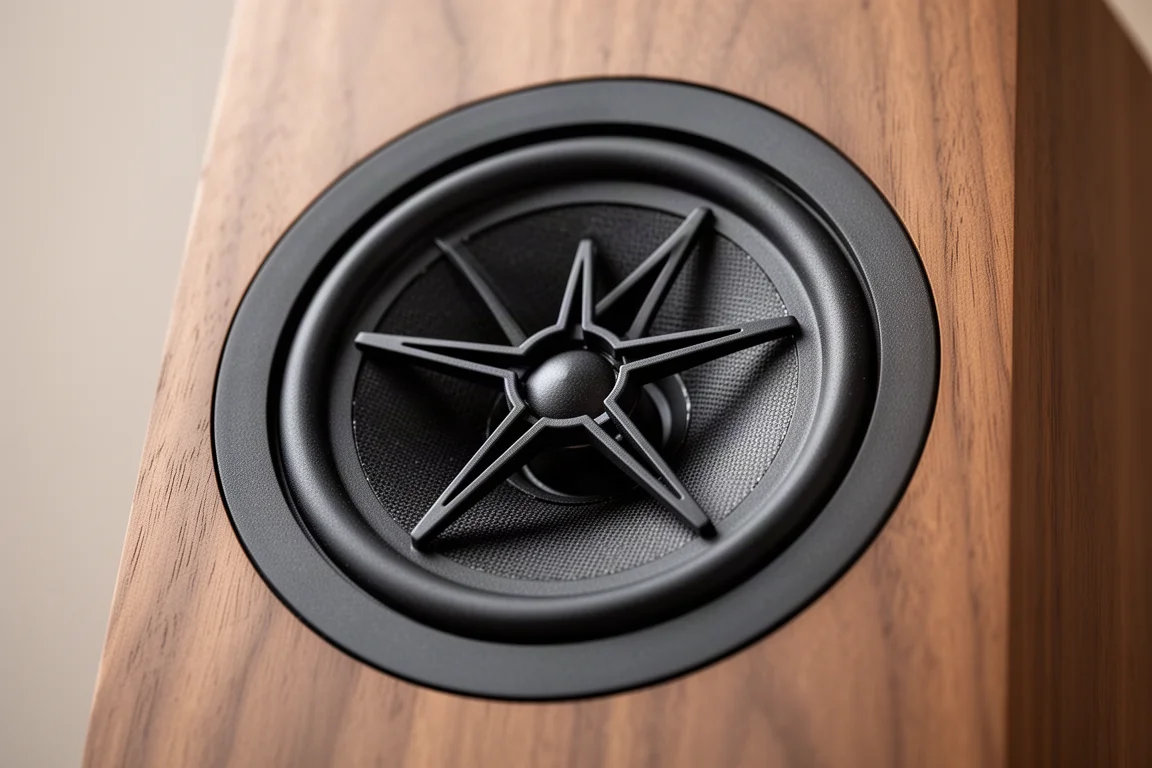
The design detail worth understanding is the acoustic lens. On the mid-woofer, it exists to maintain phase coherency, doing a job similar to a conventional phase plug but, as Paradigm describes it, with a higher degree of efficiency. The same lens treatment appears on the tweeter, where some listeners miss it entirely, and it is paired with a waveguide that controls high-frequency dispersion.
None of this is decoration. The lens pattern happens to look striking, but its purpose is functional, and the result is a driver array that behaves in a controlled way across the crossover region.
Each speaker also ships with a separate grille, which adds a second layer of protection for the drivers. The walnut finish reviewed here looks classically elegant rather than flashy, and other finishes are available.
Sound Quality and Tonality
Tonally, the Founder 40B sits close to neutral, with a few small characteristics that keep it from sounding flat.
Bass behaves like a traditional bookshelf speaker. There is very little happening below roughly 50 to 60 Hz, and on tracks built around deep sub-bass notes, the lowest information simply is not there. What the speaker does have is a tight mid-bass punch, quick and piston-like, without letting that region take over the rest of the music.
The mid-range carries a slight warmth, and the upper mid-range steps a little forward. That forwardness brings sparkle, clearer dialogue, and more distinct edges to instruments and voices. It is also the reason some listeners notice fatigue early on.
That fatigue is worth explaining, because it is not the usual kind. The treble here is neutral, neither rolled off nor boosted, so the discomfort does not come from brightness or sharpness. It comes from hearing so much well-defined detail at once, all around the listening position. Over time the density of information becomes enjoyable rather than overwhelming, and it supports long sessions once you adjust.
Treble air is the one area where the speaker asks for help from the room. Pull the speakers out from the wall and the presentation opens up and extends noticeably. Leave them close to the wall and you gain some bass weight, but you give up part of what makes the speaker special.
Imaging and Soundstaging
Imaging is where the Founder 40B separates itself from almost everything else in its price range.
On tracks with strong spatial cues, sounds do not stay politely between the speakers. They appear to the left of the listening position, to the right, and even behind the listener. The effect has been described as holographic, closer to having rear channels in a home theater than to a typical two-channel presentation.
Center imaging is sharp, and individual elements in a mix are easy to place. Nothing sounds smeared or crowded. The phase coherency delivered by the acoustic lens appears to be the mechanism, since it lets the drivers hand off to each other without phase cancellation blurring the result.
The practical consequence is that familiar recordings become easier to read. You can point at where a sound sits in the space, sometimes to within a few tens of centimeters, rather than simply hearing that it is somewhere off to one side.
Not every track will show this off. When the recording contains the information, though, the speaker renders it.
Things to Consider Before Buying
Amplifier matching matters more here than with most bookshelf speakers, because the Founder 40B sits on a fine balance. Paired with a forward or punchy amplifier, it can tip toward brightness and a V-shaped balance, with elevated bass and treble. Paired with a neutral amplifier, it stays composed and even.
An all-in-one streaming amplifier in the NAD M10 V2 mould is a sensible match, delivering a punchy, dynamic presentation without pushing the treble into fatigue. A tube integrated amplifier can add airiness, but it can also add brightness on top of the speaker’s existing openness, so choose carefully.
Placement is the other decision to get right. Moving the speakers closer to the wall behind them adds bass, but the trade is not equal. The imaging and the spatial nuances that define the speaker suffer. A better route to a full-range system is to pull the speakers out into the room and add a subwoofer.
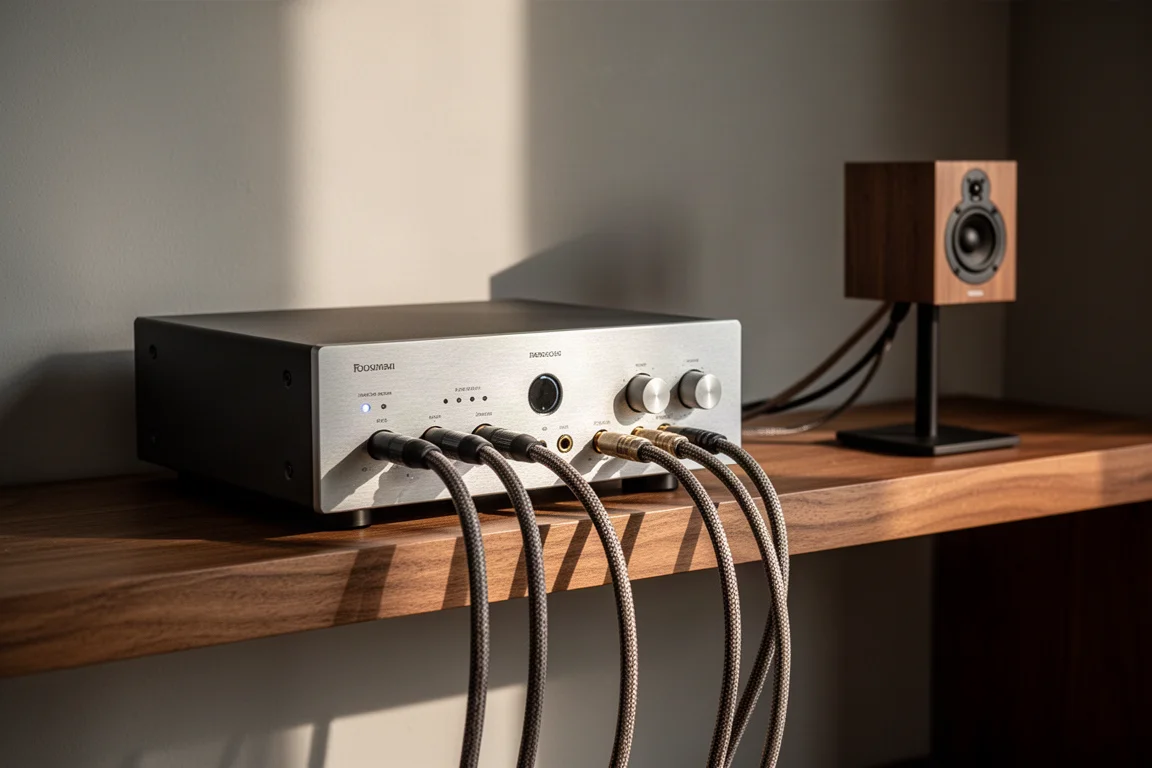
With a sensitivity of about 89 dB and an in-room figure around 92 dB, the speaker is efficient and does not demand a high-powered amplifier. That said, the amplifier’s character matters far more than its wattage here.
How It Compares With Other Bookshelf Speakers
The Founder 40B wins on image specificity and detail retrieval, and it gives up ground elsewhere. Knowing which side of that trade you care about is most of the buying decision.
Compared with a larger dual-concentric design such as the KEF R3, the Founder 40B gives up bass authority but comes out ahead on nuance and overall performance. Compared with the KEF LS50 Meta, the Founder 40B trades some mid-bass richness and a little absolute phase coherency for more detail retrieval and stronger spatial placement, and it is the less suitable of the two for a desk, where its high frequencies become too bright in a nearfield setup.
Compared with a higher-priced competitor such as the Buchardt S400 Mark II, which sells for around 2,500 USD, the Founder 40B cannot match the lower extension or the smoother, more refined highs, but it produces an imaging effect the S400 Mark II does not. Compared with a DIY kit like the CSS Audio 1TDX, which lands around 2,400 to 2,500 USD for a finished pair, the Founder 40B gives up deeper bass and broader overall capability while keeping its phase-coherent imaging advantage.
In other words, the Founder 40B is not the most complete speaker at its price. It is the most spatially precise one.
Buying Advice
Choose the Founder 40B if pinpoint imaging, detail, and a sense of spatial realism are the qualities you value most in a bookshelf speaker. Budget for a neutral amplifier, plan to give the speakers room to breathe away from the front wall, and add a subwoofer if you want full-range output.
If your priorities run the other way, toward deep bass extension from the cabinet alone or a smoother, less information-dense top end, other speakers in this price range will suit you better. The Founder 40B rewards a buyer who knows what they are optimising for.
Conclusion
The Paradigm Founder 40B does not win anyone over in the first two minutes of a store demo. Its case is built on a rigid cabinet, in-house Canadian engineering, and an acoustic lens that produces imaging and soundstaging few bookshelf speakers can match. It asks for a neutral amplifier, some space behind it, and ideally a subwoofer. Set up that way, it delivers a level of spatial detail that makes the asking price feel reasonable.
Product link
View more details for Paradigm Founder 40B
This product is mentioned in the review. Check the specifications, options, and compatibility before buying.
View more details for Paradigm Founder 40BFurther reading
Related Reviews
Bookshelf Speakers
Acoustic Energy A100 Mark II Review: A Compact Standmount With an Expansive Soundstage
The Acoustic Energy A100 Mark II brings clarity, natural tonality and a wide soundstage to an entry-level standmount, with a few setup details worth knowing first.
Bookshelf Speakers
Acoustic Energy AE-100 Mark II Review: Compact Bookshelf Speakers With Standout Imaging
A compact British two-way bookshelf speaker with deep, layered imaging, fast bass, and a slight treble lift to weigh against a crowded $500 field.
Bookshelf Speakers
Acoustic Energy AE100 MK2 Review: Measured Performance and Four Alternatives
A close look at the Acoustic Energy AE100 MK2 bookshelf speaker, what its measured performance reveals, and four alternatives with different trade-offs.