AV Receivers
Onkyo TX-RZ70 Review: An 11.2-Channel AV Receiver With Real Amplifier Muscle
A measured look at the Onkyo TX-RZ70, an 11.2-channel AV receiver with conservative power ratings, an exceptionally quiet preamp section, and a few setup rules worth knowing before you buy.
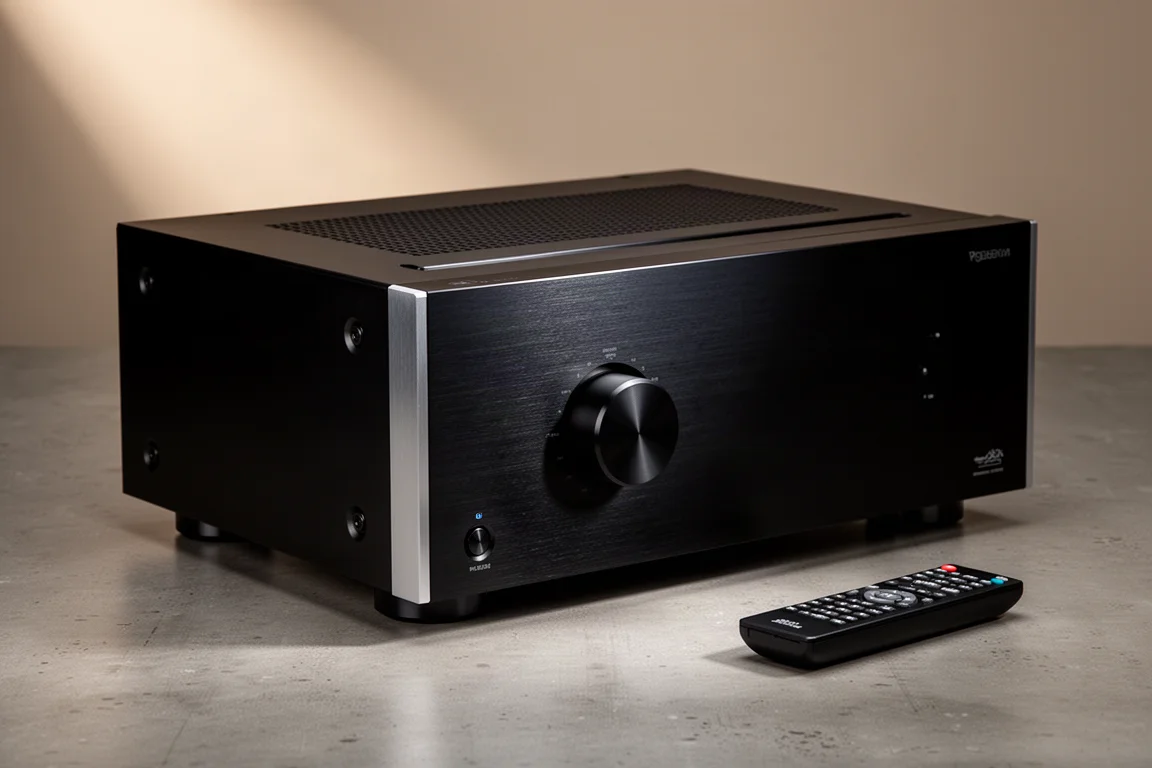
Introduction
The Onkyo TX-RZ70 is an 11.2-channel AV receiver priced at $2,800, and it lands in the busiest part of the market, where flagship feature lists and honest power delivery rarely arrive together. Measured performance suggests this one manages both. The chassis weighs roughly 50 pounds, placing it among the heaviest receivers in its class, and that mass comes from a power supply and heat sink arrangement built to feed eleven channels of amplification.
Onkyo rates the TX-RZ70 at 140 watts per channel across all eleven channels. Measured output exceeds that figure by a comfortable margin, which is unusual at this price and a strong indication that the amplifier section was not trimmed to hit a number on a specification sheet.
The TX-RZ70 shares its core platform with receivers from Pioneer and Integra, including the same amplifier sections and the same ESS ES9026PRO Sabre digital-to-analog converters. The Onkyo and Integra models carry THX Select certification, while the Pioneer version does not. All three ship with Dirac Live room correction at no additional licensing cost, and Dirac Live Bass Control upgrades are available for a fee that depends on how many subwoofers you want to support.
Who this product is for
The TX-RZ70 makes the most sense for listeners building a home theater around eleven amplified channels who want a receiver that can drive demanding speakers without adding external power. Its preamp section is clean enough to serve as the processing core of a system where the front three channels are handled by separate amplifiers, and the preamp disconnect feature supports exactly that arrangement.
It is also a sensible pick for anyone running 4 ohm loudspeakers at high volume, provided the impedance switch is left in its default position. The measured power reserves suggest the amplifier stays composed in situations where lighter receivers begin to compress.
Where it does not fit: anyone who expects to expand past eleven channels. If a 13- or 15-channel layout is the goal, the budget has to move to a different class of receiver.
Main strengths
Preamp and processing quality
Measured preamp performance is the standout of this receiver. Output is flat well beyond the audible band, roughly 1.7 dB down at the limit of the test equipment around 85 kHz. In analog Pure Direct mode, measured SINAD approaches 100 dB, and the outputs deliver a clean four volts RMS without strain.
Signal-to-noise ratio is equally strong: 112 dB when driven with a 0 dBFS HDMI signal at 2 volts RMS, and 110 dB on the worst channel. That places the TX-RZ70’s preamp among the quietest measured, including dedicated preamp processors. An FFT at 2 volts RMS shows the third harmonic sitting about 94 dB below the fundamental, with no power supply artifacts at 60 or 120 Hz and no grounding problems in the noise floor.
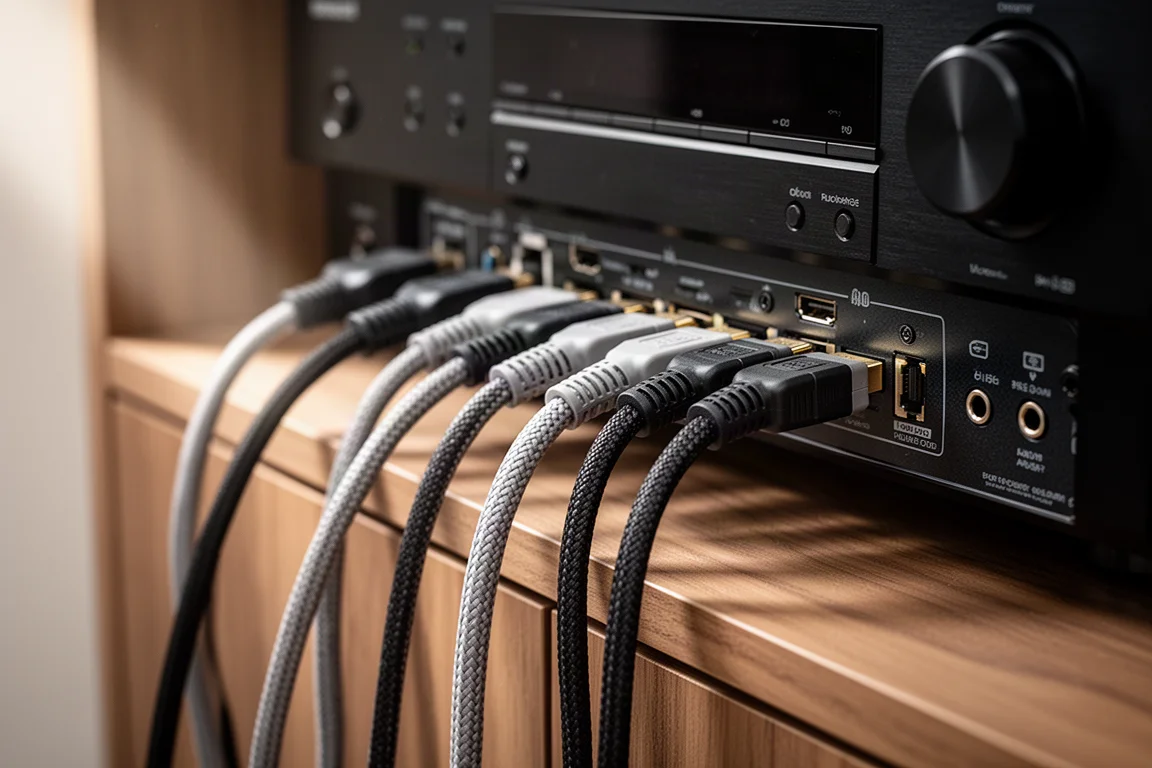
Onkyo also includes a preamp disconnect mode that physically separates the preamp from the power amplifier stages, either for the front channels only or for all of them. It does not switch the amplifiers off; it removes the coupling path so an unloaded amplifier cannot feed noise or distortion back into the preamp. Measured noise and distortion were marginally lower with the feature engaged, which makes it worth using whenever the internal amplifiers are not in play.
Bass management is textbook for a THX Select receiver, with second-order high pass and fourth-order low pass filters. Because the platform shares its DSP and converters across the Onkyo, Pioneer, and Integra models, the same behavior should carry across the family.
Amplifier power and stability
Two channels driven into 8 ohms, the TX-RZ70 produced 170 watts per channel across the full 20 Hz to 20 kHz bandwidth, against a 140-watt rating. Into 4 ohms with two channels driven it reached 264 watts with distortion below 0.005 percent, and 266 watts at 0.1 percent THD, with 300 watts available at 1 percent.
With seven channels driven at 1 kHz into 8 ohms, output measured 133 watts per channel at 1 percent distortion and 118 watts at 0.1 percent. That is more than a considerably more expensive Marantz receiver managed under the same conditions. Dynamic power, which better reflects music program material, reached 370 watts into 4 ohms with two channels driven, roughly 1.8 dB of headroom over the rated figure.
The amplifier is a low-distortion design: at 50 watts, THD plus noise measured around 0.05 percent. Power bandwidth is linear, with the 3 dB point out at roughly 77 kHz, which is exactly what a well-built linear amplifier should look like.
Build quality, cooling, and protection
Inside, the receiver uses four rows of heat sinks and a substantial power supply. Continuous sweeps at 4 ohms, run for minutes at a time, only brought the fans on gently and at low audibility, with the chassis staying cool throughout. That is a good sign for long listening sessions at high output.
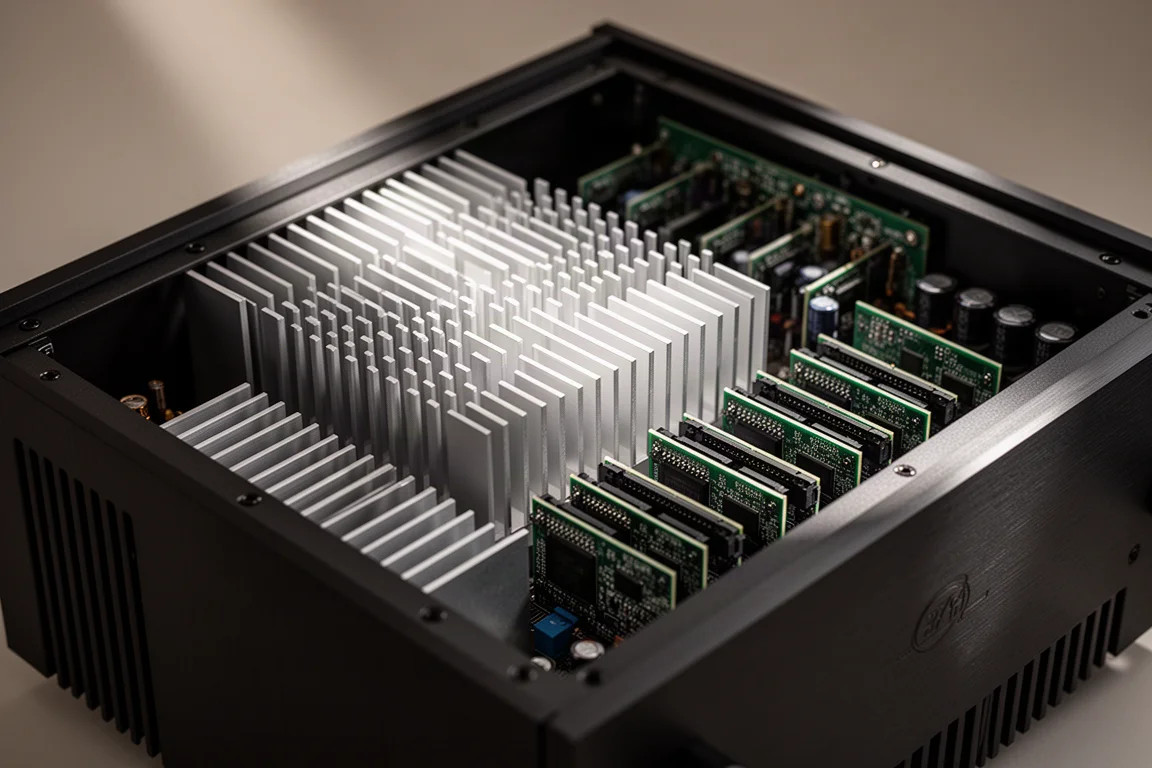
Protection behavior has improved as well. If the receiver enters fault protection it shuts down, and on restart it runs a short diagnostic on each amplifier channel, taking about two minutes, before returning to normal operating mode rather than remaining stuck in a reduced-power state. That matters if a speaker cable shorts, because the receiver identifies the affected channel instead of quietly running at a fraction of its capability.
Channel-to-channel crosstalk measures around 50 to 60 dB at 20 kHz. That is acceptable rather than class-leading, and unlikely to be audible in a normal setup.
Things to consider before buying
Leave the impedance switch alone
The TX-RZ70 includes a low-impedance setting intended to satisfy regulatory ratings, and engaging it does serious damage to performance. Measured output into 4 ohms dropped from 300 watts at 1 percent distortion to about 54 watts, and from 266 watts at 0.1 percent to roughly 47 watts, with distortion rising at the same time. Nothing about the setting helps real loudspeakers, whatever their nominal impedance. Leave it in the default high-impedance position and let the amplifier do its job.
Manual EQ needs another generation
Standing wave correction is not the flexible manual parametric EQ that enthusiasts often hope for. It applies a fixed Q of about 2 and affects every channel rather than allowing per-channel adjustment, so a correction set at 60 Hz becomes a wide, system-wide change. Room correction handles the heavy lifting well, but fine-tuning on top of it is limited.
Bass management caps sampling at 48 kHz
Once bass management is engaged, the DSP operates at 48 kHz, so a 192 kHz input is downsampled. The audible impact is minimal, and other processors in this class behave similarly, but it is worth knowing if you feed the receiver high-resolution material.
Eleven channels is the ceiling
The TX-RZ70 supports eleven amplified channels and dual independent subwoofer outputs. Expanding beyond that means moving to a different receiver class. Note also that Onkyo rates this model at 140 watts per channel, while the closely related Integra and Pioneer versions are rated at 150 watts, even though all three share the same rated power consumption.
Buying advice
At $2,800, the TX-RZ70 delivers measured amplifier performance that exceeds what several more expensive receivers achieve. If you plan to run eleven channels, drive 4 ohm speakers at high levels, or use the receiver as a preamp with external amplification for the front channels, it covers all three without obvious compromise. The preamp section is quiet enough that adding a separate processor would bring little benefit.
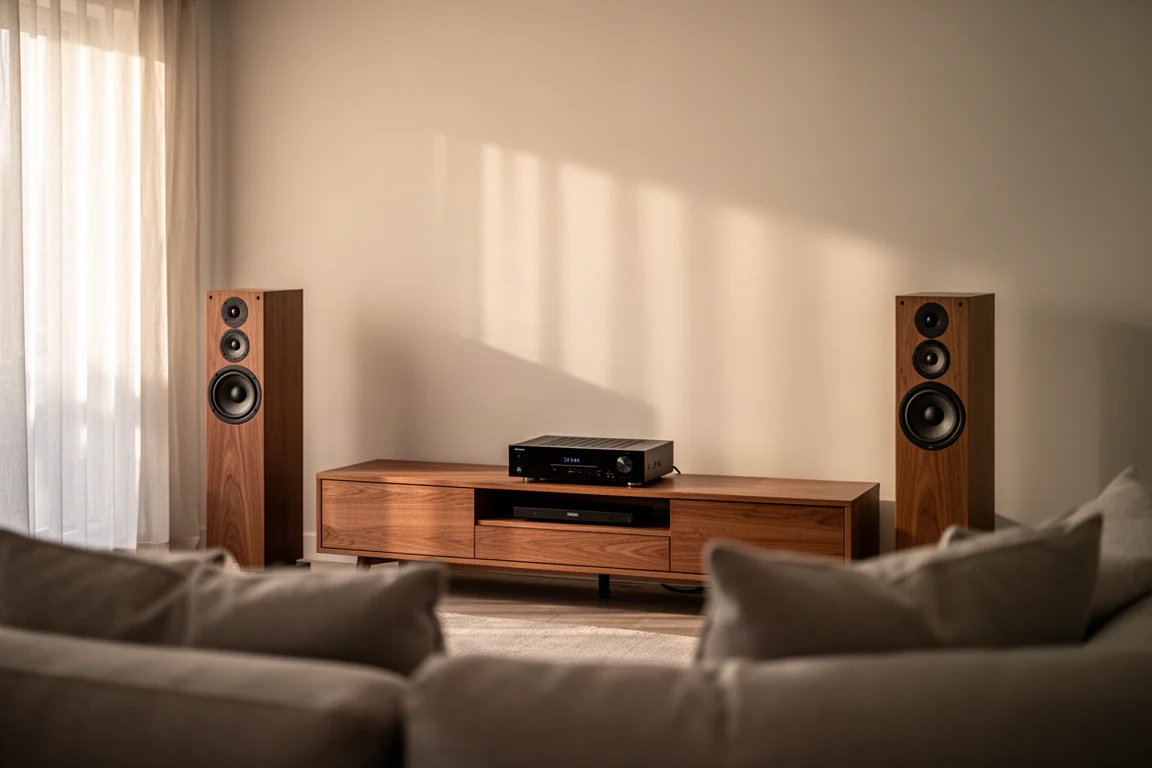
Two details are worth factoring into the decision beyond raw output. Preamp disconnect mode keeps the signal path clean when the internal amplifiers are unused, and the diagnostic protection routine means a fault does not leave the receiver running at a fraction of its capability. Those are the kinds of features that matter over years of ownership rather than on a specification sheet. Also budget for room correction upgrades only if you need advanced multi-subwoofer control, since Dirac Live itself is included at no extra cost.
Conclusion
The Onkyo TX-RZ70 is a conservatively rated, genuinely powerful 11.2-channel receiver with a preamp section that measures as well as dedicated processors costing far more. Its strengths are real and repeatable: low distortion, high signal-to-noise ratio, stable power delivery into difficult loads, and cooling that holds up under sustained output.
Its caveats are equally clear. Avoid the low-impedance setting entirely, accept that manual EQ is basic, and recognize that eleven channels is where this receiver stops. For a home theater built around that channel count and driven at realistic volumes, it is one of the strongest options at its price.
Product link
View more details for Onkyo TX-RZ70
This product is mentioned in the review. Check the specifications, options, and compatibility before buying.
View more details for Onkyo TX-RZ70Further reading
Related Reviews
AV Receivers
Anthem MRX 740 8K Review: Composed Home Theater Sound With a Few Rough Edges
A close look at Anthem's mid-tier MRX 740 8K receiver, covering its sound, ARC Genesis room correction, HDMI 2.1 features and the daily quirks worth knowing before you buy.
AV Receivers
Anthem MRX 740 vs MRX 1140: Which AV Receiver Fits Your System?
A measured look at the Anthem MRX 740 and MRX 1140, covering preamp output performance, amplifier behaviour, bass management, and expansion headroom.
AV Receivers
Best AV Receivers for Home Theater: Denon, Onkyo, Marantz and Yamaha Compared
Four home theater receivers compared on features, sound character, setup and value, with clear guidance on which one fits which kind of buyer.