Camping Fans
Odoland Camping Fan and Lantern Review: A Two-in-One Camping Fan Under $20
A measured look at the Odoland camping fan and lantern, covering airflow, noise, lantern output, runtime, weather resistance, and the real cost of running it on D batteries.
Introduction
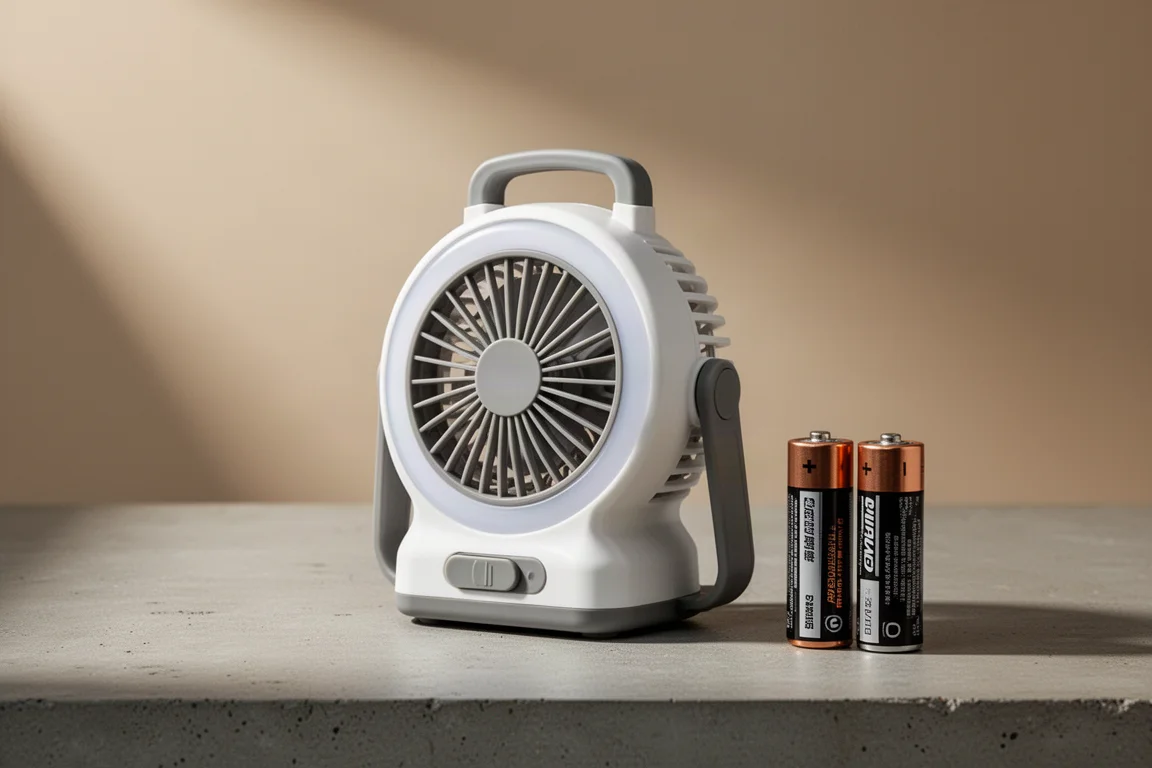
The Odoland camping fan and lantern is a two-in-one piece of gear built around a simple idea: one compact unit that moves air and lights a tent, priced at around $17. It runs on two D batteries, offers two fan speeds and a single lantern mode, and packs down small enough to disappear into a kit bag at 13.8 ounces without batteries.
That low upfront price is the headline. The questions worth answering are whether the airflow, light quality, and battery behaviour actually hold up inside a tent, and what the ongoing cost of D batteries does to the overall value. Those are the points covered below.
What the Odoland Fan and Lantern Offers
Two switches control everything. The left switch runs the fan with a low and a high setting, with the middle position acting as off. The right switch is a straightforward on/off toggle for the lantern.
Power comes from two D batteries held in a compartment at the top of the unit. Access requires turning the top of the fan anti-clockwise with a firm grip, then releasing a small latch so the lid pops open. Plus and minus markings inside show the correct orientation, and the outer cover goes back on by lining up two notches and twisting clockwise until it clicks.
The fan face measures about 5.75 by 5.75 inches, roughly 14.6 centimetres across. Total weight is 13.8 ounces (392 grams) without batteries and 23.6 ounces (668 grams) with two D cells installed. Squeezed down as far as it will go, the packed length is about 7.5 inches, or 19 centimetres.
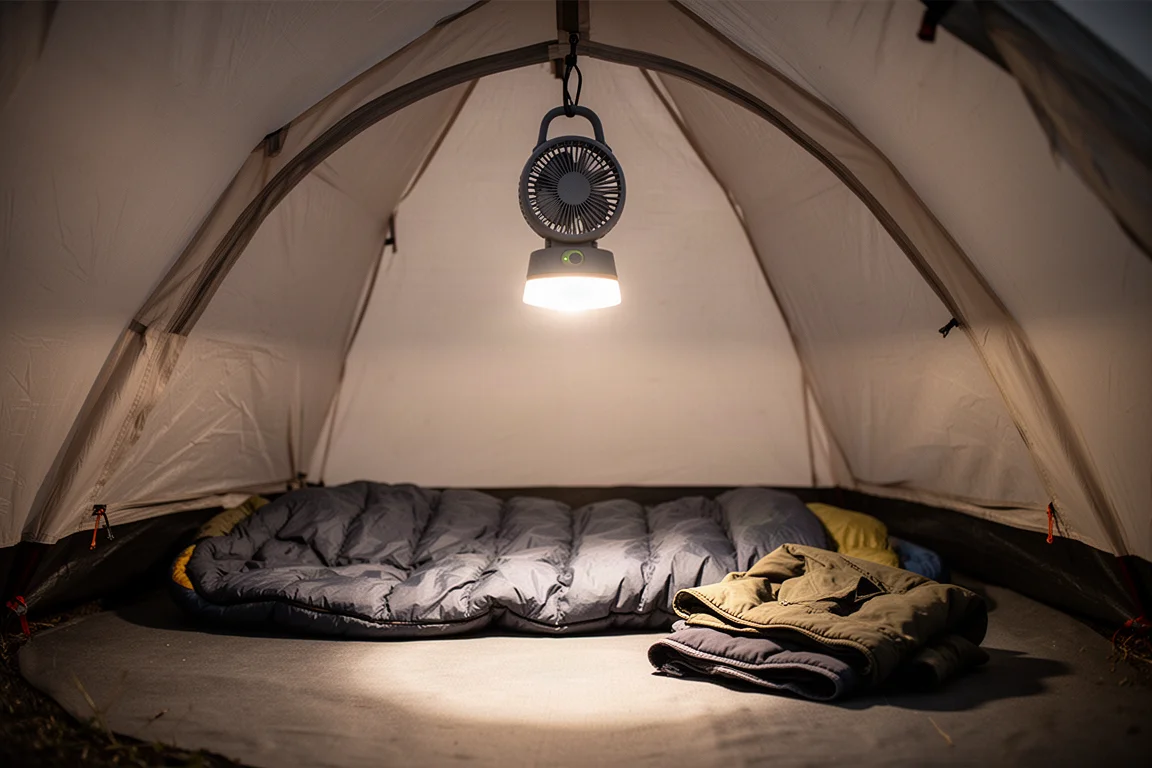
A handle sits behind the fan with enough clearance for a full grip, and a hook flips up from the middle of that handle for hanging. The fan head rotates through almost a full turn once the hook is pushed in and the handle is moved aside, and the light can be angled independently, including in the opposite direction to the fan. That flexibility is a genuine part of the design rather than an afterthought.
Fan Performance and Airflow
Airflow measured directly at the fan face came in at about 2.6 metres per second (8.5 feet per second) on the low setting and about 3.6 metres per second (nearly 12 feet per second) on high. Those are modest numbers, which matches the size of the unit.
Maximum throw distance was about 70 inches on high and slightly less on low, at around 64 inches. That was measured in still air and then confirmed inside a tent with a second instrument, which produced a similar result. That reach is roughly the length of a two-person tent, and it lines up with the intended use case. It is not enough to cool a four-person tent, and a six-person tent is well beyond what this fan can serve.
Noise Levels
Ambient room noise measured 39 to 40 decibels with the fan switched off. On low, the meter climbed to about 59 decibels, and on high it reached 62 to 63 decibels. There is also a light clicking quality to the sound that stays audible even at the lowest setting, which stands out for a fan this small.
Lantern Performance
The lantern is a single-mode on/off light with no brightness adjustment. Listed output is 80 lumens, but measured output was considerably higher at close to 398 lumens, dropping to about 230 lumens when the fan runs at the same time.
The light comes from 18 LEDs arranged in three strips of six. In practice it lights a tent very effectively: from the far edge of a two-person tent, printed text on a page stayed clearly readable, and the floor was evenly illuminated. The trade-off is quality rather than quantity. The output reads as harsh and glaring rather than soft, so angling the head away from eye level makes a real difference to comfort.
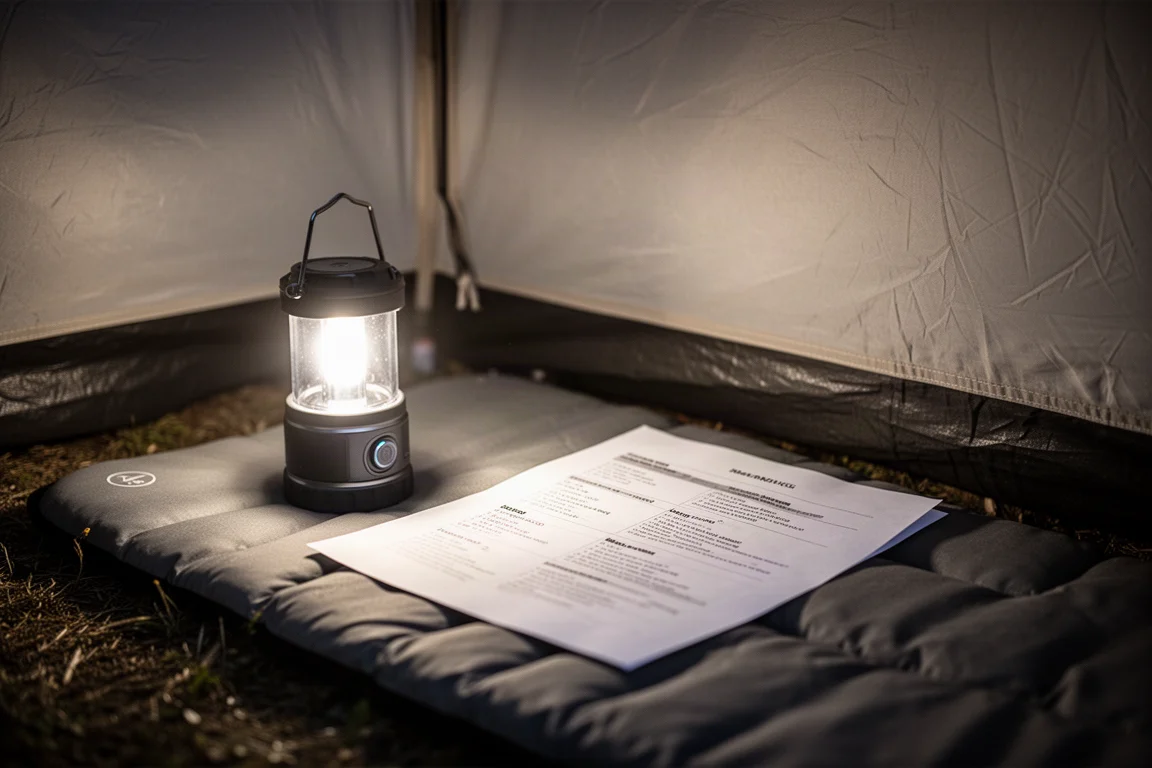
Hanging the unit is straightforward thanks to the pop-up hook, though the hook itself is large and will not pass through small fabric loops. It works better hooked over the strap or webbing that holds a loop in place, which is a small detail worth checking against your own tent before you rely on it.
Battery Life and Real-World Runtime
Official figures list 5 hours of fan runtime on high and 15 hours on low, plus 37 hours for the lantern. With fresh higher-capacity D cells, real runtime ran considerably longer: roughly 21 hours on high fan, about 40 hours of genuinely usable airflow on low, and around 58 hours of bright lantern output before the light began to fade and finally went flat at roughly 72.5 hours.
Fan output does not hold steady. On low, the strongest airflow lasted about 25 hours, then eased to around 2 metres per second, then to about 1.5, then to roughly 1 metre, and by the 40 hour mark it had dropped to about half a metre per second. At that point it barely registered on an anemometer and was too weak to be useful, so the final stretch of around seven hours is not worth counting as usable runtime.
Running the lantern and the fan together costs roughly 15 to 20 percent of runtime. High fan speed drops from about 21 hours to about 17 hours, with the light shutting off around that point and the fan continuing to fade until it stops.
Build, Durability, and Weather Resistance
The entire unit is plastic, including the fan head and the blades. Two knobs on the side of the housing repeatedly worked loose during use, which is the kind of small annoyance that tends to get worse over time.
The listed claims describe the fan as weather-resistant and moisture proof, with vague packaging wording about rain that is difficult to interpret. In a 30 minute test under moderate rain, the fan function kept working, but the light failed. A small amount of water was found inside the battery compartment, which was otherwise mostly dry.

Warranty information was not available for this unit, which leaves the standard 30-day return window as the practical safety net. Anyone planning to use the fan in wet conditions should weigh that combination of vague weather claims and a failed light carefully before committing.
Main Strengths
- Very low upfront cost, at around $17 for the unit.
- Built-in lantern, so a separate tent light is not required.
- Useful physical design, with a full-size handle and a pop-up hanging hook.
- Near 360-degree fan rotation, plus a light head that angles independently.
- Long usable runtime on low with higher-capacity batteries, far beyond the listed specification.
Things to Consider Before Buying
- Only two fan modes and a single lantern mode, with no brightness or speed fine-tuning.
- Harsh, glaring light quality rather than a soft, even glow.
- Airflow declines gradually over the run rather than holding steady, and the last hours are effectively unusable.
- Audible clicking at low speed, which is noticeable for such a small fan.
- No sleep timer, no battery indicator, and no charge-out function for other devices.
- D battery running costs add up quickly. The cheapest bulk cells come in around $1.15 each, while higher-capacity cells run closer to $2 each, which is roughly $4 per short camping trip.
- Plastic throughout, with side knobs that came loose in use.
- Weather resistance is limited in practice, with the lantern failing after 30 minutes of moderate rain.
- No warranty information beyond the 30-day return window.
- Sized for one person only, with an airflow distance matched to a two-person tent.
Who This Product Is For
This fan suits a solo camper who wants airflow and a tent light from one small, inexpensive package, and who is camping in a tent no larger than two-person size. Sharing it is not realistic, since the airflow is thin and directional and the face is under six inches across. Campers who regularly fill a four-person or six-person tent will find it underpowered for the space.
It also makes most sense for someone who already has a stock of D batteries sitting unused. Without that, the recurring battery cost becomes the dominant part of the purchase decision.
Buying Advice
The Odoland fan and lantern is worth considering if three conditions apply: you already own a supply of D batteries, you want to stay under about $20 for a fan and light combined, and the unit is for you alone. Under those circumstances it does its job, and the 360-degree rotation plus the hanging hook make it easy to position for real comfort.
The long-term math is the part to think through. After five to ten short camping trips, the total spend can climb from around $17 to roughly $57 once batteries are factored in, which changes the value picture considerably. If those conditions do not describe your situation, a rechargeable camping fan is likely the better long-term purchase, even at a slightly higher upfront price.
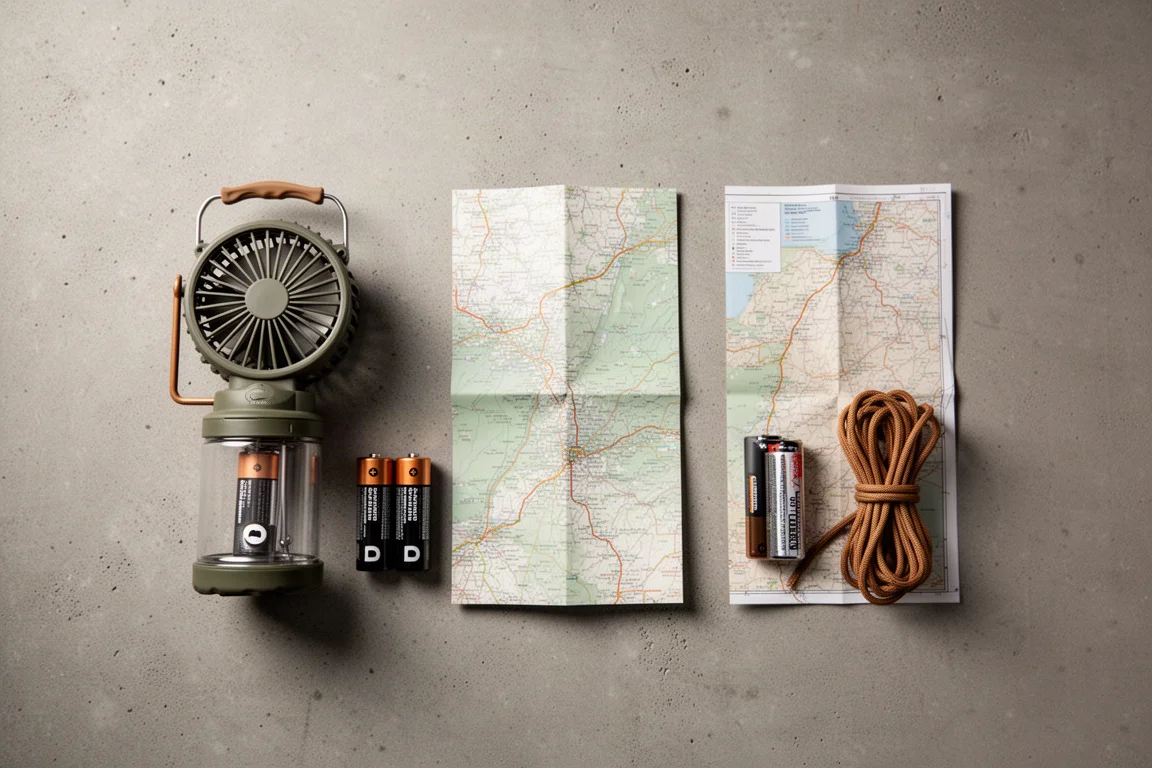
For a solo camper in a small tent who wants one compact unit that lights and ventilates, the Odoland still delivers the basics at a very low entry price. For anyone who camps often, the battery cost is the deciding factor rather than the fan itself.
Conclusion
The Odoland camping fan and lantern gets the fundamentals right for a very low price. It moves a usable amount of air across the length of a two-person tent, it lights that tent brightly enough to read by, and its handle, hook, and near 360-degree rotation make it easy to aim where you need it.
The compromises are equally clear. Light quality is harsh, fan output fades noticeably over a long run, the build is all plastic with side knobs that loosen, and the weather claims did not hold up when the lantern was exposed to sustained rain. Add the ongoing cost of D batteries and the case narrows to a specific buyer: a solo camper in a small tent who already has batteries on hand and wants to spend as little as possible. For that person, it is a sensible, inexpensive two-in-one. For everyone else, a rechargeable alternative is worth the extra outlay.
Product link
View more details for Odoland Camping Fan and Lantern
This product is mentioned in the review. Check the specifications, options, and compatibility before buying.
View more details for Odoland Camping Fan and LanternFurther reading
Related Reviews
Camping Fans
Coleman CPX6 Camping Fan Review: A Bright Lantern With Very Limited Airflow
A dual-purpose camping fan and lantern with a genuinely clever magnetic mount, a very bright light, and airflow that fades out within about half a metre.
Camping Fans
Coleman OneSource Camping Fan Review: A Compact Tent Fan With Real Trade-Offs
A practical look at the Coleman OneSource camping fan, covering airflow, noise, run times, phone charging, and the limits worth knowing before you buy.
Camping Fans
Geek Aire 10-Inch Portable Camping Fan Review: Airflow, Runtime, and Rain Testing
A practical look at the Geek Aire 10-inch portable camping fan, covering airflow range, measured runtimes, noise levels, metal build quality, and IPX4 rain resistance.