Camping Fans
Coleman OneSource Camping Fan Review: A Compact Tent Fan With Real Trade-Offs
A practical look at the Coleman OneSource camping fan, covering airflow, noise, run times, phone charging, and the limits worth knowing before you buy.
Introduction
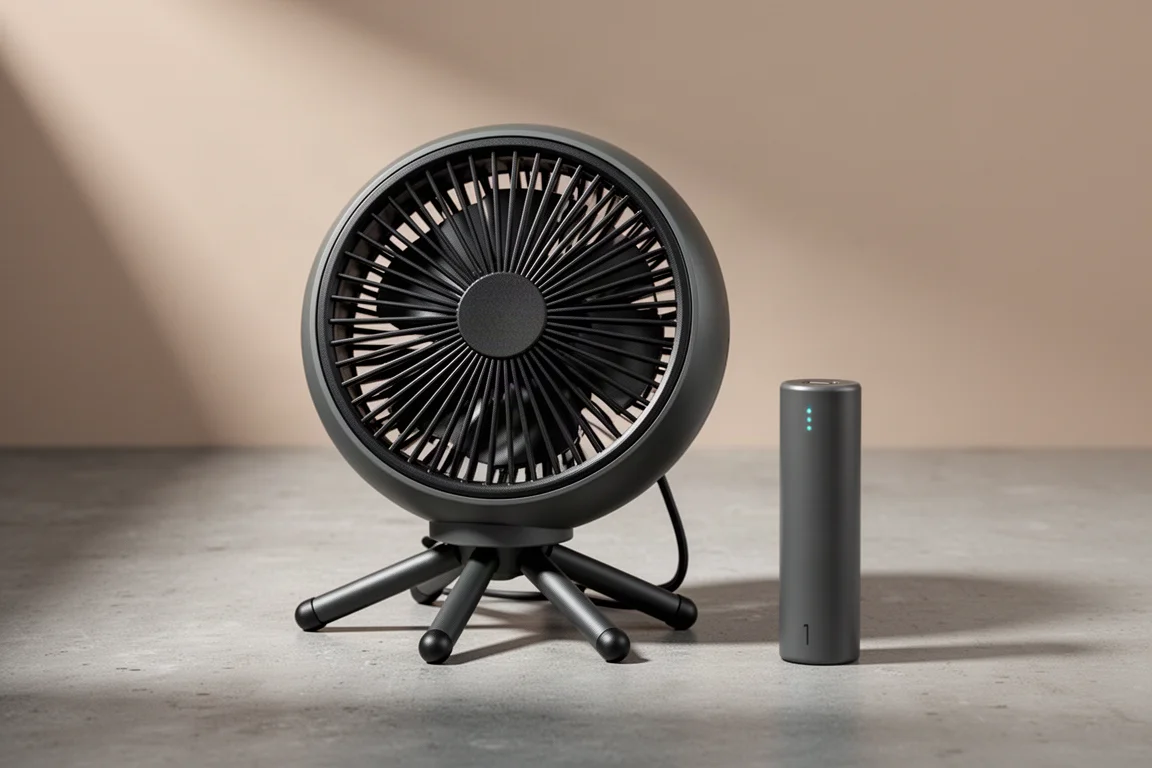
The Coleman OneSource camping fan is a portable, battery-powered fan built around a rechargeable battery from Coleman’s OneSource line. In the box you get the fan itself, the rechargeable battery, a charging cable, and printed documentation. The fan carries a three-year warranty stated on the packaging, and it does not arrive charged, so the first job is a full charge before any real use.
It has been used across roughly five months and put through airflow measurements, noise readings, run time tests, phone charging tests, and a rain test. What follows is a plain account of how it performs, where it genuinely helps, and where it falls short.

The basic pitch is straightforward: a fan that stands on its own, hangs from a hook, rotates to aim where you need it, runs from a rechargeable battery, and can top up a phone when power runs low. Most of that holds up in practice, with limits that matter once you are inside a tent.
Who this product is for
This fan makes the most sense for one or two people. Airflow reaches about 88 inches on the high setting and about 48 inches on low, but a simple windmill stopped spinning entirely at roughly the 66-inch mark, which means anything beyond that is very weak. In practice that suits a two-person tent, and at most a four-person tent. It is not a six-person tent fan. Hung at the top of a six-person tent with a peak height of about 74.5 inches, the airflow was barely noticeable from the far end.
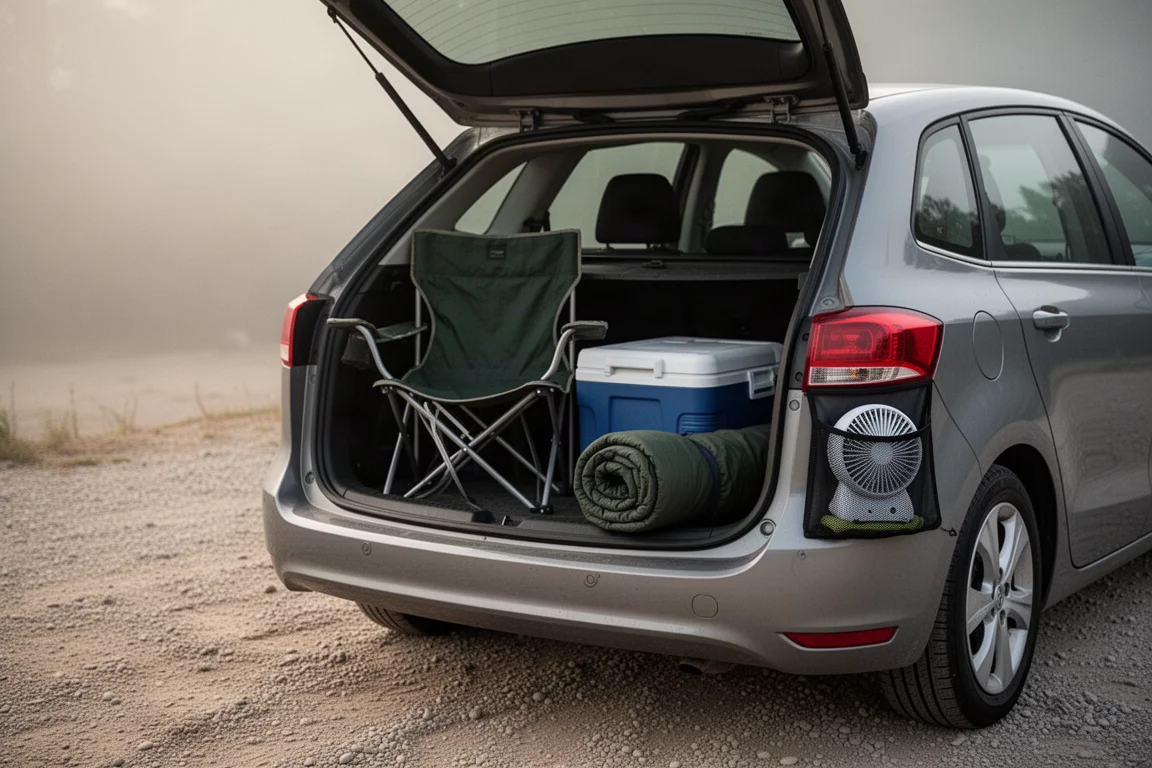
It is also a good fit for car camping and for sitting outside. The legs retract, and the fan fits neatly into a chair cup holder, which keeps the airflow close while you are seated.
Main strengths
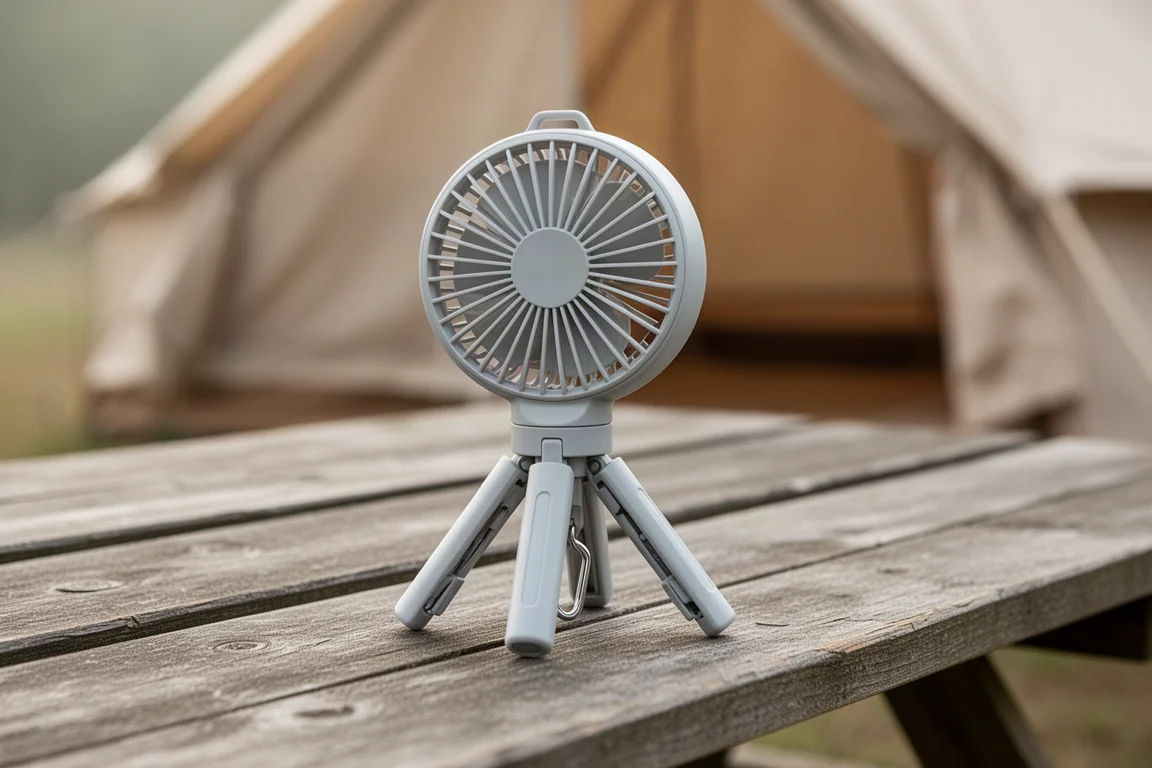
The hardware list is longer than expected for this category. A single knob at the front controls everything: O for off, 1 for low, and 2 for high. Three legs at the base click into place to turn the fan into a standing unit, and each leg has a latch that must be pressed before it can be retracted. The head rotates about 180 degrees from front to back, so it can be aimed across a tent rather than straight down. A metal hook at the bottom works as a carry handle or as a hanging point. Note that the head does not pan left to right, and it does not tilt further downward than its rotation allows.
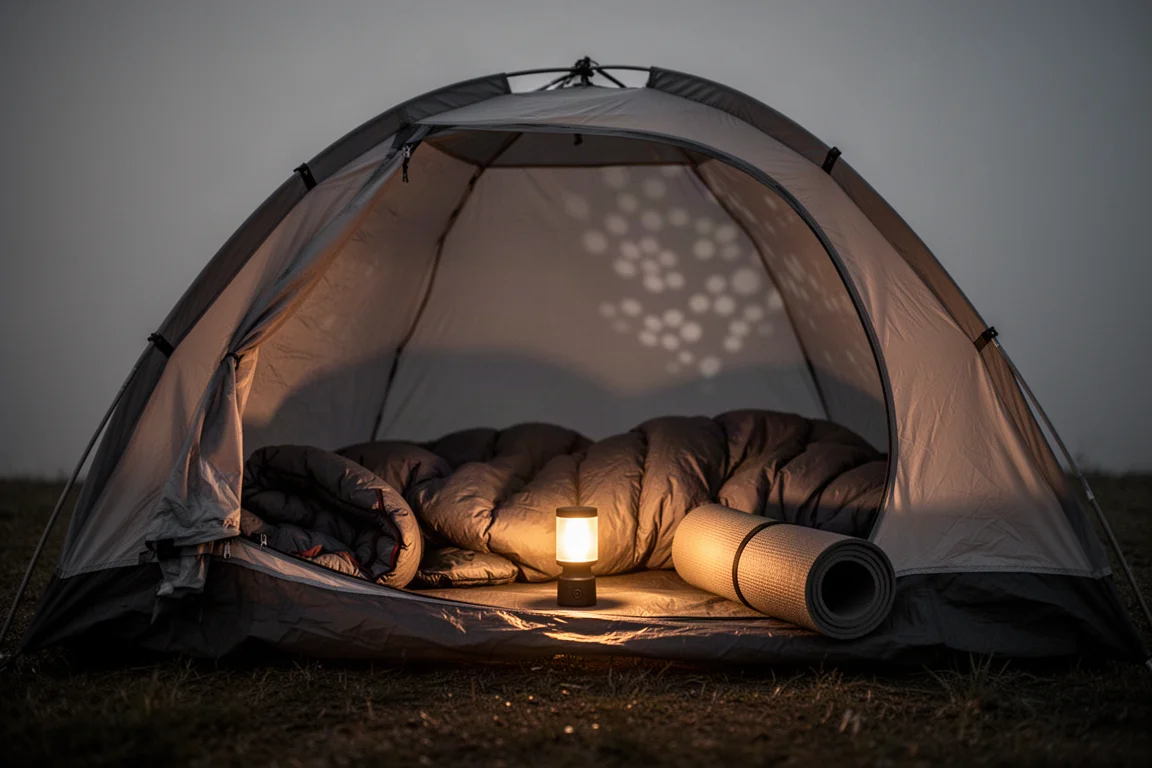
The built-in flashlight was the biggest surprise. Pressing and holding the button on the battery for two to three seconds switches it on, and the same press turns it off. The market specification lists 10 lumens, but the measured output came in at about 57 lumens, which is not blinding but is enough to light up a small tent at night. It also costs very little battery: a full charge on high speed delivered about 5 hours and 40 minutes of run time, and running the flashlight the entire time delivered about 5 hours and 34 minutes, roughly a 2 percent difference. That same button doubles as a battery check. A quick press, without holding, brings up the battery level lights, which stay on for about 35 seconds before switching off.
Weather resistance is rated at IPX4, which covers light to moderate rain. After 30 minutes of moderate rain, the fan held up fine: the knob still worked, both speeds behaved normally, and the port seals on the battery stayed tight and completely dry. The three-year warranty stated on the box is also a meaningful reassurance at this price point.
Battery, Charging, and Run Time
The rechargeable battery has a capacity of 4,800 milliampere hours. Two flaps sit at the bottom of the battery. The first hides a USB-C input for charging, and the supplied cable uses a regular USB plug at the other end for a wall outlet. Charging progress is shown by three lights: the first blinks immediately, the second starts blinking at about 30 minutes, the third at about two hours, and at roughly three hours and 15 minutes, give or take five minutes, all three become solid and the battery is full. Charging takes about two hours from a 2.4 amp output or about five hours from a 1 amp output.
The second flap covers a regular USB output port that turns the battery into a power bank. Press the button to activate phone charging. Starting with a full battery and a phone at 20 percent, 30 minutes brought the phone to 50 percent with two battery lights remaining, one hour brought it to 78 percent with one light remaining, and 1.5 hours brought it to 98 percent. Resuming the next day at 59 percent, the final battery light began blinking after 15 minutes, and the phone reached 97 percent after an hour with no lights left. The net result is roughly one and a half phone charges on an iPhone 12, which lines up with the gap between the 4,800 milliampere hour battery and the phone’s 2,815 milliampere hour battery. The leftover capacity covered about 8 minutes of high fan speed or 24 minutes of low fan speed.
Run time claims are about 6 hours on high and 15 hours on low. High speed measured slightly under that at about 5 hours and 40 minutes. Low speed ran about 17.5 hours in total, but only about 15 hours at the full 2 meters per second reading. At the 15 hour mark the output dropped to about 1.5 meters per second, a reduction of roughly 20 to 25 percent.
Airflow, Noise, and Light Output
Airflow was measured with a small anemometer. On the low setting it read about 2 meters per second. On high it came in slightly under 3 meters per second, averaging around 2.8 to 2.9 meters per second. Airflow distance reached about 88 inches on high and about 48 inches on low, though the windmill test showed the useful reach is closer to 66 inches.
Noise is a real consideration. With the fan off, the room baseline sat at about 41 decibels. On low it rose to about 55 decibels, and on high it reached about 66 to 67 decibels. That makes it one of the noisier camping fans at the higher setting.
Light output from the flashlight is modest but useful. It measured about 57 lumens against a market specification of 10 lumens, which is not a high output but is more than enough to find something in a tent after dark.
Things to consider before buying
There are only two fan speeds. That is typical of cheaper camping fans, but more expensive models often offer three or even four, and the extra control is missed when you want something between gentle and loud.
The highest speed is not especially strong, topping out just under 3 meters per second, and the airflow distance is modest. Combined with the two-speed control, that limits how much air you can move across a larger space.
There is no timer, which would be useful for conserving battery overnight. Noise at the high setting is also worth planning around if you are a light sleeper or sharing a tent.
Quality control was not perfect on the unit tested. One of the legs retracted without the latch being pressed, so the fan could collapse when simply placed on the ground.
Price matters here. The marketed retail price is around $50, though it was picked up during a Black Friday sale for about $30. At the full retail price, the value case is much harder to make, since better camping fans exist in that range.
Buying advice
This fan is worth considering if you camp in a one or two person tent and want a single compact unit that stands on its own, hangs from a hook, rotates front to back, doubles as a phone power bank, includes a usable flashlight, and comes with a three-year warranty. The run time figures also track closely with the manufacturer’s claims, which is reassuring.
It is easier to skip if you need to cool a six-person tent, want more than two speeds or a timer, need quiet operation, or expect stronger airflow. On price, it is listed around $50 at retail, while promotional pricing near $30 makes it a much more comfortable recommendation. If you are paying full retail, compare a few alternatives before committing.
Conclusion
The Coleman OneSource camping fan is a feature-rich small tent fan with accurate run time claims, a genuinely useful flashlight, and a battery that doubles as a power bank. It is held back by two fan speeds, modest airflow reach, noticeable noise at the high setting, and a quality control risk on the folding legs. At a promotional price it is a sensible choice for one or two campers. At full retail, it is worth weighing carefully against the alternatives.
Product link
View more details for Coleman OneSource Camping Fan
This product is mentioned in the review. Check the specifications, options, and compatibility before buying.
View more details for Coleman OneSource Camping FanFurther reading
Related Reviews
Camping Fans
Coleman CPX6 Camping Fan Review: A Bright Lantern With Very Limited Airflow
A dual-purpose camping fan and lantern with a genuinely clever magnetic mount, a very bright light, and airflow that fades out within about half a metre.
Camping Fans
Geek Aire 10-Inch Portable Camping Fan Review: Airflow, Runtime, and Rain Testing
A practical look at the Geek Aire 10-inch portable camping fan, covering airflow range, measured runtimes, noise levels, metal build quality, and IPX4 rain resistance.
Camping Fans
Odoland Camping Fan and Lantern Review: A Two-in-One Camping Fan Under $20
A measured look at the Odoland camping fan and lantern, covering airflow, noise, lantern output, runtime, weather resistance, and the real cost of running it on D batteries.