Astrophotography
OCAL H2 Hyperbolic Newtonian Review: A Fast f/2.72 Astrograph for Serious Astrophotographers
After more than four months and a hundred hours of testing, a detailed look at the OCAL H2's optics, mechanics, dew control, collimation workflow, and full-frame imaging results.
Introduction
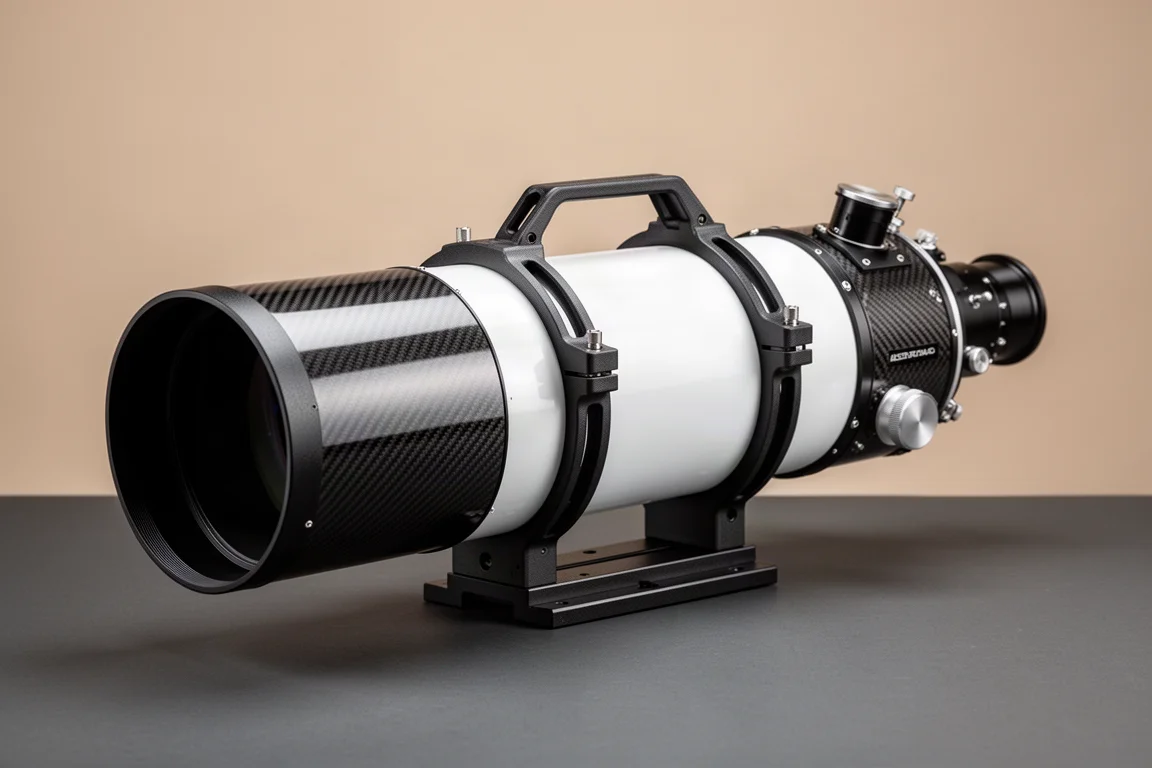
The OCAL H2 is a specialized hyperbolic Newtonian built for advanced astrophotographers who need extreme speed without giving up a wide, corrected field. It delivers a corrected field across a full-frame sensor at 560 mm focal length, which for a 206 mm aperture works out to a focal ratio of f/2.72. That combination of a large aperture and a very fast focal ratio makes it an ideal tool for nebulae, comets, and anyone with a limited number of clear nights.
This review comes after more than four months of hands-on use and well over a hundred hours spent learning the telescope, collimating it, and imaging with it. It is not a beginner’s instrument: reaching the absolute best results takes real effort from the photographer. But once dialed in, the reward is a large photon bucket that produces strikingly detailed images in far less integration time than a slower refractor would need.
Who the OCAL H2 Is For
This is an advanced telescope, and its pricing at over $5,000 reflects that. It is aimed at imagers who understand why a scope like this costs what it does, particularly those who have tried imaging Newtonians before and run into the classic problems: light leaks, poor mechanical rigidity, and focuser slop. If those issues have held your images back in the past, the H2 is built to address them directly.
In terms of targets, this scope mostly appeals to photographers who love faint nebulae. Dusty regions in Cepheus and Taurus are perfect territory for it, and its speed and aperture also make it a strong candidate for comet imaging. Its low focal ratio means that even three hours of clear sky under a dark site can produce a finished result that would take far longer at f/5 or f/7 with a refractor.
Build, Design, and Hardware Details
The tube is made of carbon fiber, 4 mm thick, and the overall package feels engineered rather than assembled. Both the primary and secondary mirrors are made of fused silica. The primary is ground into a hyperboloid shape, which requires a special coma corrector; a purpose-built four-element glass corrector is included and integrated into the focuser. It can be removed, but it must always be installed when imaging.
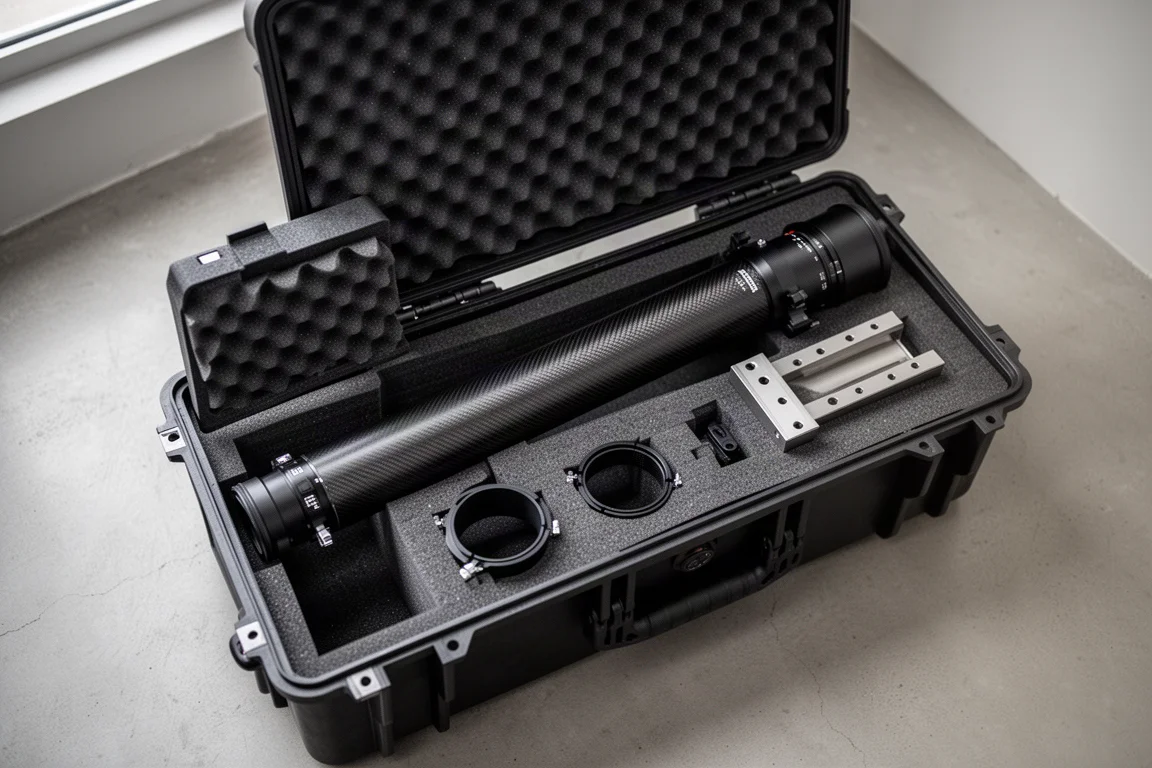
The focuser is very solidly built, silky smooth thanks to ball bearings running in special tracks, and holds heavy payloads without slipping even when gravity pulls on the drawtube. It includes built-in tilt and rotational adjustment. M48 and M54 adapters are included, so full-frame users can run a 54 mm image train all the way through to avoid vignetting. Standard 55 mm back spacing from the rear threads to the sensor is required for proper correction.
Rounding out the hardware are tube rings with M6 tapped holes and flat surfaces all around for accessories, a Losmandy-style plate with plenty of channels, and a top handle with a Synta-style finder shoe for a guide scope. For planning purposes: the telescope with rings and plate weighs 28 lb (12.7 kg), the tube is 24.75 in (63 cm) long, the front outside diameter is 10.5 in (26.7 cm), and the height from dovetail to handle top is 14 in (35.5 cm). The telescope plus case together weigh 59 lb (26.7 kg), with the case measuring 27.5 x 15.25 x 21.5 in (70 x 39 x 54.5 cm).
A highly recommended companion is OCAL’s own electronic collimator, the OCAL 4.0. If it is not part of the package you buy, picking one up separately is strongly advised.
Dew Control and Light Management
Two areas where imaging Newtonians usually fail are stray light and mirror condensation, and the H2 tackles both. The inside of the tube is painted with a special black coating advertised to eliminate 99% of stray light. In practice, no light leaks were found at the primary mirror cell at all; dark frames taken at dusk showed no difference from darks taken in complete darkness, which is a very good sign.
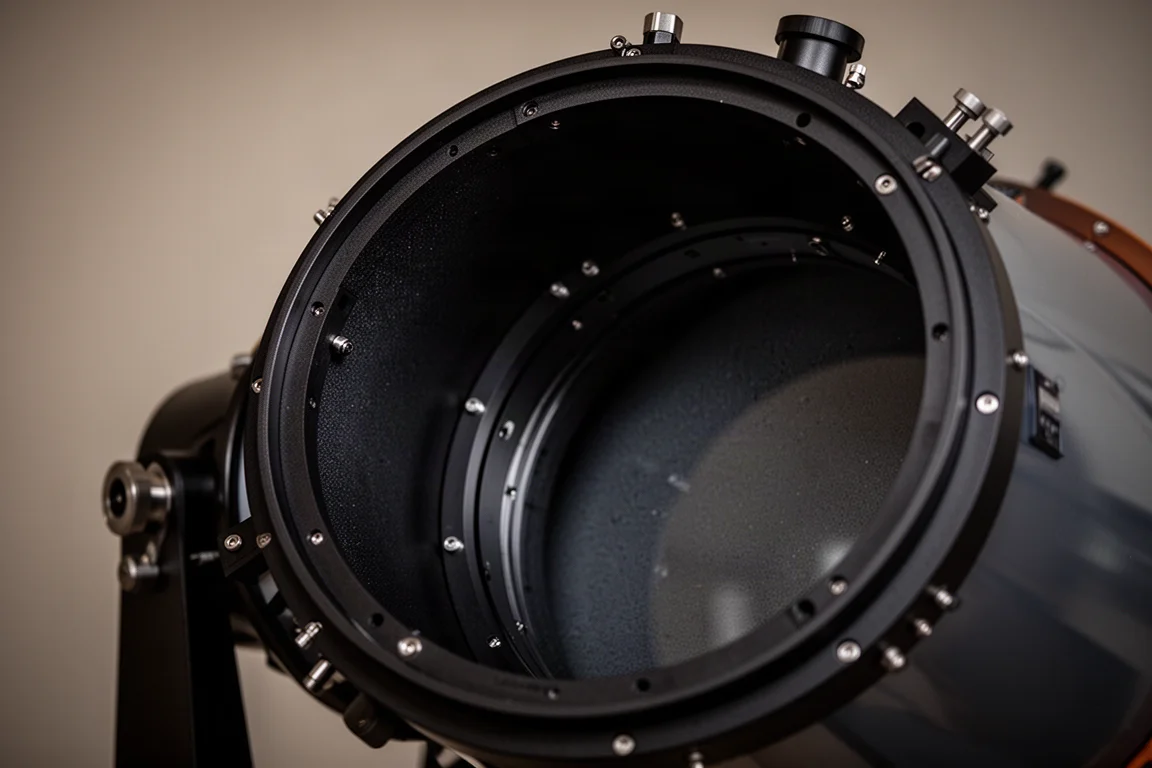
The dew prevention system is genuinely thoughtful. Small heater strips wrap around both the primary and secondary mirrors, and a small glass sensor inside the tube measures internal temperature. An external control box, powered by a standard 12 V cable and connected to a PC via USB, runs software downloaded from OCAL’s website. It measures ambient temperature and dew point, and in auto mode it applies just enough heat to prevent condensation on the mirrors.
That auto mode proved itself. One night, as a test, the software was switched off; within a couple of hours, condensation formed on the mirrors and ruined the data. With the system running on auto every night, that never happened, even in the very humid air of New Hampshire. A magnetic inspection port on the tube side, opened by pulling a blue knob, makes it easy to blow dust off the mirror with a rocket blower. The entire primary mirror cell is also removable by taking out the three collimation screws, after disconnecting the dew heater cable inside the tube and securing it so it does not snag.
Collimation: The Real Work
Collimation and focus are never trivial at f/2.7. Any tiny shift in any mechanical component can throw off the alignment, so the biggest lesson learned over four months is simple: anything that can lock on this scope needs to lock. Because of the springs and bearings built into the design, something can feel tensioned when it is not, and even a very small shift during a slew or meridian flip means you are no longer collimated at f/2.7.
The push-pull style collimation knobs take time to learn if you have never used them before, both at the primary mirror cell and at the secondary. The secondary mirror has a fairly complex system: three precision screws for main collimation, a height adjustment knob to align the focuser, and push-pull knobs to rotate the entire secondary assembly, which hides behind the oversized 80 mm secondary mirror. The good news is that once you learn to adjust and lock properly, the telescope holds collimation and focus very well through the night, and even night after night.
One important caveat concerns the manual camera angle adjuster (CAA) built into the focuser. It is needed for the published collimation procedure, but it is not a true CAA for framing or aligning diffraction spikes. Rotating it after collimation ruins the alignment, and surprisingly, even collimating at a rotated angle first still gave poor results. For framing flexibility, a separate camera angle adjuster is needed, which eats into the 55 mm of back spacing.
Imaging Results and Field Performance
Testing used three cameras on an astrophysics-class mount under Bortle 3 skies: a full-frame mono camera, a one-shot color APS-C camera, and a small sensor camera. Average RMS guiding was around 0.4 arcseconds, and typical star FWHM on good nights was about 2.7 arcseconds, which appears to be the limit of the skies rather than the telescope.
With the M54 image train, full-frame illumination looks almost perfectly flat, with only slight corner darkening that flats correct easily. A bright star test showed clean, natural star profiles with most filters. LRGB filters produced no halo whatsoever, and even narrowband filters only showed halos on very bright stars. One 12 nm shifted narrowband filter produced a sharper-edged halo that looked somewhat artificial, but this can be handled in processing or by substituting RGB stars.
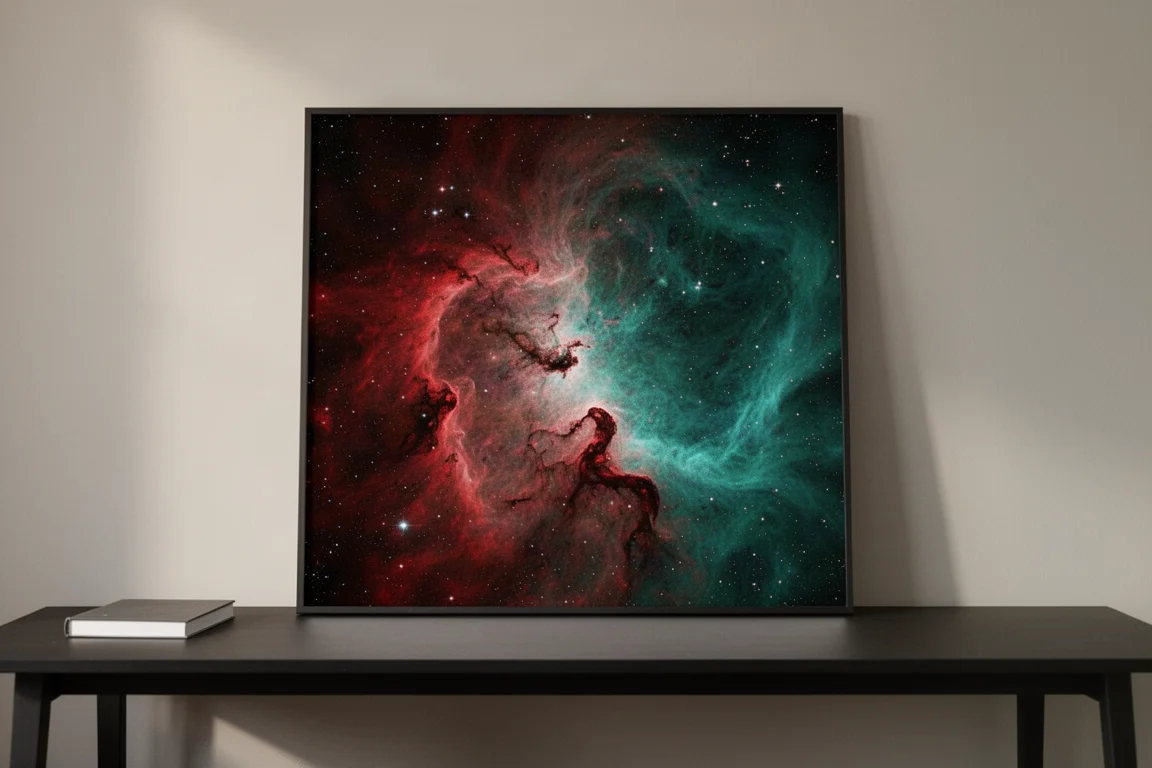
Corner performance on the demanding IMX 455 full-frame sensor with 3.76 micron pixels was very good, with only slight elongation in one corner, leaving a bit of room for improvement. A seven-hour image of the Sadr region in H-alpha revealed lots of fine detail and well-shaped stars. The Lion Nebula, captured in seven hours split equally between H-alpha and OIII, pleasantly surprised with background nebulosity appearing after just 3.5 hours of H-alpha, and a tiny planetary nebula in the field rendered nicely thanks to the aperture and small pixels.
With a one-shot color APS-C camera, just three hours of data on the Shark Nebula in Cepheus produced a result that would have taken far longer on a refractor. Going deeper on faint dust objects like LDN 1089 is where this scope truly shines. Early experiments in near-infrared with a small sensor camera also revealed structures hidden behind dark dust, and a quick comet timelapse captured without switching filters or refocusing hints at how well suited the H2’s large aperture and fast focal ratio are to comet hunting.
Who the OCAL H2 Is For
In the market context, the Takahashi Epsilon series steps from 130 mm to 160 mm to 180 mm aperture; at 206 mm, the H2 sits a size class above those. The only other hyperbolic Newtonian with similar specs found in an online search was a telescope by ASA that retailed for roughly double the price and appears to be discontinued. That makes the OCAL H2 a fairly unique offering.
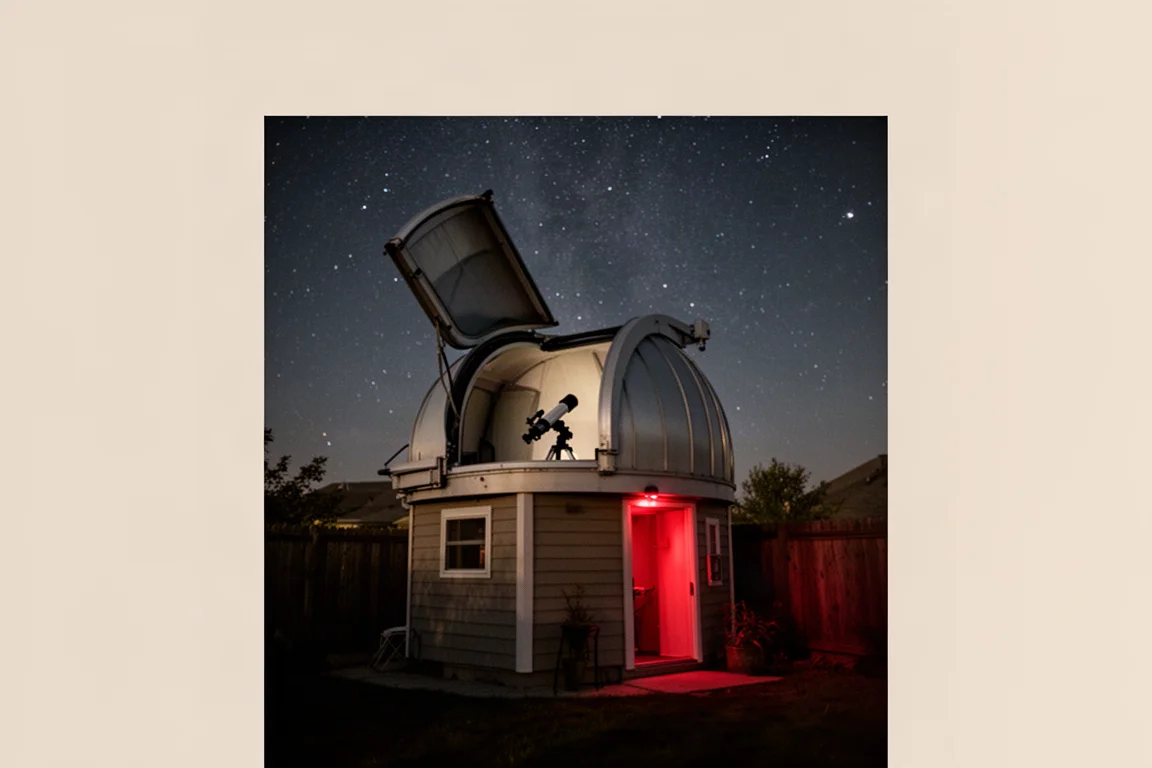
It is not a beginner’s scope, but for an imagers willing to put in the effort, the reward of a big photon bucket is evident in the data and in how quickly a very nice result comes together. The results are genuinely addictive, and the scope encourages going after faint, underloved dust targets that are difficult with slower instruments.
Buying Advice
The target retail price is $5,329, though this may vary by region due to taxes and shipping. The official US distributor is Astroworld Telescopes; in Germany it is Noctutec, and in France it is Optique Unterlinden. Before purchasing, factor in the OCAL 4.0 electronic collimator if it is not already part of the package, and budget time to learn the push-pull collimation workflow properly, since that skill is the key to unlocking what this telescope can do.
Conclusion
The OCAL H2 is a demanding but rewarding instrument. Its f/2.72 focal ratio, full-frame corrected field, robust carbon fiber build, effective dew management, and leak-free light path set it apart from typical imaging Newtonians. Collimation takes practice and patience, and the built-in CAA has real limitations. But for advanced astrophotographers chasing faint nebulae and comets with limited clear skies, it delivers results quickly enough to be genuinely transformative, and it occupies a nearly unique position in the current market.
Product link
View more details for OCAL H2
This product is mentioned in the review. Check the specifications, options, and compatibility before buying.
View more details for OCAL H2Further reading
Related Reviews
Astrophotography
ASKAR FRA400C Review: A Versatile 400mm Refractor for Astrophotography and More
The ASKAR FRA400C is a compact 72mm refractor that balances reach, versatility, and portability for astrophotographers and visual observers.
Astrophotography
Askar SQA106 Review: A Premium 106mm Astrograph With Exceptional Optics
The Askar SQA106 is a premium 106mm quintuplet astrograph with impressive sharpness across full-frame sensors, though its price and weight demand careful consideration.
Astrophotography
Astro Imaging Gear 2026: Eight New Products Worth Watching
A look at the most interesting new astrophotography and astronomy products announced this year, from fast telescopes to smart cameras and wireless accessories.