Bookshelf Speakers
NEUMI BS5 vs Sony SS-CS5: Which Budget Bookshelf Speaker Is Worth Buying?
A practical comparison of two budget passive bookshelf speakers, covering bass extension, linearity, sensitivity, and placement before you buy.
Introduction
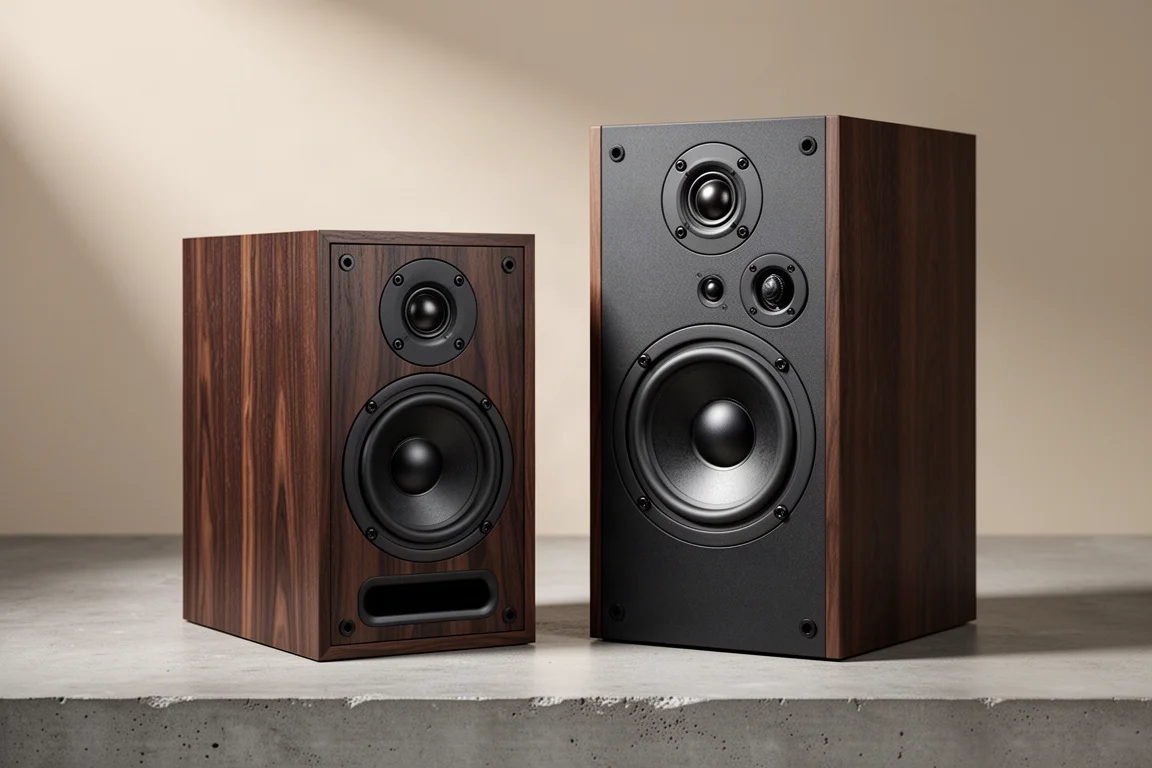
Budget bookshelf speakers are one of the easiest ways into a real two-channel or home theater system, and two models keep surfacing in that conversation: the NEUMI BS5 and the Sony SS-CS5. Both are passive bookshelf designs sold as pairs, both are small enough to sit on a desk or a shelf, and both are priced for people who are watching their spending closely.
They also take noticeably different approaches. The NEUMI BS5 aims for a more linear, more even response with deeper bass. The Sony SS-CS5 leans on a brighter top end and an additional super tweeter. This comparison walks through what each speaker does well, where each one gives something up, and which one makes more sense depending on how you plan to use it.
How These Two Budget Speakers Compare
At a glance the two speakers are more alike than different. Each is a two-way passive bookshelf model with a one-inch dome tweeter and a mid-woofer in the five to five-and-a-quarter-inch range, and each ships with a removable grille. Both are intended to be driven by an AV receiver rather than a separate high-power amplifier, which is exactly how most buyers in this price bracket will use them.
The differences start at the cabinet. The NEUMI BS5 is the smaller of the two in height, and it uses front-firing ports along with a nominal six-ohm rating and a single pair of binding posts on the back. The Sony SS-CS5 uses a rear port and adds a third driver, a super tweeter, above the dome tweeter.
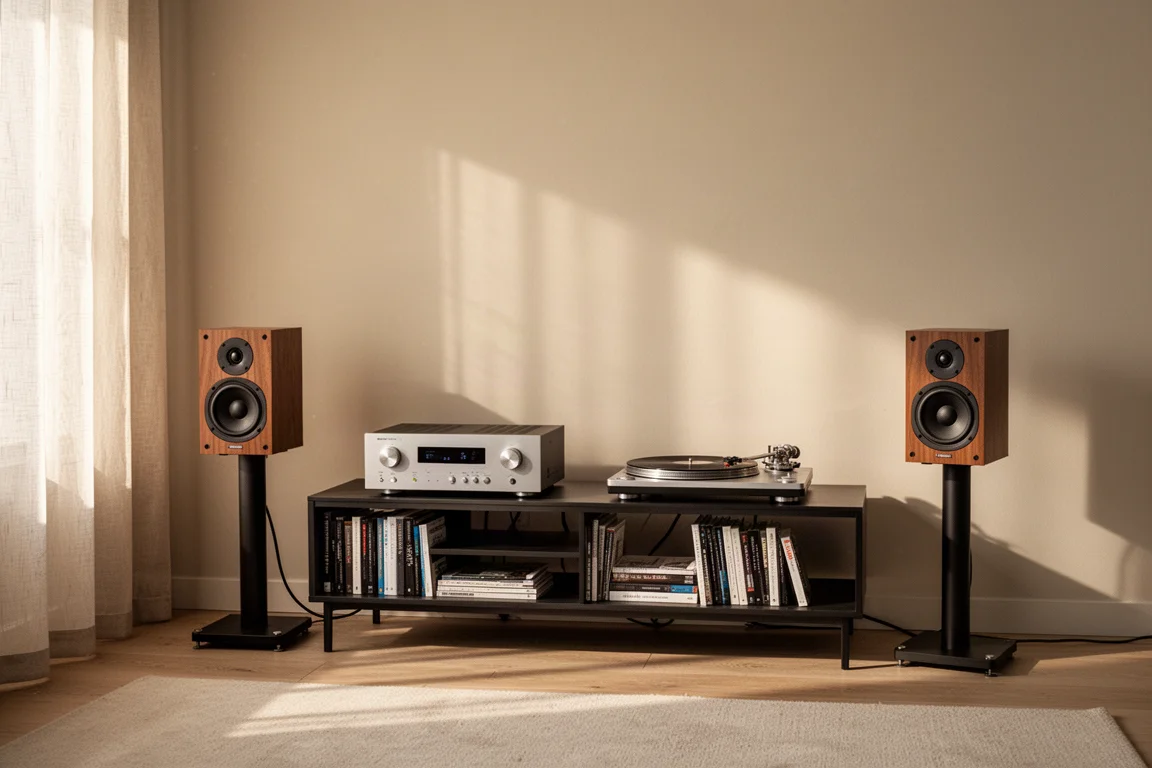
That third driver is worth understanding before you spend anything. A super tweeter is marketed on its ability to reproduce frequencies far above the range of human hearing, and the practical benefit of that is limited. Almost nobody can hear above roughly 20 kHz, and a great many listeners cannot hear anywhere near that high. The useful question is not how high a driver can reach, but whether it integrates cleanly with the rest of the speaker.
NEUMI BS5: More Linear Response, Deeper Bass
The NEUMI BS5 is the more even-tempered of the two. Its on-axis response tracks closer to a straight line across the range, and it produces meaningfully more low-frequency output than the Sony, with a roll-off point that starts roughly 15 Hz lower. In plain terms, the NEUMI plays deeper into the mid-bass, which matters a great deal if you are not planning to add a subwoofer.
Measured data does show one clear weakness: a narrow but deep dip through the midrange, on the order of five decibels, in the region around 1 kHz. It appears to come from cabinet resonances escaping through the front port. Because the problem is a dip rather than a peak, it tends not to present itself as harshness or shoutiness. It may simply leave a little something missing in that band, and it is narrow enough that many listeners will never identify it as a flaw.
Above that region the response looks considerably better, and the small waveguide on the dome tweeter helps keep dispersion reasonably consistent through the treble.
Placement is another point in its favour. Because the port fires forward, the NEUMI BS5 can be pushed closer to a wall without blocking it, and wall placement adds boundary reinforcement that lifts the lower midrange. Stuffing the ports and placing the speaker near a wall produced the most even overall result, smoothing the transition between the midrange and the mid-bass and lifting the region around 300 Hz by roughly 6 dB.
Sony SS-CS5: Brighter Treble, Narrower Dispersion
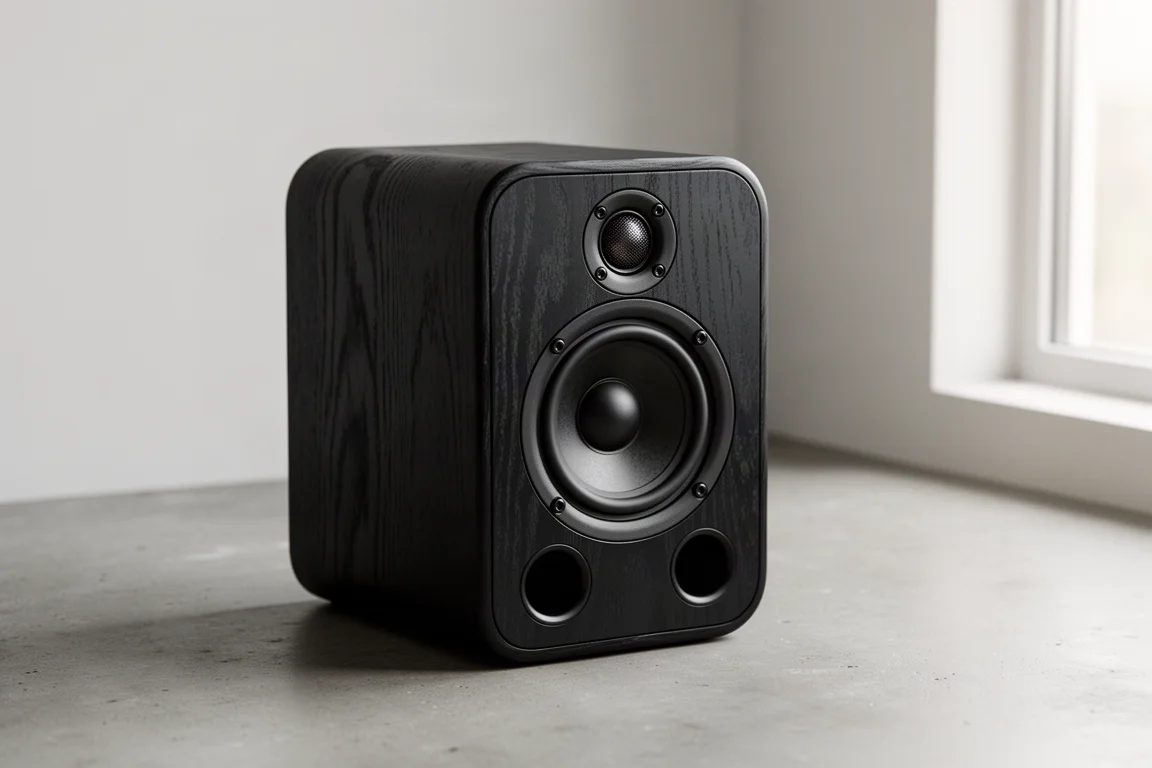
The Sony SS-CS5 has a livelier top end. The super tweeter adds output in the highest octave, roughly from 16 kHz upward, and the speaker as a whole carries a mild treble lift. Listeners who like a bright, detail-forward presentation may find that appealing.
The cost shows up elsewhere. Measured response is less linear than the NEUMI’s, with a dip around 3 kHz and a series of peaks and dips that look like crossover integration issues between the mid-woofer, the tweeter, and the super tweeter. Cabinet resonances are measurable too: accelerometer readings on the cabinet showed ringing around 1.6 kHz on the side panel and a stronger resonance near 1 kHz on the top panel, and those line up with peaks in the response.
Horizontal dispersion is narrower than the NEUMI’s, at roughly plus or minus 40 degrees through the midrange and narrowing further in the treble. A narrower window makes the speaker more sensitive to where you sit and how the room is arranged, which is worth knowing if your seating is off-centre.
The rear port is the other practical limitation. Placing the Sony close to a wall blocks the port and causes the low end to roll off even earlier, so this speaker wants some breathing room behind it. That said, its directivity index is cleaner through the lower range than the NEUMI’s, and the handoff between the tweeter and the super tweeter looks reasonable in the crossover region.
Bass Output, Ports, and Room Placement
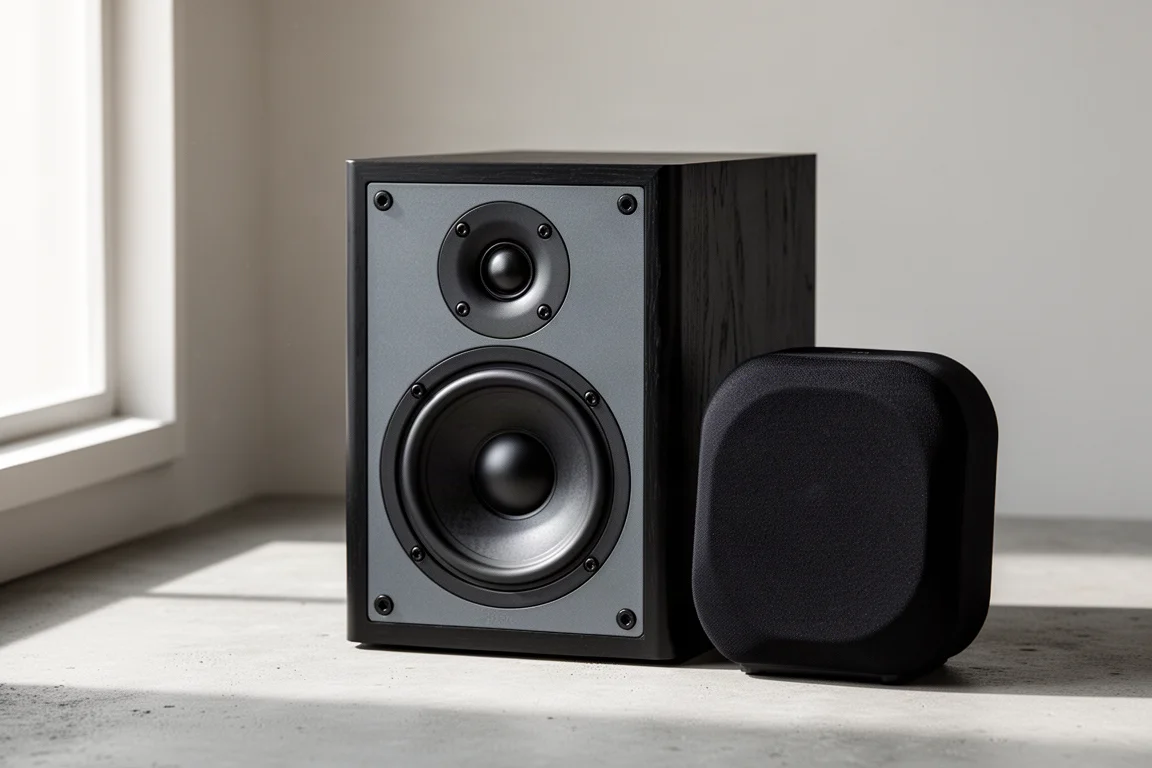
This is where the two speakers diverge most in real rooms. The Sony SS-CS5 begins rolling off around 100 Hz, so it does not deliver much below that point without help. The NEUMI BS5 extends lower, and its front port can be turned to your advantage when the speaker sits near a wall.
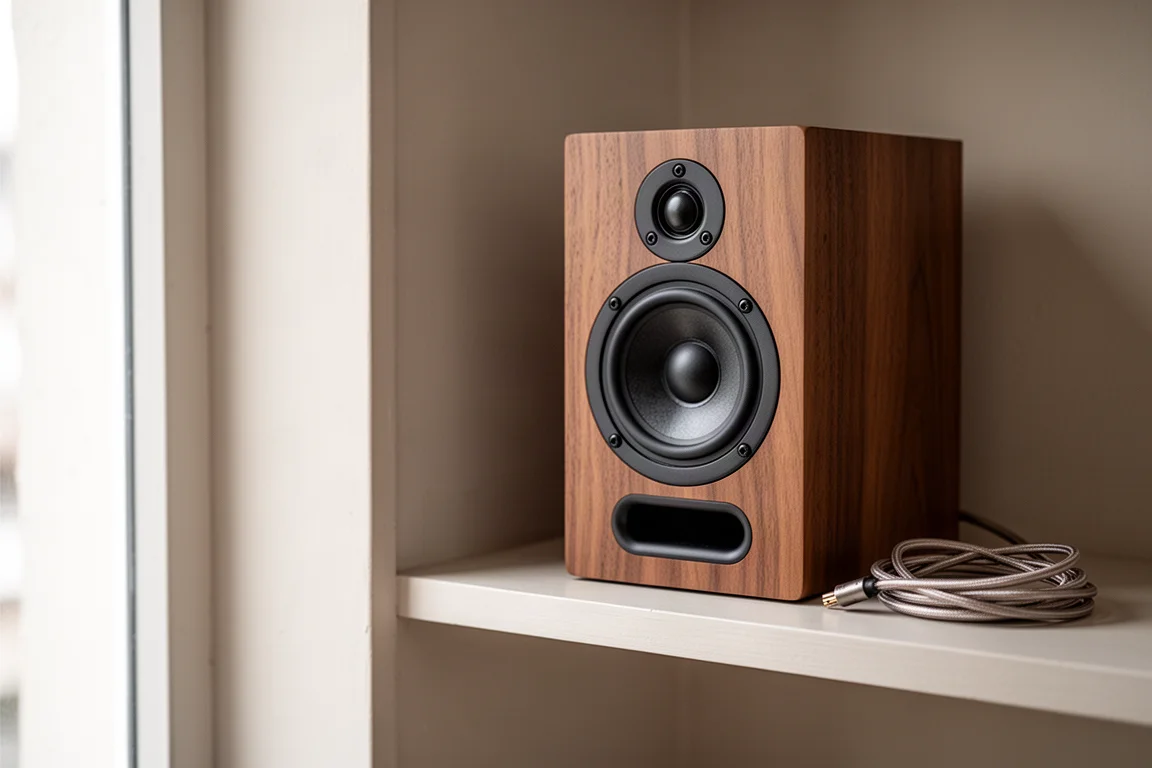
If you plan to run either pair without a subwoofer, that difference is the single biggest factor in the decision. Neither speaker replaces a dedicated subwoofer in a home theater system, and both benefit from a proper crossover when one is added. In a small room with the speakers on a desk or shelf, the NEUMI’s extra reach is the more useful of the two.
Sensitivity, Amplifier Matching, and Cabinet Design
The Sony is the more sensitive of the two, so it will play louder from the same amplifier power. The NEUMI needs a little more level for the same output, though both remain AV-receiver friendly, which is how most buyers will drive them. If your receiver has limited headroom, the Sony’s efficiency is a mild advantage.
Cabinet construction is the other shared theme. Testing on the Sony showed that its resonances originate in the cabinet itself and escape through the rear port, where they appear as boosts rather than dips. The same mechanism, working through a front port, produces the opposite signature: a dip in the response. Neither result is ideal, but the front-port dip is the more forgiving of the two to live with, and stuffing the NEUMI’s ports removes the dip while leaving the underlying cabinet resonance contained inside the enclosure.
Distortion and Dynamic Compression at Higher Volume
At a demanding 96 dB at one meter, the two speakers trade blows on harmonic distortion. The NEUMI loses composure below roughly 80 Hz, while the Sony looks slightly better in the higher frequencies but deteriorates more quickly at the bottom, where its output is already falling away.
Dynamic compression is where the NEUMI pulls ahead. Run at moderate levels of 86 to 96 dB, its output stays comparatively flat and composed. At very high levels around 102 dB it begins shedding output, particularly in the bass, which is expected from a small cabinet. The Sony shows larger swings across the range, with notable deviations around 150 Hz and in the region where the tweeter hands off to the mid-woofer. If you listen loudly, that unevenness is more likely to be audible than the raw distortion figures.
Buying Advice: Which Budget Speaker Should You Choose?
For most buyers, the NEUMI BS5 is the stronger choice. It is the more linear speaker, it plays deeper, and its front port gives it more flexibility about where it can sit. Typical pricing runs around $109 per pair, up from roughly $90 previously, and at that figure it remains one of the better values in budget bookshelf speakers. If you choose it, stuffing the ports and placing the speakers near a wall gives the most even result.
The Sony SS-CS5 still makes sense in specific cases. Its higher sensitivity suits lower-powered receivers, and its brighter top end appeals to listeners who want that presentation. Pricing is the wild card: it has sold for as little as $88 during Black Friday promotions, with typical sale prices around $130. If you find it well below the NEUMI, the gap in measured linearity may be easier to accept.
If the budget allows, a reasonable approach is to try both in your own room and keep the one that suits your space and taste. At this price, room and preference matter more than any single measurement.
Conclusion
Both of these speakers are legitimate entry points into the hobby, and neither is perfect. The NEUMI BS5 wins on linearity, bass extension, and placement flexibility. The Sony SS-CS5 counters with higher sensitivity and a brighter top end, at the cost of a less even response and a rear port that limits where it can sit. Choose the NEUMI if you want the more accurate and more adaptable speaker; choose the Sony if you want the extra efficiency and prefer its livelier treble.
Further reading
Related Reviews
Bookshelf Speakers
Acoustic Energy A100 Mark II Review: A Compact Standmount With an Expansive Soundstage
The Acoustic Energy A100 Mark II brings clarity, natural tonality and a wide soundstage to an entry-level standmount, with a few setup details worth knowing first.
Bookshelf Speakers
Acoustic Energy AE-100 Mark II Review: Compact Bookshelf Speakers With Standout Imaging
A compact British two-way bookshelf speaker with deep, layered imaging, fast bass, and a slight treble lift to weigh against a crowded $500 field.
Bookshelf Speakers
Acoustic Energy AE100 MK2 Review: Measured Performance and Four Alternatives
A close look at the Acoustic Energy AE100 MK2 bookshelf speaker, what its measured performance reveals, and four alternatives with different trade-offs.