Power Amplifiers
NAD Master Series M23 Review: Class D Clarity With Serious Power
A close look at the NAD Master Series M23 power amplifier, from its Class D clarity and bass control to the trade-offs worth weighing before buying.
Introduction
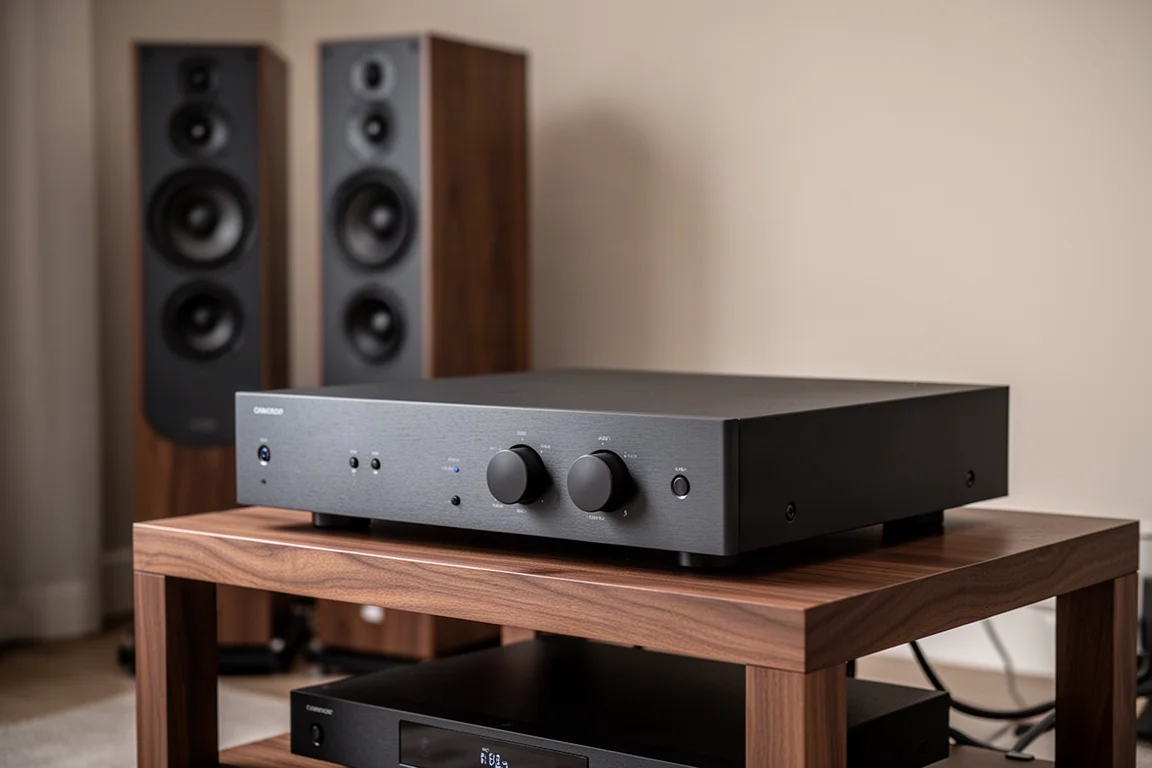
The NAD Master Series M23 is a stereo power amplifier built around Class D modules designed by Bruno Putzeys, and that choice of technology shapes almost everything about how it sounds. On paper it is a powerhouse: 200 watts per channel into 8 ohms, 380 watts per channel into 4 ohms, and 700 watts into 8 ohms when the amplifier is bridged to run as a monoblock. In the United States it sells for $3,749. It is designed in Canada, manufactured in China, and covered by a two-year warranty.
Most listening sessions never come close to using all of that output, but the headroom is reassuring to have in reserve. What registers first, though, is not the power. It is the purity and clarity of the sound, which is obvious from the very first notes and does not need a comparison to appreciate.
Who the NAD Master Series M23 Is For
This is an amplifier for listeners who value resolution, transparency and a firmly locked centre image. It suits systems where the speakers are already revealing and where the owner wants to hear deeper into familiar recordings, including the air around individual instruments and the way parts interact inside a dense mix.
It is not a forgiving amplifier, and it does not try to be. Anyone looking for a soft, mellow, warm presentation that smooths over rough recordings will be happier elsewhere. The M23 is built to tell you what is in the recording, and it does that more completely than most amplifiers in its class.
Design, Build, and Connectivity
Build quality is a genuine strength. The chassis feels solid and elegant at the same time, and the small design decisions are unusually well considered. There is no clunky power button; a small black dot on the front panel is a touch-sensitive switch that moves the amplifier in and out of standby. Details like that separate it from the crowd of two-channel power amplifiers.
Gain is more flexible than usual. Most amplifiers have fixed gain, typically around 24 or 25 dB. The M23 offers three switchable levels on the rear panel: 19 dB, 23 dB or 29 dB. The lowest setting, 19 dB, matched the reference system best and was used for listening.
Connectivity follows the same thoughtful approach. Inputs can be single-ended RCA or balanced XLR, and there is a switch for each input type. A bridging switch on the rear panel converts the amplifier into a monoblock.
Main Strengths: Clarity, Transparency, and Bass Control
Listening was carried out with a range of speakers, including the Pure Audio Project Duet 15, the Vandersteen 2Ce Signature III, the Magnepan LRS Plus and the Zu Dirty Weekend Six, fed by a Pass Labs XP-30 preamplifier, a Mola Mola Tambaqui DAC, a Technics SL-1200G turntable and a Parasound JC3+ phono stage. Across all of them, the M23’s transparency held.
With the Vandersteen 2Ce Signature III, the clarity was striking. On David Bowie’s Heroes, a dense mix full of overdubs, it was possible to hear between the instruments and follow how the parts relate to one another. On Bob Dylan’s Planet Waves, a blurry and messy recording from the 1970s, the amplifier still extracted more, and the vocals came across as assured and playful rather than serious.
The Magnepan LRS Plus showed a different facet. These panel speakers float sound in the room and disappear, and the M23 delivered maximum detail and clarity without ever sounding hard. With the Zu Dirty Weekend Six, which uses a 10-inch paper full-range driver running up to about 12 kHz with a super tweeter above it, the amplifier’s strengths offset the speaker’s weaknesses, producing the purest and cleanest presentation that speaker is likely to give.
Bass performance deserves its own note. With large woofers, including the 15-inch driver of the Duet 15 and the 10-inch driver of the Dirty Weekend Six, the M23 controlled cone movement tightly and quickly. Deep bass recordings can genuinely shake the room when the speakers are capable of it. What the amplifier will not do is add fatness or richness: the low end stays clean and a little on the cool side.
How the M23 Compares With Other Amplifiers
On the Pure Audio Project Duet 15, the Pass Labs XA25 makes the speaker sound big, alive and full of dimensionality, with depth, space and good detail resolution. Adding the M23 raised detail resolution a couple of notches and increased transparency noticeably, particularly the texture and clarity in the upper midrange and treble. The trade-off is character, because the M23 does not have the meat-on-the-bones, organic quality the XA25 can produce.
That relationship flipped with the Zu Dirty Weekend Six. There, the M23 locked in and produced a purity and cleanliness the XA25 could not match, and the XA25 sounded softer by comparison. Pairing, in other words, matters as much as the amplifier itself.
A comparison with the Bel Canto C6i integrated amplifier, another Class D design, was closer. On a Paquito D’Rivera big band recording captured in a New York church without dynamic range compression or equalisation, the C6i drove the Dirty Weekend Six with convincing energy and dynamics. Switching to the M23 added a layer of refinement: more of the church acoustic, more air moved by the brass, and a more complete sense of the space.
Things to Consider Before Buying
The bass is tight and fast rather than rich, and listeners who want a fat, warm low end should weigh that carefully. This is also an amplifier that reveals rather than conceals, so poorly recorded material will not be flattered. Speakers that are already bright or forward may not be the best match, while slightly laid-back designs, including panels and full-range drivers, tend to benefit.
Budget is the other consideration. At $3,749 in the USA, with a two-year warranty, the M23 sits firmly in serious two-channel territory, and it makes the most sense in a system where the rest of the chain is already capable of showing what it can do.
Gain matching is worth planning for as well. Having 19 dB, 23 dB and 29 dB available makes it easier to find a setting that suits a given preamplifier, and the bridging option leaves room to add a second unit later for monoblock operation.
Buying Advice
If the priority is transparency, resolution and a locked-in centre image, the M23 is easy to recommend. It is a clean, highly accurate amplifier that gets out of the way and lets recordings speak for themselves, and it will reward a revealing speaker with detail and air that softer amplifiers tend to blur.

The decision really comes down to taste. Listeners who want soft, mellow and forgiving should look elsewhere, because the M23 is not that amplifier and never pretends to be. For everyone else, matching it to a speaker that appreciates clarity is the surest route to a satisfying result.
Conclusion
The NAD Master Series M23 combines substantial power with a level of clarity that is genuinely special. Its build and connectivity are thoughtful, its gain flexibility is unusual at this price, and its bass control is excellent, even if the character leans cool rather than rich. Buy it for transparency and detail, pair it with speakers that share those priorities, and it will show you more of your recordings than you may be used to hearing.
Product link
View more details for NAD Master Series M23
This product is mentioned in the review. Check the specifications, options, and compatibility before buying.
View more details for NAD Master Series M23Further reading
Related Reviews
Power Amplifiers
Advance Paris X-A160 EVO Review: A Focused Power Amplifier Built to Last
A $1,999 stereo power amplifier with selectable class A bias, 160 watts per channel, blue VU meters, and a build designed to be serviced for decades.
Power Amplifiers
Benchmark AHB2 Review: A Compact Power Amplifier Built Around Transparency
A compact reference-oriented power amplifier with THX-patented feed-forward error correction, balanced-only inputs, and the current to drive low-impedance speakers.
Power Amplifiers
Burson Timekeeper 3X GT Review: Class A Character in a Compact Monoblock
A compact flagship monoblock with the first 30 watts in Class A, 110W into 8 ohms, pinpoint imaging, and an unusually large soundstage.