Power Amplifiers
NAD M23 Review: A Compact Class D Amplifier With Reference-Grade Measurements
A two-channel Class D power amplifier that pairs a Purifi Eigentakt module with a NAD-designed switch-mode supply, delivering high power, very low noise, and load-invariant behaviour.
Introduction
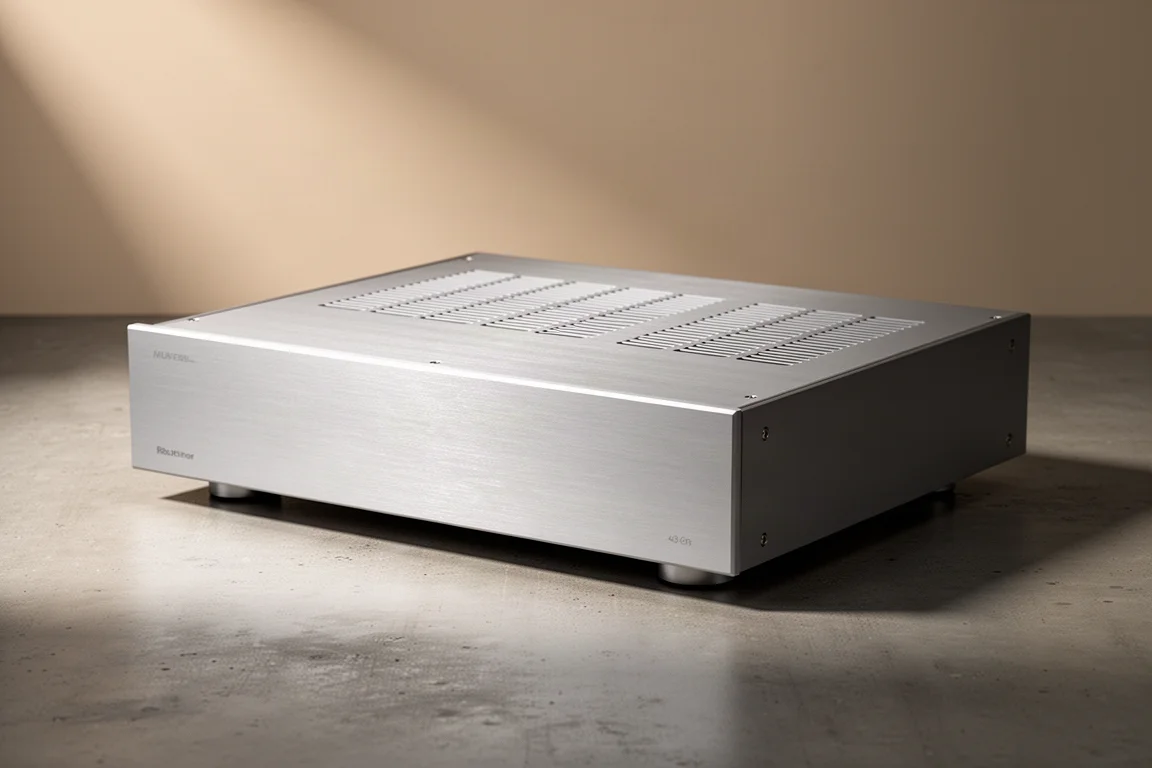
The NAD M23 is a two-channel Class D power amplifier with a retail price of $3,749. It arrives in a compact brushed aluminium chassis that weighs around 21 pounds, which is remarkably light for an amplifier rated at 200 watts per channel into 8 ohms and 380 watts per channel into 4 ohms. In bridged mode, NAD rates it at 700 watts into 8 ohms.
The heart of the design is a Purifi Eigentakt 1ET400A amplifier module, built by NAD to the reference layout, paired with a switch-mode power supply that NAD developed from the ground up. Class D efficiency here runs above 90 percent, and around 95 percent at full load, which is why the M23 does not need the large heatsinks a linear design of comparable output would require. The amplifier runs cool, stays compact, and can be picked up with two hands and moved between rooms or rack shelves without strain.

Three gain settings are available, and the switching frequency sits at 550 kHz, well above the audio band, so the output filter does not interact with the load in the way earlier Class D designs often did. That is the technical foundation behind everything that follows.
Who This Product Is For
The M23 suits listeners who want serious power without the size, heat, and weight of a traditional linear amplifier. Its measured noise floor at one watt is low enough that owners of very high efficiency horn-loaded or compression-driver speakers, including designs with sensitivity in the 90 to 100 dB range or higher, should not hear hiss coming from the amplifier at all. That is a meaningful advantage for anyone who has lived with a noisy amplifier behind sensitive speakers.
It also makes sense for multichannel and immersive system builders. When a room needs many channels of amplification, a compact high-efficiency module is far easier to house than a bank of heavy linear amplifiers, and the M23 points clearly in that direction.
Finally, it is aimed at two-channel listeners who already own a clean preamplifier or an AV receiver with solid pre-outs. This is a power amplifier, so the quality of what feeds it matters a great deal.
Main Strengths
The most striking engineering result is load invariance. Frequency response was measured with no load, into 8 ohms, and into 4 ohms, and there was no difference at all between the three. Bandwidth extends to 65 kHz. In practice this means the amplifier will sound consistent regardless of which speaker it drives, so buyers do not need to worry about matching it to a particular load.
Channel separation is another strong point. Crosstalk measured greater than 84 dB at 20 kHz and 100 dB at one watt, which is close to what you would expect from two separate monoblock amplifiers. That kind of isolation is a good indicator of precise stereo imaging.
Noise performance is excellent. The rated signal-to-noise ratio is 101.7 dB at one watt, and measurement came in about 1 dB better at roughly 103 dB. At full rated power, the figure landed at 126 to 127 dB. For context, most amplifiers measure somewhere between 80 and 90 dB at one watt, and 90 dB is already considered very quiet.
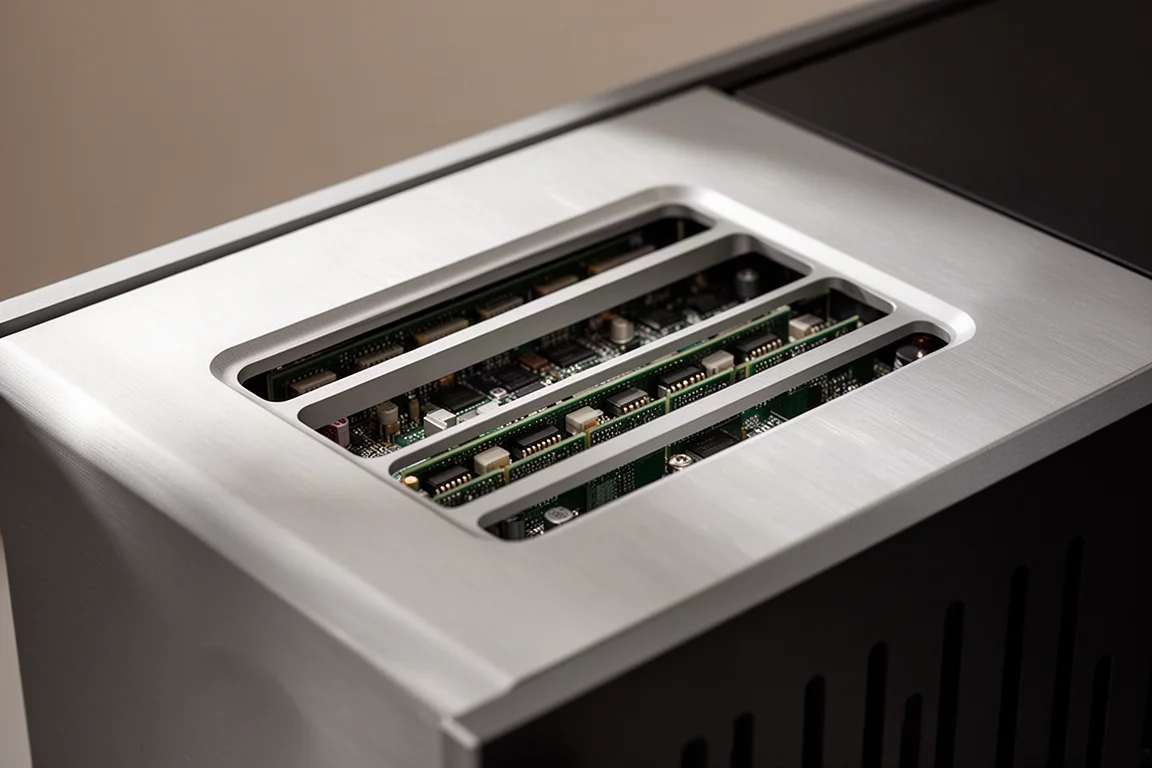
The internal layout supports those numbers. The amplifier modules sit toward the rear of the chassis and couple directly to the output connectors, away from the power supply, which lives on its own daughter board at the front. Capacitors are kept clear of the hottest areas, thick twisted cabling is used where it matters, and there are no bus bars carrying current through the amplifier. A regulated supply delivers more stable current, which helps keep distortion low. On the outside there is a capacitive touch control for power and magnetic feet for the base.
Measured Performance Highlights
At one watt and 1 kHz, harmonic distortion was effectively unmeasurable, sitting at or below the residual noise floor of the test equipment. At the full rated 200 watts, the third-order harmonic measured 113 dB below the fundamental. Distortion spectra of that cleanliness at full output are rare, and the low-frequency region stayed clean as well, with no DC offset and no ground-related artifacts.
Power delivery meets and exceeds the ratings. With both channels driven into 8 ohms, the amplifier produced 240 watts per channel at 0.1 percent THD and 259 watts per channel at 1 percent. Into 4 ohms, it delivered 444 watts per channel at 0.1 percent and 529 watts at 1 percent, comfortably above the 380 watt rating. Distortion at 380 watts measured 0.005 percent.
Across the full audio band, distortion barely rises at full power. Using an AES17 filter at 20 kHz, distortion stayed around 0.005 percent at rated output, and a two-tone test showed distortion products 120 dB or more below the test tones. Dynamic power is close to continuous power: a CA-20 burst measured 460 watts against 444 watts from a continuous sweep. The supply is capable of well over 1,000 watts across two channels, and it makes almost all of that available continuously rather than as a short-term reserve.
Bridged operation produces 900 watts at 0.1 percent and roughly a kilowatt at 1 percent, but SINAD drops from over 100 dB to around 85 dB in that mode.
Setup and Gain Matching
The M23 offers three gain settings, and choosing the right one is the single most useful setup decision an owner will make. With an AV receiver feeding the amplifier, medium gain allows the M23 to reach maximum power at a little over 2 volts of input, which most capable receivers can supply. Some receivers can deliver 4 volts RMS, which leaves comfortable headroom.
With a dedicated two-channel preamplifier and balanced connections, the low or medium setting is the sensible choice. High gain introduces a small noise penalty, and there is little reason to use it unless the source is unusually weak, such as a receiver that only manages around 1 volt RMS. Pairing an amplifier this quiet with a noisy or high-distortion preamp simply masks the performance you paid for.
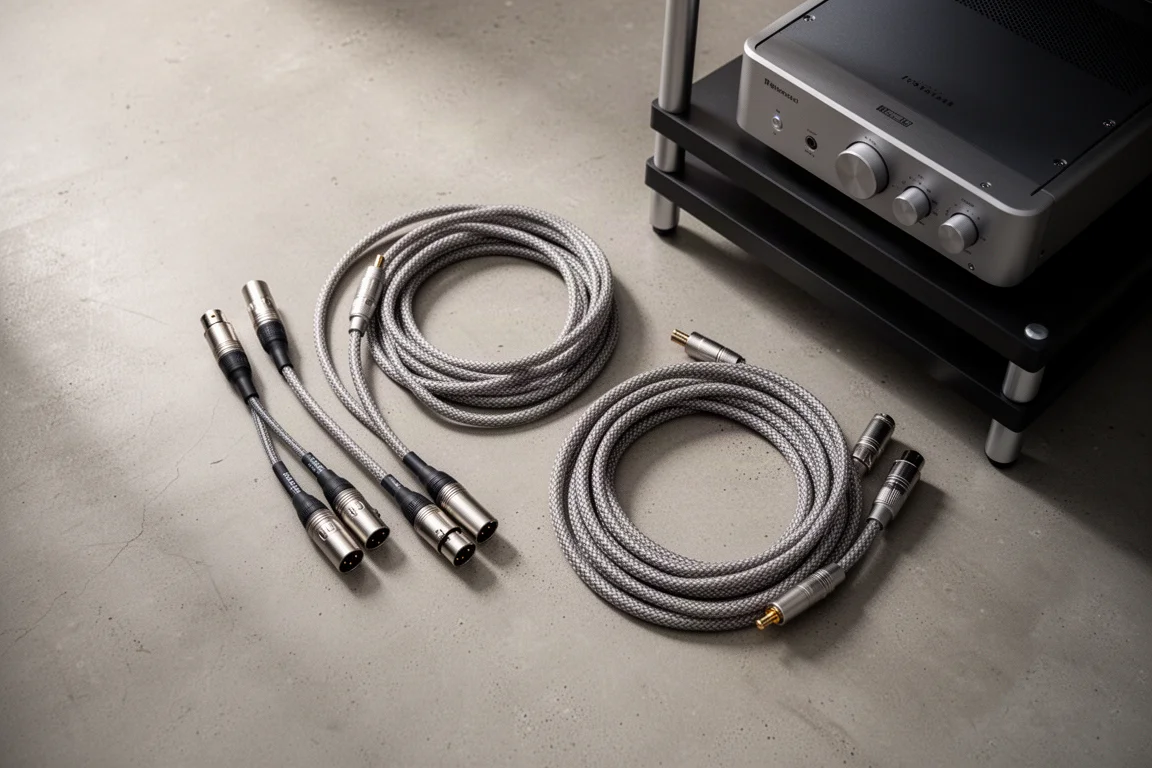
One practical note on placement: the chassis is light and compact enough to sit on a shelf or the top of a rack, and its low heat output means ventilation demands are modest compared with a linear design of similar power.
Things to Consider Before Buying
Bridging is the main caveat. Although the amplifier can be bridged, it is not recommended. Into 4 ohms in bridged mode, the unit shut down under continuous full-load test signals, SINAD fell to around 70 dB, and there was no meaningful power gain beyond roughly 1,100 watts, because the supply cannot deliver the extra current needed to double output into a lower impedance. There is also around eight inches of separation between the positive and negative speaker terminals in bridged mode, which makes it difficult to keep speaker leads close together, and wide spacing raises cable inductance. The feedback loop was not optimised for bridged operation, and doing so would have complicated the design and risked the performance of the normal two-channel mode.
Reliability deserves an honest note. One early sample failed during measurement, with a capacitor inside giving way, and the cause was never confirmed. A second unit then went through several weeks of testing, including sustained maximum output and deliberate short-circuit protection events, without a single fault, shutting down cleanly when protection engaged. That is a single unreproduced incident rather than a pattern, but buyers should know it happened.
Price is the other consideration. At $3,749 this is a premium amplifier, and the value only materialises with a clean preamp and speakers capable of revealing the low noise floor.
Buying Advice
Buy the M23 if you want high power in a small, cool-running, easily moved chassis and you already own electronics that can feed it cleanly. Owners of high-efficiency speakers get the clearest benefit, because the extremely low noise floor at one watt means silence stays silent. Multichannel builders should also take note, since this kind of module is what makes high channel counts practical in a normal room.
Set it up in two-channel mode, leave bridging alone, and start with the medium gain setting if an AV receiver is the source, or low to medium gain with a dedicated preamp. Budget for the rest of the chain as carefully as for the amplifier itself, since a noisy source will undo much of what this design achieves.
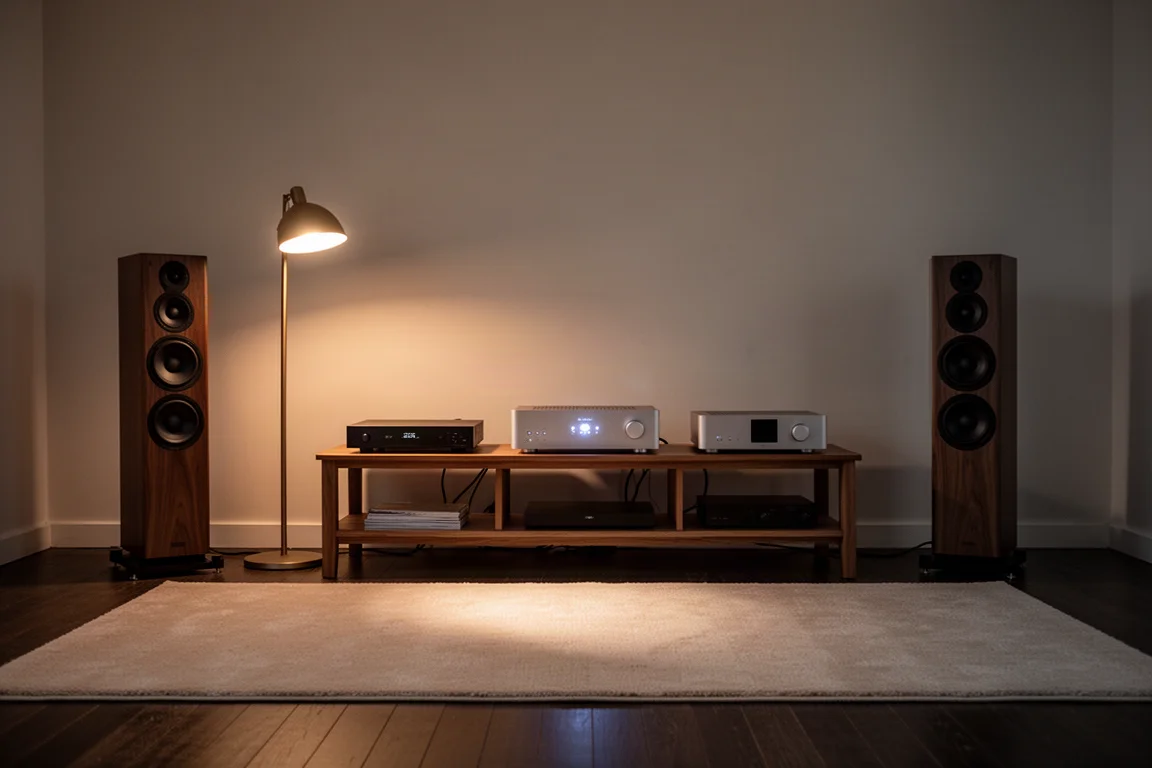
If your priority is maximum watts per dollar, or you specifically need a bridged high-power configuration, other options will serve you better. If your priority is measured performance and a low noise floor in a compact box, the M23 is a strong candidate.
Conclusion
The NAD M23 is a compact two-channel Class D amplifier that combines a Purifi Eigentakt module with a NAD-designed switch-mode supply, and the result is a package that measures exceptionally well across noise, distortion, bandwidth consistency, and channel separation. It meets and exceeds its power ratings into both 8 and 4 ohms, stays cool and light, and behaves the same regardless of the speaker connected to it.
The trade-offs are clear rather than hidden. Bridging is a feature best left unused, one early unit failed during testing without a confirmed cause, and the $3,749 price assumes a system built around it that is clean enough to let its strengths show. For the right two-channel or multichannel setup, those are reasonable conditions to accept.
Product link
View more details for NAD M23
This product is mentioned in the review. Check the specifications, options, and compatibility before buying.
View more details for NAD M23Further reading
Related Reviews
Power Amplifiers
Advance Paris X-A160 EVO Review: A Focused Power Amplifier Built to Last
A $1,999 stereo power amplifier with selectable class A bias, 160 watts per channel, blue VU meters, and a build designed to be serviced for decades.
Power Amplifiers
Benchmark AHB2 Review: A Compact Power Amplifier Built Around Transparency
A compact reference-oriented power amplifier with THX-patented feed-forward error correction, balanced-only inputs, and the current to drive low-impedance speakers.
Power Amplifiers
Burson Timekeeper 3X GT Review: Class A Character in a Compact Monoblock
A compact flagship monoblock with the first 30 watts in Class A, 110W into 8 ohms, pinpoint imaging, and an unusually large soundstage.