Hi-Fi Amplifiers
NAD C 3050 with BluOS Review: Retro Looks With Dirac Live Built In
A classic-styled integrated amplifier with streaming and automatic room correction, tested for noise, power delivery, and real-world low-frequency behaviour.
Introduction
The NAD C 3050 with BluOS is a two-channel integrated amplifier that pairs a vintage-inspired faceplate with modern network streaming and automatic room correction. It sells for around $1,800, while the standard C 3050 without BluOS sits closer to $1,300 or $1,400 depending on where you find it. The difference in price covers two specific additions: built-in BluOS streaming and Dirac Live room correction.
Those two features are the entire reason to choose this version over the base model. BluOS brings network streaming and AirPlay 2 support for Apple Music, while Dirac Live measures the room and applies correction filters to the low frequencies. Everything else, from the power stage to the input roster, is shared with the more affordable model.
This review focuses on how the amplifier behaves in a normal domestic room: how quiet it runs, how it delivers power into real loads, and what Dirac Live actually changes in the bass.
Who This Product Is For
The C 3050 with BluOS suits listeners building a compact two-channel system who would rather keep streaming and room correction inside one chassis than spread them across separate boxes. The phono input, HDMI eARC connection, and subwoofer output mean a turntable, a television, and a subwoofer can all be connected without extra hardware.
It also suits anyone curious about room correction but unwilling to run measurement software on a computer. Calibration happens through an app with on-screen instructions, and it takes little more than a microphone and a few minutes of patience.
It is worth being clear about what this is not. This is a stereo amplifier with no multichannel processing, and the app’s channel options stop at stereo. If surround sound is part of the plan, this is not the component for that job.
Main Strengths
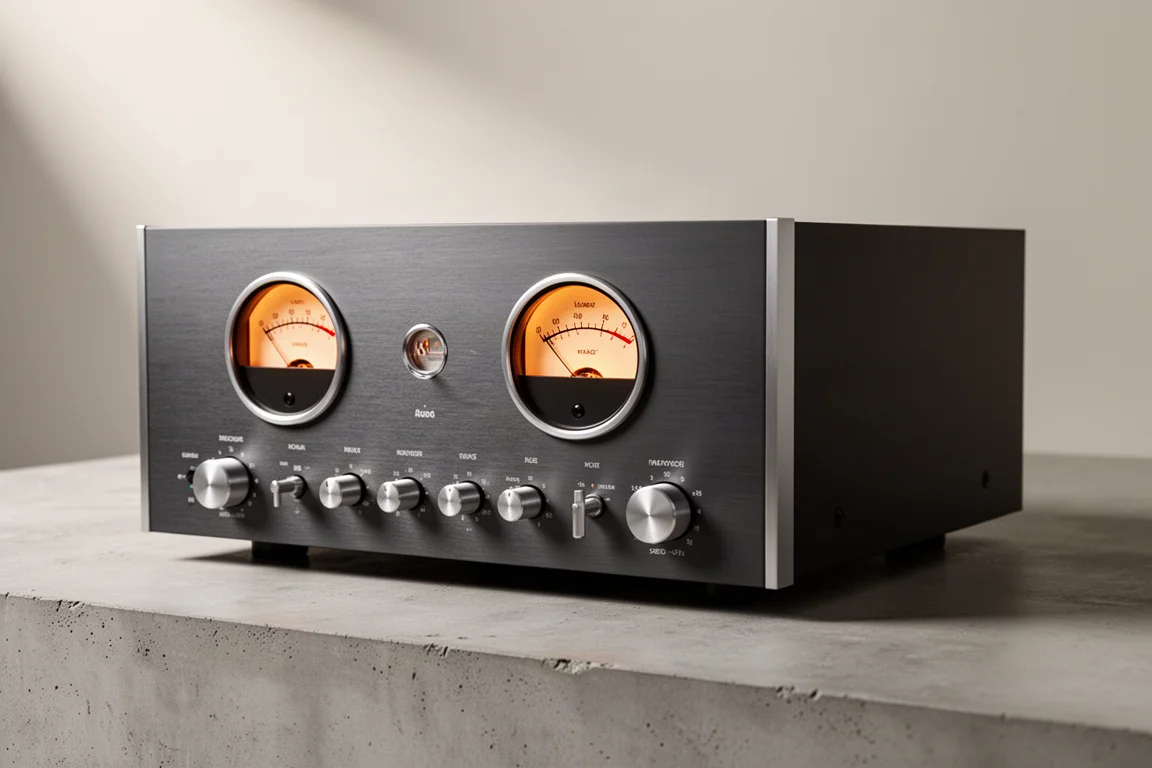
The first thing most people notice is the design. The C 3050 leans into a classic aesthetic with a clean faceplate and a pair of analogue wattage meters that move with the music. It is a rare case of a modern amplifier that looks as good switched off as it does running.
The connectivity is generous for the price. There is HDMI eARC for routing television audio through the system, two digital inputs in optical and coaxial form, stereo RCA line inputs, and a dedicated phono input for a turntable. RCA preouts allow the amplifier to feed a separate power amplifier or a pair of monoblocks, and there is a subwoofer preout for adding a powered sub later.
Subwoofer integration is handled more thoughtfully than usual. Engaging the subwoofer output activates a low-pass filter for the sub and automatically applies a matching high-pass filter to the main speakers, with the crossover frequency adjustable in the app. The two filters move together, so the mains and the sub stay properly blended rather than overlapping.
There are also A and B speaker outputs. One practical use is powering a second pair of speakers elsewhere in the house at the same time. Another is comparing two pairs of speakers directly, connecting both and toggling between them to decide which one suits the room.
Smaller details round out the package: bass and treble controls for gentle tonal adjustment, a dedicated headphone amplifier section, and Bluetooth for quick wireless playback. Running speakers of roughly 85 to 88 dB sensitivity at about 10 feet, there was no audible hiss from the listening position, and none when sitting directly beside the speakers either.
How Dirac Live and BluOS Work Together
Dirac Live is automatic room EQ. A microphone is placed where the app instructs, and the system measures each speaker individually before building a set of filters from the results. Setup follows on-screen guidance and is genuinely straightforward.
On this amplifier, Dirac Live operates from 20 Hz to 500 Hz. That limit is not a shortcut. Below roughly 500 Hz the dimensions of the room dominate what reaches the listener, while above that region the speaker itself is doing most of the work. The transition sits somewhere around 400 to 600 Hz depending on room size, which is why the correction window is drawn where it is.
The app lets you choose how aggressively the correction is applied, and results can be saved as presets and switched between. In a room measuring roughly 18 by 14 by 9 feet, with the listening position about 10 feet back, the uncorrected response showed a peak near 50 Hz and another around 150 to 160 Hz. After correction, each of those peaks came down by roughly 3 dB, which cleaned up the mid-bass noticeably. A room problem can only be corrected so far, but the improvement was real rather than theoretical.
For listeners who want correction above that range as well, a fuller Dirac Live option is available separately. For most rooms, the more sensible approach is to choose a good pair of speakers, let the speakers define the character above 500 Hz, and let the included correction handle what the room is doing below it.
Power, Measurements, and Real-World Output
The C 3050 is a Class D design rated at 100 watts per channel into both 4 and 8 ohms, with both channels driven simultaneously. It is not rated for 2 ohm loads, and no 2 ohm testing was performed.
Power-versus-distortion measurements put the practical limits higher than the rating suggests, at roughly 130 watts into 8 ohms and about 170 watts into 4 ohms before the amplifier reaches its ceiling. That is useful headroom rather than a headline number, since music only demands those levels in short bursts.
The more revealing test compares single-tone and multi-tone output at the same input voltage. At low level, a single tone produced 1.92 watts and a multi-tone signal produced 1.94 watts. At the top end, a single tone reached the rated 100 watts into 4 ohms while a multi-tone signal delivered 97 to 98 watts. A gap that small indicates the power supply holds up under sustained, complex signals instead of sagging when many frequencies arrive at once.
Frequency response was measured into static 4 ohm and 8 ohm loads as well as two reactive loads that simulate a real loudspeaker. The traces sit almost on top of each other, with deviations on the order of a tenth of a decibel. In practice that means the amplifier does not change its tonal balance when it is asked to drive an awkward load.
Things to Consider Before Buying
Class D amplification still prompts hesitation in some listeners, and it is fair to acknowledge that. The relevant question is not the amplifier class but the execution, and here the execution is clean: no audible noise floor with typical speakers, stable response across different loads, and power delivery that meets its rating.
The absence of a 2 ohm rating is worth noting. Speakers that dip well below 4 ohms are outside what this amplifier is specified to handle, so check the impedance curve of your speakers if they are known to be demanding.
Dirac Live is capped at 500 Hz on this model. Anyone who wants full-range correction will need to budget for the optional upgrade rather than assuming it is included.
Output is 100 watts per channel. That is ample for most domestic rooms and listening distances, and it drove several pairs of speakers with sensitivities between 85 and 88 dB to levels well beyond what was comfortable. In a much larger room, at a long listening distance, or for listeners who routinely want very high playback levels, more power may be preferable.
Finally, the app’s channel handling stays within stereo. There is stereo and mono operation with some mixing flexibility, but nothing beyond two channels.
Buying Advice
The honest calculation comes down to whether you want streaming and room correction in the same box. If you are assembling a two-channel system and your room has audible bass problems, which most rooms do, the extra spend is easy to justify. Dirac Live is the feature that changes how the system sounds in the room, and it is the part most listeners would not want to give up once they have heard it.

A word on equalisation: purists often resist it, but low-frequency correction is a different matter from tone-shaping the whole range. Leave the midrange and treble to the speakers, and let the correction handle what the room is damaging in the bass.
If you already own a separate streamer and have no interest in room correction, the standard C 3050 saves a few hundred dollars and delivers the same amplification. For anyone building a system around this amplifier from scratch, the BluOS version is the one that earns its price.
Conclusion
The NAD C 3050 with BluOS is a well-executed integrated amplifier. It looks distinctive, offers an unusually complete set of inputs and outputs for its class, runs quietly with normal speakers, meets its power rating and then some, and pairs that with streaming and automatic room correction in a single chassis. The 500 Hz limit on Dirac Live is a deliberate engineering choice rather than a compromise, and it addresses the range where rooms cause the most trouble. If you want a classic-looking stereo amplifier with modern room-aware sound, this one is worth serious consideration.
Product link
View more details for NAD C 3050 with BluOS
This product is mentioned in the review. Check the specifications, options, and compatibility before buying.
View more details for NAD C 3050 with BluOSFurther reading
Related Reviews
Hi-Fi Amplifiers
Accuphase E-280 Review: Entry-Level Accuphase With Flagship Attention to Detail
A close look at the Accuphase E-280 integrated amplifier, covering its champagne build, AAVA volume control, sound quality, and the speakers and sources that suit it best.
Hi-Fi Amplifiers
Advance Paris A10 Classic vs Yamaha A-S301: Two Integrated Amplifiers Compared
A practical comparison of a $350 integrated amplifier and a $2,500 reference model, covering the differences that matter and the ones that do not.
Hi-Fi Amplifiers
Affordable Chinese Amplifiers Worth Buying: Five Budget Hi-Fi Amps Compared
A practical look at five affordable amplifiers, what each one does well, and the trade-offs to weigh before you buy.