Hi-Fi Amplifiers
More Angel Preamp and Angel 4 Power Amplifier Review: Transparency First
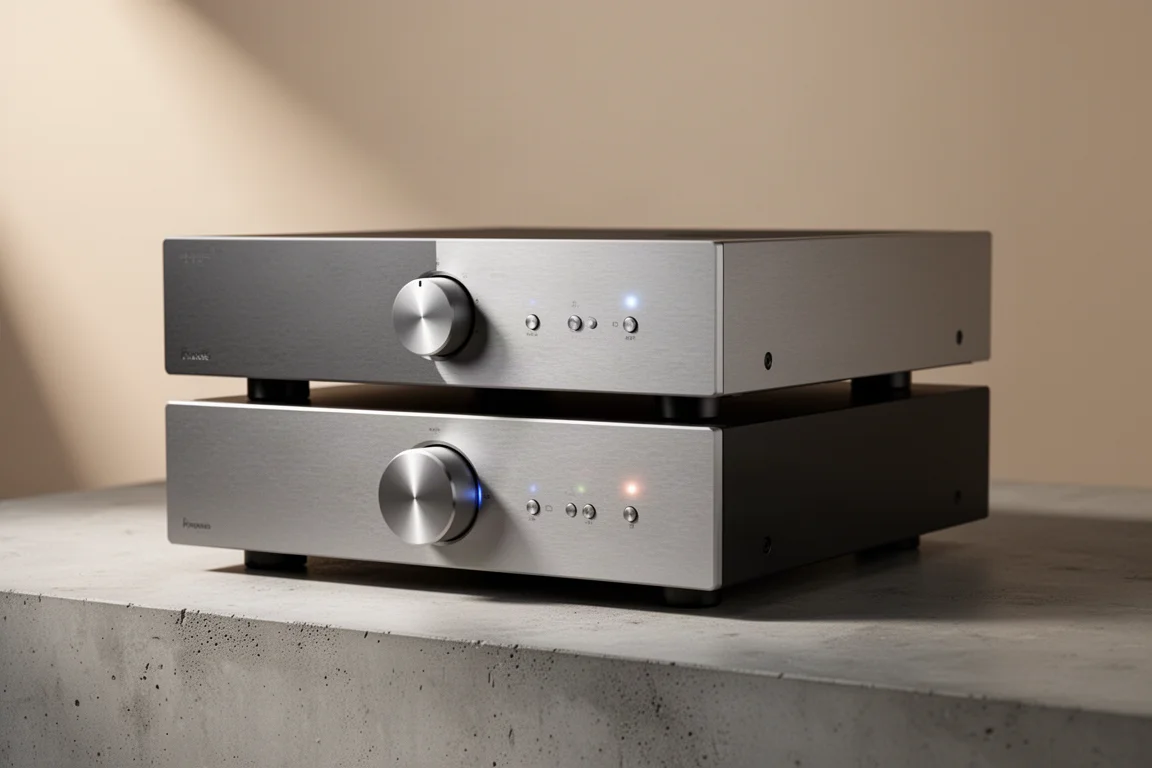
A British pre and power amplifier combination built around low negative feedback, unity gain control and an unusually clean, uncoloured presentation.
Introduction
More Amps is a small British amplifier maker, and the Angel preamp and Angel 4 power amplifier are its two core products. The company was incorporated in 2018 by Tim Larimore, an electronic engineer based in Dorset, England. He began his career in the aerospace industry and spent most of his working life as a software engineer and system integrator in the telecoms industry, while tinkering with amplifier design as a hobby until he felt he had something genuinely worth building. The Angel series takes its name from a favourite demo track by Willie and the Bandits.
The two units are sold separately, at £2,795 for the Angel preamp and £4,995 for the Angel 4 power amplifier. Both are currently available through a small number of dealers in the UK, which makes an audition the sensible first step where one can be arranged.
Why This Pre and Power Combination Stands Out
Low and zero negative feedback designs have a long history in high-end audio. Accuphase has used low feedback circuits since 1999, Luxman’s Z series replaces the X series with an integrated feedback engine system that claims a 50 percent reduction in distortion, and builders such as Dan D’Agostino and Gryphon Audio, whose flagship Apex power amplifier uses zero global negative feedback, have staked their reputations on the approach.
More Amps follows the same path with its own reasoning behind it. After years of experimentation, Tim Larimore concluded that total harmonic distortion figures matter far less than intermodulation distortion, provided THD stays below a sensible threshold. Intermodulation distortion is what appears when two tones pass through a non-linear stage and the output contains extra sum and difference frequencies that were never in the recording.
The design response is to make each stage as linear as possible, in the manner of a valve amplifier. Input and driver stages carry very little excess gain, so they need very little negative feedback to stay in line. The claimed result is a lack of muddiness, stronger dynamics and a more open soundstage.
More Angel Preamp: Unity Gain Control in a Slim Chassis
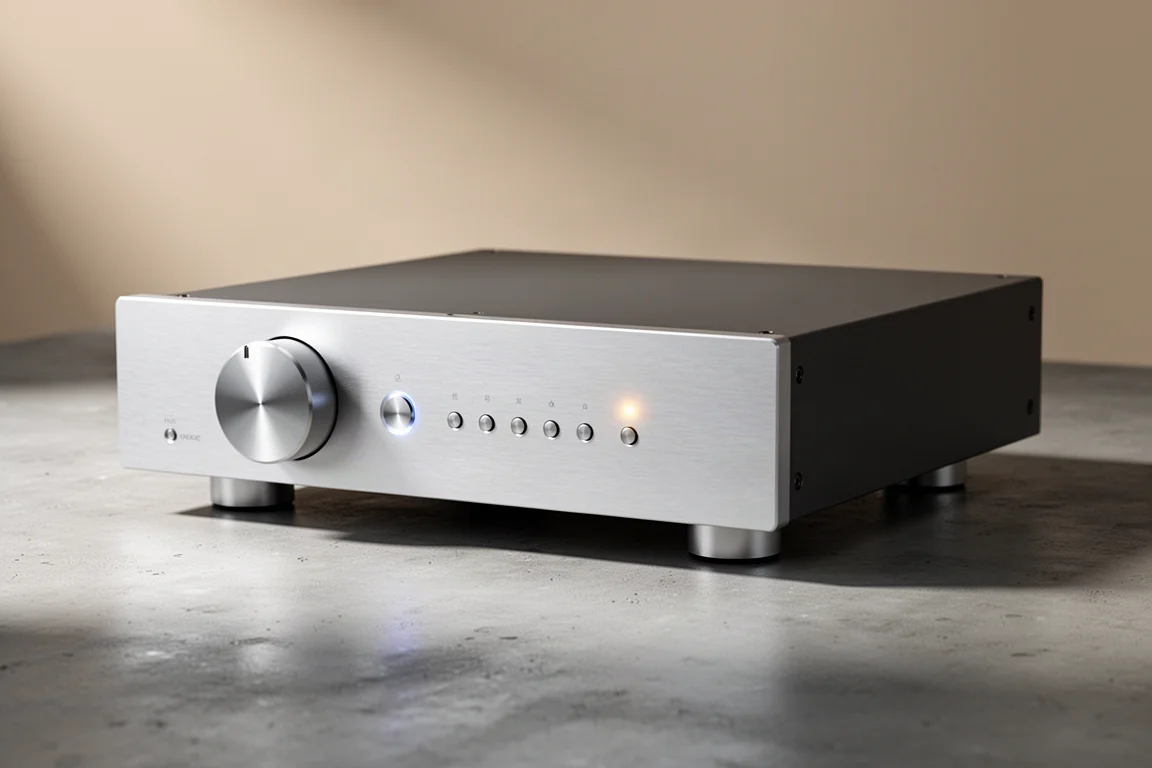
The Angel preamp is a slim, full rack width unit weighing 3 kg. Volume is handled by a motorised Alps attenuator, and because the preamp provides no voltage gain, the dial travels further than most listeners expect. The action is silky smooth and usable across its range, so the adjustment is more a matter of habit than of inconvenience.
A row of buttons beside the illuminated logo selects between four line level inputs, a unity gain input for integrating with an AV system, a tape loop for recording devices, and mute and standby. A billet aluminium remote control is supplied, and it is reassuringly heavy with the essential functions on board.
Around the back there is a switch that moves the preamp between floating and fixed ground to help eliminate ground loops caused by source equipment. A bank of RCA connectors serves the four inputs, the tape loop and the home theatre bypass, while single ended and XLR balanced outputs are provided for connecting different power amplifiers.
Internally, the priorities are a short signal path and good quality parts. The input switching relays use self-wiping contacts that should not degrade over time, and they cost roughly twenty times the price of standard relays. Two independent power supplies keep the digital microprocessor that controls the system logic separate from the analogue audio side, and every stage, including the voltage regulators, runs with low feedback.
One known weakness of passive preamps is that long cables add capacitance, and that capacitance resists the tiny voltage changes in the signal itself. The Angel preamp answers this with an active unity gain output stage, giving it the ability to drive long cable lengths without the loss a purely passive design would suffer.
More Angel 4 Power Amplifier: Class AB With Low Feedback
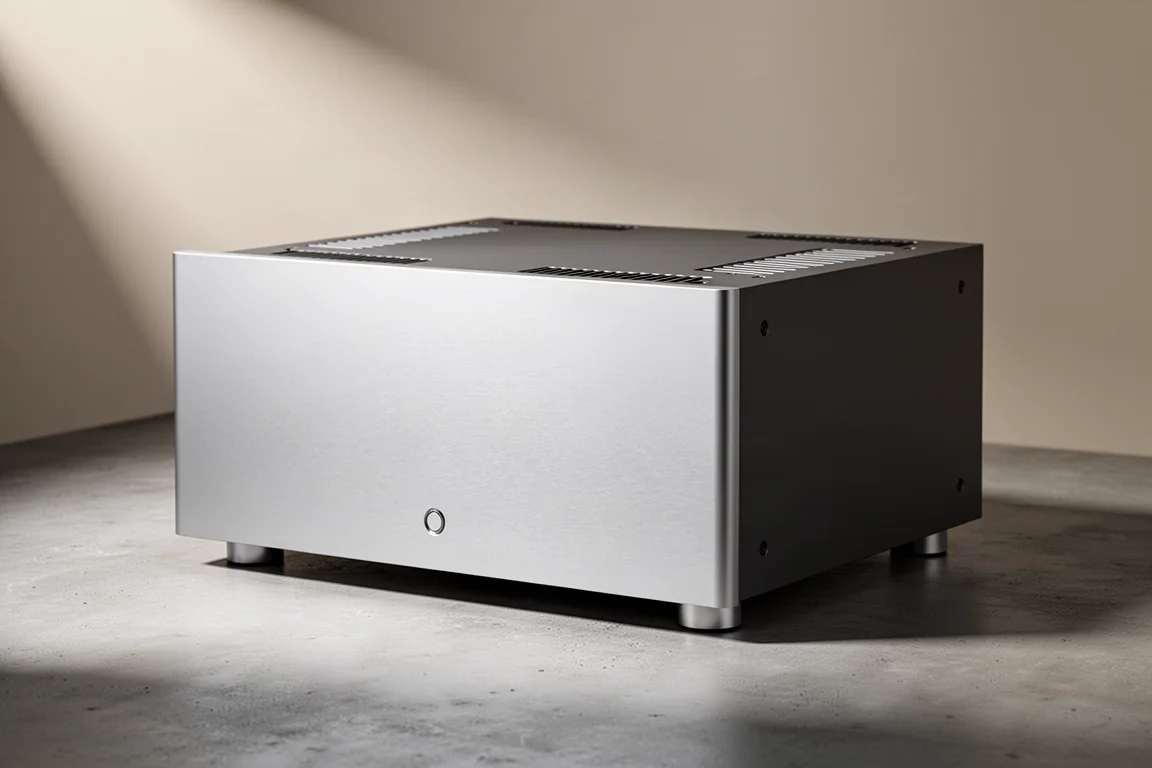
The Angel 4 matches the preamp in width but not in mass, at 18 kg against 3 kg. It is a Class AB design rated at 75 watts into 8 ohms, doubling into 4 ohms.
The rear panel is deliberately sparse. One set of RCA inputs takes the signal in, one set of speaker terminals sends it out, and a trigger cable can be run between the preamp and the power amplifier so both units enter standby together when the remote is used.
The output stage uses four ring emitter transistors per channel, selected for linearity in the crossover region, which is the point where one transistor hands the signal to another and, in most designs, the primary source of intermodulation distortion. Those transistors are intended to hold their linearity even when delivering high current. An optimal biasing circuit monitors and compensates for temperature changes, keeping crossover distortion sustainably low.
Power supply design carries extra weight here because low feedback amplifiers reject supply fluctuations less effectively than high feedback designs, so they demand more of the supply. The Angel 4 uses two banks of capacitors, one to smooth the incoming mains and the other to handle the fluctuations created when current is delivered to the loudspeaker. The aim is a stable reference voltage even as power is drawn.
Sound Quality: Transparency and Control
Transparency is the quality that defines this combination, and it is not a word to use lightly. Detail retrieval is excellent and coloration is remarkably low, so the amplifiers largely step out of the way of the music. Tonally, everything sits where it should.
A jazz recording such as Jimmy Smith’s Midnight Special shows what that means in practice. The organ is precisely placed, the saxophone keeps its timbre and clarity, and the hi-hats fall away naturally. Transient attack, the body of a note and its decay all arrive intact, and vocals are not tripped up either.

Low frequencies are gripped and controlled, though not endlessly forceful. On Hans Zimmer’s Gotham’s Reckoning from The Dark Knight Rises, the big symphonic drums come across as polite rather than physical. The soundstage is deep but could be a little wider, and the contrast between quiet and loud passages could be greater. Listeners who expect dramatic dynamic swings and a kicking bass line from amplifiers at this price should weigh that carefully.
How It Compares With Other Amplifiers
Compared with an integrated amplifier such as the Hegel H190, the More pair will not give you a wider canvas or greater dynamic thrills, but in clarity, control, depth of field and overall musical insight the two are not close. A pre and monoblock set such as the Exposure 21 with 18 Super Monoblocks goes the other way, beating the Angel duo on scale and dynamics, though it is more coloured, and adjusted for inflation that older combination would come out at around £8,000 today. The Burson Soloist 3X GT preamp with Timekeeper 3X GT monoblocks sits at a similar price in the UK and is similarly resolving of detail, with a significantly drier tonality and perhaps a little more dynamic. What the comparisons really show is a consistent pattern: the More amps give away some bass weight and soundstage width in exchange for clarity and a lack of coloration.
System Matching and Speaker Considerations
This pair will expose whatever is upstream of it. A streamer with an upgraded power supply fed the DAC over I2S, with a DDC in the chain.
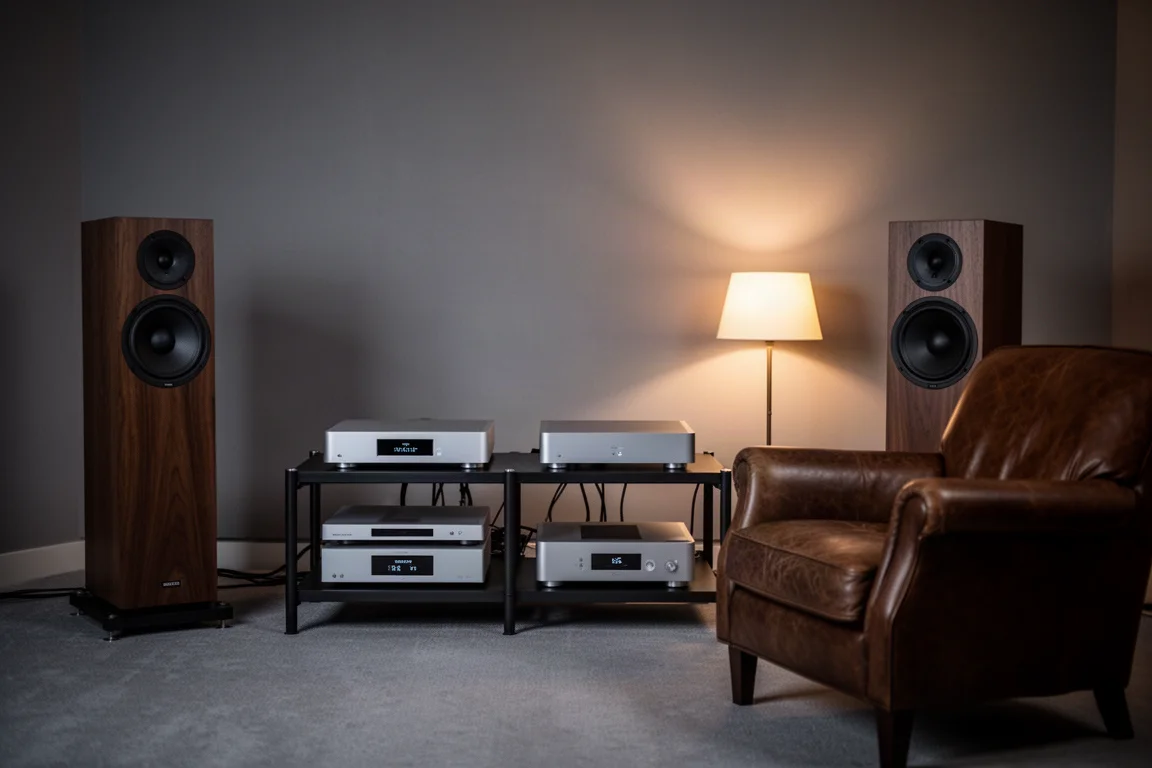
The first speakers tried were capable, affordable floorstanders with tight, agile bass and clean, natural mids, though a little dark on top. They were ultimately not resolving enough to get the best from the Angel preamp and Angel 4. A more revealing reference pair showed what the amplifiers can do through the middle and high frequencies, preserving timbre and detail, but the amps were held back by those speakers’ limits in bass definition.
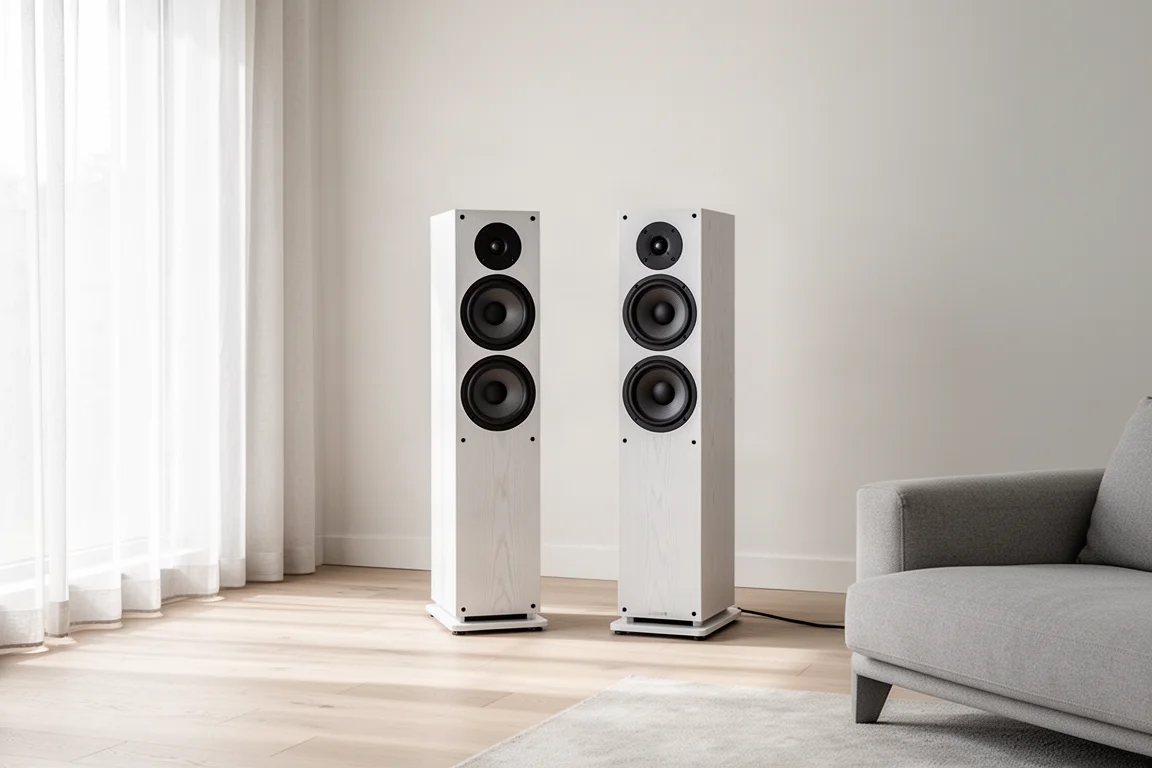
A pair of ATC SCM40s, at roughly twice the price of that reference pair, is a more realistic match. Speakers at that level are where this combination is likely to find a suitable home, and the budget should reflect it: the amplifiers reward a resolving system and give little back to a system that is not.
Buying Advice Before You Commit
The case for this combination is straightforward. If you already own a competent integrated amplifier in the region of £3,000 and want to move up a level or two in clarity, refinement and natural presentation, the Angel preamp and Angel 4 are worth seeking out.
The case against is equally clear. If dynamic scale, bass impact and a wide, dramatic soundstage are what you value most, the More amps are not the obvious choice at this price, and the comparison with the Exposure set above is the reason why.
Availability is the practical hurdle. The amplifiers are sold through a small number of UK dealers, so an audition is the sensible route where one is possible. Buyers elsewhere may have to wait and see whether a distributor picks the brand up in their region, which is a common stage for a young company to pass through.
Conclusion
The Angel preamp and Angel 4 power amplifier make a strong first impression for a young British brand. The transparency, low coloration and control on offer go beyond what most amplifiers at this price deliver, and the engineering behind them is coherent rather than fashionable. They ask for a revealing system and a listener who values refinement over fireworks. Paired with speakers of the right calibre, they are easy to recommend.
Further reading
Related Reviews
Hi-Fi Amplifiers
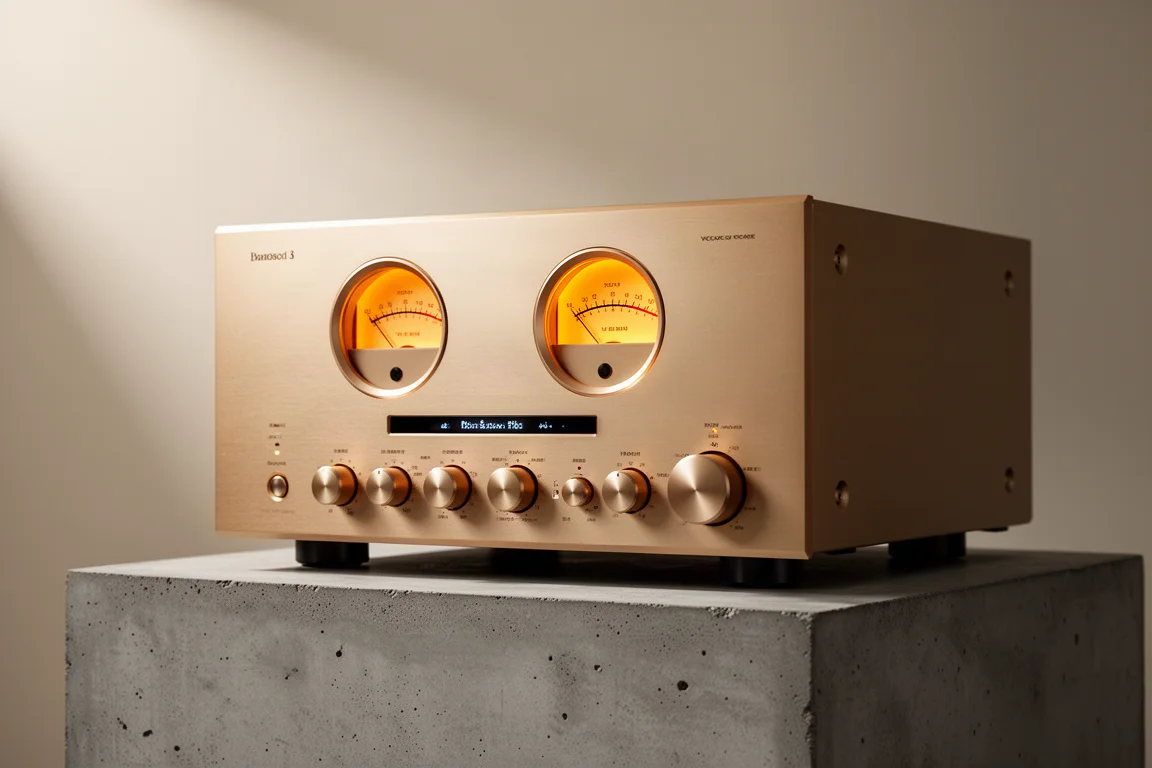
Accuphase E-280 Review: Entry-Level Accuphase With Flagship Attention to Detail
A close look at the Accuphase E-280 integrated amplifier, covering its champagne build, AAVA volume control, sound quality, and the speakers and sources that suit it best.
Hi-Fi Amplifiers
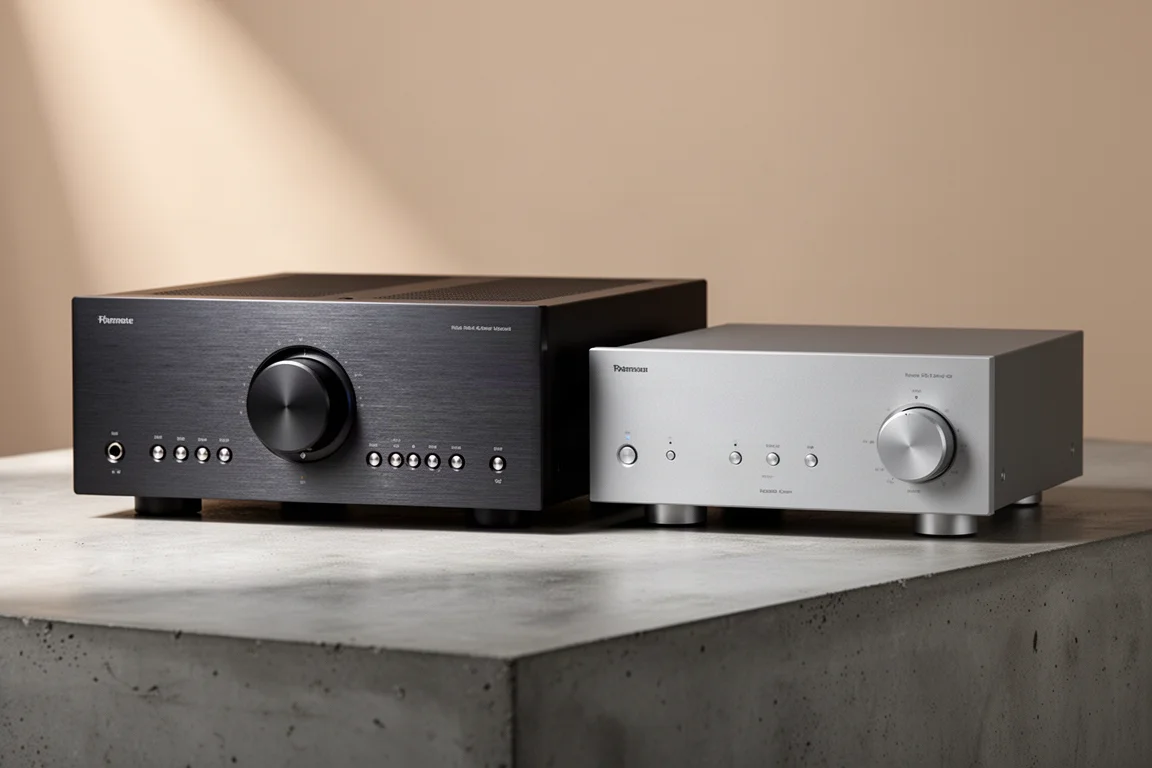
Advance Paris A10 Classic vs Yamaha A-S301: Two Integrated Amplifiers Compared
A practical comparison of a $350 integrated amplifier and a $2,500 reference model, covering the differences that matter and the ones that do not.
Hi-Fi Amplifiers
Affordable Chinese Amplifiers Worth Buying: Five Budget Hi-Fi Amps Compared
A practical look at five affordable amplifiers, what each one does well, and the trade-offs to weigh before you buy.