Bookshelf Speakers
Mookie Three-Way Passive Bookshelf Speaker Review: A Real Three-Way for $75
A compact passive bookshelf speaker with a genuine three-way crossover, impressive vocal clarity, and clear limits on volume and bass.
Introduction
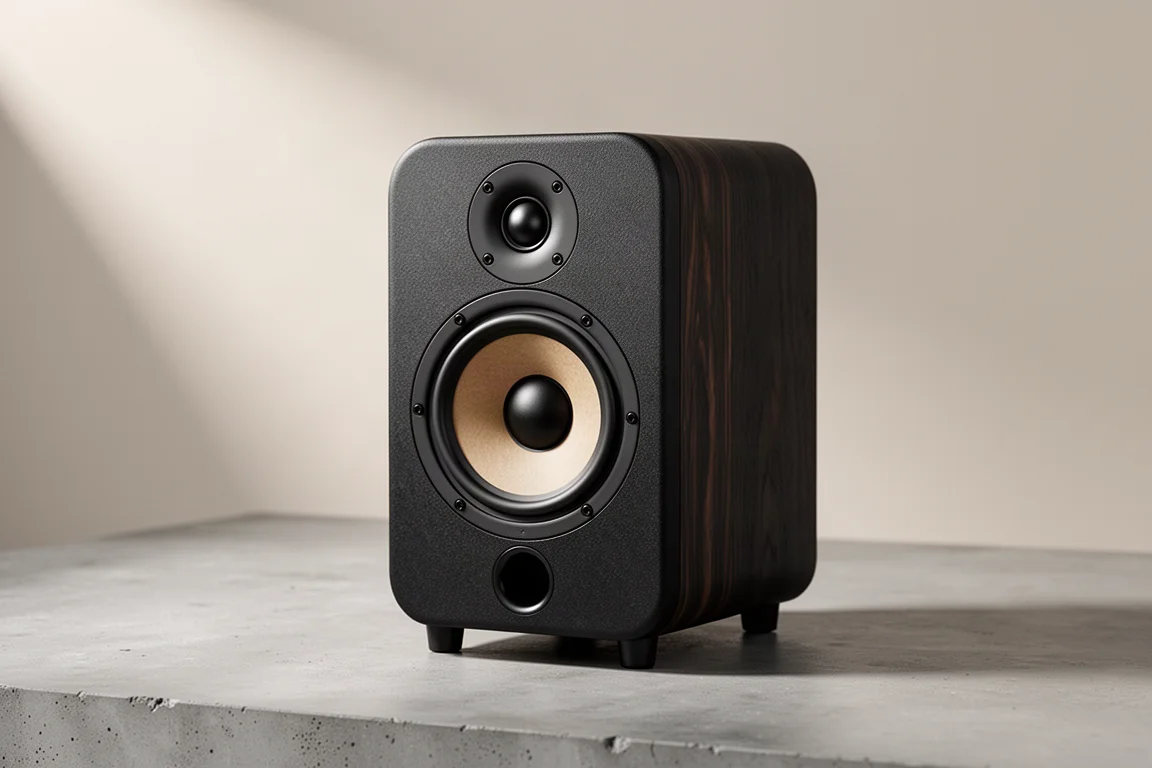
A genuine three-way passive bookshelf speaker for around $75 is a rare thing. At this price, most designs use two drivers and a basic crossover, and plenty use a single full-range driver with no crossover at all. The Mookie three-way passive bookshelf speaker takes a different route: a one-inch soft dome tweeter, a two-inch mid-range driver, and a five-and-a-quarter-inch paper cone woofer, all sharing a compact cabinet with a real crossover dividing the signal between them.
Everything except the tweeter uses paper cones, the cabinet has a front-firing port, and the rear panel carries a keyhole hanger plus a set of small push-type binding posts that accept banana plugs. It is sold as a pair on Amazon, and it is important to note that this is the passive model, not the powered speaker that shares a similar appearance.
Expectations matter here. This is a small, low-sensitivity speaker with clear limits, and it rewards being used in the situations it was designed for rather than being pushed beyond them.
Who this product is for
The Mookie is a small-room speaker, not a main system for a large living room. It makes most sense in a desktop setup, a bedroom, a kitchen, or a compact study where the listening distance is short and the volume stays reasonable.
Because of the keyhole hanger on the back, wall mounting is a genuine option rather than an afterthought. That makes the speaker useful as a surround channel in a home theatre setup, or as a way to keep a desk clear when space is tight.
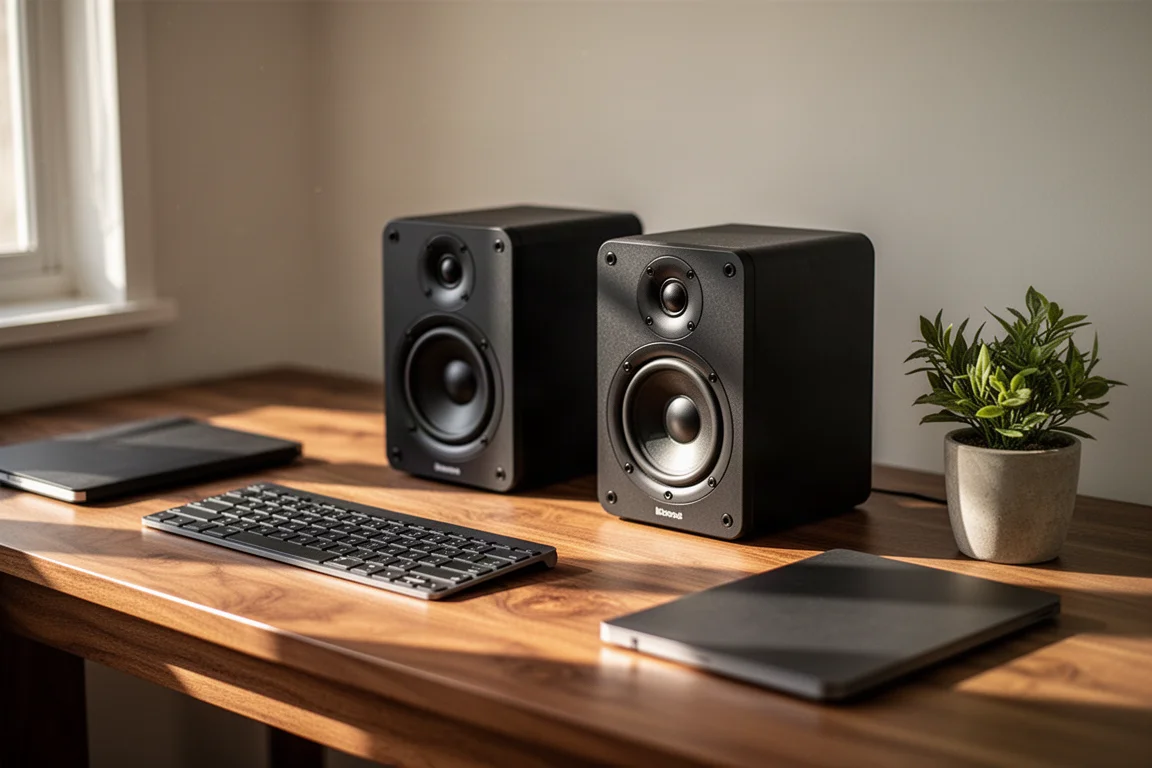
The front port is a meaningful detail for wall mounting. With the port firing forward, the speaker does not rely on space behind the cabinet, so it can sit close to a wall without the bass turning muddy. Even aimed straight out into the room rather than angled inward, the speaker holds a surprisingly stable stereo image.
Main strengths
The first strength is simply that this is a true three-way design with a working crossover. Adjusting tone controls shifts the treble and bass while vocals stay at a consistent level, which shows the mid-range driver is being fed separately rather than running full range. The frequency response also sounds reasonably flat, without an obvious bump in the bass or a rolled-off top end.
Vocal clarity is the standout quality. Male and female voices come through with unusual definition for the price, and quiet details such as breath sounds and room reverb are audible in the mix. Instruments that sit in the mid-range, including acoustic guitar and piano, stay articulate instead of blurring together.
Soundstage and imaging are the second surprise. The mid-range drivers are offset rather than centred, which means there is a distinct left speaker and a distinct right speaker. That asymmetry pays off: a hard left-to-right panning passage moves seamlessly across the space between the speakers, and the centre image locks in tightly. Vocals sit slightly forward of the rest of the stage, which is what you would expect from a dedicated mid-range driver, and they stay there even when the tone controls are adjusted.
Soundstage and imaging in practice
Placement rewards a little care. In an equilateral triangle setup, with the speakers around five feet apart and the listening position about five feet back, the stereo image is convincing and stable. Moving closer to the speakers improves it further rather than collapsing it.
One detail worth noting is image height. Vocals and centre content often appear slightly above the speaker cabinets rather than level with them, which is uncommon at this price and adds a sense of scale to the presentation.
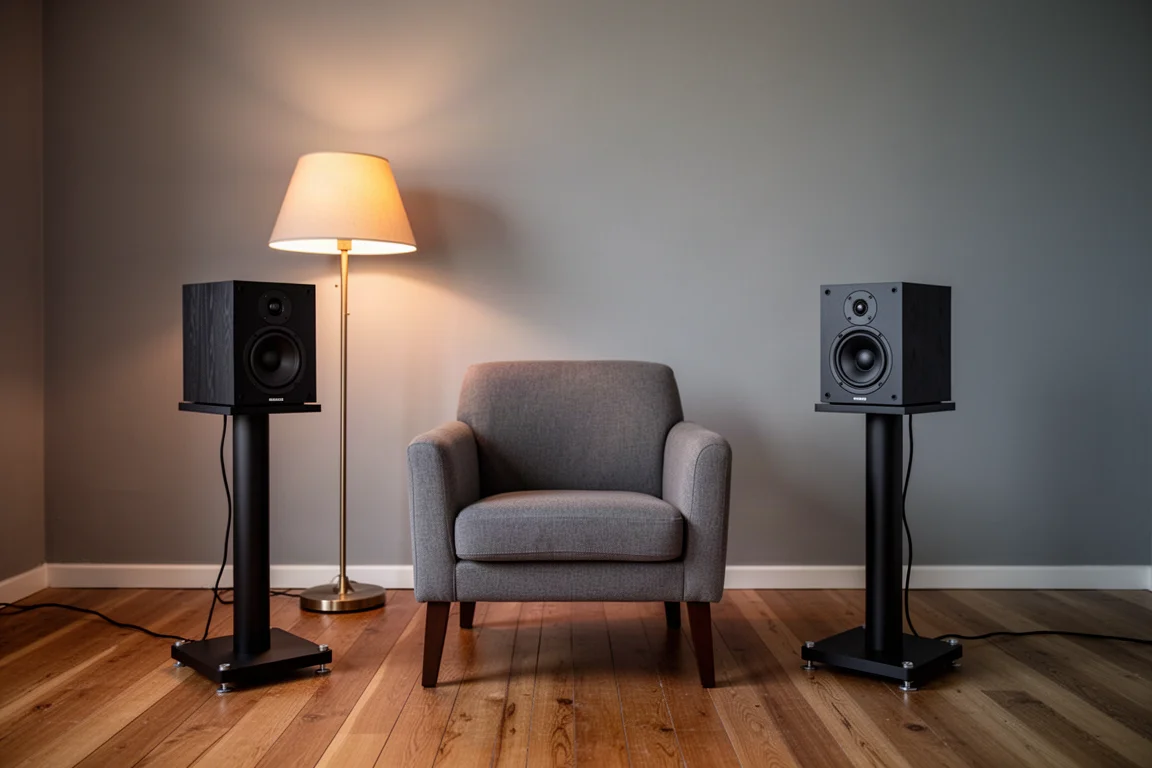
For acoustic music, singer-songwriter material, and anything that benefits from a forward mid-range presentation, this is a remarkably engaging speaker. Dense, dynamic productions are a different story, and that is where the limits begin.
Where the speaker reaches its limits
Sensitivity is rated at 81 dB, which is very low, and it shapes everything about how this speaker should be used. It sounds its best between roughly 70 dB and 80 dB at the listening position. At about 82 dB and above, the presentation starts to fall apart: the mid-range becomes shouty, the treble turns thin, and instrument separation is lost. A brief bass transient that pushes into the mid-80s is tolerable, but sustained levels of 85 dB to 90 dB are not realistic. In fairness, many far more expensive bookshelf speakers also struggle at those levels.
Bass is the second constraint. On large low-frequency hits, the woofer sounds like it is reaching the end of its travel, and the driver’s build quality becomes apparent. This is a speaker that benefits from a subwoofer for bass-heavy material, which is a reasonable expectation at this price.
The cabinet is the third area worth knowing about. Tapping the side panels reveals a slightly hollow character, and boosting the bass with tone controls causes the enclosure to vibrate enough that low frequencies begin to cover the mid-range. Adding internal bracing would help, though it requires opening the cabinet. At moderate volumes and with the bass left flat, this is not an issue.
Finally, treble decay is a little brief. Cymbals are clear but do not hang in the air the way they do on more expensive designs. Squeezing three drivers and a crossover into a cabinet this size involves compromises, and this is one of them.
Things to consider before buying
Amplifier matching matters more than usual because of the 81 dB sensitivity and four-ohm nominal impedance. The speaker needs an amplifier with a neutral presentation. Electronics with a lean, mid-forward character will push an already forward mid-range too far and make the speaker sound harsh.
Neutral class D amplifiers pair well, including the Aiyima DO3, A07, and A08. Warmer or more neutral integrated options also work, and the low sensitivity means the speaker genuinely benefits from the extra headroom that better amplification provides.
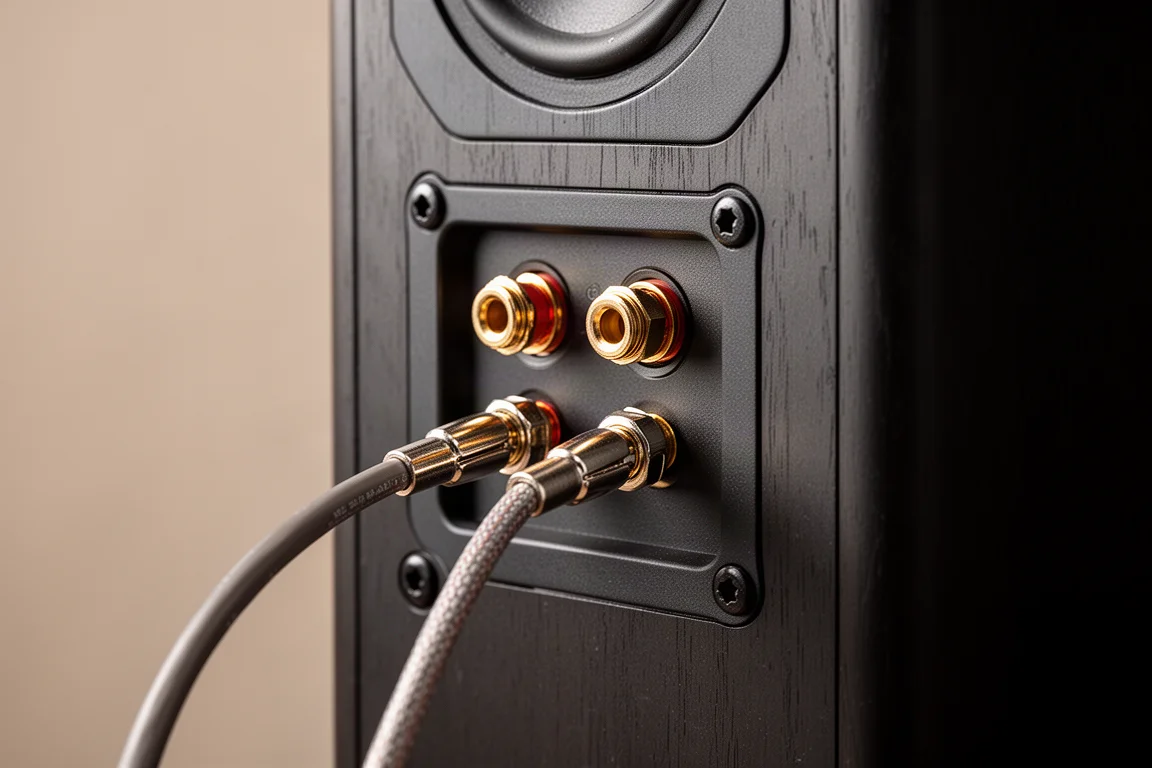
Connections are simple. The push-type binding posts on the back accept banana plugs, and standard speaker cable works fine. If you plan to hang the speakers on a wall and want a small amount of toe-in, a thin rubber bumper on one side of the rear panel is enough to angle the cabinet slightly inward.
Pairing and system building
The Mookie scales with the electronics in front of it. Paired with a higher-quality chain, the clarity and soundstage both improve noticeably. A neutral, clean-sounding amplifier gets the most out of the speaker, while a lean amplifier will expose the forward mid-range and make the presentation harder to live with.
A complete budget system is genuinely achievable. An Aiyima T8 at around $130 works as a DAC, headphone amplifier, and preamp with RCA, coaxial, optical, and USB inputs. An Aiyima A07 speaker amplifier runs about $70 to $80. Together with the Mookie speakers, that is a full setup for under $300. Stepping up to an Aiyima A300 at around $175 with a Geshelli Labs J2 at $250, or $300 with USB, brings a further jump in clarity and stereo imaging.
Buying advice
Buy the Mookie if your listening happens at moderate volumes in a small room, or if you need compact wall-mountable speakers for a desktop or surround setup. Buy it if you listen mostly to acoustic, vocal, and singer-songwriter material, where its mid-range clarity and imaging are genuinely impressive.
Be honest about volume and bass. If you like to listen loud, want deep low-frequency output without a subwoofer, or need a speaker that can fill a large room, this is not the right choice. Rock, metal, and bass-heavy electronic music work at lower volumes, but they will expose the limits of the woofer and the enclosure.
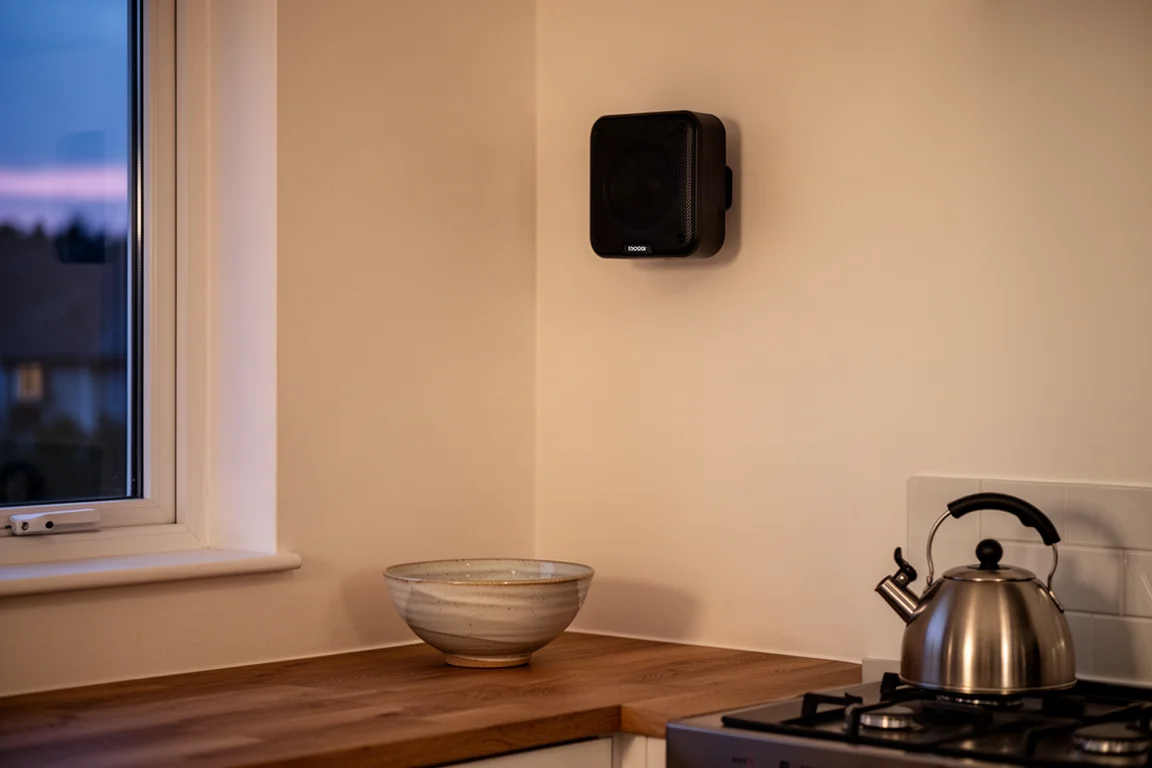
Treat it as a specialist rather than an all-rounder, and it delivers far more than the price suggests. Matching it with a neutral amplifier and keeping expectations aligned with its size is the key to getting the most from it.
Conclusion
The Mookie three-way passive bookshelf speaker is a genuine three-way design with a working crossover, excellent vocal clarity, and stereo imaging that comfortably exceeds its price class. Its constraints are equally clear: very low sensitivity, limited output, modest bass capability, and a cabinet that could use more bracing.
For a desktop system, a small room, or a surround channel, and for listeners who value mid-range clarity over volume, it is an easy recommendation at around $75 a pair. Approached with the right expectations, it is one of the more surprising budget audio purchases available.
Product link
View more details for Mookie Three-Way Passive Bookshelf Speaker
This product is mentioned in the review. Check the specifications, options, and compatibility before buying.
View more details for Mookie Three-Way Passive Bookshelf SpeakerFurther reading
Related Reviews
Bookshelf Speakers
Acoustic Energy A100 Mark II Review: A Compact Standmount With an Expansive Soundstage
The Acoustic Energy A100 Mark II brings clarity, natural tonality and a wide soundstage to an entry-level standmount, with a few setup details worth knowing first.
Bookshelf Speakers
Acoustic Energy AE-100 Mark II Review: Compact Bookshelf Speakers With Standout Imaging
A compact British two-way bookshelf speaker with deep, layered imaging, fast bass, and a slight treble lift to weigh against a crowded $500 field.
Bookshelf Speakers
Acoustic Energy AE100 MK2 Review: Measured Performance and Four Alternatives
A close look at the Acoustic Energy AE100 MK2 bookshelf speaker, what its measured performance reveals, and four alternatives with different trade-offs.