Power Amplifiers
Monoprice Monolith M5100X Review: Five Channels of Class AB Power for $549.99
A five-channel power amplifier with a large toroidal transformer, convenient XLR inputs, and a $549.99 price. Here is what to weigh before buying.
Introduction
Monolith is Monoprice’s premium audio line, and the M5100X is the brand’s five-channel power amplifier. It is rated at 90 watts into 8 ohms with all channels driven, and it sells for $549.99. For home theater owners who want traditional class AB power rather than a stack of compact class D modules, that combination deserves a closer look.
Monoprice backs the amplifier with a three-year warranty and a 45-day return window, so a system builder can try it at home before committing. The remaining question is whether the design and the published specifications hold up against the alternatives in the same price bracket.
What follows covers who the M5100X suits, where it performs well, and which details are worth checking before you order one.
Who This Amplifier Is For
The M5100X is built for five-channel home theater systems, and it can also drive a multi-channel music setup. Monoprice rates it for speakers between 4 and 16 ohms, which covers a wide range of loudspeakers.
It is also a practical choice for anyone whose preamp or processor offers only XLR outputs. The amplifier includes five XLR inputs alongside five RCA inputs, which removes the need for a pile of adapter cables. Monoprice states clearly that these XLR inputs are unbalanced and provided for convenience rather than for a fully balanced signal path.
Main Strengths
Build Quality and Internal Design
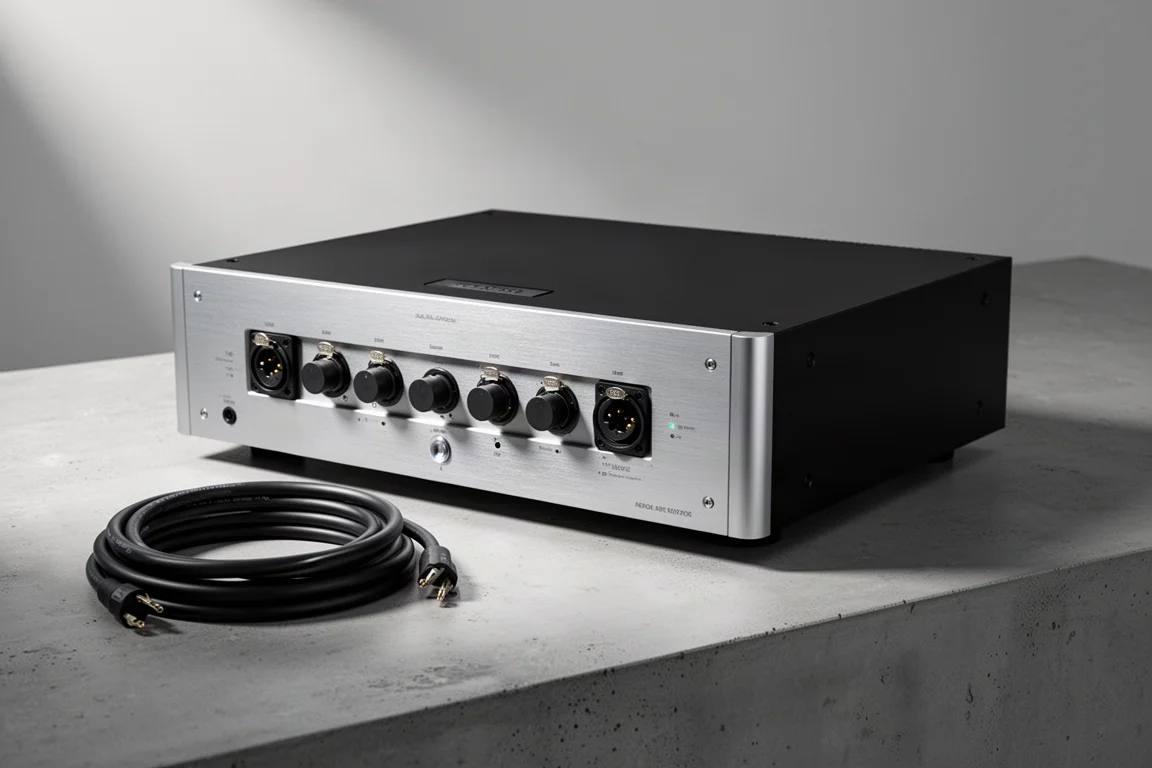
The front plate is brushed aluminium with facets on the left, right, and top edges, and the amplifier rests on four feet. The top panel is fully ventilated, which lets you see the internals. A large toroidal transformer sits in the middle, and it is bigger than the transformer used in the two-channel version of this amplifier. Large capacitors and a modular board layout are also visible, with separate boards serving different sections of the circuit.
At 35.5 pounds the M5100X is not especially heavy for a five-channel design. Two internal fans spin up briefly at power-on, and the chassis measures 21.5 by 19.5 by 9 inches.
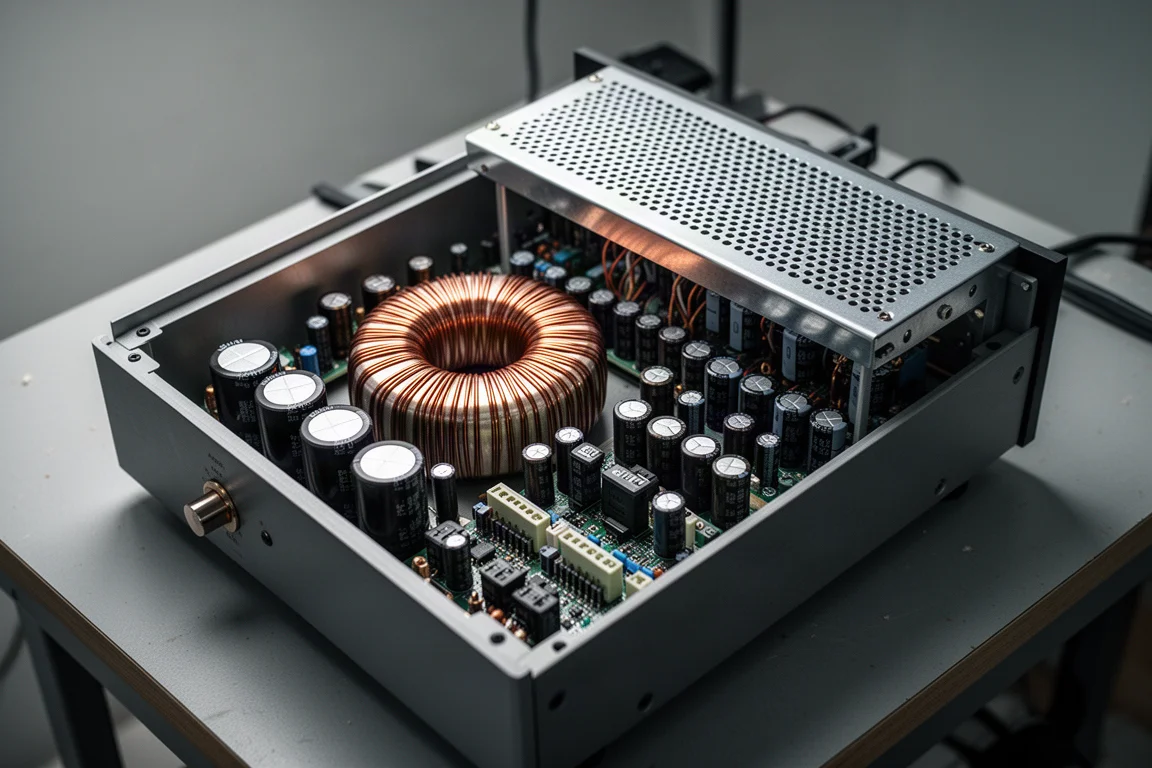
The traditional, processor-free topology is the most interesting part of the design. There is no digital processing stage inside, and that simplicity is generally good news for long-term reliability.
Inputs, Outputs, and Setup
Each of the five channels gets its own RCA input and its own XLR input, arranged in pairs across the rear panel, followed by a red and black pair of five-way binding posts. A 7 to 12 volt trigger input and a 12 volt trigger output sit at the far right, next to a master power toggle and a two-pin IEC power inlet.
The front panel keeps things minimal. A single power button glows red in standby and blue when the amplifier is running. The unit is manufactured in China.
Power and Sound Characteristics
The published figures are straightforward. Full-band output is 90 watts into 8 ohms with all channels driven, and 135 watts into 4 ohms. At 1 kHz the 8 ohm rating rises to 155 watts. Total harmonic distortion is listed at 0.02 percent, A-weighted, with a signal-to-noise ratio greater than 100 dB. Gain is 28.5 dB on the RCA inputs and 28 dB on the XLR inputs, damping is greater than 500, and input impedance is 27 kilo-ohms.
The 4 ohm figure does not double the 8 ohm figure, which some buyers watch closely. In practice, amplifiers with a smaller gap between those numbers can still drive 4 ohm loads without trouble, so the ratio alone is not a reason to walk away.
Listening impressions put the M5100X in familiar territory. Against a considerably more expensive Emotiva XPA Gen 3, the difference came down to low-end weight and dynamics, with the pricier amplifier sounding a little more substantial, while soundstage and center imaging were broadly comparable. Against class D amplification, the M5100X came across as noticeably more dynamic. Nothing stood out as a problem across movies or music.
Things to Consider Before Buying
The XLR inputs are not truly balanced. If a fully balanced signal path matters to your setup, this amplifier does not deliver one, even though it accepts the connector.
Price is the second consideration. The Emotiva BasX A5 lists at $599, about $50 more, with 95 watts into 8 ohms and 130 watts into 4 ohms, the same 0.02 percent distortion figure, a signal-to-noise ratio greater than 116 dB, and 29 dB of gain. Those numbers are close, and regular Emotiva promotions can narrow the price gap further. For buyers who already own Emotiva components and do not need XLR inputs, that path stays competitive.
Two internal fans are also worth knowing about. They spin up at power-on, and in a home theater rack running at normal listening levels they are unlikely to be noticeable.
Buying Advice
If your processor outputs only XLR, the M5100X solves a real inconvenience. It accepts those connections directly, costs $50 less than the closest Emotiva alternative, and removes the need to buy a set of adapter cables.
For everyone else, the decision comes down to ecosystem and price timing. Emotiva builds nothing but hi-fi components and runs frequent promotions, so the two options often land within a few dollars of each other. Monolith has an established reputation in the value hi-fi space, and the three-year warranty plus the 45-day return policy make trying the M5100X a low-risk exercise.
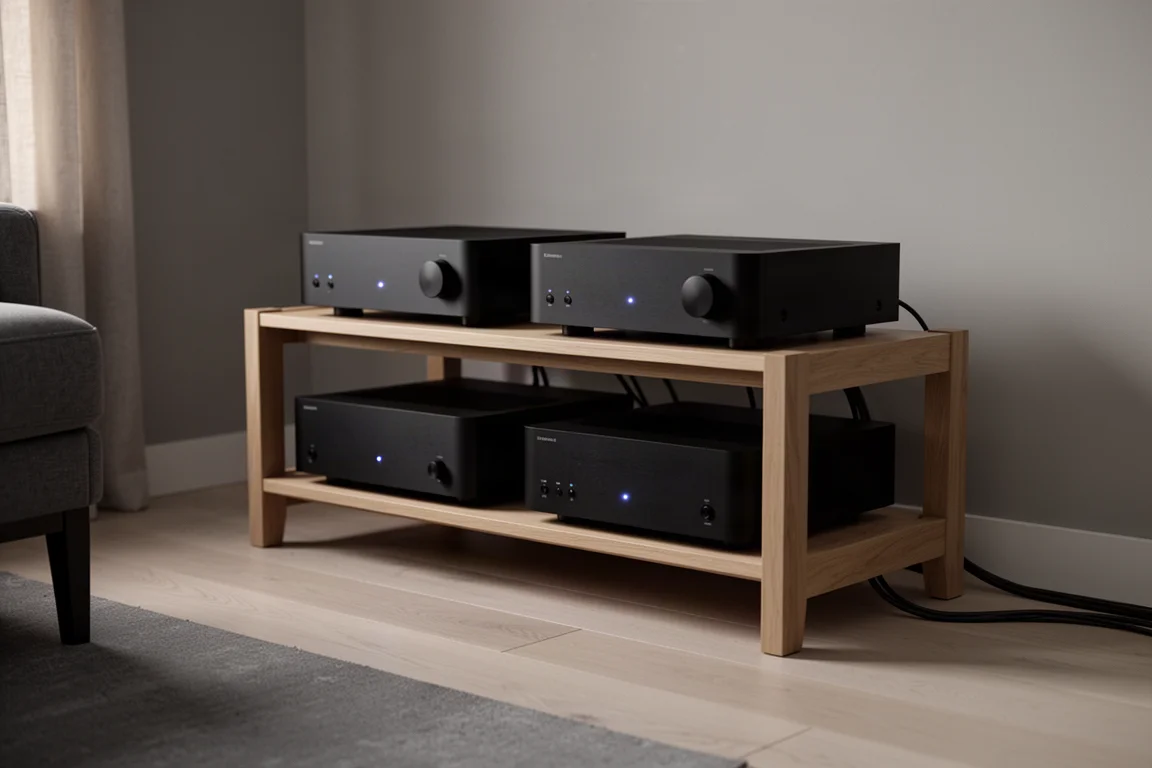
One further point in the amplifier’s favor is longevity. The circuit uses a long-established class AB layout with a toroidal transformer and no digital processing, and that kind of design tends to age well. If a system needs more than five channels, two units cover ten channels for roughly the price of a single high-end multichannel amplifier.
Conclusion
The Monoprice Monolith M5100X delivers five channels of class AB power, a large toroidal transformer, and convenient XLR inputs for $549.99. Its published specifications sit close to the nearest competitor, and its dynamic character gives it an edge over compact class D designs.
Buyers who need XLR connectivity, or who simply want a traditional amplifier without a processing stage inside, will find it easy to justify. Check the current price against Emotiva promotions, and let the return window do the rest.
Product link
View more details for Monoprice Monolith M5100X
This product is mentioned in the review. Check the specifications, options, and compatibility before buying.
View more details for Monoprice Monolith M5100XFurther reading
Related Reviews
Power Amplifiers
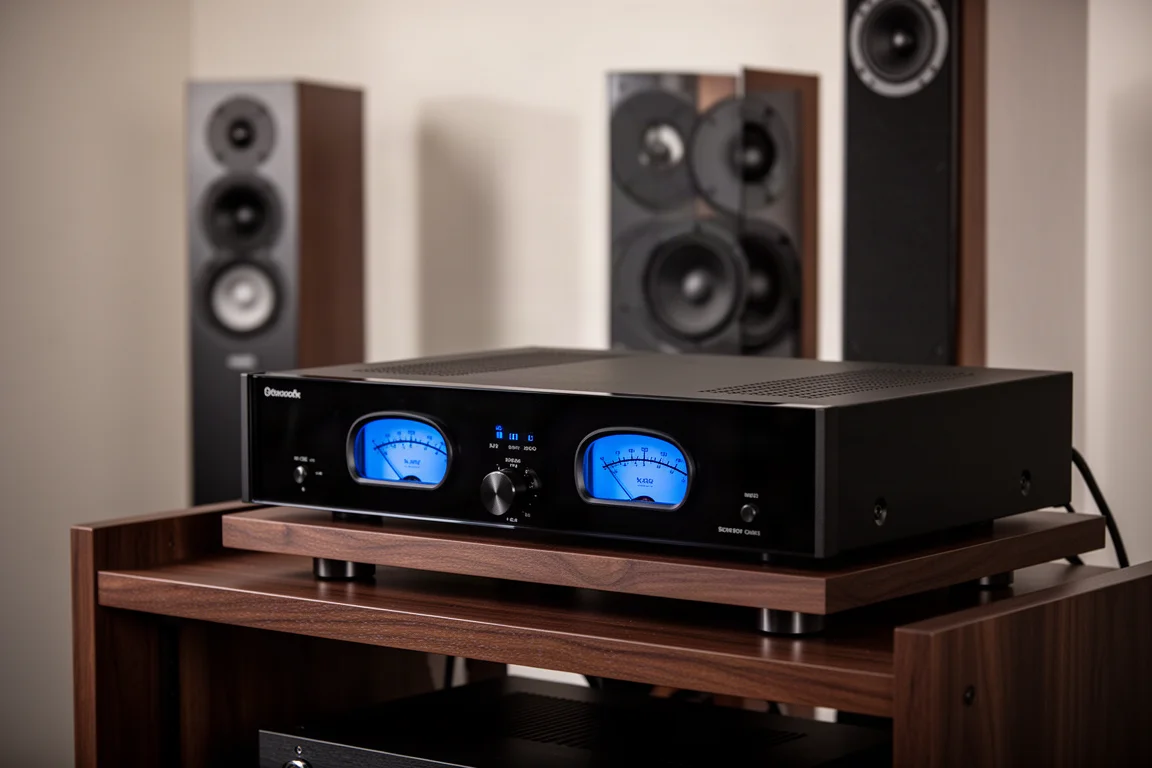
Advance Paris X-A160 EVO Review: A Focused Power Amplifier Built to Last
A $1,999 stereo power amplifier with selectable class A bias, 160 watts per channel, blue VU meters, and a build designed to be serviced for decades.
Power Amplifiers
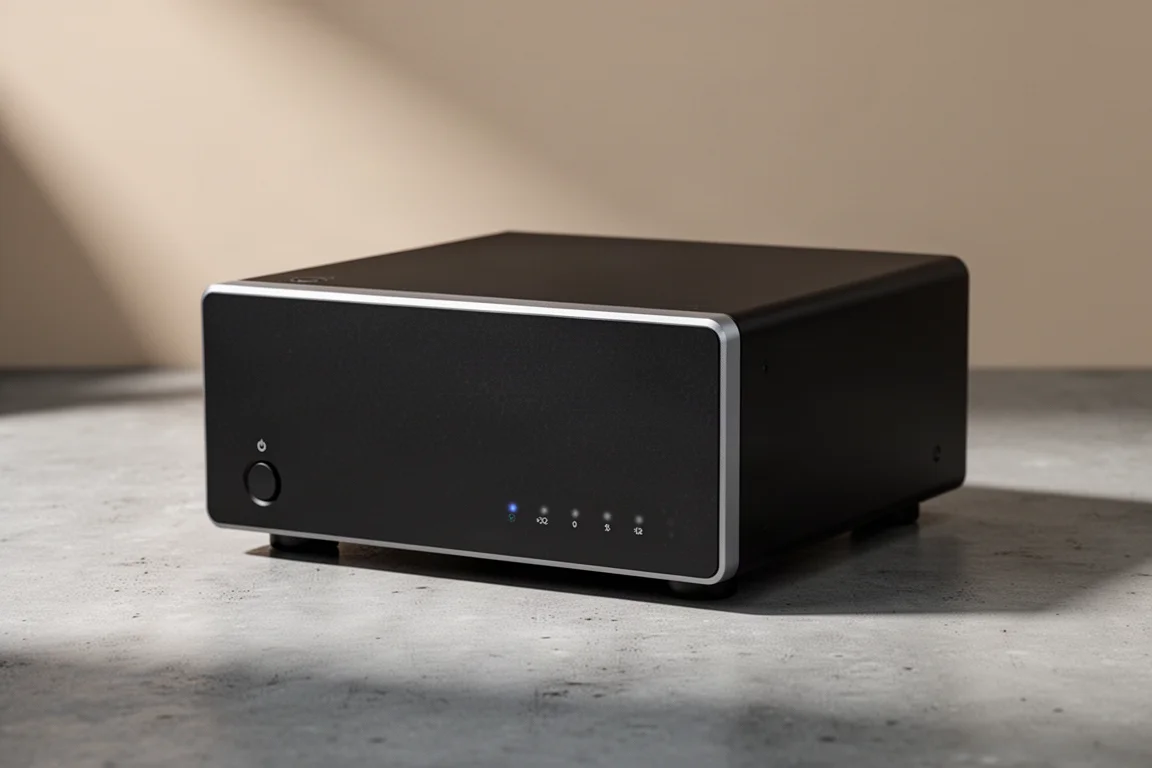
Benchmark AHB2 Review: A Compact Power Amplifier Built Around Transparency
A compact reference-oriented power amplifier with THX-patented feed-forward error correction, balanced-only inputs, and the current to drive low-impedance speakers.
Power Amplifiers
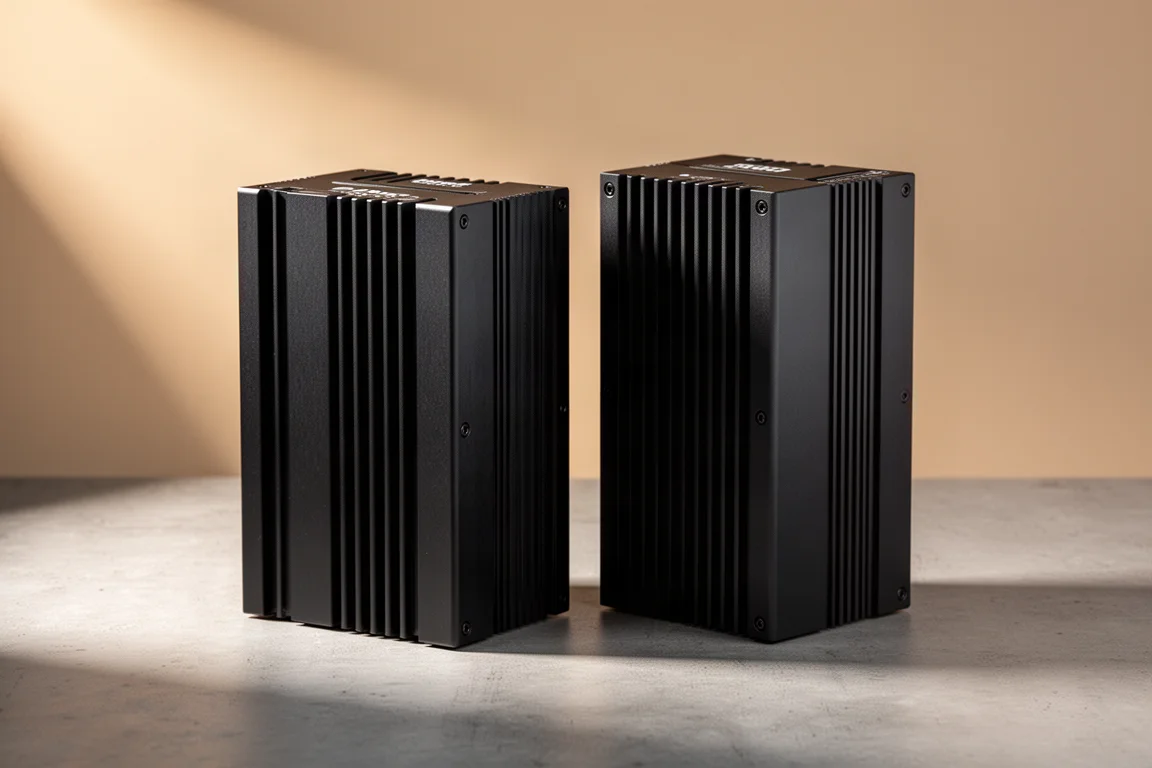
Burson Timekeeper 3X GT Review: Class A Character in a Compact Monoblock
A compact flagship monoblock with the first 30 watts in Class A, 110W into 8 ohms, pinpoint imaging, and an unusually large soundstage.