Hi-Fi Speakers
Monitor Audio Studio 89 Review: A Compact Standmount With Studio Honesty
A close look at the Monitor Audio Studio 89, a compact standmount with trickle-down Platinum technology, neutral tonality, precise imaging and a clear limit on dynamic swings.
Introduction
Monitor Audio introduced the Studio 89 on 1 July, reviving a model name that reaches back to the Studio 15, the company’s first speaker to carry the Studio badge, launched 35 years ago. That original model was also the first Monitor Audio speaker to use metal dome tweeters and metal cone drivers, two technologies that went on to define the brand.
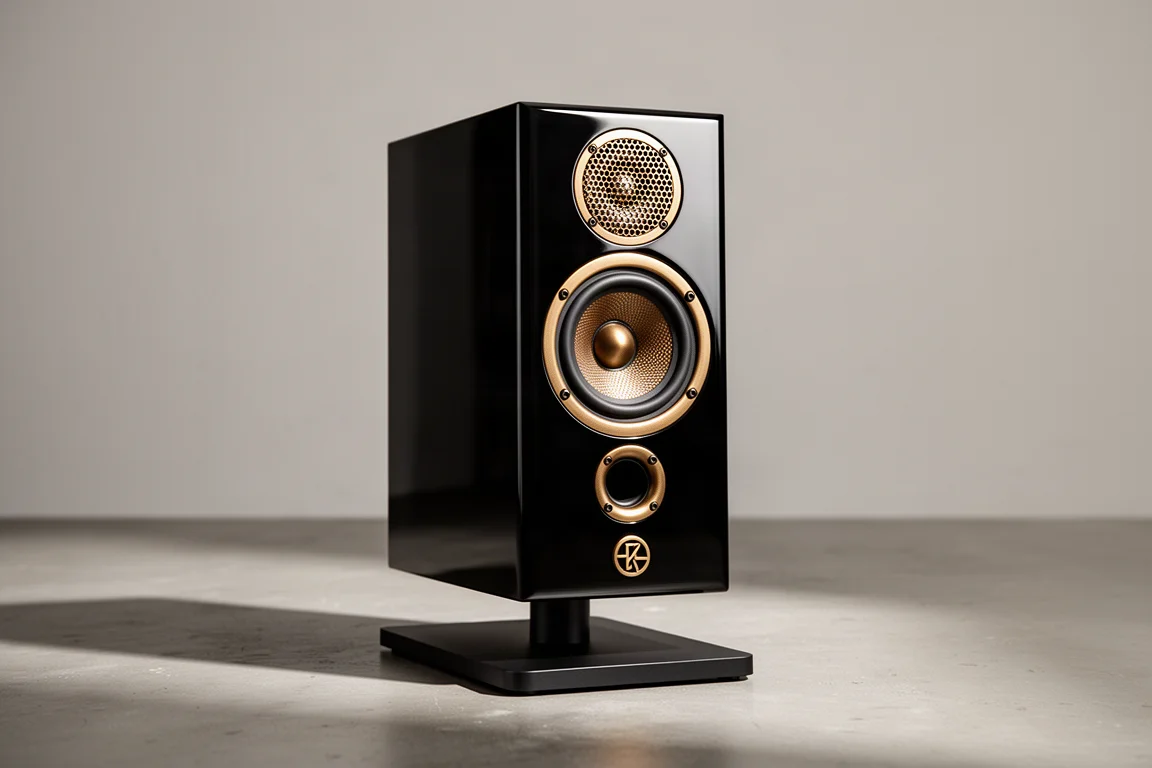
The new speaker borrows its name from the launch date of the Studio 15 rather than its looks. Beyond the gloss black cabinet and the anodised gold drivers, the two models share little visually. The more interesting lineage is technical: the Studio 89 does not descend from the Silver series or the Gold series, but takes trickle-down engineering from the Platinum 3G range and from the £70,000 Hyphn flagship.
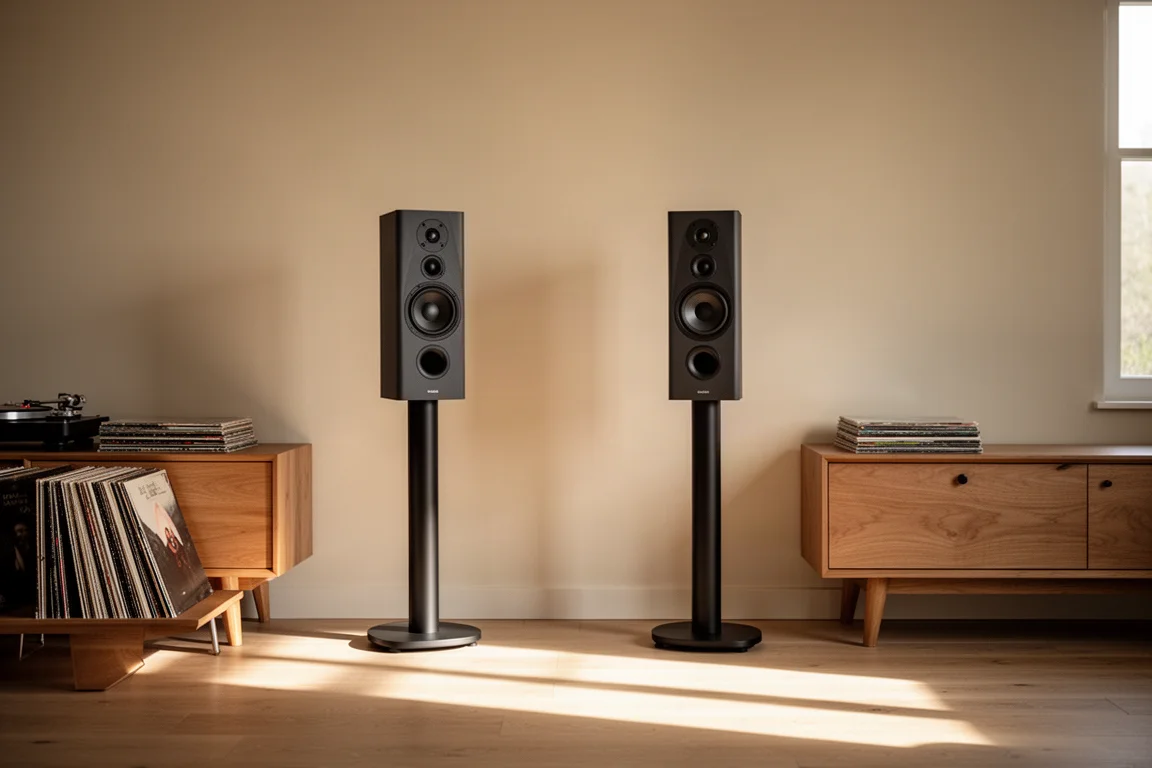
In the UK the Studio 89 retails at £1,999. Monitor Audio also offers optional 500B diecast aluminium stands, which are worth considering for more than looks. They are solidly built, with wide outrigger feet, a mass-fillable central column and a top plate sized so that the speaker can be bolted down. The speaker itself measures 340 mm high, 361 mm deep and just 157 mm wide, and weighs 7.6 kg.
Who the Monitor Audio Studio 89 Is For
This is a compact standmount aimed squarely at domestic listening rather than studio work, despite the name and the monitor-like tonal honesty. It suits listeners who prioritise resolution, timing and a precise stereo image in a small to medium room, and who play a broad range of acoustic, vocal, jazz, soul, blues and classic rock material.
It is less suited to listeners who want a small cabinet to reproduce heavy crescendos and large orchestral dynamic swings at realistic levels. Anyone who spends most of their listening time on dense, high energy recordings should weigh that limitation carefully before committing.
Main Strengths: Neutral Tone and Precise Imaging
The first surprise is tonal balance. Monitor Audio speakers carry a reputation for sounding bright, and the Silver 50 and Silver 100 deliver striking resolution with a touch of brightness attached. The Studio 89 does not follow that pattern. Play something warm and it sounds warm, play something cool and it sounds cool. That is the most practical way to judge neutrality without having been present at the recording.
Detail and refinement sit in a different class from the Silver series. The soundstage is large and unusually precise, wide and deep but also easy to place performers within. That kind of placement is only achievable with an excellent sense of timing, and the Studio 89 has it.
Bass is punchy and articulate, with decent weight for the cabinet size, though extension is limited. The quoted minus 6 dB point is 48 Hz in room, so many listeners will get better results by adding a subwoofer and integrating it subtly. Above the bottom octave, the amount of detail on offer is extraordinary. Midrange transients have a crisp attack that avoids sounding hard-edged, and notes decay into a notably dark background.
Driver Technology and Cabinet Construction
The Studio 89 is a D’Appolito array, or MTM layout. Behind a honeycomb grille sits a centrally mounted air motion transformer, with two identical 108 mm (4 1/4 inch) C-CAM midwoofers above and below it.
The MTM arrangement exists to address lobing, the uneven radiation pattern created when a tweeter and a midrange driver of different sizes reproduce the same frequencies from different physical positions. Joseph D’Appolito’s answer was to keep the midwoofers small and to use high order crossovers, typically third order slopes with an 18 dB per octave rolloff, so that the dispersion of the drivers matches as closely as possible. The Studio 89 crosses over at 2,400 Hz using third order slopes and premium parts, including polypropylene capacitors and iron core inductors, with the exception of the large inductor on the midwoofer.
The midwoofer cone uses the third generation of Monitor Audio’s rigid diaphragm technology, the same approach found on the current Platinum series and the Hyphn flagship. A ceramic-coated aluminium magnesium outer skin sits over a Nomex honeycomb core with a woven carbon fibre under skin, combining lightness with stiffness. The tweeter is a micro pleated diaphragm, an air motion transformer design that extends out to 60,000 Hz, giving it speed and plenty of headroom at the top.
Construction details are equally deliberate. The tweeter is mounted to a diecast aluminium front panel for rigidity and isolated from the cabinet by a gasket. Two through-hole bolts clamp the rear baffle to the front assembly, compressing the cabinet and effectively adding bracing. The twin slotted ports, which Monitor Audio calls HIVE, have laminations on their surface to reduce turbulence and port chuffing. The binding posts are chunky, rhodium plated and mounted on an anodised gold face plate, carried over from the flagship model.
Setup and Partnering Equipment
These are on-axis speakers, so aim the tweeters at ear height and directly toward the listening position. Placement relative to the walls behind them matters more than the MTM layout itself, most likely because of how the twin slotted ports interact with nearby boundaries. A minimum of 90 cm (3 ft) from the centre line of the front baffle to the wall behind, with the speakers set roughly 15 cm (half a foot) further back than many conventional two-way designs, provides the right bass reinforcement without disturbing the soundstage.
Listening distance deserves attention too, at a minimum of 2.4 m (8 ft), because tonal variations become more obvious as you move relative to the speakers than they do with many traditional two-way designs.
Partnering equipment is less fussy. A solid state integrated amplifier such as the Exposure 2510 brings articulate timing and reasonable control. A valve amplifier running replica vintage Philips EL34 output valves softens the edges and adds a richness that makes long listening sessions easy. For a long-term solid state match, the Hegel H190 adds clarity and control and opens up the soundstage, demonstrating how well the Studio 89 scales.
Things to Consider Before Buying
The notable limitation appears with demanding material. On hard rock and large orchestral works, when heavy crescendos or wide dynamic swings arrive, the Studio 89 steps down from exceptional to something above average. The effect shows up even at moderate average listening levels of around 80 dB. Two 4 1/4 inch drivers may have roughly the equivalent cone area of a single 6 inch driver, but they do not behave like one under dynamic pressure; they behave like two small drivers. A larger speaker with a single 5 1/4 inch midwoofer can feel less dynamically compressed on busy tracks, even where the Studio 89 is clearly ahead on clarity, soundstage and imaging.
There is also a slight leanness to the presentation. Attack and decay are superb, but the middle of a note, the part known as the body or release, does not carry quite the acoustic mass required for a fully natural result. Words such as cool, dry or analytical would be unfair, yet the characteristic is present.
Finally, the finish is a matter of taste and best judged in person. The satin drivers and logo are finished in an antique gold that contrasts with the piano black cabinet without shouting. Budget for the optional stands and, in most rooms, a subwoofer.
Buying Advice
The Studio 89 is among the most detailed and precisely timed speakers available at around £2,000, as long as the music stays away from the most energetic end of the spectrum. That single caveat is what keeps it short of a top award, and it is worth being honest about before you buy.
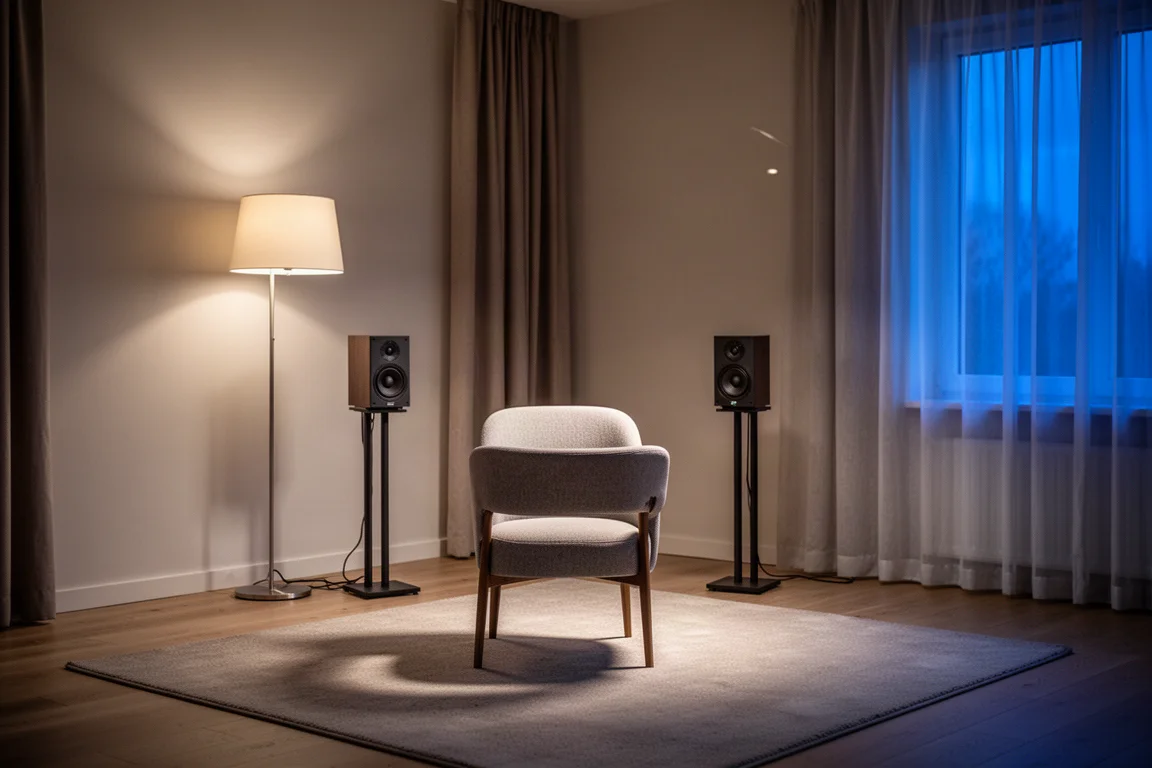
If your library is built on acoustic, vocal, jazz, soul, blues and classic rock, this is an easy speaker to recommend. If a large share of your listening is dense, high energy material played loudly, a larger cabinet with more cone area will serve you better. Either way, plan for the matching stands, allow room behind the speakers, and pair them with electronics that can show off their strengths. The Studio 89 comes very close to being a supremely capable studio monitor, and its piano black and satin gold clothing makes clear that it is intended for the home.
Conclusion
Monitor Audio has produced a compact speaker that is class-defining in tonality, detail, imaging and timing, with a clear limit on dynamic swings. It earns a very highly recommended verdict for listeners whose music plays to its strengths, and it asks for a little care with placement and partnering equipment to give its best.
Product link
View more details for Monitor Audio Studio 89
This product is mentioned in the review. Check the specifications, options, and compatibility before buying.
View more details for Monitor Audio Studio 89Further reading
Related Reviews
Hi-Fi Speakers
1723 THX Tower vs 1528 Bookshelf: Which Speaker Fits Your Room?
Two speakers at roughly the same price, built very differently. How the 1723 THX tower and the 1528 bookshelf compare on construction, bass, power needs, and sound.
Hi-Fi Speakers
Acoustic Energy AE 300 Review: Deep Bass From a Compact Standmount
A two-way standmount with real wood veneer, surprising low-end weight, and a warm, easygoing character. Here is what to know before buying.
Hi-Fi Speakers
Acoustic Energy AE1 40th Anniversary Review: A Modern Take on a British Classic
A compact standmount that revives a 1980s favorite with all-new parts, a warm mid-centric balance, and a price of £1,499 per pair.