AV Receivers
Marantz NR1711 Review: A Slim 7.2-Channel AV Receiver That Makes Sense
The Marantz NR1711 fits 7.2 channels, Dolby Atmos, and 8K-ready HDMI into a slim chassis. Here is what it does well, where its modest power shows, and who should buy it.
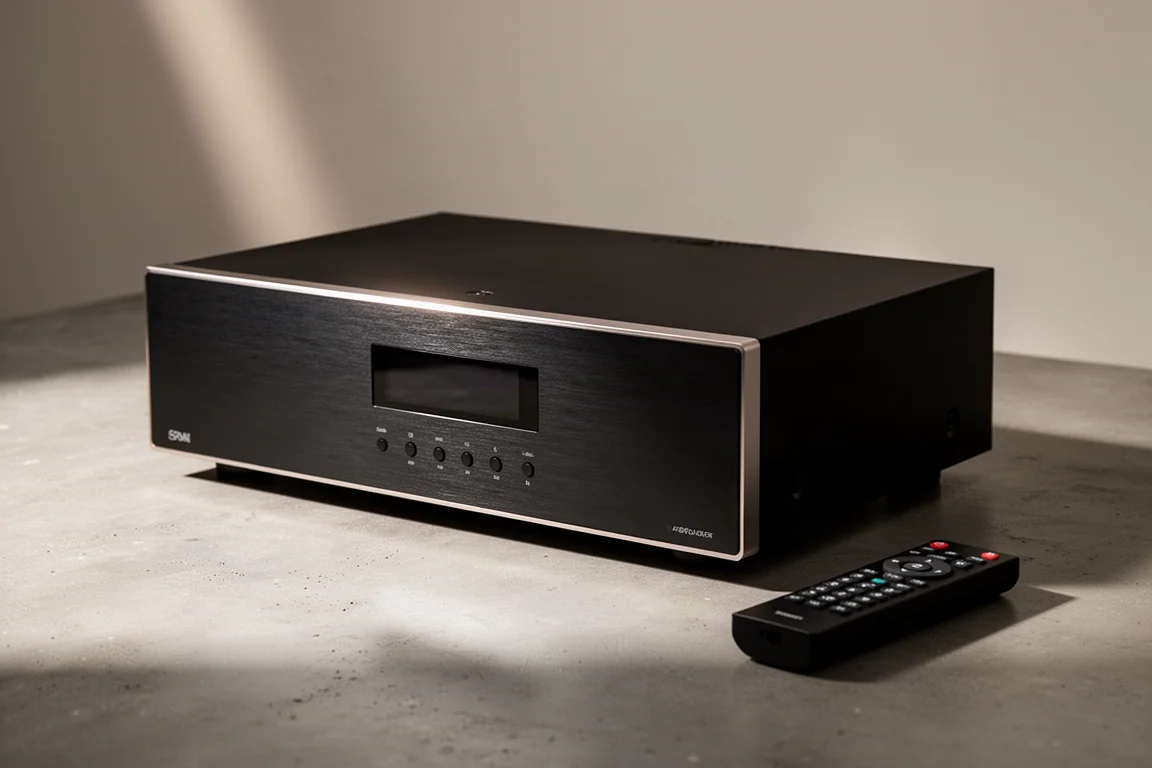
Introduction
Slim AV receivers solve a very specific problem: fitting serious home theater hardware into a cabinet or living room where a full-size chassis simply will not work. The Marantz NR1711 is the brand’s top of the line slim receiver, and it carries a 7.2-channel configuration into a body that takes up far less space than a conventional unit.
That mix of capability and footprint is the core of its appeal, but it also raises an obvious question about power. Here is what the NR1711 does well, where it asks for compromise, and which listeners will get the most out of it.
What the Marantz NR1711 Offers
The NR1711 is a 7.2-channel receiver rated at 50 watts per channel in stereo. Marantz does not publish an all-channels-driven figure, so expectations should be set accordingly: that number will not hold once five or seven speakers are in play.
On the video side, the receiver supports 8K/60 and 4K/120, and it can scale lower-resolution digital signals up to 8K over HDMI. HDR support covers Dolby Vision, HDR10+, Dynamic HDR, and HLG. Gamers get Auto Low Latency Mode and Variable Refresh Rate.
Audio features include Dolby Atmos and DTS:X, a built-in moving magnet phono preamp, and a pair of stereo preamp outputs for use with a third-party amplifier. Streaming runs through the HEOS platform, with Wi-Fi, AirPlay, Bluetooth, Spotify Connect, and Roon support, plus voice control through Google Assistant and Amazon Alexa.
Setup is refreshingly straightforward. Inputs and outputs are clearly labeled, and there is enough room to make connections comfortably, which is notable given how slim the chassis is.
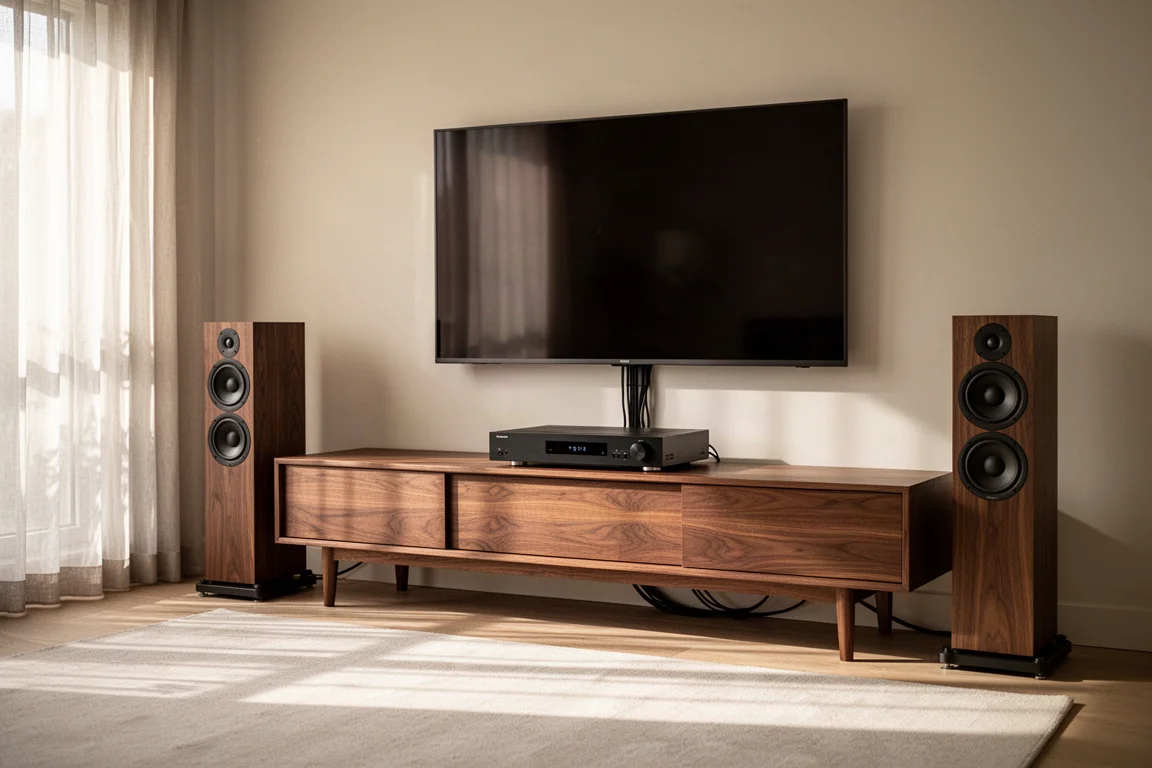
The channel layout is more flexible than the compact size suggests. You can run a full 7.2-channel home theater, or power a traditional 5.2 system and use the remaining two channels for a second zone or to bi-amp the front speakers. A basic 5.2.2 Dolby Atmos arrangement is equally viable.
One limitation appears early: only one of the six HDMI inputs supports 8K/60 and 4K/120. If you own both a current console and a high-end graphics card, you will need to decide which device gets that port. Blu-ray players and streaming boxes are unaffected.
Sound Quality and Performance
Power is the first thing to address. In practice, the NR1711 drove a surround system built around KEF Q750 towers and a matching Q650c center comfortably up to around 80 to 85 dB. Push past that threshold and the receiver starts to lose some control, with detail becoming a little messy. Without a subwoofer connected, it coaxed reasonable bass out of the Q750 towers, though it sounded lightweight at times. Bass between roughly 40 and 80 Hz is capable and detailed, and the low midrange holds up well.
The midrange is largely linear and neutral, with no audible attenuation as it moves toward the treble. It leans slightly warm or laid back, with good detail and definition and a general smoothness to the delivery. Dialogue stays intelligible whether you are listening in stereo or through a center channel. The treble has good detail, but at high volumes there is some generalization, minor distortion at the extremes, and a touch of grain.
Soundstage performance is a genuine surprise. The NR1711 opened up the KEF towers noticeably compared with a more expensive integrated amplifier, and while focus and separation are not quite as sharp, the result is impressive for a receiver in the sub-$1,000 category. Using the stereo preamp outputs with a separate amplifier tightened textures and made subtle details far clearer, and in that configuration the NR1711 holds its own for two-channel listening.
Dolby Atmos work is a highlight. With height speakers placed on top of the towers, the receiver placed sound convincingly overhead and even behind the listening position. Below roughly 85 dB, dynamics are unlikely to disappoint. The NR1711 is not explosive, but it is not dull or lifeless either, and it strikes a sensible balance.
Gaming, Video, and Streaming
The NR1711 accepted and passed through a 4K/120 HDR signal from a PlayStation 5 without issue, and no additional input lag was detectable compared with connecting the console directly to a television. Legacy composite and component video inputs are included for older devices, though Marantz notes that analog video signals are not converted or upscaled to 8K.
The built-in phono preamp is solid rather than class-leading, and it is a good match for a basic or affordable turntable. Room correction comes from Audyssey MultEQ, and adding the MultEQ app unlocks the same level of in-room response customization available on costlier receivers from the same parent company, which is a meaningful bonus at this price.

Streaming is handled through the HEOS platform, with Wi-Fi, AirPlay, Bluetooth, Spotify Connect, and Roon as options, and voice control available through Google Assistant or Amazon Alexa. For most households, that covers everything a media room realistically needs without adding a separate streamer.
Who the Marantz NR1711 Is For
The NR1711 suits listeners who want a compact, well-built receiver that is easy to set up and easy to live with. It is a natural fit for a basic 5.1 or 5.2 setup, or a 5.2.2 Dolby Atmos layout, used at moderate to fairly loud volumes with reasonably efficient speakers. It also appeals to anyone who values a slim chassis and clearly labeled connections over raw output figures.
It is a less obvious choice for listeners who want maximum power, plan to drive demanding speakers, or need several 8K-capable inputs. Those who want the most advanced room correction and the deepest level of control will find more capable options further up the market.
Main Strengths
- A slim chassis that still feels solidly built
- Full 7.2-channel processing with Dolby Atmos and DTS:X
- 8K/60 and 4K/120 support with Dolby Vision, HDR10+, Dynamic HDR, and HLG
- Auto Low Latency Mode and Variable Refresh Rate for gaming
- Stereo preamp outputs that create a clear upgrade path
- Audyssey MultEQ room correction with app-based customization
- Convincing Atmos placement and a wide soundstage for its price category
- Straightforward setup with clearly labeled connections
Things to Consider Before Buying
The main caveat is power. The 50 watts per channel figure applies to stereo operation, and no all-channels-driven rating is published. Once five or seven speakers are running, output is likely to fall to roughly 30 watts per channel or less, which is where demanding speakers and high volume levels start to expose the receiver’s limits. The treble can also thin out and turn slightly grainy at higher volumes.
Connectivity carries a similar trade-off. Only one HDMI input supports 8K/60 and 4K/120, so newer consoles and graphics cards have to share a single port. Composite and component video inputs are included for legacy devices, but analog video signals are not converted or upscaled to 8K.
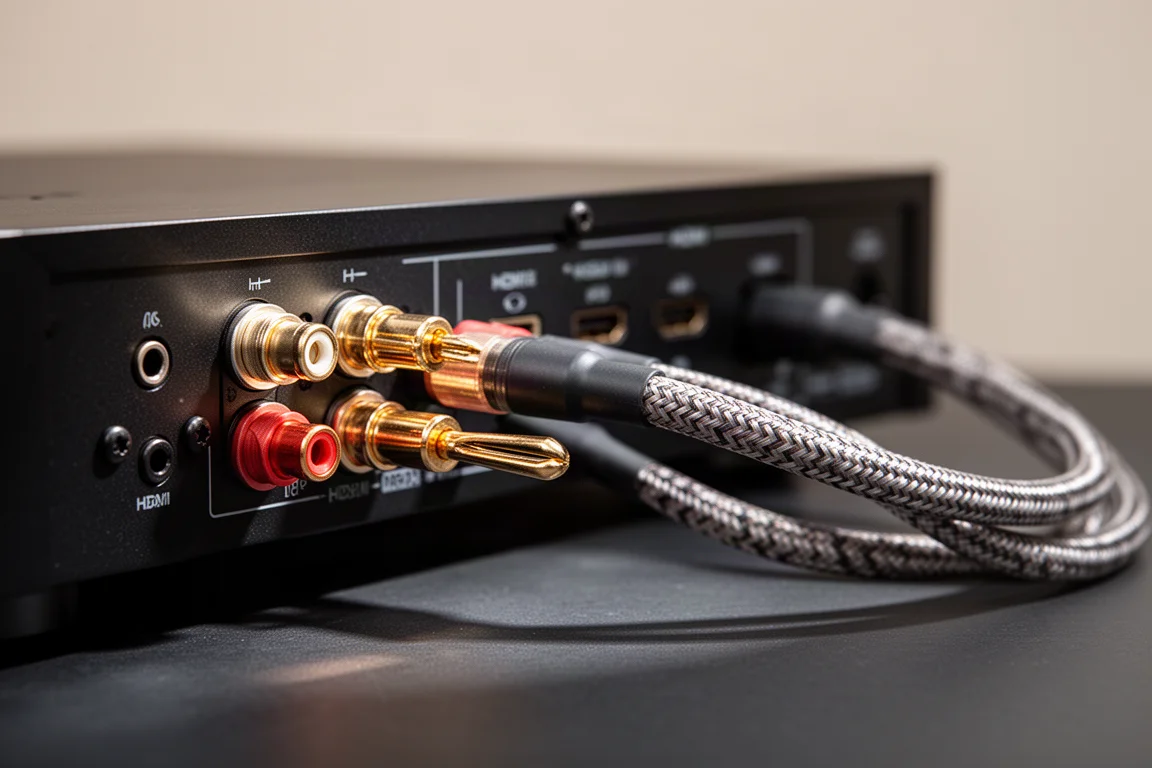
Speaker matching deserves attention before you buy. Aim for speakers in the 6 to 8 ohm range with sensitivity around 89 to 90 dB or higher. The receiver will drive a 4-ohm load, but very low-sensitivity, low-impedance designs are best avoided, and tower speakers in a given line are usually easier to drive than their bookshelf siblings.
How the Marantz NR1711 Compares
The closest value alternative is the Onkyo 5100 at $599, which offers more 4K/120-capable inputs but is not built to the same standard, a difference that becomes obvious when the two sit side by side. On build quality and slim profile, the Marantz is the easier choice. The Onkyo RZ50 sits in a different class entirely: it costs more, delivers cleaner and clearer power, uses Dirac room correction, and is aimed at advanced users who want the latest connectivity and maximum flexibility. Similarly priced options from Denon and Yamaha appear to offer comparable feature sets with more next-generation HDMI flexibility and more power on paper, though those specific units have not been tested here.
Buying Advice
If your priority is a compact receiver that is simple to set up, sounds good with both movies and music, and does not demand a rack of space, the NR1711 is easy to recommend. Match it with reasonably efficient speakers in the 6 to 8 ohm range, keep listening levels sensible, and it will handle a 5.2 or 5.2.2 setup well.
There is also a clear upgrade path. The stereo preamp outputs let you add a separate amplifier later, which noticeably improves detail and focus without replacing the receiver. Marantz also offers a matching slim stereo amplifier if you want to keep the footprint consistent.
If you need more power, multiple 8K-capable inputs, or the most capable room correction available, plan to spend more. For everyone else, the NR1711 covers the essentials with a level of build quality that is hard to find in a chassis this small.
Conclusion
The Marantz NR1711 is not the most powerful or the most feature-packed AV receiver you can buy, and it does not try to be. It is a well-built slim 7.2-channel receiver with a strong feature set, convincing Dolby Atmos performance, and a genuinely simple setup process. Buyers who pair it with suitable speakers and understand its power ceiling will find a great deal to like.
Product link
View more details for Marantz NR1711
This product is mentioned in the review. Check the specifications, options, and compatibility before buying.
View more details for Marantz NR1711Further reading
Related Reviews
AV Receivers
Anthem MRX 740 8K Review: Composed Home Theater Sound With a Few Rough Edges
A close look at Anthem's mid-tier MRX 740 8K receiver, covering its sound, ARC Genesis room correction, HDMI 2.1 features and the daily quirks worth knowing before you buy.
AV Receivers
Anthem MRX 740 vs MRX 1140: Which AV Receiver Fits Your System?
A measured look at the Anthem MRX 740 and MRX 1140, covering preamp output performance, amplifier behaviour, bass management, and expansion headroom.
AV Receivers
Best AV Receivers for Home Theater: Denon, Onkyo, Marantz and Yamaha Compared
Four home theater receivers compared on features, sound character, setup and value, with clear guidance on which one fits which kind of buyer.