Integrated Amplifiers
Marantz Model 60n Review: A Streaming Integrated Amplifier With Real Value
A network streaming integrated amplifier with HDAM circuitry, a toroidal transformer, and a warm musical character, plus the compromises worth knowing before you buy.
Introduction
Marantz has been building audio equipment since 1952, when Saul Marantz sold his first piece of gear, and the brand’s reputation for a sweet, musical sound has carried through seven decades. Vintage Marantz components have held their appeal across generations, and the modern Model 30 series deliberately echoes the classic 1970 Model 30 integrated amplifier that Saul Marantz himself designed and engineered.
The Model 60n is the most accessible expression of that idea so far: a network audio integrated amplifier with streaming built in, a moving magnet phono stage, and enough analog and digital inputs to serve as the centerpiece of a two-channel music system.
Who the Marantz Model 60n Is For
The Model 60n is aimed at listeners who want a single component to handle vinyl, streaming, and television audio without moving into flagship territory. Three analog inputs plus a moving magnet phono stage cover a turntable and a couple of line-level sources, while optical, coaxial, HDMI ARC, and USB-A inputs handle the digital side.
It suits someone who values a warm, musical presentation and wants the option to add a separate power amplifier later through the preamp output, or a subwoofer through the mono subwoofer output.

It is also a sensible choice for a first serious two-channel system. The feature set is broad enough that most sources in a typical living room can connect directly, and the amplifier is built to stay in a rack for years rather than act as a temporary stopgap.
Design, Build, and the Classic Marantz Look
At almost 29 lbs, the Model 60n carries far more heft than its price suggests, which points to a substantial power supply and serious build quality inside.
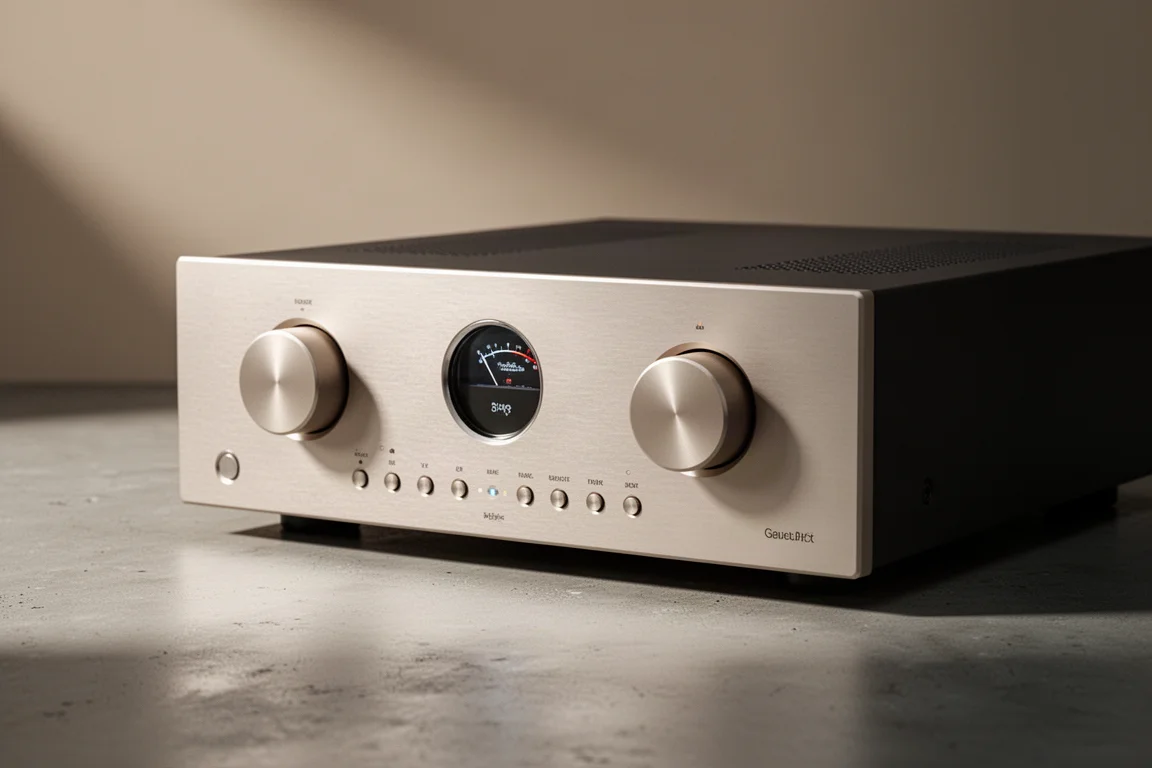
The exterior follows the family language closely. Early Marantz integrated amplifiers used a symmetrical, mirror-image layout with controls split across the left and right sides, and a round porthole-style meter in the center. The Model 60n keeps that arrangement, with the central window handling display functions. It is available in black or silver gold, and the silver gold finish in particular recalls the classic Marantz integrated amplifiers of more than fifty years ago. A raised front panel sits above a body with a carbon-fiber look.
Connectivity and Streaming Features
The analog side is generous at this price: three analog inputs, a moving magnet phono input, a preamp output for adding a separate amplifier later, and a mono subwoofer output.
Digital inputs include optical, coaxial, HDMI ARC, and USB-A, and they handle high-resolution audio up to 24-bit/192kHz and 11.2 MHz DSD.
Network streaming runs through the HEOS ecosystem, which was developed by Denon, a sister company of Marantz. HEOS carries a broad range of music services, and AirPlay 2 support covers anything missing from that list. Bluetooth receive and transmit are built in as well.
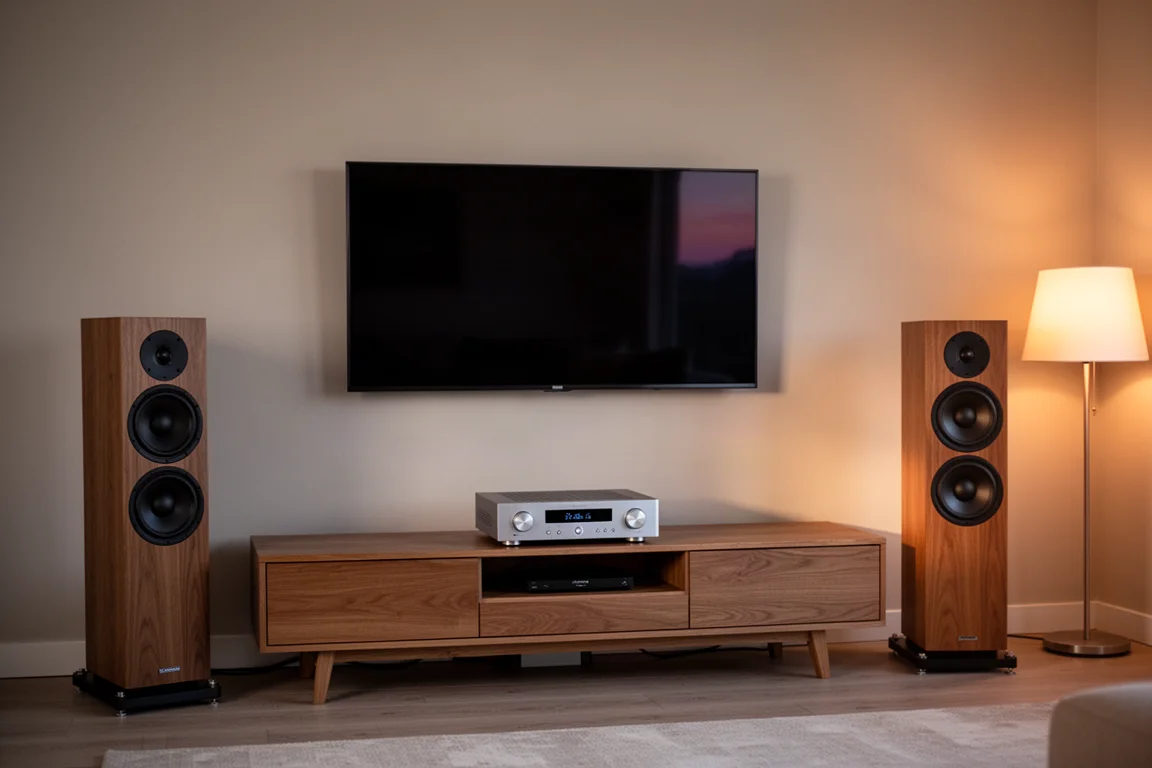
The HDMI ARC input deserves particular attention. On a compatible television it lets the TV remote control the Model 60n’s volume, which makes the amplifier a practical answer for anyone who wants better television sound without adding a receiver and a second remote to the coffee table.
Amplifier Design and the HDAM Modules
Look inside and the cost-cutting that usually accompanies an affordable integrated amplifier is largely absent. The Model 60n uses a large toroidal power transformer, and the internal layout keeps sensitive audio components well away from the power supply. Output transistors sit on extruded aluminum heat sinks.
The amplifier section is a Class AB current feedback, push-pull design rated at 60 watts per channel into 8 ohms and 80 watts per channel into 4 ohms.
Marantz also kept its own HDAM (Hyper Dynamic Amplifier Module) circuitry in the Model 60n, specifically the HDAM SA2 and SA3 technology, rather than substituting a cheaper off-the-shelf op-amp solution. HDAM grew out of the company’s dissatisfaction with cost-optimized op-amp circuits that had become cheaper but worse sounding. The modules use discrete circuitry and hand-selected components, and Marantz has used them in its better equipment ever since.
Listening Impressions
The Model 60n’s character is warm and musical, and that quality comes through most clearly on vocal material. Through stand-mounted bookshelf speakers, tracks such as Norah Jones’ “Don’t Know Why” and Crosby and Nash’s “Lay Me Down” placed voices front and center with a natural, easy presentation that is uncommon at this price.

Composure matters as much as tone here. The current feedback design and the substantial power supply keep the presentation steady rather than strained, which is what allows long listening sessions to stay comfortable instead of fatiguing.
Things to Consider Before Buying
The one genuine compromise is the subwoofer output, whose crossover is fixed at 150 Hz rather than variable. The step-up Model 40n and the compact Model M1 both offer selectable crossovers. Implementing a variable crossover in the analog domain at this price point is not practical, and a fixed analog crossover keeps the signal path pure for vinyl listeners. If you plan to run a subwoofer mainly with digital sources, the lack of adjustability is worth knowing about in advance.
Two other details separate the Model 60n from its siblings. It does not include the night mode and dialogue enhancement found on the M1, which are useful if the amplifier will double as a television sound system. It is also manufactured in Vietnam, whereas the Model 40n is built at the Marantz factory in Shirakawa, Japan.
Power output is the last thing to weigh. At 60 watts per channel into 8 ohms, the Model 60n will drive most stand-mounted and moderately sensitive floorstanding speakers comfortably, but owners of harder-to-drive speakers or listeners in larger rooms should consider whether the extra output and dynamic control of the Model 40n is worth the additional cost.
Buying Advice
Judged on value, the Model 60n is one of the strongest entries in the Marantz range. It carries the company’s HDAM circuitry, a toroidal transformer, a well-isolated internal layout, and a full complement of analog and digital inputs, while the fixed 150 Hz subwoofer crossover is the only meaningful compromise.
For most listeners the decision comes down to speakers and room size. If your speakers are reasonably efficient and your room is modest, the Model 60n delivers the Marantz sound with money left over. If you own demanding speakers or listen in a larger space, the Model 40n’s bigger toroidal transformer, thicker multi-layer chassis, copper-mounted output transistors, and additional dynamic control justify the step up. If the system is primarily for television audio and space is tight, the compact Model M1 covers that job for less.
Conclusion
The Model 60n brings the essentials of the Marantz integrated amplifier tradition into a single, network-connected component at a price a wide range of music lovers can reach. Its build quality, feature set, and warm musical character make it an easy recommendation for a two-channel system built around vinyl, streaming, and television audio, provided the fixed subwoofer crossover and the 60-watt power rating suit your speakers and your room.
Product link
View more details for Marantz Model 60n
This product is mentioned in the review. Check the specifications, options, and compatibility before buying.
View more details for Marantz Model 60nFurther reading
Related Reviews
Integrated Amplifiers
Advance Paris A10 Classic Review: Vintage Looks and a Lively, Punchy Sound
The Advance Paris A10 Classic pairs glowing blue VU meters and a tube stage with one of the widest input sets on any integrated amplifier. Here is what it does well and what to weigh before spending $2,500.
Integrated Amplifiers
Advance Paris A12 Apex Review: A Modern Integrated Amplifier With Vintage Character
A dual mono integrated amplifier with 180 watts per channel, a tube front end, VU meters, and a connectivity list that covers turntables, televisions, computers, and headphones.
Integrated Amplifiers
Advance Paris Nova Range Review: AI130, AI190 and Modular Upgrades
A practical look at the Advance Paris Nova range, including the AI130 and AI190 integrated amplifiers and the modular streaming, Bluetooth and remote accessories that expand them.