Wireless Speakers
Marantz Horizon and Grand Horizon Review: Two Luxury Wireless Speakers Compared
Marantz returns to powered speakers with the Horizon and Grand Horizon. Here is how the two models differ in size, drivers, amplification, and room-filling sound.
Introduction
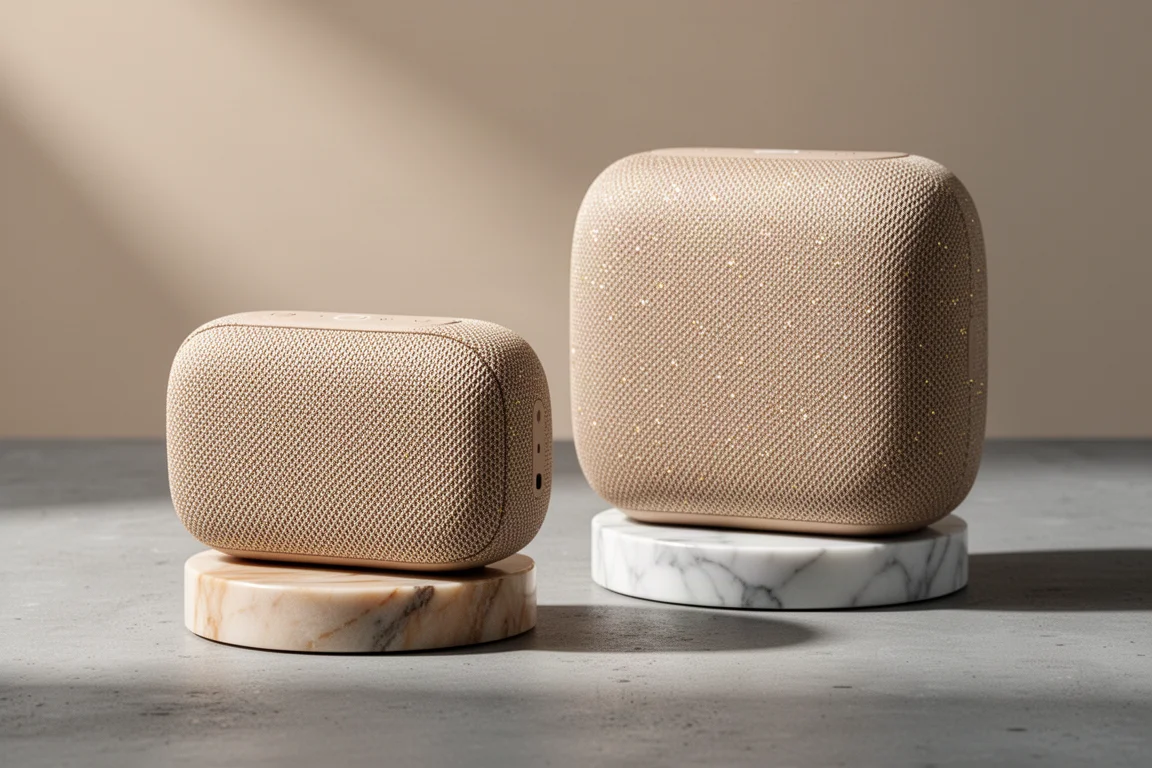
Marantz has not introduced a powered speaker in more than ten years, and the Horizon and Grand Horizon are the result of roughly three years of work to change that. The aim was to bring high-end sound into a room without complicated setups, tangled cables, or bulky separates, while keeping the craftsmanship and in-room presence of a luxury product. Both models are designed and built from the ground up, and both borrow the Marantz window-port motif that appears across the brand’s classic and modern designs.
They are statement pieces as much as they are speakers, and that shapes everything from the materials to the way you control them.
What the Horizon and Grand Horizon Get Right
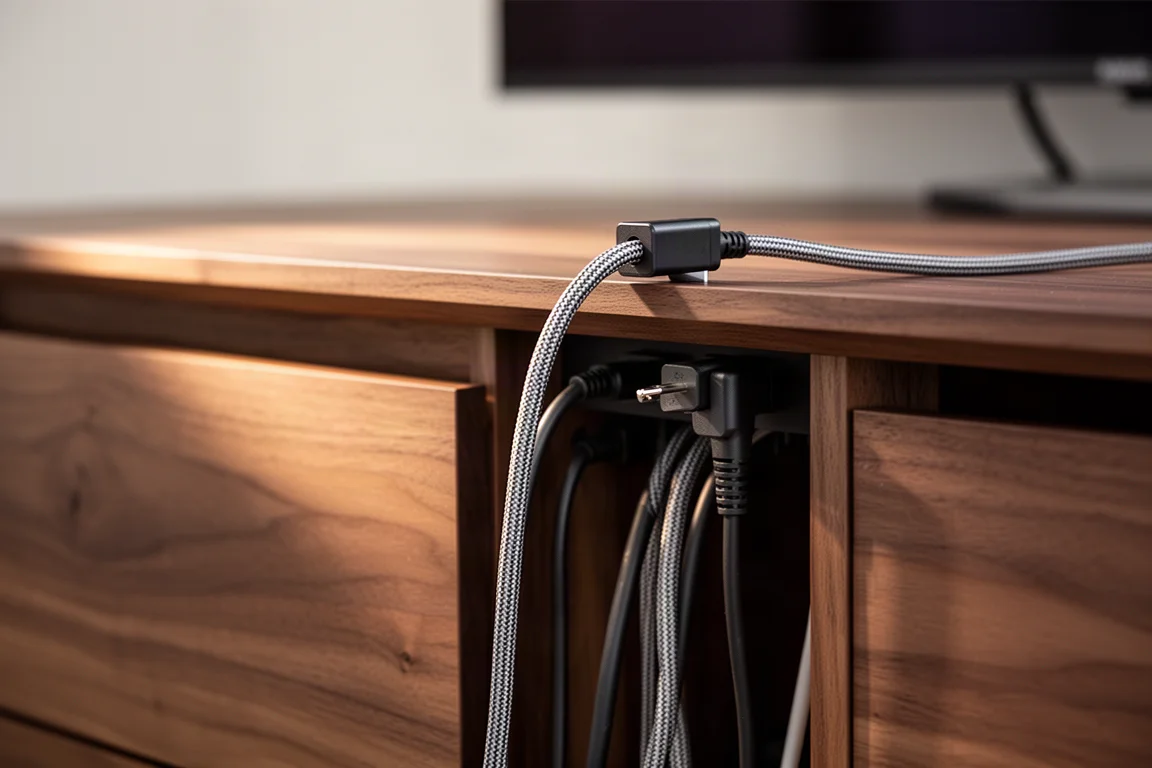
Both speakers are single units that fill a room with full stereo sound, so a pair is not required to get started. They arrive already attached to their base: plug in the power cable, connect your inputs, and you can begin listening. A magnetic cover then hides the rear connections so the back of the cabinet stays clean, and the braided power cable uses a right-angle connector that sits flush against the housing.
The packaging follows the same thinking. The outer lid slides off, the speaker lifts out by the handles on its protective case, and the case unzips to release the unit. It is a small detail, but it sets the tone for a product positioned as pure luxury.
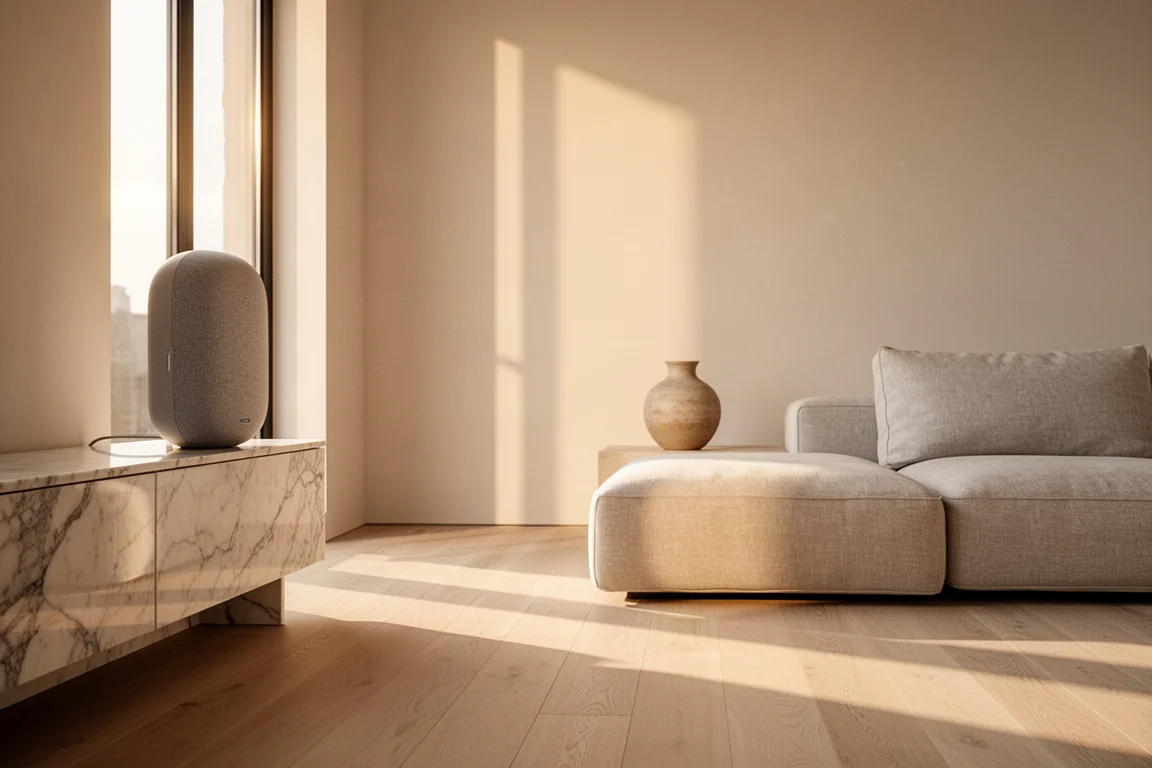
The other immediate standout is the Aura Control trim ring. Touching and holding a finger around the ring adjusts volume through 100 hidden LEDs that illuminate as you move. A built-in sensor detects when you are nearby and wakes the speaker, then lets it sleep once you step away, which is why there is no power button at all.
Design and Materials: Radiance Fabric and Marble
Each speaker is wrapped in Marantz Radiance 360 seamless fabric, a bespoke material made from recycled ocean plastics with gold flecks woven into it. The wrap runs all the way around the cabinet with no creases or edges. Three finishes are available: Midnight Sky, Moon Ray, and Marantz Champagne, so the speaker can be matched to a room rather than hidden inside one.
Each finish is paired with a color-accented natural marble base. The speaker can sit on a table or cabinet, be removed from the base and mounted directly on a wall, or, in the case of the smaller Horizon, be fitted to an optional tripod stand made from American Walnut that gives it a vintage camera tripod look.
Weight is part of the story. The Horizon is around 28 lb and the Grand Horizon is close to 47 lb, and both feel substantial rather than plasticky in the hand.
Marantz Horizon: The Compact Model
The Horizon is the smaller of the two and still fills a good-sized room on its own. Its driver complement is a 6.5-inch front-firing subwoofer with a color-matched cover over the front panel, two 25mm silk dome tweeters, and two full-range drivers. The amplifier section is rated at 310 watts with 745 watts of peak power.
In listening, the Horizon holds up when moved around a room, including a corner position against a wall and out in open space. It produces sound that seems to come from a much larger speaker than its dimensions suggest, and the in-app DSP handles the differences between placements.

Marantz Grand Horizon: More Output, More Low End
The Grand Horizon steps up to an 8-inch front-firing subwoofer, three 25mm silk dome tweeters, and four 76mm mid-range drivers. Amplification rises to 370 watts with 860 watts of peak power. The result is noticeably more low-end punch while keeping the same clarity wherever you stand in the room.
Placement still changes the sound a little, as it does with any speaker, and the same in-app DSP controls smooth out those differences. The Grand Horizon is the model to consider if the speaker will anchor a larger space or sit beside a television as part of a stereo pair.

Driver Technology and Mirage DSP
The drivers are proprietary Marantz Gravity Drive units, arranged within each cabinet to work together rather than as a conventional front baffle. Marantz Mirage DSP is built in specifically for these speakers, allowing a single cabinet to produce full stereo sound and giving owners control over clarity, spaciousness, and warmth.
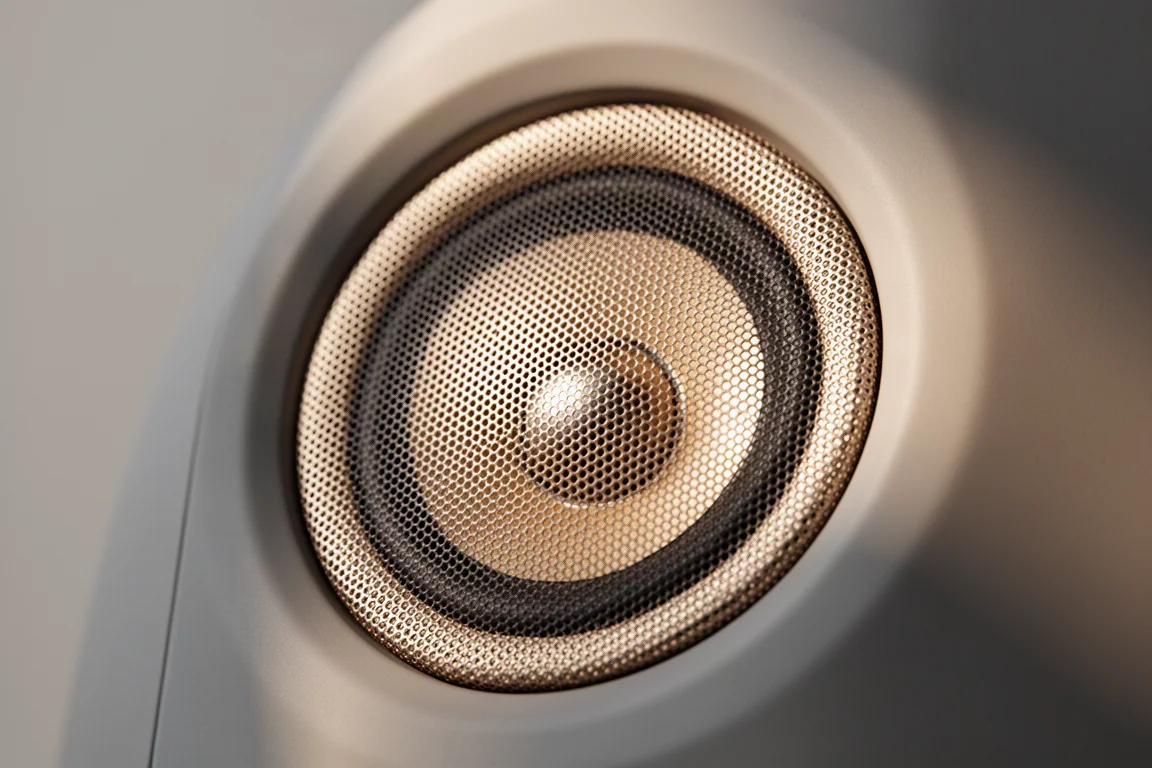
There is also a Sound Master mode that tunes the speaker to the room, and all of these controls live in the HEOS app alongside your music.
Amplification: Marantz Rise and GaNFET
All of those drivers are powered by Marantz Rise amplification, which is built on GaNFET, or gallium nitride field-effect transistor, technology. GaNFET devices switch much faster than the standard silicon MOSFETs used in most amplifiers, which allows for higher efficiency and fidelity. They are widely regarded as the development that pushed Class D amplification further than many thought possible.
Connections and HEOS Streaming
The amplifier housing at the rear offers stereo RCA, an optical digital input, HDMI eARC for a television, and USB-C. HDMI eARC means you can control volume with your own TV remote, and Dolby Atmos decoding is built in for movies and shows. USB-C accepts USB music drives, and the RCA inputs suit CD players, tape decks, or a turntable used with a separate phono preamp, since no phono stage is built in.
HEOS handles streaming and control. Universal search covers all connected services at once, playlists can mix tracks from different services, and Amazon Music, Deezer, and Tidal are supported, with more services planned. Spotify Connect, AirPlay 2, and Bluetooth 5.4 are also built in. Because both models are HEOS devices, they can be combined with other HEOS-enabled components for whole-home audio, and two units can be paired for left and right channels around a TV.
Things to Consider Before Buying
These are heavy speakers, at roughly 28 lb and 47 lb, and they are designed to be seen. If you want something that disappears into a bookshelf, the footprint and the marble base will not suit that. There is also no built-in phono preamp, so a turntable needs its own. The tuning options are deeper than most wireless speakers offer, which is a benefit if you enjoy adjusting a system and unnecessary if you would rather never open an app.
Buying Advice
Choose the Horizon if you want one speaker that can carry a normal living room, or if the optional walnut tripod stand appeals and you plan to move it between spots. Choose the Grand Horizon if you have a larger space, want more low-end weight, or intend to build a two-speaker setup around a television. Either way, the value sits in the combination of materials, driver engineering, and the HEOS platform rather than in raw output alone.
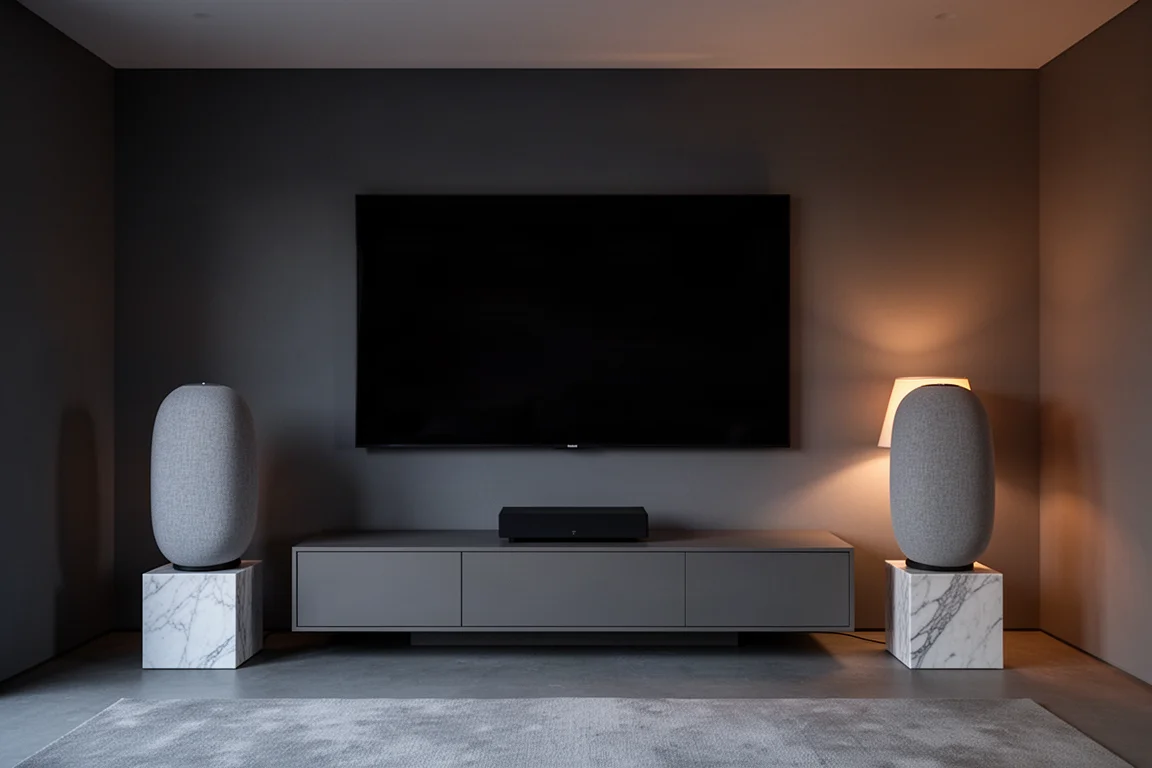
Both models are room-dependent, and the honest difference between them is scale and bass extension rather than character. A smaller room rarely needs the extra output of the Grand Horizon, while a large open space will make better use of it.
Conclusion
The Horizon and Grand Horizon are a genuine departure for Marantz, and they work because they treat a wireless speaker as a piece of furniture and a piece of hi-fi at the same time. The Radiance fabric, marble base, and Aura Control ring make them easy to live with, while Gravity Drive drivers, Mirage DSP, and GaNFET amplification give them the performance to justify the space they occupy. If you want a statement piece that also happens to be a serious speaker, this pair deserves a close look.
Further reading
Related Reviews
Wireless Speakers
Bang & Olufsen Beolab 8 Review: A Compact Three-Way Speaker Built for Flexibility
A close look at the Beolab 8, a compact three-way powered speaker with customizable finishes, two listening modes, and a bass limiter worth understanding before you buy.
Wireless Speakers
Denon Home 200, 400, and 600: Which New Denon Home Speaker Fits Your Room?
A practical look at the new Denon Home lineup, covering shared features, driver differences, Dolby Atmos delivery, and which of the three models suits which room.
Wireless Speakers
Devialet Phantom II Review: Big Bass From a Very Small Wireless Speaker
A compact wireless speaker with genuinely remarkable bass output, sharp imaging, and a few trade-offs worth understanding before you buy.