Home Theater
Marantz AV20 and AMP 20: A 13-Channel Processor and 12-Channel Amplifier Explained
A practical look at the Marantz AV20 preamp processor and AMP 20 power amplifier, from channel matching and bridging to room correction, HEOS multi-room audio, and pricing.
Introduction
Separates-based home theater has a clear appeal: processing in one chassis, power in another, and each half free to be sized, cooled, and upgraded on its own schedule. The Marantz AV20 and the Marantz AMP 20 are a matched pair built around exactly that idea.
The AV20 is a 13-channel preamp processor with HDMI 2.1 switching, four independent subwoofer outputs, and a choice between Audyssey and Dirac Live room correction. The AMP 20 is a 12-channel power amplifier rated at 200 watts per channel into 8 ohms and 400 watts into 4 ohms, with bridging available on every channel pair.
Both sit at the premium end of the market at around $6,000 each, so the useful questions are practical ones: how the channel counts line up, what the pair does well in a real room, and where a buyer needs to plan ahead.
What These Two Pieces Bring to a System
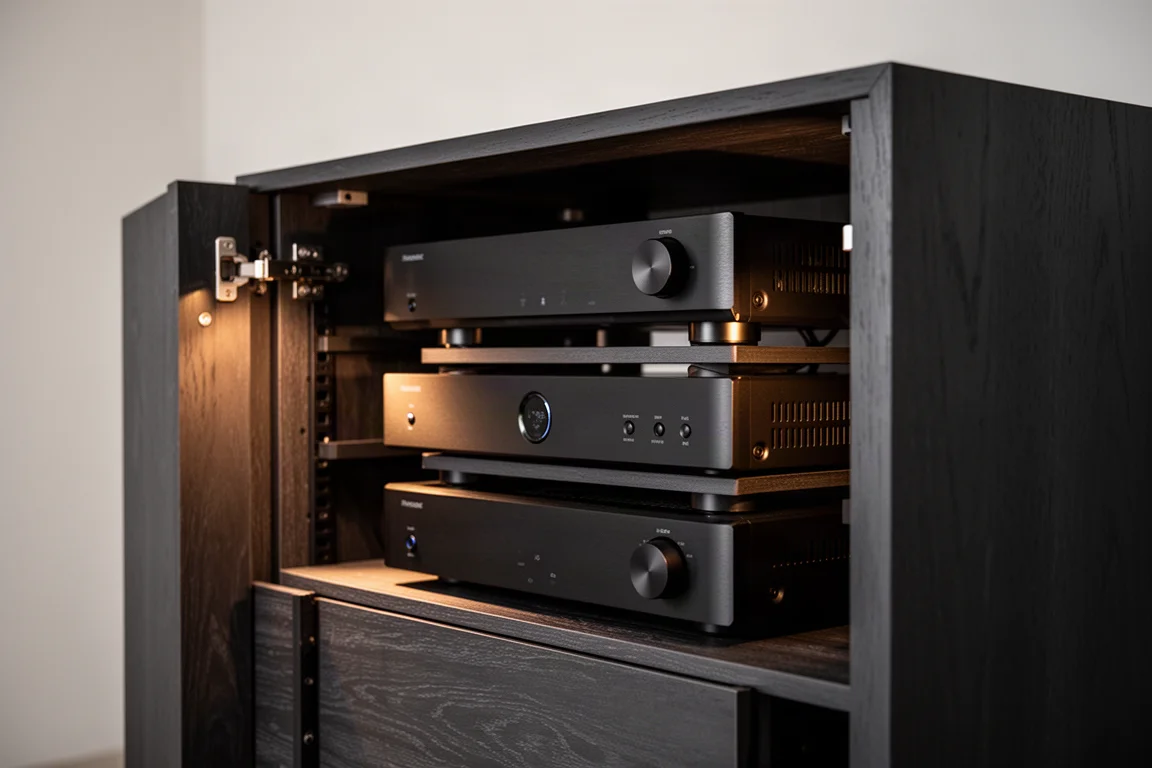
Separating processing from amplification is the central idea here. The AV20 handles decoding, input switching, bass management, and room correction in one chassis, while the AMP 20 keeps the high-current amplification stages, their heat, and their power supply in a second box. Each unit can then be placed and ventilated on its own terms, and either half can be changed later without replacing the other.
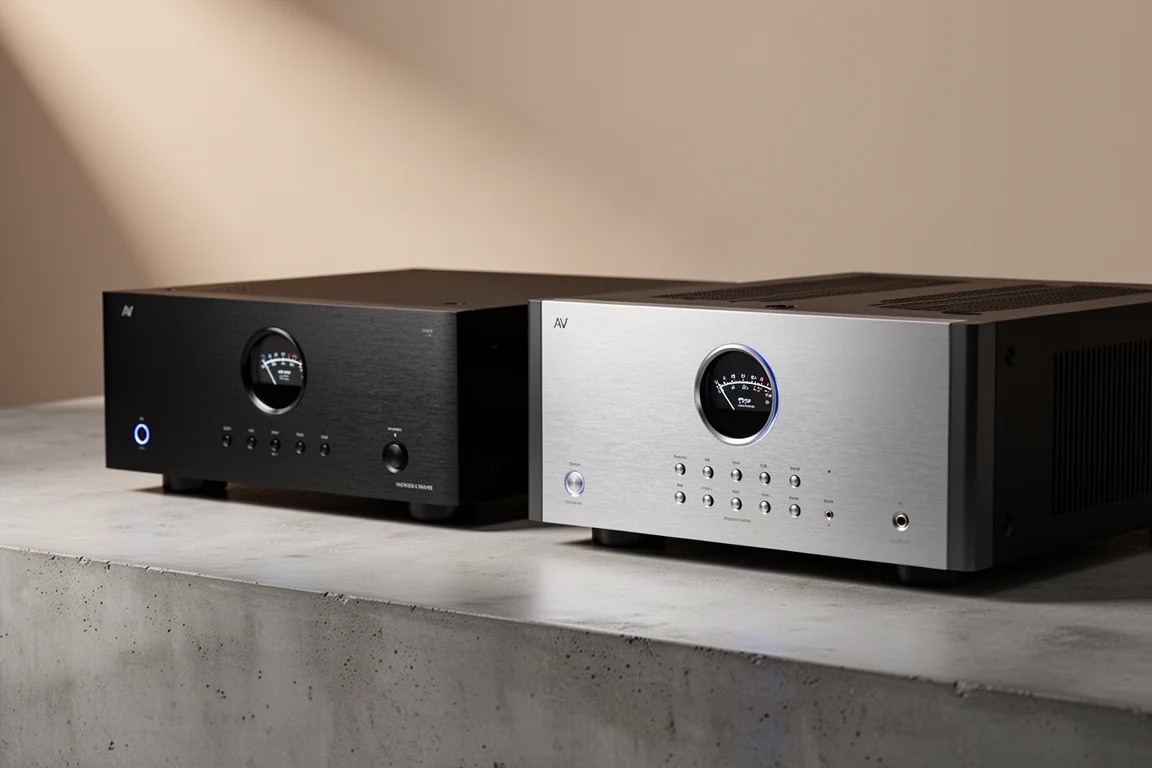
The two share a single design language: an aluminum front fascia, a circular porthole detail at the center, textured side panels, and a power button on the left edge. On the AV20 the porthole sits above a front LED panel and a setup microphone input, both hidden behind a drop-down door alongside a USB input. On the AMP 20 the same window holds a power meter that can be switched off, with a dimmer control on the opposite corner.
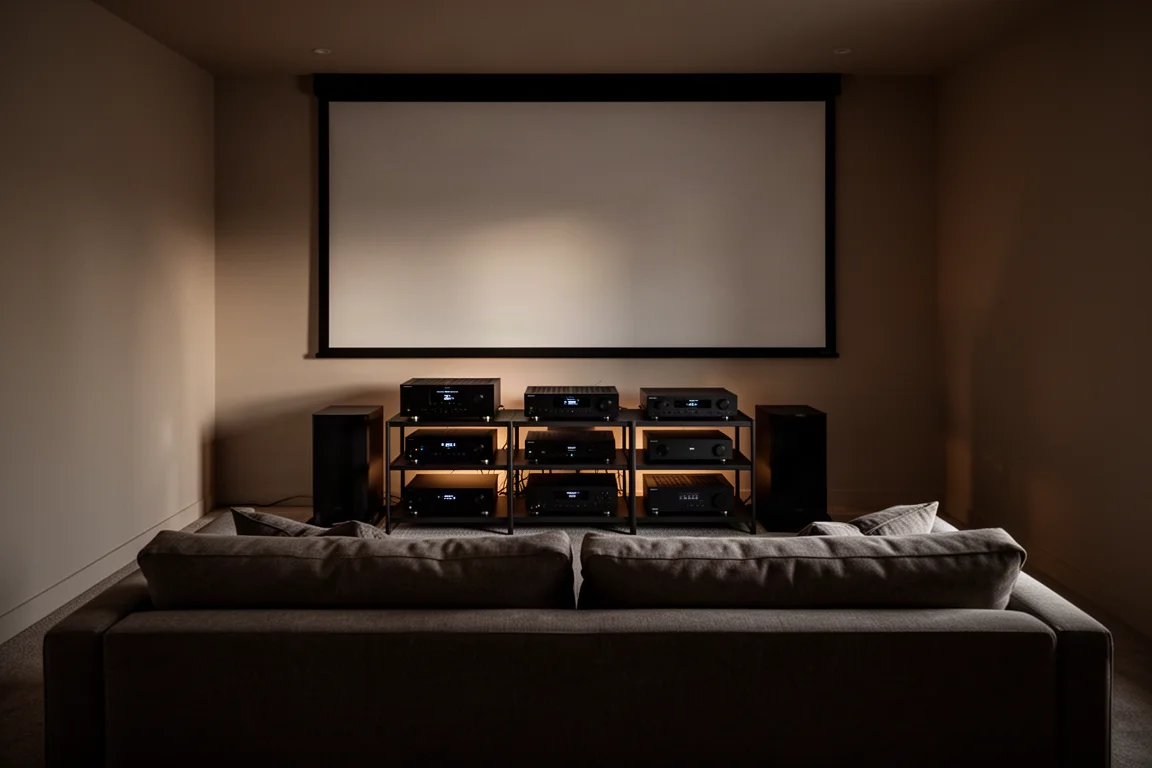
Size is one of the more practical differences between generations. The AV20 measures roughly 17 inches wide, 7.5 inches tall, and 16.25 inches deep, which makes it noticeably shallower than the earlier AV10 and easier to fit into a standard AV rack. The AMP 20 matches the 17-inch width and the same depth, stands about 7.25 inches tall, and weighs 39.7 pounds, which is substantial without being awkward to handle.
Marantz AV20: A 13-Channel Preamp Processor
The AV20’s front panel stays spare: a volume knob with firm, well-weighted tension, a selection knob on the left, a quarter-inch headphone jack on the right, and a power button at the far left. In the box you get an Audyssey calibration microphone and its stand, a power cable, a remote control with batteries, two Bluetooth and Wi-Fi antennas, an AM antenna, a set of labels, and a quick start guide.
Around the back, the AV20 offers HDMI 2.1 inputs that are 8K60 compliant at up to 40 Gbps, along with three HDMI outputs, one of which is assigned to zone 2, plus eARC support. The HDMI stage also supports AMD FreeSync and auto low latency mode. Below that sit preouts for all 13 channels, four independent subwoofer outputs on either RCA or XLR, and balanced XLR connections. There is also a trigger, a flasher connection, a remote control port, RS232, composite video connections, coaxial and optical inputs, and a phono input on the left side.
Three separate zones are supported, and the unit can be configured through its own web interface by entering its IP address into a browser. From there you can reach audio settings, subwoofer level trims, video and HDMI options, speaker layout and amp assign, distances and levels, crossovers, two speaker presets, network settings, and HEOS controls. Speaker presets, preout assignment per speaker, and per-channel graphic EQ are all adjustable, which gives a lot of freedom when a room has unusual speaker placement.
Marantz AMP 20: A 12-Channel Power Amplifier
The AMP 20 mirrors the AV20’s fascia almost exactly, with a centered power meter, a dimmer toggle on the right, a power button on the left, and the same pebbled texture along the sides. It is the same 17 inches wide and about 16.25 inches deep as the processor, stands around 7.25 inches tall, and weighs 39.7 pounds.
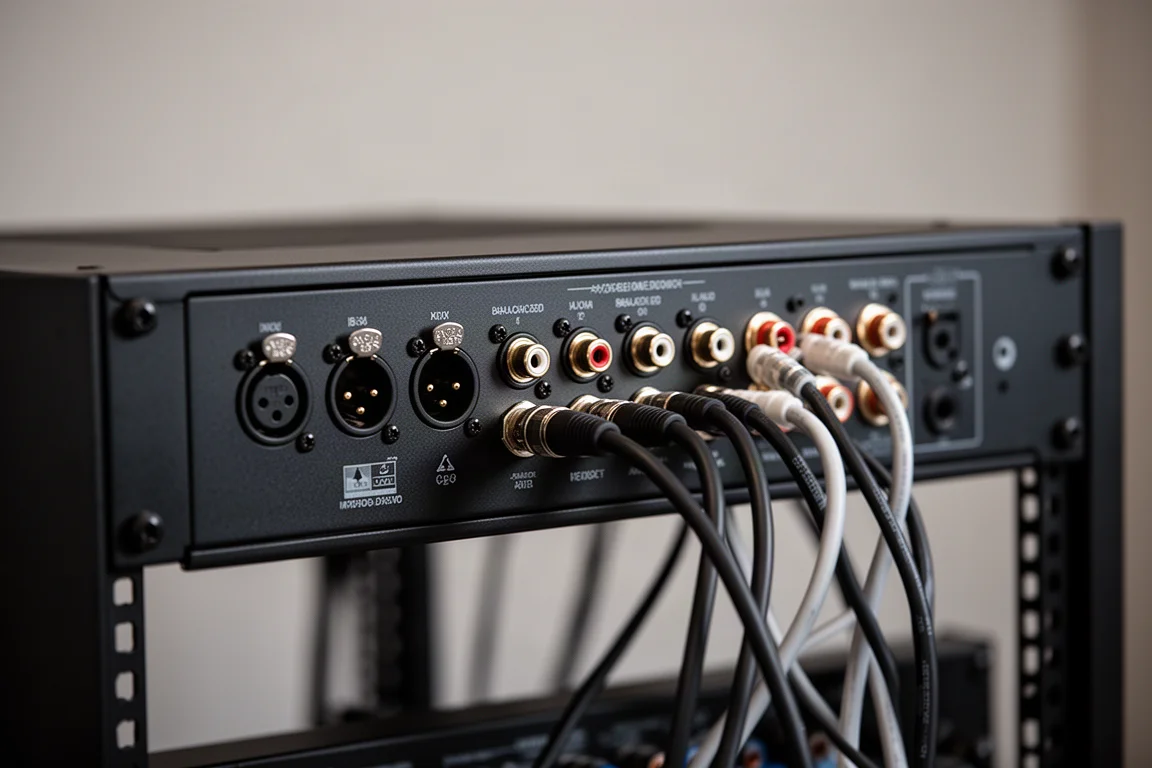
The rear panel carries an auto standby switch, amplifier control and trigger inputs and outputs, a flasher connection, a remote control port, RCA inputs and outputs, RS232, and the power inlet. Amplification is delivered through heavy-duty binding posts for all 12 channels, rated at 200 watts per channel into 8 ohms and 400 watts per channel into 4 ohms. Every channel can accept either an unbalanced RCA or a balanced XLR input.
Bridging is available across the amplifier. Pairing two channels in bridge mode yields 400 watts into 8 ohms, and the full amplifier can be bridged from 12 channels down to six, or any combination in between, which gives plenty of freedom when a system needs more output on a few key speakers.
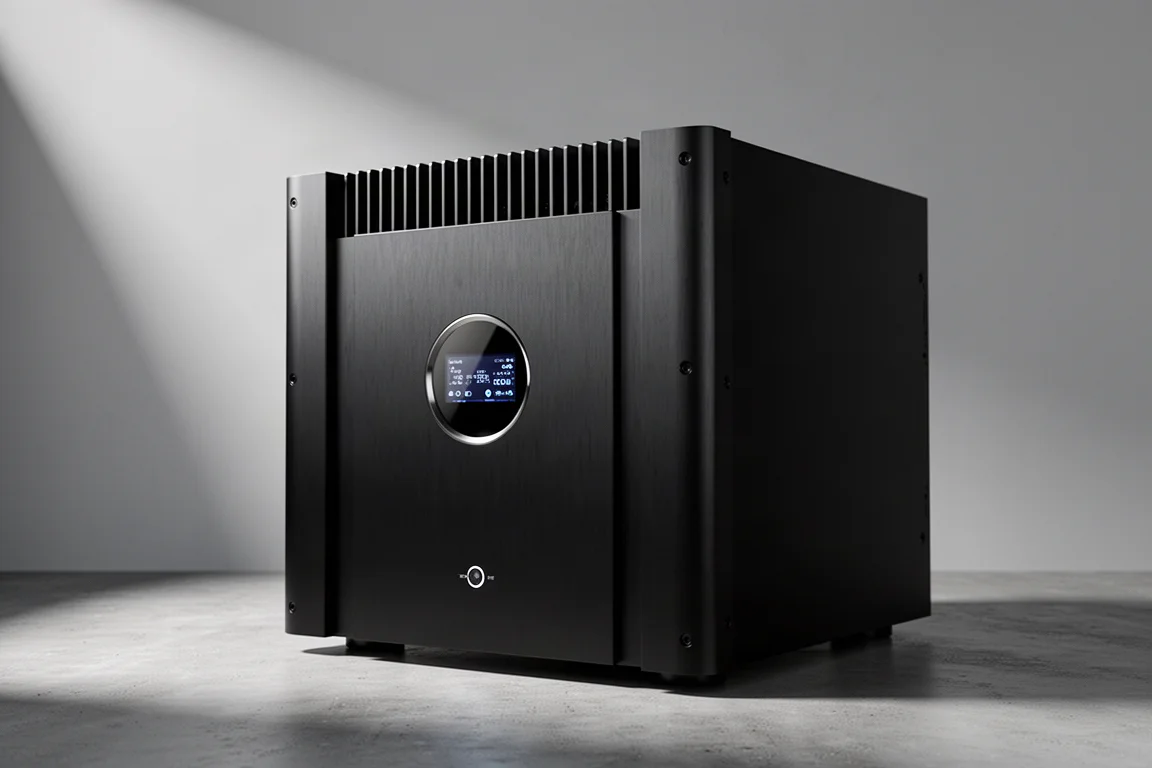
The amplifier platform is based on class D ICE edge modules and uses the same 1500-watt regulated switch-mode power supply found in the 16-channel amplifier in the same family. Because the supply is regulated, output does not climb when only a single channel is driven, and more importantly it does not sag when several channels are working at once. Bench testing of the 16-channel version of this platform produced 96 dB SINAD, excellent channel separation, and a frequency response that stays consistent whether the load is 8, 4, or even 2 ohms. Class D or not, the amplifier runs a little warm, so leaving room for ventilation above and behind it is worthwhile.
Matching Channels, Bridging, and Headroom
The obvious question with this pair is the channel mismatch: the AV20 processes 13 channels, while the AMP 20 amplifies 12. For a system that genuinely needs all 13 amplified channels, that leaves one channel to cover, and one common solution is to borrow a single channel from another amplifier already in the rack.
There is also a cleaner option that comes down to planning. The AV20’s 13 processing channels can be matched to the 16-channel amplifier in the same family, which allows the front three channels to be bridged for the left, center, and right speakers. That arrangement adds roughly 3 dB of headroom on the front stage while still using every available channel.
If the plan is an 11-channel layout instead, the AMP 20 covers it comfortably. Bridging the center channel in that configuration adds about 3 dB of headroom where dialogue and effects most often need it, and all 12 amplifier channels still get used. In other words, the right amplifier choice depends on how many channels the room actually needs rather than on matching the numbers exactly.
Room Correction: Audyssey, Dirac Live, and What Comes Next
The AV20 ships with Audyssey room correction, which works with the calibration microphone and stand included in the box. Dirac Live is the second option, available through a subscription, and it is an extra-cost add-on rather than something bundled with the processor. Both approaches are managed from within the unit once filters have been created.
Dirac Live setup runs through a desktop application. After the processor is detected on the network, the process moves through volume calibration, where the master volume is set and the level of each speaker is matched against a test tone. You then choose an arrangement: tightly focused for a single seat, focused for a small group, or wide imaging for a larger room. Measurement follows, with nine microphone positions covering the main listening position and the surrounding area.
The filter design stage is where Dirac Live offers the most control. A curtain can be dragged across the frequency range so correction applies only where you want it, and the target curve can be edited point by point for each speaker. Once the curve is set, filters are exported to one of three available slots on the AV20, and the processor picks them up from its own menu.
Dirac Live also brings bass management into the picture, which suits the AV20’s four independent subwoofer outputs. Looking ahead, Dirac Art is scheduled to arrive on the AV20 through a future update at an additional cost, though no time frame has been announced.
HEOS Multi-Room and Everyday Streaming
HEOS is the multi-room platform built into the AV20, and it turns the processor into the hub of a whole-home music system. Adding a compatible wireless speaker is a short process: open the app settings, choose to add a device, confirm the speaker is powered and showing a solid status light, select the model, then give it a name and indicate where it sits in the room, whether that is open space, against one wall or shelf, in a corner, or near two walls. The speaker then joins the network on its own.
From the HEOS home screen you get access to favorite stations, music services, and direct input selection for the processor and any connected speakers. Rooms can be grouped so that the same music plays through the AV20 and a wireless speaker at the same time, and the grouping takes a single tap. Sound modes for the AV20, including direct, pure direct, Dolby audio, Neural X, and multichannel stereo, can also be changed from the app, which is convenient when the rack is out of easy reach.
Sound Quality in Practice
In a 9.1.4 theater layout, the strength of the AV20 is placement. Overhead effects track cleanly across the height layer, objects pan smoothly from speaker to speaker, and quiet details such as a faint ticking clock stay anchored to the correct side of the room. The noise floor is very low, and the amplifier never ran short of output even with the system pushed loud, although the speakers in that setup were compact enough to make light demands on it.
A two-channel configuration tells a different part of the story. Bridged to deliver 400 watts per channel and driving tower speakers, the AMP 20 presents music with a forward, detailed character. Bass response and the weight of male vocals are solid, and on bass-heavy pop and rap material it holds its own against a comparable class A/B design. It leans slightly warm rather than neutral, and it does not pretend to be a dedicated two-channel audiophile amplifier, but it is considerably more musically capable than its home theater brief would suggest.
One feature worth understanding before relying on it is directional bass, which sends bass below the crossover point from each speaker to the nearest subwoofer. In practice the effect is subtle. Across a range of film material and crossover points between 80 Hz and 120 Hz, the difference was difficult to pick out, and raising the crossover that high tended to take weight away from the main speakers. It is a setting to experiment with rather than one to count on.
Buying Advice
At around $6,000 for the AV20 and $6,000 for the AMP 20, this is a considered purchase, and the decision should start with channel count. If the room genuinely needs 13 amplified channels, plan for the extra channel from the outset, or step up to the 16-channel amplifier in the same family and bridge the front three. If 11 channels is the target, the AMP 20 with a bridged center channel is the more sensible pairing.
Budget for the room correction decision as well, since Dirac Live is a paid add-on rather than a standard feature, and Dirac Art will follow on the same terms. It is also worth noting that the AV20 keeps composite video connections and an AM antenna input, which will matter to some owners and be irrelevant to others. Give the amplifier space to breathe, since it runs warm, and take advantage of the AV20’s shallower chassis if rack depth has been a constraint before.
Conclusion
The AV20 and AMP 20 work best as a pair that has been planned rather than assembled by accident. The processor is the more flexible half, with 13 channels of processing, four independent subwoofer outputs, HDMI 2.1 switching, two room correction paths, and HEOS multi-room built in. The amplifier is the simpler half, but with 12 channels, bridging on every pair, and a regulated supply that holds steady under load, it covers a wide range of systems.
Get the channel count right and the pair delivers precise, detailed home theater sound with enough musical ability to handle two-channel listening, plus an easy route into whole-home audio. For anyone building a long-term separates system, that combination is worth the planning.
Further reading
Related Reviews
Home Theater
Anthem AVM 90 Review: A 15.4-Channel Flagship Preamp Processor
A close look at Anthem's flagship preamp processor, covering its dual ESS DAC architecture, 15.4-channel layout, ARC Genesis calibration and four independent subwoofer outputs.
Home Theater
Apple TV 4K With AirPods: A Best-Value Home Theater Setup
An Apple TV 4K paired with AirPods over Bluetooth makes a compact home theater setup for movies, spatial music and late-night viewing, and it can be assembled for as little as $300.
Home Theater
Arcam AVR15, AVR25, AVR35, and AVP45 Compared: Which AV Amplifier Fits Your System?
Four new Arcam home theater components share nine-channel amplification and Dirac Live, but differ in power, processing ceiling, and channel flexibility.