Hi-Fi Amplifiers
Loxjie A40 vs WiiM Amp: Two Compact Amplifiers Compared
A feature-packed budget amplifier with HDMI ARC, a phono stage and a headphone output meets a streaming all-rounder with a more natural sound.
Introduction
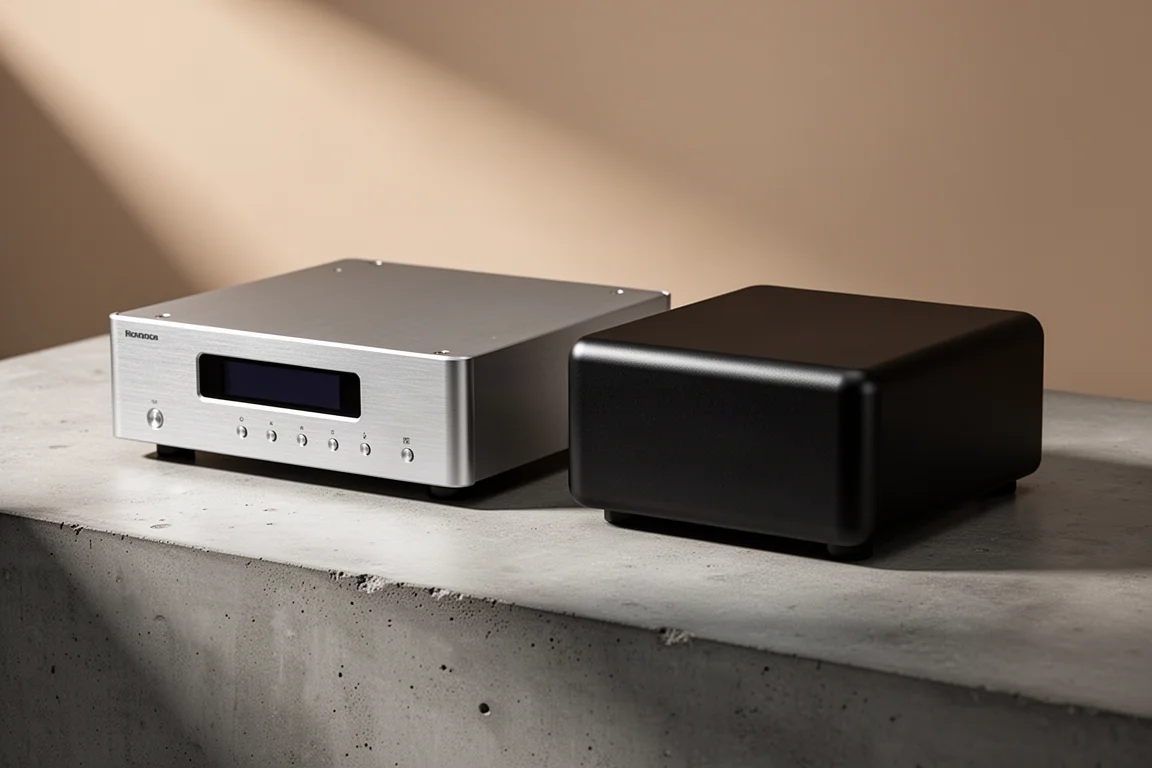
If you want a compact amplifier that covers TV sound, a turntable, headphones and a pair of speakers without taking over the living room, two names keep coming up in the same conversation: the Loxjie A40 and the WiiM Amp. They sit close in price, both include HDMI ARC and an internal power supply, and both aim to be the single box at the centre of a small system. They also make very different trade-offs.
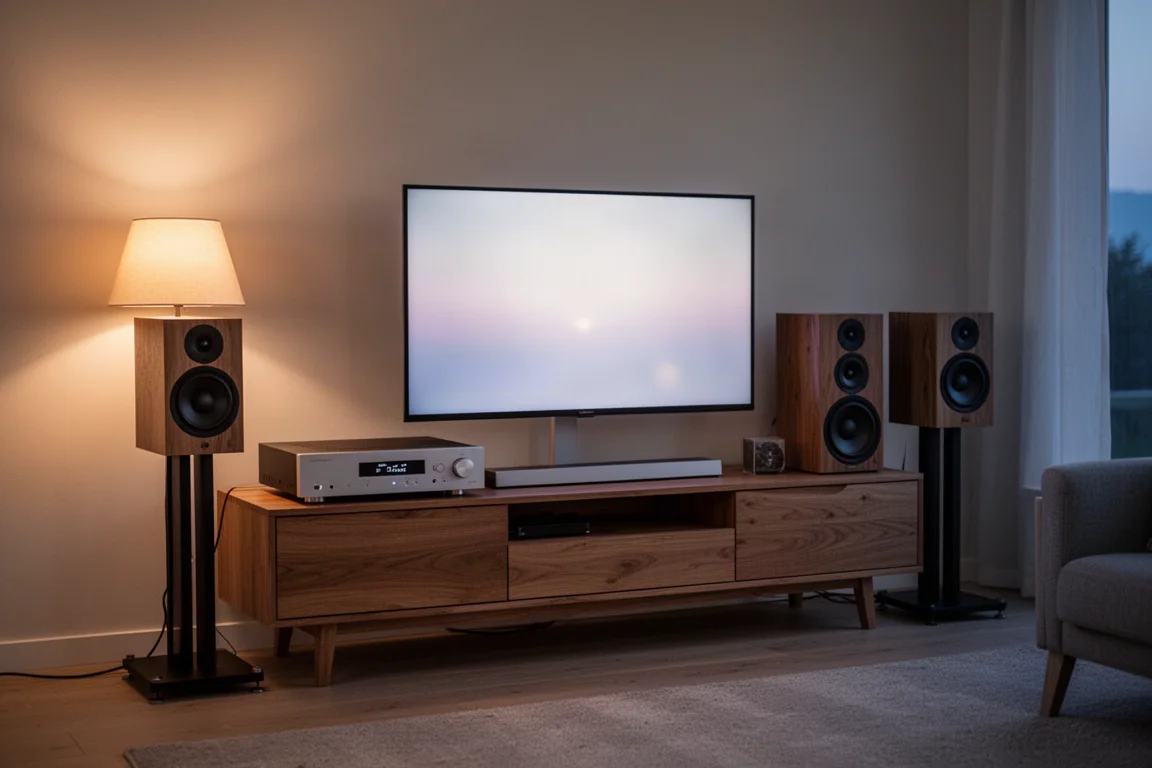
The Loxjie A40 leans on connectivity and value. It lists at $255 and has recently been offered at around $225 on sale, and it packs in a phono stage, a USB DAC, coaxial and optical inputs, HDMI ARC, Bluetooth, a subwoofer output, and both single-ended and 4.4mm balanced headphone outputs. The WiiM Amp costs around $300 and takes the opposite approach: fewer physical inputs, but streaming built in, a deeper equaliser and proper bass management.
This comparison looks at what each amplifier actually delivers, where each one falls short, and which makes more sense for a given room and budget.
Loxjie A40: A Compact Amplifier With a Very Long Feature List
The A40’s selling point is how much it fits into a small chassis. Around the back you get a phono input, a USB DAC input, coaxial, optical and HDMI ARC, plus a subwoofer output. Bluetooth covers LDAC, aptX and AAC. On the front there are two headphone connections: a standard single-ended output and a balanced 4.4mm Pentaconn jack. A remote control is included, and while it feels basic rather than premium, it works.
Power comes from an Infineon Merus MA5332MS class D chipset, claimed to deliver 165 watts into 4 ohms without needing a heatsink. Treat that number as a claim rather than a guarantee. In practice the A40 drove the speakers it was paired with to volumes that were genuinely uncomfortable in a large living room, which is more than most small systems ask for.
There are a few built-in EQ presets and a bass control that behaves a little like a loudness setting, so you can adjust balance without adding external processing.
The gaps are worth knowing about. There is no streamer inside, so you need a separate source for streaming services. There is also no bass management: the subwoofer output has a low-pass filter, but the main speakers keep running full range. That matters if you plan to play loud with a subwoofer in the system.
WiiM Amp: The Streaming All-Rounder
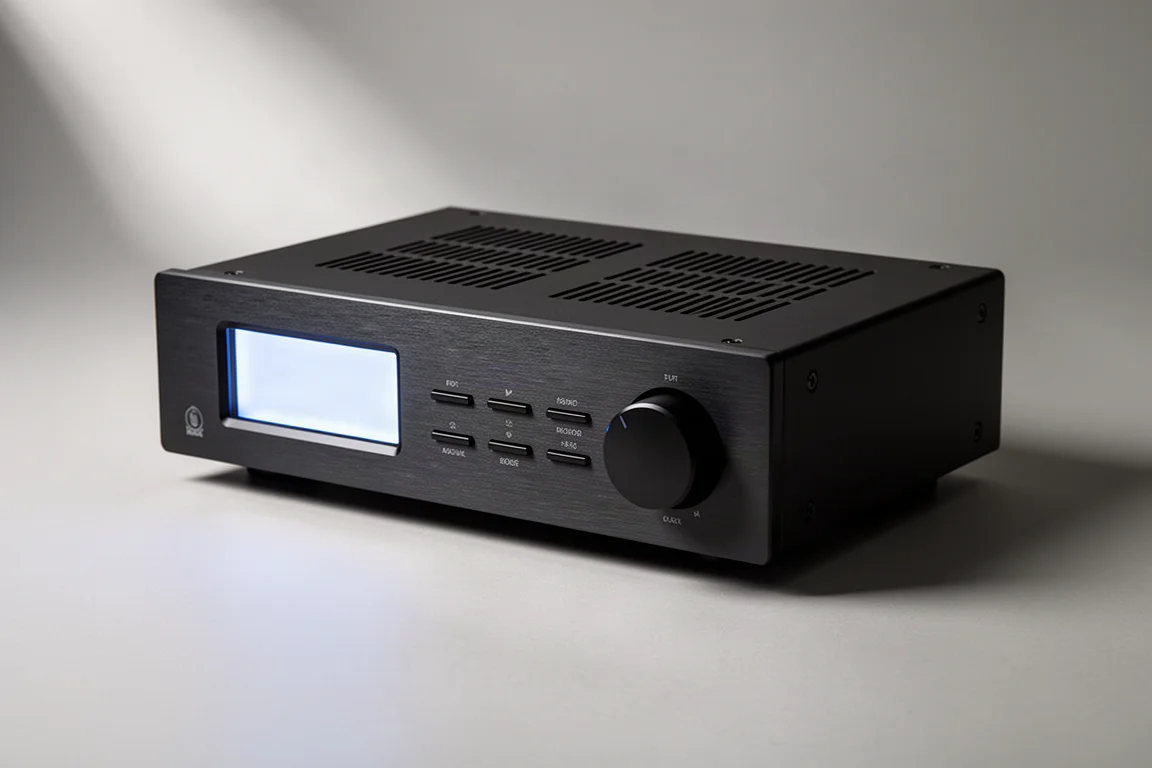
The WiiM Amp arrived with a strong reputation, having picked up amp of the year recognition in 2023, and it is priced around $300. It uses the Texas Instruments TPA3255 class D chipset and is rated at 60 watts into 8 ohms, with an internal power supply.
Its advantages are integration and tuning. Streaming is built in, so there is no need to add a separate source. The equaliser is far more flexible: a 10-band EQ, around eight presets and tone controls give you real tools for taming a difficult speaker and room combination. Bass management is the other notable feature, applying a high-pass filter to the main speakers so they are not asked to reproduce deep bass. With a subwoofer in the chain, that reduces the power needed for loud playback.
The trade-offs are simple to state. There is no headphone output, so headphone listeners need a separate amplifier. There is no phono stage, so a turntable needs its own preamp. And it costs more than the A40.
Sound Quality and Power Compared
Both amplifiers drove the same speakers to uncomfortable levels, so raw volume is unlikely to be the deciding factor. On paper the Loxjie A40 claims far more power, but that advantage rarely matters with the affordable speakers these amplifiers are usually paired with.
Tonally, the two differ. The A40 sounds clean and clear, without the aggressive top end that older class D designs were known for. Some listeners may genuinely prefer it. The WiiM Amp, however, sounded more natural on the same speakers, closer to the character of a decent class AB amplifier. Clean, revealing speakers flattered the A40; the same speakers sounded better still on the WiiM Amp.
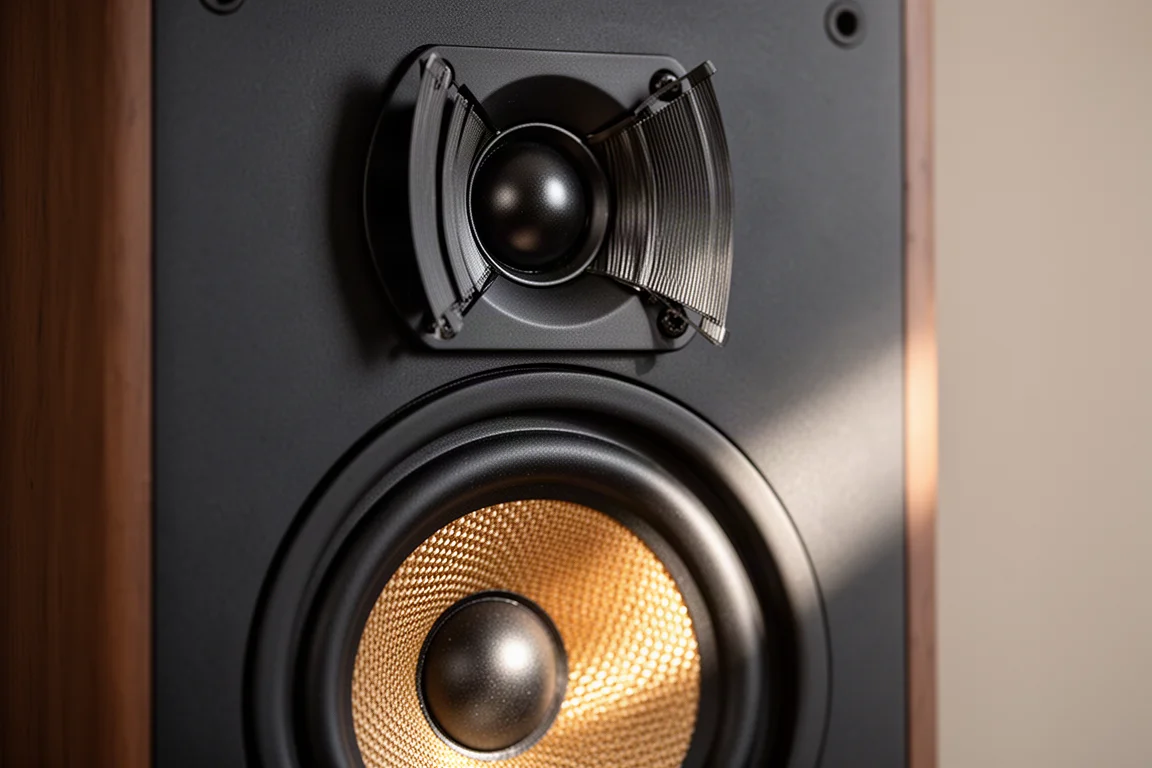
The practical conclusion is that the A40 gets close on sound, and the WiiM Amp edges ahead on refinement. If tone matters more to you than a long feature list, that is the gap to weigh.
Phono Stage, Headphone Output, and Subwoofer Support
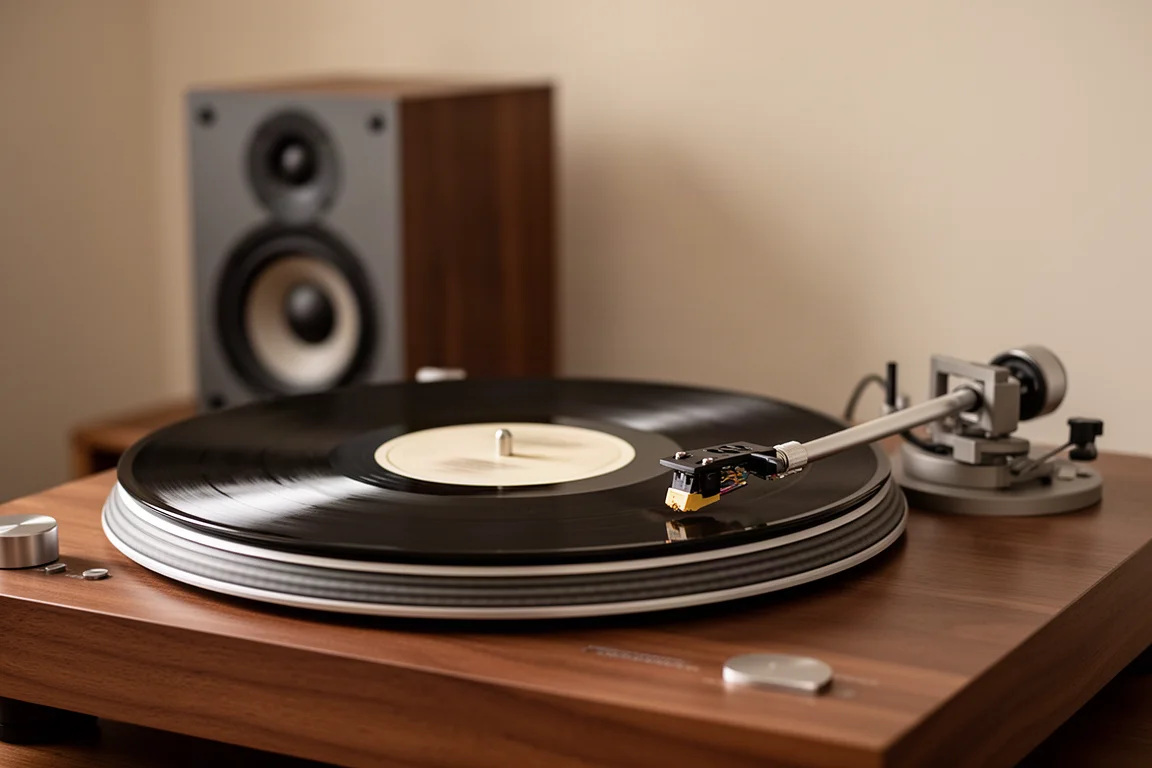
The A40’s phono stage is the kind of feature that usually gets cut at this price, and it is serviceable rather than special. Compared against an affordable outboard phono stage, it held its own. If you are building a budget vinyl system, it removes a box and a cable from the chain. If vinyl is the main event, a dedicated phono stage will still be better.
The headphone output is the other headline addition. It is essentially the single-ended section of a small desktop DAC and headphone amplifier, and it will drive most headphones comfortably. It will not match a dedicated headphone amplifier costing a couple of hundred dollars, and it is not the right choice for very demanding planar magnetic headphones. For everyday listening, it is a genuine bonus.
Subwoofer support is where the two diverge most clearly. Both have a subwoofer output. Only the WiiM Amp applies a high-pass filter to the main speakers, which is the more useful arrangement when you want to relieve both the amplifier and the speakers of deep bass duties.
Connectivity, Setup, and Everyday Use
Setup is straightforward on both. Each has an internal power supply, so there is no external brick to hide, and each accepts HDMI ARC for TV audio, which keeps everyday viewing to a single remote.
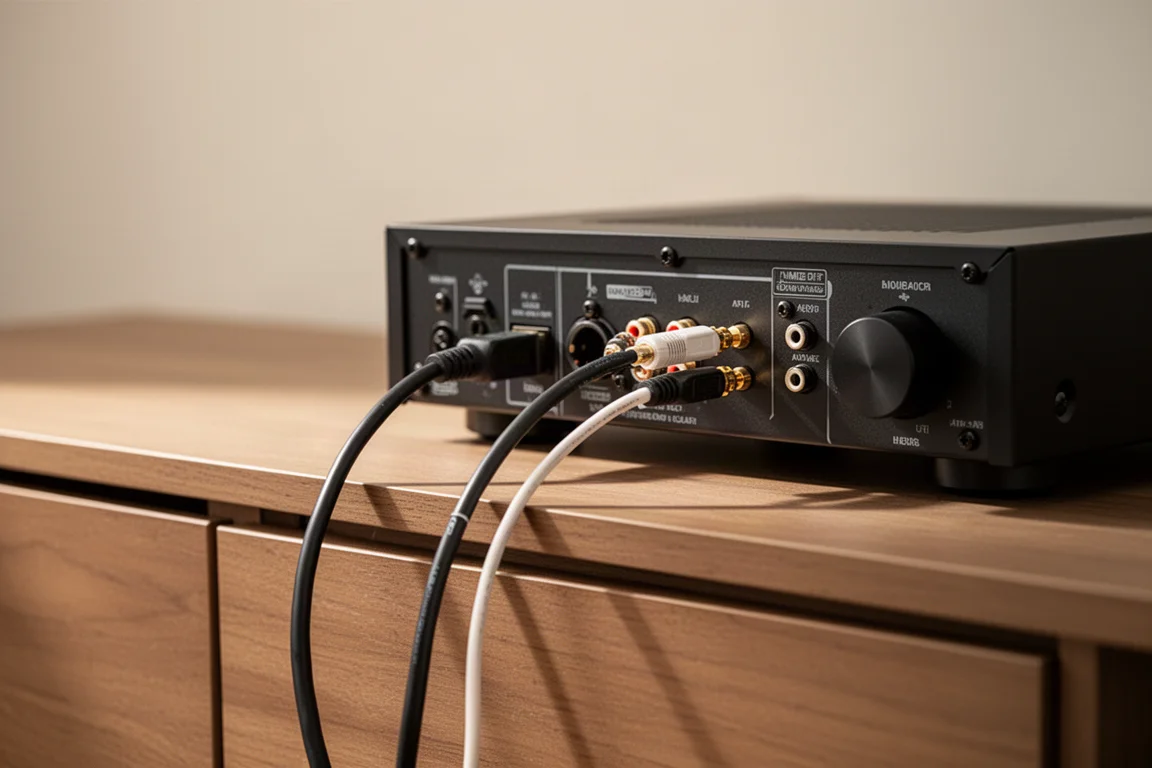
The A40 gives you more ways in: phono, USB, coaxial, optical and HDMI ARC, plus Bluetooth. If you have a CD transport, a games console, a turntable and a TV, the A40 can absorb all of them without an external switch.
The WiiM Amp covers fewer physical inputs, but it replaces several of them with streaming. If most of your listening comes from a streaming service, that is the more elegant solution, and it means fewer boxes and fewer cables behind the console.
Long-Term Value and System Building
Value is where the A40 is hardest to argue with. At $255, and around $225 during a recent sale, it covers TV audio, vinyl, headphones and speakers in one box. Add a pair of budget bookshelf speakers, which can be found for around $123, and a complete system lands near $350. If you later want streaming, a compact streamer can be added to the optical input for around $80.
The WiiM Amp costs more at around $300, and for that you get streaming, a more capable equaliser, bass management and the more natural sound noted above. If those features match how you listen, the extra spend is easy to justify.
Buying Advice: Matching the Amplifier to Your Room
Choose the Loxjie A40 if you want the widest possible set of inputs in one small box, need a phono stage and a headphone output, and would rather put the difference into better speakers. It suits small rooms, tight budgets, and systems built around a turntable, a TV and a pair of reasonably efficient speakers. Adding streaming later is cheap and easy.
Choose the WiiM Amp if streaming is central to how you listen, if you want a proper equaliser and tone controls to shape the sound, or if you plan to run a subwoofer and want bass management to take the strain off your main speakers. Skip it if you need a headphone output or a phono input.
Either way, both amplifiers do more than their prices suggest, and neither will leave you short of volume in a typical room.
Conclusion
The Loxjie A40 and the WiiM Amp are two different answers to the same question: how do you build a compact, affordable system that handles a TV, music and a pair of speakers? The A40 answers with inputs, a phono stage and a headphone output at the lower price. The WiiM Amp answers with streaming, a deeper EQ, bass management and a more natural tone for a little more money. Match the feature list to the way you actually listen, and either one will serve a small system well.
Further reading
Related Reviews
Hi-Fi Amplifiers
Accuphase E-280 Review: Entry-Level Accuphase With Flagship Attention to Detail
A close look at the Accuphase E-280 integrated amplifier, covering its champagne build, AAVA volume control, sound quality, and the speakers and sources that suit it best.
Hi-Fi Amplifiers
Advance Paris A10 Classic vs Yamaha A-S301: Two Integrated Amplifiers Compared
A practical comparison of a $350 integrated amplifier and a $2,500 reference model, covering the differences that matter and the ones that do not.
Hi-Fi Amplifiers
Affordable Chinese Amplifiers Worth Buying: Five Budget Hi-Fi Amps Compared
A practical look at five affordable amplifiers, what each one does well, and the trade-offs to weigh before you buy.